Moonlight Nearly Sweeps The Spirits

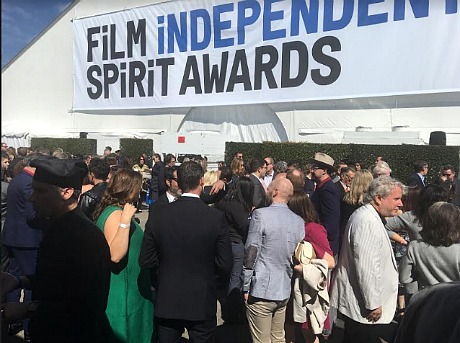
The 32nd annual Spirit Awards were mostly owned by Moonlight, and oh, what a slog it was, realizing early on that Barry Jenkins‘ film would probably win every award it was nominated for — Best Picture, Best Director, Best Screenplay (Jenkins and Tarell Alvin McCraney), Best Cinematography (James Laxton) and Best Editing — and having to sit there and just take it. A fine, affecting, well-made film that obviously got through to a lot of people, and the karma was right and the stars were aligned. No problem.

Manchester By The Sea‘s Casey Affleck and Elle‘s Isabelle Huppert took Best Actor and Best Actress awards, but both were foretold. Hell or High Water‘s Ben Foster won for Best Supporting Male (no prob but I would’ve picked A Bigger Splash‘s Ralph Fiennes) and Molly Shannon‘s mom-dying-of-cancer performance in Other People won the Best Supporting Female trophy.

Quote from my 1.22.16 Other People Sundance review: “There’s already a consensus that Molly Shannon, who plays a spirited suburban mom dying of leiomyosarcoma, will be Best Actress-nominated for a Spirit or a Gotham Award.”

Robert EggersThe Witch won for Best First Feature and Best First Screenplay. And the great O.J.: Made in America won for Best Documentary Feature.

Excerpt from a 2.2.17 HE piece called “Little Bitch”: “That handjob is a very big factor in Moonlight. It’s really ‘the’ factor when you think about it. A more complete title would have been Moonlight: Handjob On The Beach.” Quip from Spirit Awards co-emcee John Mulaney during today’s opening monologue: “Basically the Spirit Awards are a secret handjob on the beach, but enough about Moonlight.”
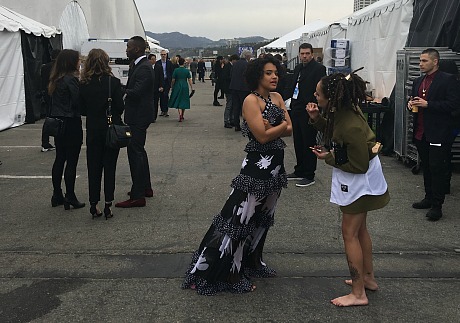
(l.) Moonlight costar Mahershala Ali with a couple of ladies; (far right, barefooted) American Honey star Sasha Lane.
Read more

When Coney Island Was A Thing

A four-day-old Film Stage piece (2.21) by Leonard Pearce reported that Woody Allen‘s Coney Island-set period film is titled Wonder Wheel — a childhood reminiscence piece, presumably in the vein of Radio Days.

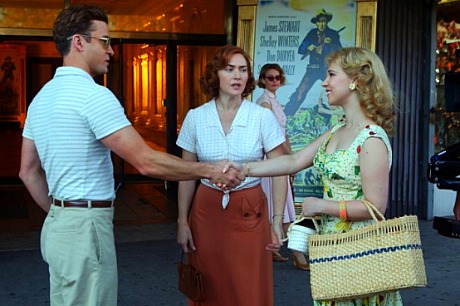
The film “takes place in the summer days of the 1950s,” Pearce writes, but unless it covers two or more years the action takes place in 1950. The proof is in the lobby poster in the below still. With James Stewart, Shelley Winters and Dan Duryea costarring, the film is Anthony Mann‘s Winchester ’73, which opened on 7.12.50. The Brooklyn-raised Allen was 14 on that date.

The costars are Kate Winslet, Justin Timberlake, Juno Temple, Jim Belushi, Tony Sirico, Jack Gore, Steve Schirripa and Max Casella. Like everyone else I’m expecting a 2017 Cannes Film Festival debut.


Justin Timberlake, Kate Winslet and Juno Temple in Woody Allen’s Wonder Wheel.

Absurdly Overpraised Get Out Boasts Intriguing Concept But Turns Out To Be Minor-League

Jordan Peele‘s Get Out, which I saw in the Grove yesterday afternoon, deserves points for blending racial satire with a current of Stepford Wives-like horror, and particularly for the low-key restraint that Peele deals during the first 45 minutes or so.

But while I respect the audacity behind (as Armond White has pointed out) a mix of Guess Who’s Coming To Dinner and Meet The Fockers with B-level horror, I found what Peele is saying about Obama-era relationships between upscale blacks and whites to be easy and specious. Plus I was seriously disappointed by the standard-issue blood-and-brutality chops during the last half-hour, not to mention Peele’s complete indifference to logic and consequences at the final fade-out.

The critics who’ve gone hog-wild over the racial-anxiety-meets-horror concept have overplayed their hand. They’re singing praises from their own p.c. echo chamber partly because — wait for it — the director-writer and the good-looking, smooth-cat hero Chris (played by Daniel Kaluuya) are African-American, and because the 2017 Film Critic’s P.C. Handbook absolutely forbids dissing or even questioning any kind of subversive genre-bender of this type.

The truth is that Get Out starts well, slowly building on the intrigue and intimations of bad stuff to come, but it gradually devolves the more the horror elements take hold. It’s just not that clever or well thought-out.

SPOILER: Peele’s central idea is that good white liberals (i.e., the kind who “would’ve voted for Obama a third time if we could’ve,” as Bradley Whitford‘s Dean Armitage, the father of Kaluuya’s girlfriend Rose, says early on) are liars — they’re just as racist as any rural Trump fan but with the ability to hide behind a facade of gracious, laid-back behavior. Moreover, their goal is to de-ball blacks who mix them with them socially and politically, and so blacks who ingratiate themselves with allegedly enlightened whites are being hoodwinked and led astray.

Peele isn’t exactly expressing a philosophy of black separatism, but he’s obviously saying “watch out for upscale whiteys…they ain’t on our team.” All of Get Out‘s horror and mayhem stems from this basic viewpoint.

Read more