Reluctant To Admit That Boredom Seeped In

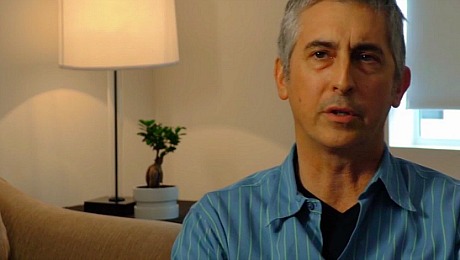
Such is the ardor and devotion of the notorious James Gray cabal that when a fellow who is either a member or temporarily posing as one — New Yorker critic Anthony Lane — tries to gently dismiss Gray’s The Lost City of Z (Amazon Bleecker, 4.14), he can’t help but dance a little side-step. Which wouldn’t be a problem if you weren’t muttering to yourself, “C’mon, man…spit it out.”

One, do not trust the 89% Rotten Tomatoes rating — the foo-foos have been worshipping Gray for years and will almost always give him a pass no matter what. I’ve said two or three times that this film will empty the sand out of your hourglass and make you feel imprisoned in your theatre seat. On top of which you must always, always beware of the word “fantasia” if the speaker isn’t referring to a 1940 animated Disney feature. Remember also that Lane is obliged to show a certain deference to David Grann‘s “The Lost City of Z,” which ran in The New Yorker before being published in book form.
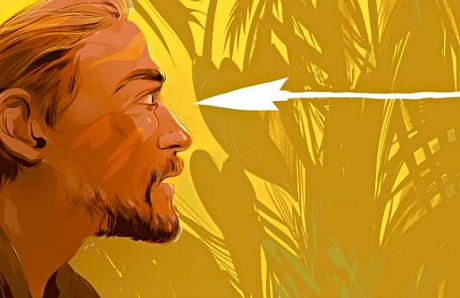

New Yorker illustration by Wesley Allsbrook.

Two excerpts tell the tale:

Lane excerpt #1: “Gray has borrowed the title [of the book], and he dramatizes many of the episodes to which Grann and other writers have referred. Yet the movie that results should not be combed for historical truth. It is best approached, I would say, as a fantasia on Fawcettian themes.”

Lane excerpt #2: “Does The Lost City of Z count as an action movie? It seems more like a study in restlessness. You could frame Percy Fawcett as desperate, deluded, and ill-prepared. [But] Gray’s Fawcett is a sturdy and somewhat monotonous creature, who, for all the strivings of Charlie Hunnam, does not consume us.”

I re-posted my reactions, originally penned after catching The Lost City of Z at the 2016 NY Film Festival, on 2.23.17.
After Months Without A Title, Bigelow’s Riot Pic Has Embraced Detroit

Wikipedia and other sources are reporting that the title of what used to be known as Kathryn Bigelow’s Untitled Detroit Riots Project (Annapurna, 8.4) will be…uhm, Detroit. The first teaser-trailer pops tomorrow (Wednesday, 4.12). Blogaroos are still scratching their heads over over that curious early-August release date, but I’m sure it’ll work out in the long run.

You Fuck Up, You Know What

Commentary from screenwriter William Goldman on the Butch Cassidy and the Sundance Kid Bluray, not transcribed but recalled: “We were lucky with Butch. We had a great director [George Roy Hill], and we had Connie Hall‘s phenomenal photography and a great crew and a solid script and a neat story and the casting was perfect. But if just one of these elements didn’t happen…it tells you that a good script and a good director and the right cast aren’t enough . The photography has to be right on, ditto the score and the editing…and if just one of these elements isn’t exactly right, you are dead. Nobody realizes how important the editing is, or how important the composer is…and there’s no reason for people outside the movie business to realize this, that movies are so fragile and anything can screw them up.” (Initially posted on 7.5.06.)

Greenberg Love Undimmed

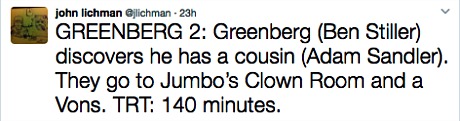
John Lichman was kidding when he tweeted this, but I would be over the moon with joy if a Greenberg sequel could somehow happen. Seriously. Noah Baumbach directing, of course. Ben Stiller and just about any strong costar. Adam Sandler could save…okay, half-save his career if he costarred.

In actuality: “Noah Baumbach’s The Meyerowitz Stories, a potential Cannes title, will premiere in select theaters and on Netflix later this year. It stars Adam Sandler, Ben Stiller, Dustin Hoffman, Elizabeth Marvel (Homeland, House of Cards), Grace Van Patten (Tramps, Stealing Cars) and Emma Thompson.

“It’s described as an intergenerational tale of adult siblings contending with the influence of their aging father. Scott Rudin, Baumbach, Lila Yacoub and Eli Bush produced.”

Big Greenberg Divide,” posted on 4.3.10: I don’t know where the below photo below was taken (the guy who sent it to me didn’t say, and he hasn’t answered my follow-up e-mails) but I’m really, really hoping it wasn’t taken at the Angelika in lower Manhattan. If it was this would imply that supposedly ahead-of-the-curve New Yorkers can be just as stubbornly conservative in their tastes as hinterland types. Please tell me it was taken in Orlando or Natchez or Des Moines.

Read more

Drop-Out Moments

13 or 14 years ago screenwriter William Goldman (Marathon Man, All The President’s Men, Butch Cassidy and the Sundance Kid) explained what a “drop-out” moment is — i.e., when something happens in a film that just makes you collapse inside, that makes you surrender interest and faith in the ride that you’re on. You might stay in your seat and watch the film to the end, but you’ve essentially “left” the theatre. The movie had you and then lost you, and it’s not your fault.

I was with Moonlight during the first two chapters of Chiron’s life, the ones that starred Alex Hibbert as “Little” and Ashton Sanders as the teenaged version. Both were “soft” in the same ways — tender, slender and frail — and I felt for their sadness and trepidation. But I dropped out when the muscular, panther-like Trevante Rhodes came along to inhabit the adult Chiron.

There was simply no believing Rhodes used to be a slender little wimp…no way. And the idea of this studly, good-looking guy having never had sex with anyone since that one heart-stopping handjob on the beach…no way again.

Caspar Phillipson‘s casting as JFK didn’t cause me to lose interest in Pablo Larrain‘s Jackie, but the instant I laid eyes I said to myself, “This guy is supposed to be Jack Kennedy? I don’t think so!” He was too short, for one thing — shorter than Peter Sarsgaard‘s Robert F. Kennedy, which was fairly ridiculous knowing that Jack was a good two inches taller than Bobby in real life.

Phillipson didn’t “kill” Jackie for me, but his presence did persuade me that it wasn’t a home run and that my only option was to wait for interesting stuff to happen. I said to myself, “A movie about the Kennedy White House uses a fucking Danish actor and then shaves his hair too closely so you can see whitewalls? Scalp was never visible on the sides of JFK’s thick thatch, and the makers of this movie didn’t know that when they prepared Phillipson for the part? Forget it.”

I “drop out” of a lot of movies the instant I hear they’re being made. Don’t get me started but there are hundreds in this camp. If any movie is costarring Dwayne Johnson or Vin Diesel, I’m gone. If Ben Mendehlson is in a film, I’m 90% ready to to jump ship, sight unseen.

Read more

One Man’s Nitrate Letdown

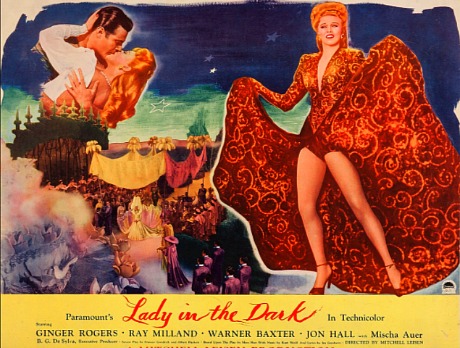
Entertainment journalist-critic Chris Willman caught three of the four highly ballyhooed nitrate screenings shown during last week’s TCM Classic Film Festival. These films were Otto Preminger‘s Laura, Alfred Hitchcock‘s The Man Who Knew Too Much and Mitchell Leisen‘s Lady in the Dark. (Willman missed Michael Powell and Emeric Pressburger‘s Black Narcissus.)

Willman went each time with genuine eagerness, but he couldn’t quite see what the big deal was. Here’s his report:

“I saw three of the four nitrate screenings at the TCM Fest. I’ve been hesitant to publicly riff on them because I’m one of those non-audiophile people who would fail a vinyl/digital comparison test, so I may be equally blind when it comes to certain visual subtleties. That said, I was underwhelmed, at least after impossible expectations had been set up for how these prints would change our lives.

Martin Scorsese introduced the first night and spoke in predictably entertaining terms about his own religious experiences with nitrate, dating back to seeing something at the old Melrose Theatre in the ‘80s. He and other speakers left the impression that we were about to see something that would be more vivid and startling than 3D, high frame rate and an acid trip combined.

“And then we saw the original The Man Who Knew Too Much, and it looked to me like a really good, albeit normal, 35mm print. I figured that might just be the limitations of 1930s photography and that Laura the following night would be the conversion experience. Again: I would not have thought it anything but a really strong 35mm print if I didn’t know any better. I missed Black Narcissus, which I think would have been the ultimate knockout of the four, if anything was going to be.

Read more

Payne’s Detail

I don’t like buying Twilight Time Blurays because they’re always jacking up the price — TT always charges $30 for Blurays that should, according to God’s benevolent scheme, be priced at $20. Which is why I chose to purchase the recently popped British Bluray of Hal Ashby‘s The Last Detail for 15 pounds, or $18.72 U.S. I watched the movie a couple of weeks ago — definitely the best it’s ever looked or sounded. Then again I haven’t seen the UHD 4K streaming version, which you can actually buy via British Amazon.


Alexander Payne as he appears in Robert Fischer’s “About a Trip: Alexander Payne on Hal Ashby’s The Last Detail

Last night I watched a supplementary Bluray video containing Alexander Payne‘s thoughts and ruminations — “About a Trip: Alexander Payne on Hal Ashby’s The Last Detail,” and it’s almost worth the price in itself. Charming, open-hearted, highly intelligent.

Here is an audio excerpt in which Payne (a) describes his favorite scenes in this 1973 film, (b) laments the absence of long, slow dissolves in today’s films (along with the use of zoom shots and voice-overs), (c) flat-out calls The Last Detail “a love story,” which of course it is, (d) mentions that he was very impressed with Daryl Ponicsan‘s script for Last Flag Flying, and was thinking about directing it back in ’10 or thereabouts, and (e) further mentions that the plot hangs on the three characters (Buddusky, Mulhall, Meadows), now in their 60s, getting together to deliver the body of Meadows’ son, killed in the Iraq War, to his mother or to a funeral service or something along those lines.

Richard Linklater wound up directing Last Flag Flying. It costars Bryan Cranston as Buddusky, Steve Carell as Larry Meadows and Laurence Fishburne as Mulhall. The Amazon release will probably open sometime in the fall.

Read more

Friendly Skies

Update, clarification: My initial reaction to yesterday’s United Airlines bloody-beat-down episode (which happened in Chicago on Sunday evening, or the night before last) was not that David Dao, the bespectacled Vietnamese doctor, wasn’t entitled to keep his seat, but that he became a screaming two-year-old once the security guys tried to throw him off. And that his bizarrely repeated chant of “I have to go home, I have to go home, I have to go home” indicated some kind of obsessive, primitive mentality.

The United guys obviously caused the trouble and are taking the hit, but at the same time I can’t throw in with people who howl like bobcats. The entire twitterverse has condemned United — 100% agreement. But nobody will acknowledge, much less react to, Dao’s primal screaming.

Read more