Travers on Flag, Wonder Wheel, Current War

Rolling Stone‘s Peter Travers has seen Richard Linklater‘s Last Flag Flying (debuting at New York Film Festival), Woody Allen‘s Wonder Wheel (ditto) and Alfonso Gomez Rejon‘s The Current War (TIFF). Here are his observations:

Last Flag Flying: “Bryan Cranston, Steve Carell and Laurence Fishburne all hit acting peaks in Richard Linklater’s look at three military buddies still trying to heal psychic wounds three decades after they served together in Vietnam. The trio is forced to reunite after years apart, however, when Carell’s son dies while fighting in Iraq. It’s the mission of these middle-aged men to bring the boy home for burial. The Boyhood director’s latest is a triumph that also features stellar newcomer J. Quinton Johnson (Everybody Wants Some) as a young marine.” Wells reaction: An acting “triumph” or a general triumph all around? Too vague.

The Current War: “How will today’s audiences, with notoriously short attention spans, react to a century-old battle between Thomas Edison (Benedict Cumberbatch) and George Westinghouse (Michael Shannon) over whose electrical system was better? For those who think AC/DC is just an Australian rock band, this period piece will be an education — though not a dull one. As directed by Alfonso Gomez-Rejon (Me and Earl and the Dying Girl) from a script by playwright Michael Mitnick (Sex Lives of Our Parents), this drama bursts with cinematic energy and is fueled by a plot as relevant as who’s building the next and best smartphone app. As for Cumberbatch and Shannon, they’re acting titans.” Wells reaction: Travers seems to imply that it’s strictly for 45-plus viewers due to Millenials not being the slightest bit interested.

Read more

Toronto Arrival, Telluride Clean-up

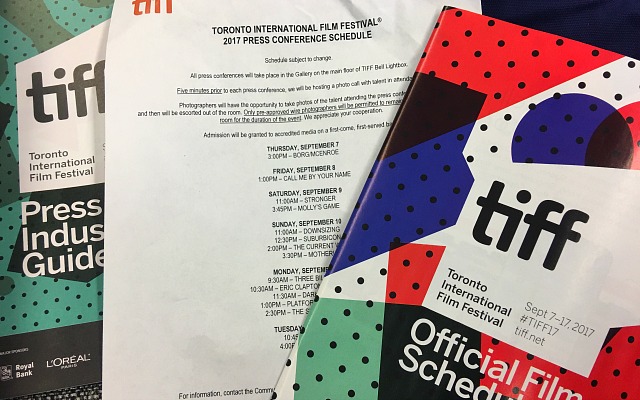
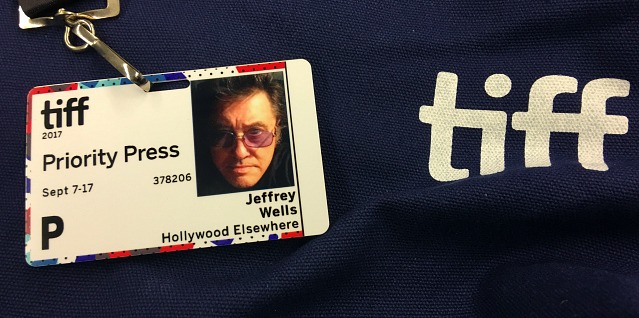
Hollywood Elsewhere’s Porter flight arrived in Toronto around 3 pm or thereabouts. I went straight to the Airbnb at 74 Oxford Street in the Kensington district, which may be my favorite Toronto neighborhood of all time. I picked up the press pass and other materials at the Bell Lightbox around 5 pm, and then hung in the press room until the 7 pm closing. I guess I’ll grab a salad and plan the next few days.


HE’s own Tatyana Antropova, taken as we left Telluride early Monday afternoon. The drive back to Albuquerque took five and a half hours.


Read more

In For it

I won’t be seeing Darren Aronofsky‘s mother! until Sunday morning (9.10), but I’m loving how it’s provoking intense reactions. From Daily Beast critic Marlow Stern: “This is a film designed to fuck with you. And fuck with you it does.”

The Playlist‘s Jessica Kiang: “An incendiary religious allegory, a haunted-house horror, a psychological head trip so extreme it should carry a health warning and an apologia for crimes of the creative ego past and not yet committed, it’s not just Aronofsky’s most bombastic, ludicrous and fabulous film, spiked with a kind of reckless, go-for-broke, leave-it-all-up-there-on-the-screen abandon, it is simply one of the most films ever.”


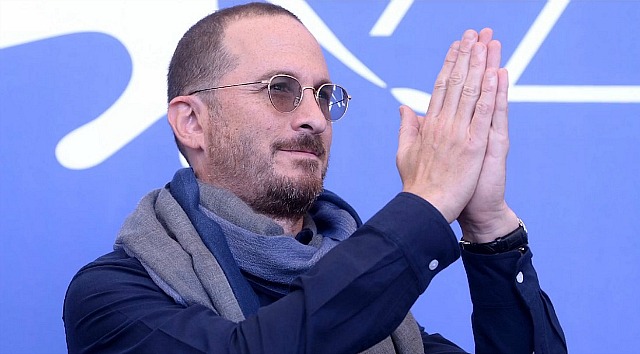
mother! director Darren Aronofsky, snapped a day or so ago at the Venice Film Festival.

There’s a paragraph in Todd McCarthy‘s THR review that strikes me as one of the most damning descriptions of of a reputable name-brand filmmaker that I’ve ever read by a reputable name-brand critic.

“Beyond the climactic free-for-all lunacy, this seems above all a portrait of an artist who has untethered himself from any and all moral responsibility,” McCarthy writes, “one so consumed by his own ego and sense of creative importance that he’s come to believe that nothing and no one remotely competes with the importance of his work.”

In other words, McCarthy is saying, Aronofsky is some kind of sociopath. This obviously argues with Aronofksy’s claim that mother! is meant to be some kind of climate-change allegory. If I were Aronofsky I would write a THR guest editorial and spell things out, especially about the necessary task of provocation that most major-league artists try to live up to.

Naturally, the McCarthy review makes me want to see mother! all the more.

Read more

Muschietti Kicked Out of Val Lewton Club

I saw IT (Warner Bros., 9.8) last night, and I’m sorry but it’s shit. Did I just say that? Would it sound less damning if I called it an IT sandwich?

What I mean is that the movie I saw at Loews Lincoln Square felt like shit to me — professionally polished but with a sensibility that felt coarse and calculating to a fare-thee-well. It’s basically a low-rent scare-a-thon for the none-too-brights… tediously familiar (small Maine town, Stephen King porridge, pre-teen pallies doing the Stand By Me thing) and strictly aimed at those who need a “holy shit!” or “oh, Jesus, that was gross!” moment every five or six minutes.

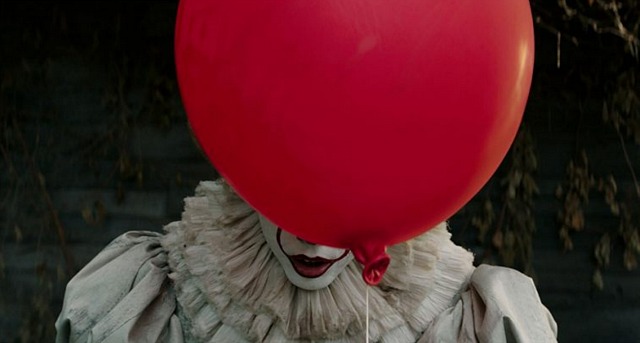
Sorry, dude, but I have aesthetic standards. IT radiates pro-level assurance from a character, dialogue and general compositional standpoint, but the spooky/scary moments (most of which involve Bill Skarsgård‘s demonic clown, i.e., “Pennywise”) are used too often, and are too in-your-face.

As scary flicks go I prefer subtle chills and tingles (the kind that producer Val Lewton provided in the ’40s, and which 21st Century audiences encountered in Andy Muschietti‘s Mama, Robert EggersThe Witch and Jennifer Kent‘s The Babadook) rather than torrents of blood gushing out of a bathroom sink. 

I recognize that most American moviegoers love the blood-torrents approach, and that mine is a minority view. Nonetheless there’s no question that (a) I have better taste in scary cinema, and (b) that most American horror fans are popcorn-munching boobs.

IT is expected to make at least $60 million this weekend and possibly earn three times that overall. This tells you a lot about the taste levels of your average American moviegoer.

I was cautiously optimistic before last night’s showing because of Muschietti’s direction. I was expecting or at least hoping that he might duplicate some of those subtle, fleeting, spine-chill moments that he and producer Guillermo del Toro brought to Mama. No such luck. 

Muschietti’s thinking seems to have been “if I play it too adult and classy, the fans of Walmart-level horror films will tune out. I have to keep goosing them, over and over…one shock moment every few minutes. If the dumbshits don’t tell their friends that it’s their kind of horror film, IT will go belly-up and I may have a bit of difficulty scoring my next highly-paid gig.”

I’m presuming that Muschietti was leaned on by three IT producers with flagrantly nonVal Lewtonish instinctsRoy Lee (The Grudge, The Ring), Don Lin (Gangster Squad, Lego Movie, Lego Batman Movie) and Seth Grahame-Smith (author of Pride and Prejudice and Zombies and Abraham Lincoln, Vampire Hunter). In my mind these guys are demonic — the devil incarnate.

Knife Slice

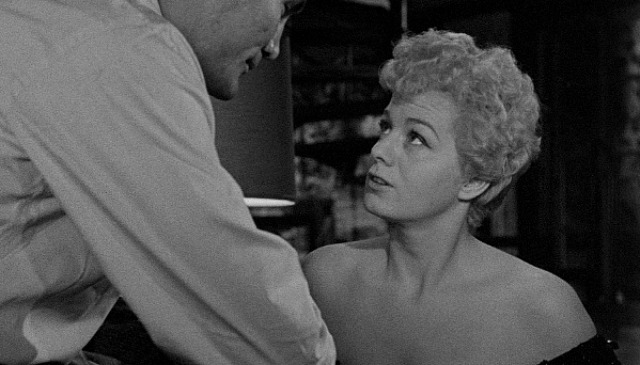
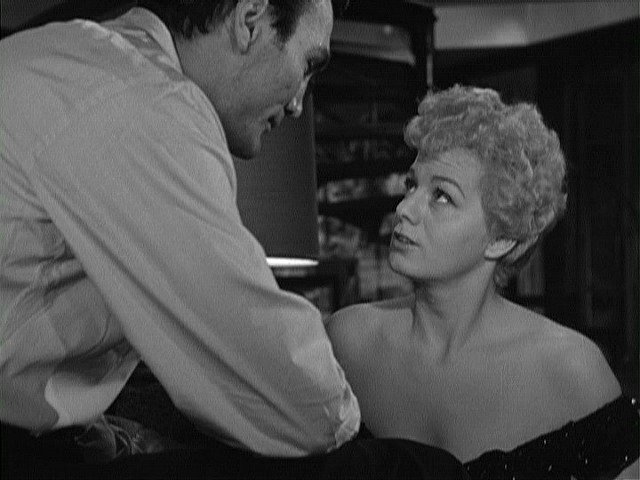
Arrow Academy’s Bluray of Robert Aldrich, James Poe and Clifford OdetsThe Big Knife popped on 8.28. DVD Beaver screen-capture comparisons show that the Bluray looks much better than the 2003 DVD. The sore spot is the cropping — the Bluray uses a 1.85 cleavered image while the DVD went with a standard mid ’50s boxy format. Consider the comparison framings of a scene between Jack Palance and Shelley Winters [below]. If you think the cleavered Bluray image is preferable, there’s really something wrong with you. Obviously being able to see Palance’s hair and sideburns…either you get it or you don’t.

Mudbound Peek-Out

Posted on 1.2.17: Dee ReesMudbound (Netflix, 11.17), a ’40s period piece about racial relations amid cotton farmers toiling in the hardscrabble South, bears more than a few resemblances to Robert Benton‘s Places In the Heart (’84).

The latter is far, far superior — better story, more skillfully written, more emotionally affecting. But three Mudbound performances — given by Carey Mulligan, Mary J. Blige and Jason Mitchell — are quite special and almost redeeming.

Based on Hillary Jordan‘s 2008 novel, Mudbound (adapted by TV writer-producer Virgil Williams) is about the relations between the white McAllans, owners of a shithole cotton farm (no plumbing or electricity) in the muddy Mississippi delta, and their black tenant-farmer neighbors, the Jacksons, in the immediate aftermath of World War II.

The McAllans are composed of paterfamilias Henry McAllan (a sullen, beefy-looking Jason Clarke), his city-bred wife Laura (Mulligan), their two kids, Henry’s racist dad (Jonathan Banks) and Henry’s younger brother, Jamie (Garrett Hedlund), who recently served as a bombardier during the war in Europe.

The Jackson principals are Hap (Rob Morgan), his wife Florence (Blige) and their oldest son Ronsel (Mitchell), also a recently returned WWII veteran.

Jamie and Ronsel relate to each other because of their similar age, shared war experience and not being as tied to regional racial traditions, and Laura is obviously a more refined and compassionate person than her somewhat grunty husband. But the low-rent, under-educated delta atmosphere represses like a sonuvabitch, and from the moment the McAllans arrive you’re thinking “wait, I’m stuck in this hellish mudflat environment for the rest of the film?”

You’re also thinking “why has Mulligan decided to marry the pudgy, ape-like Clarke — she could obviously do better.”

Yes, Mudbound has a heart and a soul and a compassionate view of things. But my mantra as I watched it was “lemme outta here, lemme outta here, lemme outta here, lemme outta here, lemme outta here,” etc.