“Caught this…rainbow trout on Strawberry Lake in Utah with nothing but a screwdriver on a stick, my Trump shirt, and the will to survive,” Skarlatos wrote. In other words, the Trump shirt provided some kind of spiritual fortification in this pitched battle between man and trout.
Alek Skarlatos on Utah’s Strawberry Reservoir on 7.17.16.
Seriously, the guy’s a friggin’ true-blue hero but also (this has to be said) some kind of resentful, vaguely bigoted, intellectually-stunted asshole? Or something in that realm?
Does anyone know if Spencer Stone is a Trumpster also? No way Anthony Sadler is, right? Being a Trump guy isn’t the same as being for McCain in ’08 or Romney in ’12. Standing by this appalling and malevolent sociopath isn’t some kind of style or attitude choice — it’s venal and unpatriotic.
HE to Skarlatos: Just because you did the hard, brave thing in the face of terrorism doesn’t mean you’ve got your act together in other ways. Take your Trump love and, no offense, shove it up your ass.
A struggling working-class type haphazardly falls in with a rich and arrogant fussbudget, and after initial complications and against all odds they somehow strike up a romance.
It all started 44 years ago with Lina Wertmuller‘s Swept Away. Mariangela Melato and Giancarlo Giannini played the warring lovers. The best scene was when Melato asked Giannini to sodomize her, and Giannini said “sodomy…what’s that?”
Thirteen years later Gary Marshall and screenwriter Leslie Dixon delivered a differently plotted, broadly comedic American version called Overboard (’87), with Kurt Russell as Giancarlo and Goldie Hawn.
15 years later Guy Ritchie‘s Swept Away remake (’02) appeared with Madonna in the rich bitch role, and the less said about that the better.
Now comes an Rob Greenberg‘s Overboard remake (Lionsgate, 4.13), but with the genders reversed — Ana Faris as Kurt and Eugenio Derbez as Goldie, and with Dixon back as a cowriter. I wouldn’t be surprised to learn than Greenberg doesn’t even know who Wertmuller is. Hollywood film culture has really downgraded and mongrelized itself over the last 25 or 30 years.
“The fact is that two of the hottest Best Picture contenders — Guillermo del Toro‘s The Shape of Water and Jordan Peele‘s Get Out — are pretty close to B movies, or at least what used to be regarded as B-level material — a romantic monster flick and a dark horror-zombie satire.
“In the mid 50s the forebears of these films — Jack Arnold and William Alland‘s The Creature from the Black Lagoon (’54) and Don Siegel and Walter Wanger‘s Invasion of the Body Snatchers (’56) — never had a chance of any kind of Oscar attention, much less respect, but The Creature from the Love Lagoon and Invasion of the White Suburban Obama Lovers are right at the top of the heap today. Along with Three Billboards and Lady Bird, of course.” — from “Oscar Bait Movie Is Over,” posted on 1.13.18.
“Shape, Three Billboards and Get Out are the leading soft default picks across the board. But Shape is the apparent darling.
“The reasons for Shape‘s possible victory: (a) it’s a lot warmer than Dunkirk and certainly warmer than the somewhat jagged-edged Three Billboards, (b) it isn’t dealing gay cards (which is a seeming disqualifier among older white male Academy members given that last year a meditative, under-stated gay movie won the Best Picture Oscar), (c) it’s an emotionally inviting fable with a Johnny Belinda-like lead performance from Sally Hawkins, and (d) you don’t have to believe in socially progressive largesse or be on the ‘woke’ bandwagon — you just have to be susceptible.
“Accept it — a Best Picture Oscar for a very handsomely composed genre film about rapturous mercy sex with the Creature From the Love Lagoon might soon be placed alongside the statuettes for Birdman, Spotlight, The Hurt Locker, 12 Years A Slave, Platoon, The Godfather Part II, A Man For All Seasons and The Best Years of Our Lives in the Academy’s golden display case in the upstairs lobby. Probably. Maybe.
“It will therefore cinch a hard-fought triumph over (a) one of the boldest, most avant garde and stunningly captured war films ever made, (b) the most emotionally affecting and transformational gay love story since Brokeback Mountain and probably of the 21st Century, and (c) one of the sharpest, punchiest and most fetchingly performed coming-of-age tales about a young woman at the start of her adult life, and in a year that obviously cries out for a top-tier woman-directed film and/or a female-centric story to be celebrated above all.” — from “Maybe It’s Not Over,” posted on 1.12.18.
Even within the fake-poster realm, what is that thing on the lower left portion of the image? Some kind of prosthetic stump? A broken-off robot arm? Klaatu barada nikto?
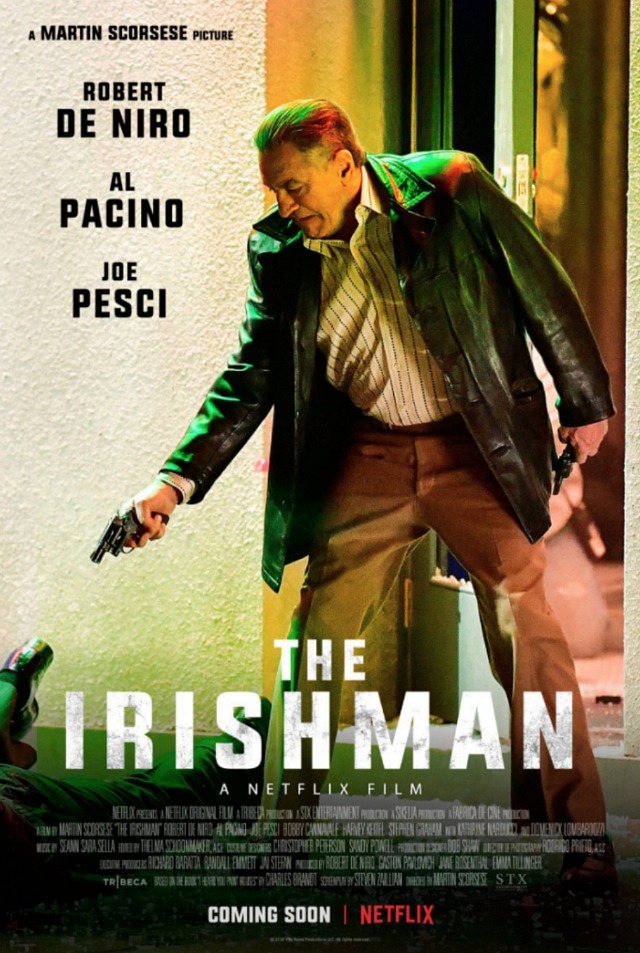
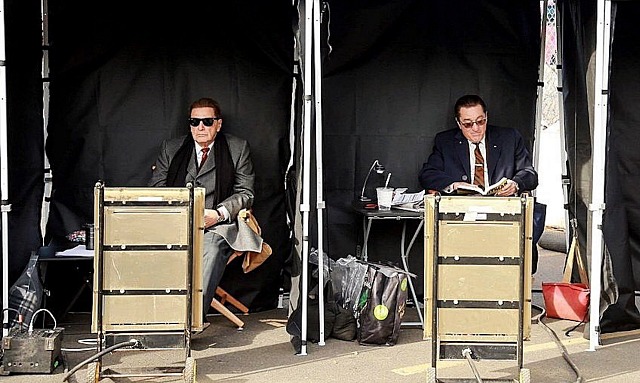
The latest reporting claims that Martin Scorsese‘s The Irishman is costing north of $140 million. But unlike Quentin Tarantino‘s “not Manson” movie, the period gangster flick, which will almost certainly open at year’s end, appears to have a reasonably decent chance of recouping costs.
The relentless over-praising of Jordan Peele‘s Get Out continued this evening with the Writers Guild of America bestowing its Best Original Screenplay prize on the darkly humorous horror-satire, the general topic being bad whitey shit or Invasion of the White Suburban Obama–Loving Hypnotists.
A decade or two from now a reputable, hard-working film historian will write the definitive saga of how a catchy John Carpenter or Larry Cohen-type film managed to become one of the most unlikely award-season favorites of all time.
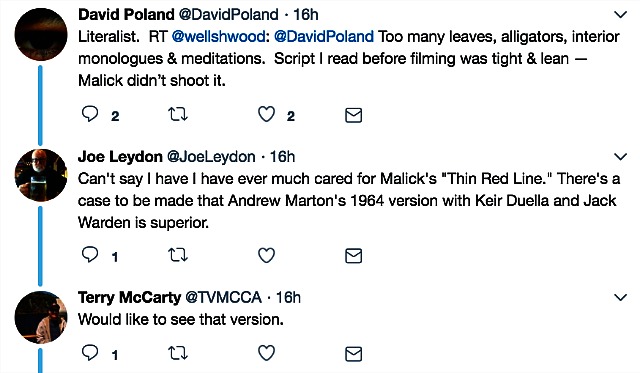
I used to own a Criterion Bluray of Terrence Malick‘s The Thin Red Line, but I could never make myself watch it a third time. My first exposure was at an early press screening, and a second time on Bluray when it popped in September 2010. But that was it.
I’m always excited when I watch scenes from Malick’s 1998 film on YouTube, but I found it labored and ponderous during my two full-boat viewings. I was exhausted at the end of both.
Last night David Poland tweeted about what a masterpiece it is, and I responded as follows: “Too many leaves, alligators, interior monologues & meditations. Script I read before filming was tight & lean — Malick didn’t shoot it.” It was The Thin Red Line that (a) fixed Malick’s reputation as a nature-revering, tossed-salad filmmaker, and (b) resulted in that famous quip about Malick never having “met a leaf he didn’t like.”
Three days ago Showbiz 411‘s Roger Friedmanwrote that Quentin Tarantino‘s “not Manson” movie “is in jeopardy at Sony and may not get made at all.” Because he’s been “hearing that Sony is having second thoughts because of Tarantino’s double trouble in the press” — the Uma ThurmanKill Bill car crash thing plus saying that Samantha Geimer was down for sex with Roman Polanski in ’77.
Tarantino has apologized for both, but he’s nonetheless been painted as a #MeToo bad guy. Tarantino’s apologies may have saved him, but in most instances the penalty for being so labelled has been instant death.
If I was Sony honcho Tom Rothman I wouldn’t deep-six Tarantino’s movie over offensive statements or stunt-driving missteps, but over the budget. I don’t know where Friedman heard that the Manson flick will cost $200 million, but maybe that’s a production-plus-marketing figure.
Last November The Hollywood Reporter‘s Borys Kit reported that the film, which will roll sometime this summer, would cost in the vicinity of $95 million, which, when you add the usual absurd marketing costs, means it would have to gross $375 million worldwide to break even, according to “one source” Kit spoke to.
Even with Leonardo DiCaprio, Brad Pitt and Margot Robbie costarring, nobody is going to beat down the doors of theatres to see a late ’60s hippy-dippy movie (never forget how Millenials regard the ’80s as ancient history) about desperate actors and a few delusional cultists stabbing some poor rich people to death. I’m not saying QT’s film won’t be buzzy or that it won’t sell a lot of tickets, but I doubt if it will sell enough to justify the cost. Because the milieu is fundamentally perverse and bizarre and dark and twisted.
To my surprise the theatre was 95% packed. I guess I wasn’t the only one who wanted to see Spencer Stone, Anthony Sadler and Alek Skarlatos overpower that terrorist asshole and beat the shit out of him, and so I sat through 85 minutes of meandering, faint-pulse exposition to watch that happen.
The 15:17 to Paris (which should have been titled 3:17 to Paris) is obviously (a) not a real movie, (b) weak docudrama tea and (c) weirdly Christian to boot, but I didn’t hate it. I knew it would be shit, and so I was ready for that, and then it turned out to be mildly weightless. Most of it felt like I was sitting in the back seat of an Uber or on a high-speed European train, waiting to reach my destination. Was it horrifically boring? No, but it wasn’t what anyone would call engaging or riveting.
The guy next to me was murmuring slight approval from time to time, but I could tell he was waiting for the movie to kick into gear and actually do something. But it wouldn’t. It refused. I could sense that the guy wasn’t miserable, but he was certainly underwhelmed. The vibe in the theatre #4 was flat while it played, only one guy clapped when it ended, and I overheard two angry complaints out in the lobby.
I didn’t find it painful to sit through — just slightly boring. The bad-behavior childhood stuff…later. The stuff about the rebellious, bull-headed Stone going through Air Force training…didn’t care. I was fascinated once the incident finally happened (I never knew Stone would’ve been shot right through the forehead if Ayoub El Khazzani‘s rifle hadn’t jammed) and I loved the aftermath in Paris when Francois Hollande presented the trio with Legion of Honor medals.
The Christian stuff (i.e., Stone wondering if God has a special plan for him, and Skarlatos’ mom sensing that “something really exciting” is going to happen to him) is bullshit. It’s awesome that Stone, Sadler and Skarlatos did what they did, but I don’t want to hear any Christian propaganda about divine destiny. God has no rooting interest in anything good or bad happening on the planet Earth…none. If you want to believe that God had a plan for Spencer Stone, you also have to accept that he had one for Kevin Cosgrove.
Alejandro Gonzalez Inarritu‘s Babel, the final installment in what some called his “trilogy of death” (the first two being Amores perros and 21 Grams), opened on 10.27.06. A morose if brilliantly woven tapestry piece about random fates, Babelearned $34,302,837 domestic and $135,330,182 worldwide. It collected seven Oscar nominations (including Best Picture and Best Director — for a while it looked like a winner) and won the Golden Globe for Best Motion Picture, Drama.
And over the last 11 years, the twitterverse has been reflexively shitting on it. Too grim, “misery porn,” schematically forced, etc. I was a devout Babel worshipper during the ’06 and early ’07 award season, but the negative aftermath has been so persistent over the last 11 years that my admiration has weakened or even lapsed. Against my own critical judgment and history, I’ve come to associate Babel with vibes and feelings that I’d rather not revisit.
The title is the title, although the three-part essay is actually about the south-of-the-border rennaissance that began with the emergence of Inarritu, Alfonso Cuaron and Guillermo del Toro in the late ’90s.
None of this year’s Best Picture nominees delivered anything close to the currents in Alexander Payne‘s The Descendants, particularly in those two scenes between George Clooney, Matthew Lillard and Judy Greer. Six years ago, feels like longer.
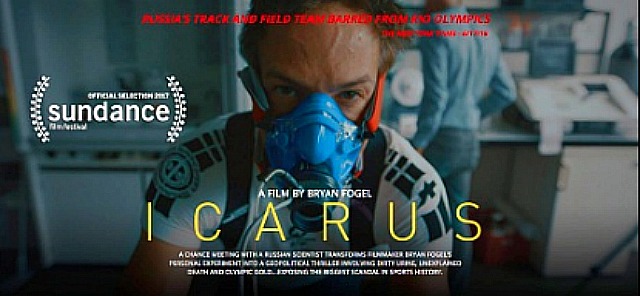
Posted on 1.26.17 from the Sundance Film Festival: Hollywood Elsewhere loves Icarus, the Russian doping doc that Netflix picked up two or three days ago. I’ve no striking observations or insights to add to the general chorus, but I can at least say that after a slow start Icarus turns into a highly gripping account of real-life skullduggery and paranoia in the sense of the classic William S. Burroughs definition of the term — i.e., “knowing all the facts.”
As noted, Bryan Fogel‘s two-hour film starts off as a doping variation of Morgan Spurlock‘s Super Size Me, and then suddenly veers into the realm of Laura Poitras‘ Citizenfour.
It doesn’t tell you anything you didn’t already know or suspect, mainly that (a) the use of performance-enhancing drugs is very common in sports (everyone does it, Lance Armstrong was the tip of the iceberg) and (b) there isn’t a dime’s worth of difference between Vladmir Putin and his top henchmen and the Al Capone mob of 1920s Chicago — lying, cheating sociopaths of the highest or lowest order (take your pick).
I was a little worried during the Super Size Me portion, in which bicyclist Fogel and Russian scientist Grigory Rodchenkov embark on a project with the goal of outsmarting athletic doping tests. It’s interesting at first, but it goes on too long. After a while I was muttering “so when does the Russian doping stuff kick in?”
Suddenly it does. Rodchenkov gradually admits to Fogel that he orchestrated a Putin-sanctioned doping program that gave the Russian athletes an advantage at the 2014 Sochi Olympic Games, which led to the winning of 13 gold medals.