Respected If Unexceptional Craftsman

The late Michael Anderson directed two films of particular note — Around The World in 80 Days (’56) and Logan’s Run (’76). Both were successful in their time (Around The World cost $6 million to make but earned $42 million worldwide, or the 2018 equivalent of $378 million) but both are regarded as meh-level today.

Anderson was a fine, get-it-done craftsman but nothing he directed really stands out today except, perhaps, for The Quiller Memorandum (’66). He also directed Shake Hands with the Devil (’59). The Wreck of the Mary Deare (’59). All the Fine Young Cannibals (’60), The Naked Edge (’61) and The Shoes of the Fisherman (’68).

The below clip from Around The World shows you what a stodgy and elephantine thing it was visually. It was a pompous travelogue flick that was sold as a classy reserved-seat event, and projected in 30-frame-per-second Todd AO.

Apparently true anecdote: Producer Mike Todd forbade the selling of popcorn during reserved-seat engagements.

Around The World played for close to two and half years straight — October ’56 to early ’59 –at Manhattan’s Rivoli Theatre. It played for 94 weeks straight at San Francisco’s Coronet Theatre, from 12.26.56 until 10.19.58. In 1959 it opened wide in 35mm widescreen. It won the Best Picture Oscar because it was financially successful, and because of all the pomp and braggadocio.

Read more

Provocative Patter

Last night Michelle Wolf, a 32 year-old standup comedian, former contributor to The Daily Show with Trevor Noah and future host of a Netflix talk show, put herself on the national map. She did so with some wonderfully blistering material at the White House Correspondents Association dinner, which was held at the Washington Hilton.

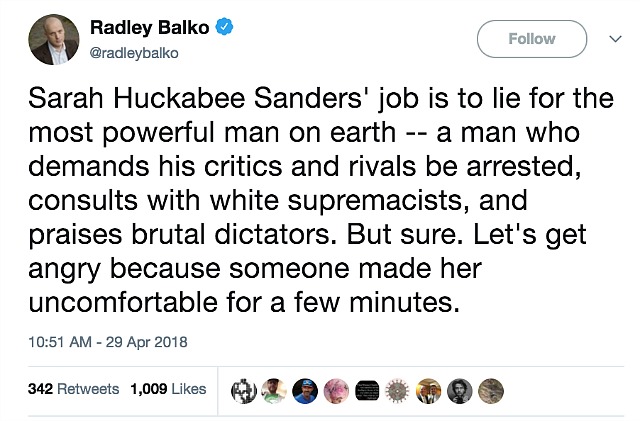
It wasn’t so much that Wolf tore into Donald Trump — everyone does that — but that she infuriated White House press secretary Sarah Huckabee Sanders.

“Every time Sarah steps up to the podium, I get excited,” Wolf said. “I’m not really sure what we’re going to get, you know? A press briefing, a bunch of lies or divided into softball teams. ‘It’s shirts and skins, and this time don’t be such a little bitch, Jim Acosta.’

“I actually really like Sarah. I think she’s very resourceful. But she burns facts and then she uses that ash to create a perfect smokey eye. Like maybe she’s born with it, maybe it’s lies. It’s probably lies.

“I’m never really sure what to call Sarah Huckabee Sanders. Is it Sarah Sanders, is it Sarah Huckabee Sanders, is it Cousin Huckabee, is it Aunt Huckabee Sanders? What’s Uncle Tom but for white women who disappoint other white women? Ah, I know…Aunt Coulter.”

Read more

What Really Happened

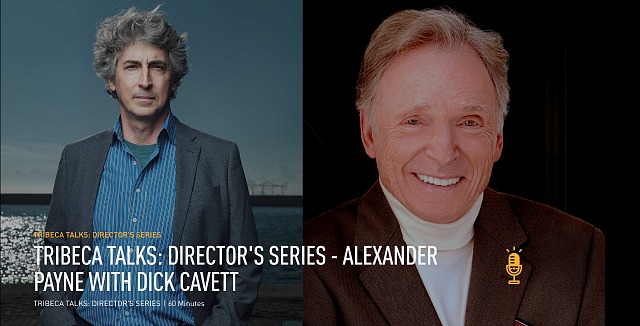
During a Tribeca Film Festival discussion/interview held yesterday, director Alexander Payne described last year’s Downsizing, by any definition a critical and box-office disappointment, as a tough row to hoe.

A 4.28 Indiewire story by Michael Nordine said Payne described the making of the futuristic fantasy as “difficult on every level — writing, financing, editing.” Payne also “addressed the lukewarm reviews it [received after] opening late last year, suggesting that its ambitious narrative may have been too much to fit into the framework of a single film.”

Whatever that means.

If I’d been in Payne’s shoes, I would have just blurted out the following: “I wish it had turned out as well as Election or Sideways or The Descendants, but it didn’t. It hurts but occasional failures are unfortunately part of the commercial filmmaking process, and at a certain point you just have to say ‘okay, fuck it…I liked it but the critics and the public didn’t…next.’

Downsizing had a killer concept, an excellent first act, and a really great transformation sequence that went over like gangbusters at Cinemacon in March 2017. But the second act wasn’t quite as good, and the third act…all that off-to-Norway, climate-change, methane-gas stuff…really didn’t work and I couldn’t fix it.

“Plus half the audience couldn’t understand Hong Chau. Plus I read somewhere that younger audiences hated it. Obviously I pushed their buttons, just not in a way that I was expecting.

“I probably should have taken Jeffrey Wells’ advice and thrown in some Incredible Shrinking Man stuff. Tiny Matt Damon getting chased by a house cat, getting pecked by birds, coping with cockroaches. The popcorn crowd would’ve gone for that, and Downsizing would’ve probably have made more money if I had. I’m just not low-rent enough. I’m too upmarket in my thinking.”

Guilty Parties

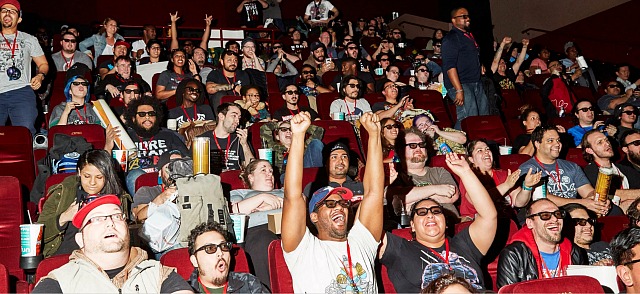
Look at these jowly, bearded, T-shirt-wearing lowlifes…here they are, the joyful, good-natured fanboys whose appetites have helped to degrade if not destroy the commerciality of adult-angled, quality-aspiring theatrical cinema over the last decade or so. You know…movies about actual human beings and their lives…stories that don’t involve CG or super-powers or flying around or destroying cities?

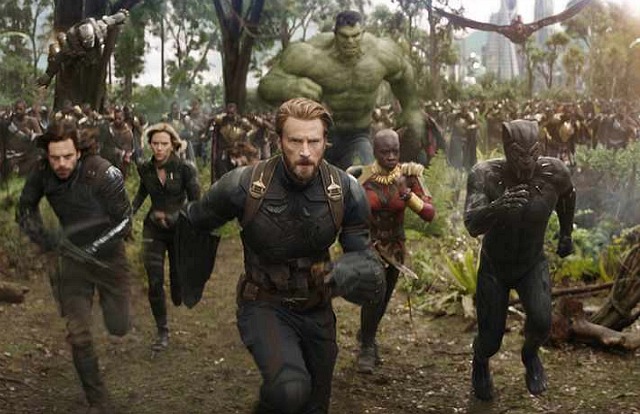
You can chuckle or shrug your shoulders and say “whatever” about the 31-hour Marvel movie marathon that began four days ago at Manhattan’s AMC 25, and ended Thursday evening with a screening of Avengers: Infinity War. Justa buncha goobers having a good time, right? Iron Man, The Incredible Hulk, Thor, Captain America: The First Avenger (my second favorite Marvel flick after Ant-Man), The Avengers, Guardians of the Galaxy, Avengers: Age of Ultron, Captain America: Civil War, Doctor Strange, Spider Man: Homecoming and Black Panther. Sleeping bags, energy bars, spare iPhone batteries, water bottles.

But these are the bad guys — slap-happy geeks whose tastes and ticket-buying power have re-shaped and all but poisoned the theatrical realm, congregating at a kind of ground zero movie temple. Yes, HE-favored films still play at the plexes between October and December. Yes, civilized cinema can still be found here and there. And when that doesn’t work, it’s simply a matter of flopping onto the couch and watching cable and streaming in this, a golden era for home-viewing.

About the marathon itself, here’s (a) a 4.27 N.Y. Times piece by Jason Bailey and (b) a David Ehrlich Indiewire piece about the same, also posted on 4.27.

Not Funny Now, But Back Then…

Obviously built on dismissive racial stereotypes, this Mel Blanc-Jack Benny routine was regarded as hilarious back in the day. If I were to really let my guard down I’d admit that it’s still half-funny now, albeit in a lame, stupid-ass way. Four years ago a YouTube commenter named Armando Vertti said “I’m Mexican, and I find this SO FUCKING FUNNY!” It shows how different American attitudes were back in the Eisenhower-Kennedy days. (The sombrero-wearing guy was Mel Blanc, who voiced all the big WB cartoon characters — Bugs Bunny, Daffy Duck, Porky Pig, Tweety Bird, Sylvester the Cat, Yosemite Sam, Foghorn Leghorn, etc.) The tide turned in the mid to late ’60s, of course. Bill Dana dropped his Jose Jimenez routine in 1970. Will I get into trouble for posting this? I’m just saying “this is how it was.”

Joe Popcorn Coughs Up

Words can’t express the joy, rapture and ecstasy I’m feeling over the huge success of Avengers: Infinity War. Knowing that Marvel fans and general moviegoers will be parting with roughly $245 million by Sunday night…well, it just tickles my soul and lifts me out of my seat. The second largest all-time domestic debut, second only to the $247 million earned by Star Wars: The Force Awakens. Hell, Infinity could even beat Force.

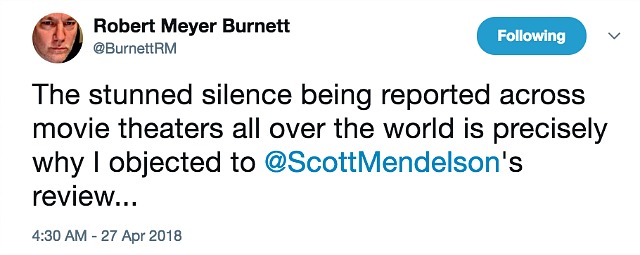
Four questions for anyone who saw it yesterday or earlier today: (1) Did you see any kinds “bawling” about the deaths of certain Marvel characters?, (2) Leaving aside the digital disintegration deaths (which of course are certain to be reneged upon in the next and final installment), do you feel that enough Marvel characters died?, and (3) Did anyone notice any audience members expressing surprise or dissatisfaction about the ending? Did anyone say “what?” when the film cut to black?

Brains & Consequence

After he lost his afternoon show on MSNBC three years ago, I wondered what Ronan Farrow‘s next move might be. Late last year I found out. The 30-year-old son of Mia Farrow published a devastating Harvey Weinstein expose in The New Yorker, and then, earlier this month, he won the 2018 Pulitzer Prize for public service, sharing the award with the authors of the first chapter-and-verse Weinstein article, which ran in the N.Y. Times.

He’s also authored a new and respected book on American foreign policy, “War on Peace.”

Like everyone else, I strongly suspect that the late Frank Sinatra, not Woody Allen, is Farrow’s biological dad. And there’s something else that I think is fair to mention, given that he tried his hand at a visual medium. Obviously brilliant and well-educated, Farrow is nonetheless an odd physical specimen. His head seems too big for what seems like an adolescent frame — slight, slender, boyish shoulders. Then again he reportedly stands 5′ 10″, or two inches taller than Sinatra.

Curious Reverence

“It’s not a film that I like; it’s a film that I love. When I say I don’t like it, it’s that I don’t like the feel of the film. I don’t like its sterility. I like a film with a little more emotional balls, just as a movie, to get involved in. But as a work of art, I love it. It had an had an enormous, enormous impact on me, at a certain point.” — James Cameron speaking about 2001: A Space Odyssey in a 4.26 Toronto Star interview by Peter Howell.

What films do I greatly admire or highly respect, but which I don’t really like on a gut level? Because they lack emotional balls or have rubbed me the wrong way or whatever?

Michelangelo Antonioni‘s The Passenger. It’s a masterful film about being at the end of your rope, about ennui and futility and cul de sac alienation. I adore the final shot, of course, but it delivers a current of lethargy and bitterness that’s fairly unlikable. I tried to re-watch it on Bluray recently and gave up after a half-hour. It’s more than a little boring. But I know it’s a great or near-great film, and I’ll never call it dismissable or a shortfaller.

I recognize that Sergio Leone is a pantheon-level director who elevated ’60s spaghetti westerns by injecting a certain fuck-all nihilism and a degree of psychological complexity, and that his use of dynamic close-ups upped his rep as a kind of visual maestro. He’s a first-rate auteur, but I can’t think of a single one of his films that I actually like.

I worship Barry Lyndon, of course, but I really don’t like what I once called the “dead zone portion” — from the instant that Ryan O’Neal blows pipe smoke into Marisa Berenson‘s face until he shows up for that duel with Leon Vitali.

I’ll never trash Martin Scorsese‘s The King of Comedy — it’s a ballsy capturing of a certain American malaise, about third-raters and loneliness and a bottom-line feeling among millions that fame is the end-all and be-all, and that without it life would be a fairly miserable proposition. But apart from two or three scenes with Jerry Lewis (especially the “so was Hitler!” moment with Robert De Niro and Diahnne Abbott) I’ve never liked it. One serving after another of shamelessness, delusion, bile and idiocy. I remember my first viewing in ’82 and realizing about a half-hour in that it was going to play on this level all the way to the end. But I admire Scorsese for having made it, and I would never call it bad or even flawed. I just don’t care for the taste.

Oh, and 2001 is not my idea of sterile. Dry and dispassionate, yes, but the drollness and dark humor, not to mention the enraged, flipped-out behavior of a certain homicidal computer, are delicious.

Last-Minute Dropout

For seven or eight years Washington Post critic Ann Hornaday and I have shared a two-story, 19th-century apartment in the Old Town section of Cannes. (The address is 7 rue Jean Mero, four or five minutes from the Palais.) Ann can’t attend this year because her dad is ailing in Iowa, so half the place is suddenly sublettable. WaPo film reporter Steven Zeitchik is first in line but he hasn’t gotten approval yet, and maybe that won’t happen. If anyone’s interested it’ll be 925 euros — you’d have the downstairs, I have the up. Here’s a video I took back in 2011. Excellent wifi.

Brokaw Pushback

It seems highly significant that over 60 women have signed a letter of support for NBC News legend Tom Brokaw, who was slammed yesterday with sexual harassment accusations from former NBC news reporter Linda Vester.

Vester contended that Brokaw acted in a boorish and icky manner while allegedly attempting to ignite a romantic involvement back in the mid 1990s, when Brokaw was in his mid 50s and Vester, born in ’65, was nudging 30.

With frontline news professionals like Rachel Maddow, Andrea Mitchell, Maria Shriver and Kelly O’Donnell signing the letter, it shows that feelings of loyalty and affection for Brokaw are very strong. It also suggests that a consensus has been reached that Vester may not be cool on some level.

Brokaw “has given each of us opportunities for advancement and championed our successes throughout our careers,” the letter reads. “As we have advanced across industries — news, publishing, law, business and government — Tom has been a valued source of counsel and support. We know him to be a man of tremendous decency and integrity.”

Variety‘s Cynthia Littleton reports that the letter was written by Elizabeth Bowyer, who worked with Brokaw on his best-selling books “The Greatest Generation” and “Boom: Voices of the Sixties” and also produced the Tom Brokaw Reports documentary series.

Bowyer told Littleton that the response to the letter was “overwhelming” and she received many emails from women asking that their names be included, with responses still coming in as of Friday evening.

Invested, Devotional

From the p.r. copy: “Kevin Macdonald‘s Whitney uses rare archival footage and photos of the late Grammy-winning singer Whitney Houston for a portrait of the legendary singer’s life and career. The first documentary to be approved by the Whitney Houston Estate, pic will take a comprehensive and intimate look at the superstar’s triumphs and struggles during her 30-year career in the entertainment business.”

It seems significant that the teaser-trailer doesn’t mention singer-songwriter Bobby Brown, who was married to Houston for 14 years (’92 to ’06) and has long been regarded as a non-helpful influence in her life, particularly regarding her substance-abuse issues.

Everyone will need to compare MacDonald’s doc to Nick Broomfield‘s Whitney: Can I Be Me, a 2017 Showtime doc that was fairly candid about some things that I suspect MacDonald will skirt or pay little attention to. Whitney’s drug use, the Brown relationship, her hidden sexuality (which was reiterated by her father in a 2017 interview), and her daughter Bobbi Christina Brown, who died under regrettable circumstances at age 22.

Read more

Refreshments With Mr. Vitali

Two weeks hence Tony Zierra‘s Filmworker, a brilliant tale of the life and times of Leon Vitali, will open at Manhattan’s Metrograph, and then a week later at West L.A.’s Nuart. I’ve been insisting for months that this is an absolutely world-class doc, not to mention the best inside-the-beltway, what-it-was-really-like Stanley Kubrick doc ever made.

Yesterday I sat down with Vitali at a Starbucks in Culver City. We shot the shit for 40 minutes or so, the only problem being that we sat outside on a patio, and that meant contending with the rumble of L.A. traffic — cars, trucks, ambulances, fire engines — not to mention a Starbucks cleaning person who kept generating that awful “aaahhhggg!” sound when you drag metal tables and chairs across concrete. So it might be a bit of a struggle to listen to our chat, but by all means have a go.

Leon Vitali, former actor (Barry Lyndon, Eyes Wide Shut), longtime Stanley Kubrick assistant, Warner Bros. visual consultant and star of Filmworker (Kino Lorber, 5.11).

Given the traffic noise and the difficulty in hearing each and every syllable, I asked Leon whatever came into my head, chatting more than interviewing really.

Vitali: “I did the color timing on the 2001: A Space Odyssey 4K Bluray, and 4K is so beautiful…the details, the shadows…looking at it on these very high resolution monitors. It looks great, everybody loves it, and I’m not blowing my own trumpet. HE: “What would you say is the difference between the forthcoming unrestored Chris Nolan version and the spiffed-up 4K Bluray?” Vitali: “The difference is that the 4K has more clarity and sharpness and detail.” HE: “So people seeing the Nolan version in Cannes will say, ‘This is wonderful…not as sharp or as clear as the 4K but it looks very good.'”

Sidenote: For some reason I developed an idea years ago, perhaps after speaking with Dan Richter, the guy who played the bone-tossing “Moonwtacher” in 2001, that the “Dawn of Man” sequence was shot early in the schedule. Vitali told me yesterday that it was actually the last thing to be shot.

HE: “Your voice has a softer quality right now, but there are passages in Filmworker in which it has that deep, resonant, gravelly sound…the kind of great-sounding voice that can only result from years and years of cigarette smoking. Are you smoking now?” Vitali: “Not as much. I’ve cut down. At my height with Stanley I was smoking three packs a day. Stanley [himself] would have one every now and then.”

HE: “I always loved the sound of Stanley’s voice. The timbre and the accent. The voice of a cultured, well-educated New York cab driver. A guy who grew up in the Bronx and knew all the angles.” Vitali: “He never lost that.”

HE: “The special groove of Filmworker for me, is that when you’ve found something that really matters to you…that for all practical and aesthetic purposes has become a source of profound satisfaction, as your work with Stanley became…for me it makes Filmworker such a sublime film, because it understands and conveys that special devotion.” Vitali: “I went to drama school [when young] and I met this guy who taught me how to harness a certain inner energy…it made me realize, once you really get into something, something that really seeps in and opens you up…you’re in there and it’s no contest…you know?”

Read more