
Body Heat

This Back Roads trailer tries to whip things into a lather a little too quickly, but I’m sensing intensity. Based on Tawni O’Dell’s 2004 novel and obviously not a remake of the same-titled 1981 Martin Ritt film with Sally Field and Tommy Lee Jones.

Alex Pettyfer, probably best known to audiences as the novice male stripper in Steven Soderbergh‘s Magic Mike, always aspired to more. Following years of being sold as little more than a slab of meat to lust after, it’s been an uphill battle for the actor to convince audiences that he has more to offer. With Back Roads, his first go-round in the director’s chair, Pettyfer takes his future into his own hands.” — from Marshall Shaffer’s Tribeca Film Festival review of Back Roads, posted on 4.24.18.

Boilerplate: “After his mother (Juliette Lewis) goes to jail for shooting and killing his abusive father, Harley Altmyer (Alex Pettyfer) is left to care for his three younger sisters in a rural Pennsylvania town. The uneducated Harley works two dead-end jobs to preserve what’s left of his family, including the rebellious, sexual 16-year-old Amber (Nicola Peltz). He finally begins to feel hope when he connects with an older, married woman (Jennifer Morrison). But when shocking family secrets emerge, Harley’s life begins to spiral downward.”
Cat Who Can Blow

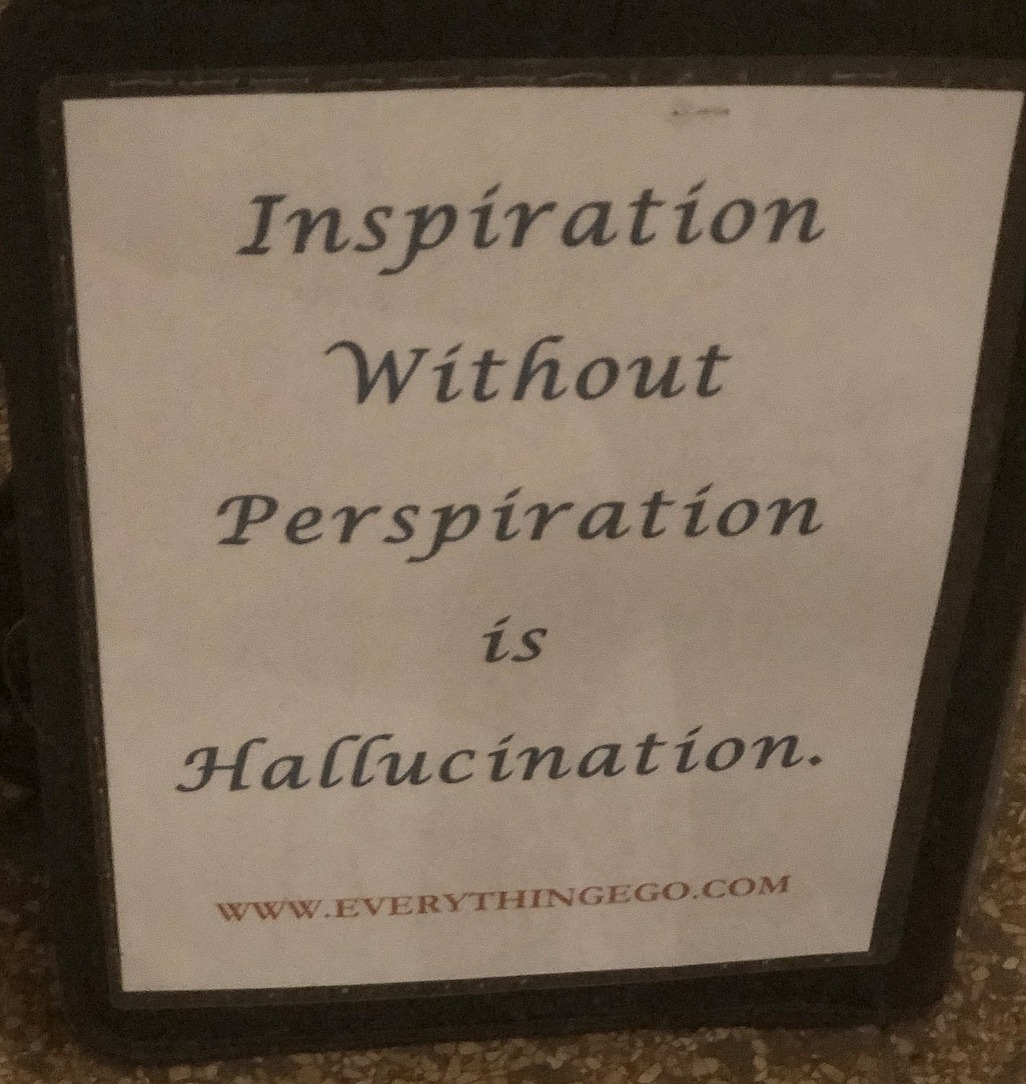
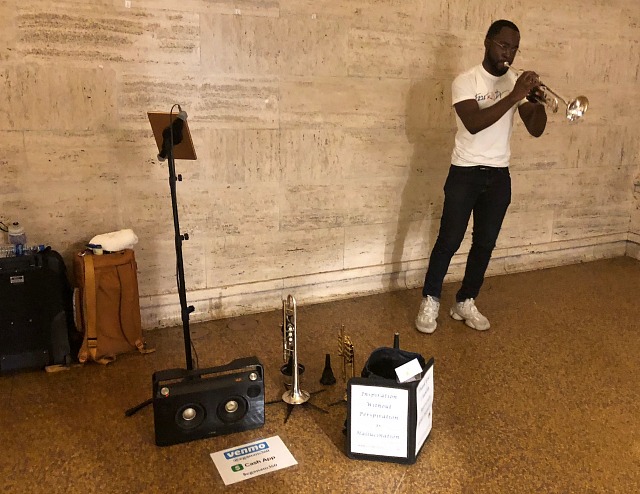
Just another trumpet-player in Grand Central Station, right? No — it’s Eganam. For what it’s worth I played trumpet in my early teens, and I believe I have a certain ear for anyone gifted and playing extra-smooth. A few others were paying as much attention as I was, and there was a fair-sized pile of cash in the guy’s tip bucket. From the site: “Born in Ghana, West Africa, Eganam migrated to the United States in February 1999, at the age of ten. Seven months later he began playing the trumpet. On 9.27.15 he performed at Carnegie Hall with the International Youth Philharmonic Orchestra. Now a member of the United Nations Symphony Orchestra and a student of New York Philharmonic’s Ethan Bensdorf, Eganam is working toward becoming a world-renowned trumpeter and music educator.”

“Green Book” Is Taking Over

On 10.4 I posted a Best Supporting Actor riff titled “Mahershala Ali Again. Really.,” which advanced the notion of a second Best Supporting Actor Oscar for the Green Book co-star. On 10.26 I posted another called “Mahershala Ali Kick-Ass Syndrome,” which noted that 15 out of 25 Gold Derby “experts” had put Ali at the top of their Best Supporting Actor spitball lists…a seeming lock to win.

Today Gold Derby‘s Tom O’Neil took a stab at explaining the Mahershala surge.

Gold Derby-wise, Ali has not only jumped in front of Beautiful Boy‘s Timothee Chalamet in the Best Supporting Actor race, but “seems to have established a firm lead,” O’Neil notes.

This is at least one category, it seems, in which “less” may be judged to be of greater value than “more”. Chalamet’s drug-addict performance is anguished and intense in a kind of Lee Strasberg acting-class way — a guns-blazing thing — while Ali’s Don Shirley, a brilliant pianist, is quiet and subtle. So why is Ali suddenly out-pointing Chalamet by such a significant margin?

Because the viewer senses a guarded sadness in Shirley, and a guy who’s a bit too rigid and controlled. Understandably, you come to realize, but he’s breathing only through his music. Ali acquaints you with Shirley bit by bit, layer by layer. Before long you’re hoping to see him kick back and breathe a little.

“Timing is part of the reason,” O’Neil writes. “Green Book is now screening widely to industry audiences across Hollywood, and enjoying fresh, happy buzz as word spreads that it might be the next Best Picture winner and also that — watch out, pay attention — Viggo Mortensen could win Best Actor too. Really! And Peter Farrelly for Best Director.”

Bicycle Panic

Yesterday I peddled three or four miles to a Lenscrafters to fix my distance glasses. It’s right near a typically calming but soul-less megamall called the Oglethorpe. I locked the bike to a lamppost (i.e., adjacent to the main outdoor parking lot), and then visited a Barnes and Noble to do some filing. I wound up staying there about five or six hours.

When I came back out for the bike I couldn’t open the number-code lock. I have a phone-photo of the code, of course, and I’ve used it successfully ten or twelve times since last weekend. But yesterday it wouldn’t do.

I called the bicycle rental shop before closing time but they didn’t answer. I called again for good measure. I sent two “EMERGENCY!” emails with an explanation + photos of the pole-locked bike. I finally had no choice but to leave it there — what was I going to do, pitch a tent and sleep there to discourage thieves?

I’m still trying to reach the bicycle rental people. I have to leave for the airport in 45 minutes and they won’t pick up. Who runs a bicycle rental business without posting an emergency cell-phone number? Or routinely checking emails for possible emergencies?

I know they’re going to try and charge me for some kind of stress-and-recovery fee, which really wouldn’t be fair. I did nothing wrong.

11:30 am update: The rental shop FINALLY called back, said they’d pick up the bike, not to worry, etc.

Art of Honest, Half-Assed Reviewing

A follow-up to last night’s “Will Joe Popcorn Save Rhapsody?” post: I’ve said two or three times that Bryan Singer‘s Bohemian Rhapsody (20th Century Fox, opening tonight) is a generally pleasing in-and-outer — humdrum or “bizarrely anodyne” during stretches, but also one that occasionally catches the heat and delivers serious highs. Then it’s back to anodyne.

The Bohemian Rhapsody problem is that the Queen guys (Brian May in particular) wouldn’t grant rights to a biopic that didn’t deliver a basically positive spin — i.e., “Freddie had his excessive episodes but the fans loved him and the band plus he cared about his mum and dad and wife as far as it went, and of course the songs still rock.” So that’s the yoke — why the film doesn’t feel whole, much less transcendent.

It’s nonetheless a sporadically pleasing thing to sit through, and it really is unfortunate, I feel, that critics and editors (the Rotten Tomatoes and Metacritic fraternity that has rendered verdicts of 57% and 49% respectively) aren’t a little more comme ci comme ca about equivocating in an honest way when a film is a solid half-and-halfer.

The phrases “reasonably passable,” “not half bad and sometimes better than that,” “could be a lot worse,” “basically decent” and “imperfect but not a burn” are used by this columnist when the shoe fits, but you’ll hardly ever read them in a typical review. Because critics are trained early on to either pan or approve — to basically lean one way or the other. Don’t confuse the reader by sounding wimpy or uncertain.

Except the flighty, spazzy nature of Bohemian Rhapsody doesn’t (or at least shouldn’t) allow a critic or viewer to lean one way or the other. It’s a once-in-a-blue-mooner that sidesteps suckage but at the same time doesn’t quite get there. In mountain-climbing terms it’s about two thirds of the way between base camp and the peak. Okay, halfway.

Double clarification: The “bizarrely anodyne” comment is from a 10.31 New Yorker piece, “A Truly Perfect Thirty Seconds of Queen“, by Amanda Petrusich.