Wokesterism Has A Precedent

Roughly three or four years ago, the lefty-elite wokester era of filmmaking and film criticism began. How long it will last is anyone’s guess, but the guiding theme or mission of wokester cinema and wokester criticism is to (a) instruct by dramatizing social problems and (b) inspirational contrarian responses to said problems by women, POCs and LGBTQs. Resistance, progressive enlightenment, representation, etc. Fuck the white-guy oppressors.

Wokesterism is roughly similar to the WPA-funded social realism phase which happened among painters and art critics in the late 1920s and 1930s. Then as now, the idea is to produce art that “draws attention to the real socio-political conditions” of those who’ve dealt with socio-economic oppression “as a means to critique the power structures behind these conditions.” The quotes are taken from the social realism chapter in a reputable art history site, but they bear a certain similarity to the here-and-now.

As we all know the modern art movement began with the first stirrings of French impressionism, which began to manifest in the late 1860s and 1870s (Claude Monet, Pierre-Auguste Renoir, Édouard Manet, Edgar Degas, Paul Cezanne) and was really off to the races by the 1880s, which is when Vincent Van Gogh and Paul Gaugin got rolling. Then came Post-Impressionism, Expressionism, Cubism, Dada-ism, Surrealism, etc.

And then came the German Depression of the ’20s and the Great Depression of 1929, and suddenly the whole modern art movement was more or less called off — suspended, put on hold — for the noble and celebrative common-man proclamations of social realism, which became the whole show throughout the ’30s. Largely government-funded art that celebrated the proletariat struggle while portraying tensions between working people and the oppressive, hegemonic forces of heartless capitalism.

Social realism ended with the beginning of WWII and certainly the winning of that conflict, and then came Abstract Expressionism (Franz Kline, Clyfford Still, Hans Hofmann, Willem de Kooning, Jackson Pollock, Mark Rothko), Pop Art, Photorealism and whatever the fuck followed.

I don’t have the first clue whether Wokesterism is any kind of current in the presently-configured art world, but I know for sure that it’s ruling the roost as far as indie movies are concerned — indie-level, Sundance-aspiring cinema coupled with your rank-and-file wokester critics doing the obligatory fawn whenever and however they can. Because the progressive zeitgeist insists that they do. Because, frankly, their jobs depend on it.

As Sasha Stone noted today, we’re living in “the era of the hive mind.”

“White” Guy vs. Wokesters

Brett Easton Ellis on Green Book (at 18-minute mark): “What’s a movie I really liked that critics missed? It’s gonna be controversial but Green Book is one of those movies. Manohla Dargis said on Oscar night said, ‘Disgusting…how did this happen?’ Justin Chang at the L.A. Times had a breakdown too. And Wesley Morris wrote a brilliant piece about Green Book two days before voters went into the Academy that said ‘this is a movie you cannot support.’

“[But Morris] didn’t convince them, which proved that people like the movie a lot more than critics did, and that critics used their ideology to describe the movie rather than just enjoy the very real pleasantries of the film, which were really about craft, writing, acting, production [values].

“One of the reasons why I know so many who really like that movie is that is one of the only cultural artifacts from last year that really was about hope. A sense of hope between the races. No matter how clumsy or corny you thought it was.

Many people were moved by that notion, and a lot of critics rejected because they didn’t feel it was woke enough in the same way as Sorry To Bother You or BlacKkKlansman or Blindspotting. Which are actually very negative movies about bringing people together…bringing together black and white whereas Green Book, in its old fashioned way, said this is a possibility, these man can exist, they can love each other. And as hokey as it might seem, a lot of people liked that message, and they wanted to see that.” — Brett Easton Ellis (“White“) in a recent Commonwealth Club chat with moderator Nellie Bowles, N.Y. Times tech and culture reporter.

Also: Asked for his general thoughts about Moonlight, Ellis says “it’s okay…I think it was over-rated. That’s all.” (HE: Yes!) Sensing the chilly reaction to this viewpoint, Ellis adds, “Oh, God…oh, gasp! I said Moonlight was over-rated! Oh, my God! That’s the problem. Saying that and getting that reaction…that self-seriousness about Moonlight is part of the problem. Because you can’t say anything [negative] about Moonlight. You have to love it! You have to love it. Many people don’t.”

Read more

“If I Blundered As You, My Head Would Roll”

HBO is naturally making light of a Starbucks-like coffee cup making a two-second appearance during last night’s episode. It’s the only way to play it — relax and laugh. But wouldn’t you expect that somebody (an assistant director or continuity person, say) would face severe consequences for this after the media stops paying attention?

Failing an on-set discovery, couldn’t someone have CG-erased the cup in post-production? How hard could that have been? Think of all the people who were on-set and all the editors, FX specialists and producers who watched this sequence before it aired last night. There must have been dozens.

An official HBO release stated that “the latte that appeared in the episode was a mistake — Daenerys had ordered an herbal tea.”

Game of Thrones art director Hauke Richter told Variety‘s Jordan Moreau that it’s not uncommon for items to end up misplaced on set, go unnoticed and appear in the final cuts of movies and TV shows. The coffee cup appearance has been “so blown out of proportion [because] it has not happened with Thrones so far.”

Arguably In Same Rightwing Ballpark As Eastwood

Some resent the fact that legendary French actor Alain Delon, 83, will receive an honorary Palme d’Or at the forthcoming Cannes Film Festival. Women and Hollywood founder Melissa Silverstein has stated in a 5.6 Variety article that she harbors this resentment. She’s not the only progressive to regard Deion as a toxic figure. . Because Delon — let’s face it — has been known as an ascerbic rightwinger for many years.

In a tweet to Variety‘s Brent Lang and Elsa Keslassy, Silverstein said that Delon “has publicly admitted to slapping women…has aligned himself with the racist and anti-Semitic National Front…has claimed that being gay is ‘against nature.’ By honoring Delon, Cannes is honoring these abhorrent values [despite having] committed itself to diversity and inclusion.”

We all know how this is going to play out. Nobody is going to try to launch a serious Delon assault at this stage. A hot-shot actor since the late ’50s and quite the hearthrob into his 50s, Delon is too old, too storied and too iconic to assassinate.

While he’s no doubt evolved into some kind of National Front immigrant-loather, Delon is arguably no worse, philosophically or politically, than Clint Eastwood. (He may be somewhat to the right of Eastwood, but he’s no foam-at-the-mouth maniac.) There were stories six years ago about Delon’s son having accused him of striking his wife, Rosalie Van Breemen, which Delon denied.

“I can only speculate that some people feel fatigue about these issues, and he hasn’t been technically accused of anything,” Silverstein told Variety. “But I don’t think you have to be accused of something if you’ve espoused these types of sexist, homophobic and anti-Semitic views. I don’t think a person like that should be honored [but] I don’t think people care, and that’s sad.”

Delon’s peak period lasted 17 years (’60 to ’76), beginning with Rene Clement‘s Purple Noon (’60), continuing with Jacques Deray‘s Borsalino (’70) and ending with Joseph Losey‘s Mr. Klein (’76). Other highlight films include Luchino Visconti‘s Rocco and His Brothers, Michelangelo Antonioni‘s L’Eclisse, Luchino Visconti‘s The Leopard, Jean Pierre Melville‘s The Samurai and Le Cercle Rouge, Jack Cardiff’s The Girl on a Motorcycle and Deray’s La Piscine.

Read more

Pre-“McCabe” Incarnation

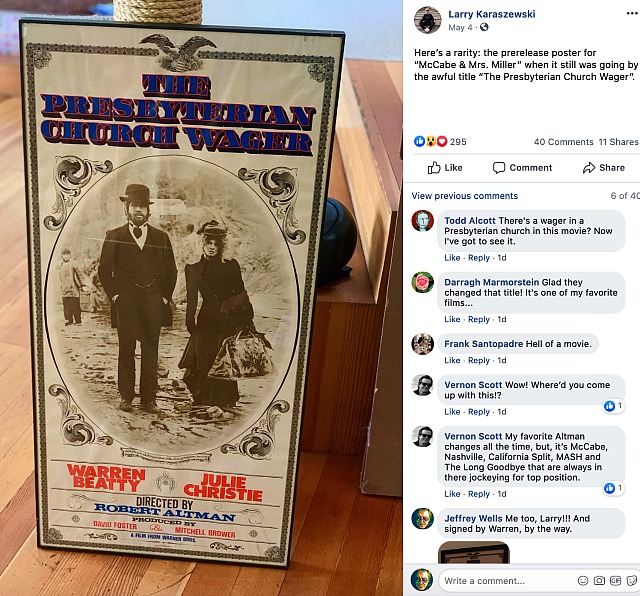
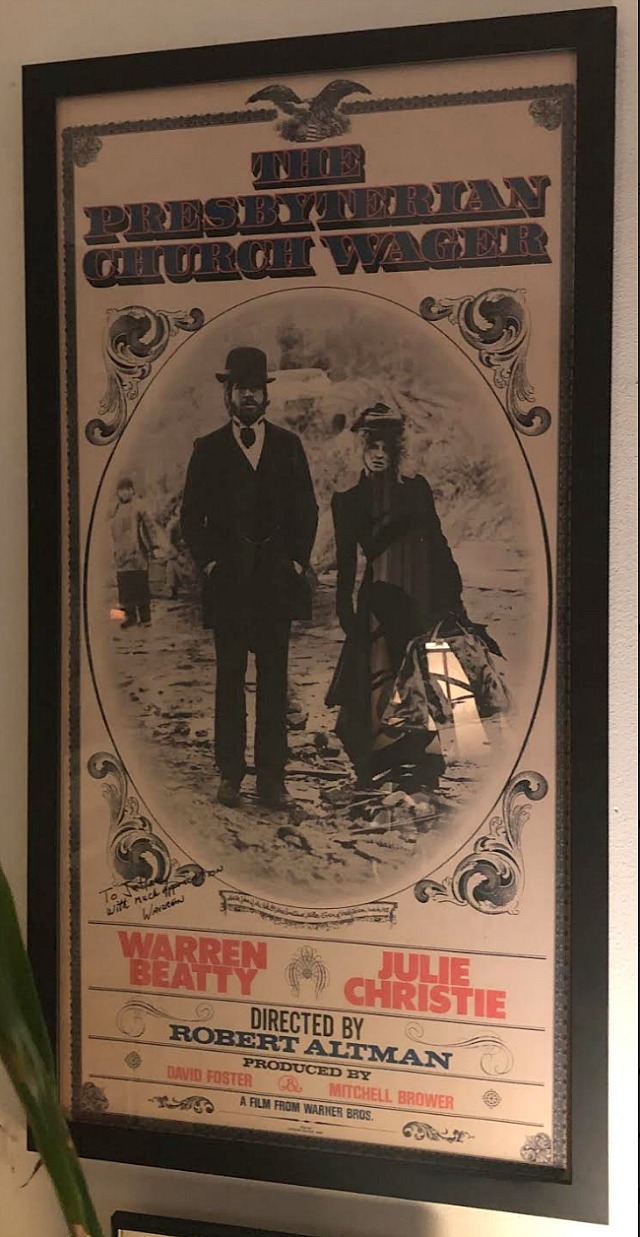
A couple of days ago on Facebook, Larry Karaszewksi, the renowned screenwriter (along with partner Scott Alexander), director, producer and co-chair of the Academy’s Foreign Language Oscar executive committee, posted a photo of a rare cultural artifact — a framed poster for Robert Atman‘s The Presbyterian Church Wager, which later became McCabe and Mrs. Miller.

Until Larry posted this I was under the impression that only three Los Angelenos owned mint-condition TPCW posters — Indiewire‘s Anne Thompson, myself and dp Svetlana Cvetko. The poster hanging in my living room is an expensively scanned digital copy of an original that Thompson loaned me several years ago. Three copies were made; I persuaded Warren Beatty to sign them.

Haven’t Used Alka-Seltzer In Decades

Speaking of ethnic defamations a la Lady and the Tramp, is it fair to throw the famous “mamma, mia, that’s a spicy meatball!” Alka Seltzer commercial into the same racist dustbin? It flaunted a crude ethnic stereotype (i.e., the old-world “moustache Pete” Italian husband being served spaghetti by a fat Mama Corleone) for comic effect, and in so doing painted Italian-American culture with the broad brush of cliche.

And yet neither the Italian American Anti-Defamation League nor the Italian-American Civil Rights League made a peep when the commercial aired in 1969. A half-century ago their mission was to pressure the film and TV industry from constantly depicting Italian Americans as gangsters and street hoods.

Give the Alka-Seltzer guys credit for coming up with a handful of great slogans and commercials from the late ’60s to mid ’70s. The top three are “I can’t believe I ate the whole thing,” “spicy meatball” and “plop plop fizz fizz.” I can’t recall the last time I used Alka Seltzer, but it was a long time ago. I still use Pepto-Bismol

Read more

Revamping “Cringeworthy” Racist Stereotyping

A Variety report by Matt Donnelly and Chris Willman assures that Disney’s forthcoming Lady And The Tramp reboot (not “animated” but a blend of CG and live action) will be scrubbed clean of politically incorrect inferences and foul racist stereotyping.

I’n alluding to the notorious Siamese cat song, sung by the Asian-accented “Si” and “Am” (i.e., Peggy Lee) in the original 1955 animated feature (“We are Siamese if you please, we are Siamese if you don’t please”), and Disney’s decision to give it a p.c. makeover.

The tune is being rewritten by Janelle Monae, and the cats in the new version are “not Siamese,” according to the Variety story. That way progressive Asians (including those who made and celebrated the immaculately tasteful Crazy Rich Asians) won’t feel offended.

To explain p.c. objections to this 64-year-old song, Donnelly and Willman reference an influential Flavorwire essay titled “The Code Behind the Kitty: Unpacking the Racist Myth of the Siamese Cat.” The article was posted by Marcus Hunter on 6.13.13.

The piece noted that Si and Am are among “the most racist cartoon characters ever depicted on film,” and described them as “jaundiced and sly, slick and feral [and] domesticated, though nevertheless propelled by their mischievous, impish nature to deceive and intimidate.”

In other words, Si and Am denigrate Asians. They could also be regarded, I suppose, as animated cousins of Mickey Rooney’s Asian landlord in Breakfast at Tiffany’s as well as characterizations of what Secretary of State Dean Rusk once called “the yellow peril.”

Read more