Earthbound

Noah Hawley‘s Lucy in the Sky (Fox Searchlight/Disney, 10.4) is about an emotional breakdown suffered by astronaut Lucy Cola (Natalie Portman) after she returns from a long space voyage and begins a hothouse affair with a fellow astronaut, Mark Goodwin (Jon Hamm).

Boilerplate: “Lucy heads into a downward spiral as she loses her connection to her family, and particularly when Goodwin begins another affair with an astronaut trainee. The film is loosely based on astronaut Lisa Nowak‘s criminal activities around her romantic involvement with fellow astronaut William Oefelein.”

The noteworthy thing is the decision by Hawley and dp Polly Morgan to use shifting aspect ratios — widescreen (2.39:1) for footage shot during Lucy’s time in earth orbit, and a more confining a.r (1.37:1) for scenes on earth.

Read more

Flash of Wayne Williams

From HE correspondent Mark Smith: “The second season of Mindhunter is about utilizing the new FBI science: can the psychological profiles of the incarcerated serial killers that Holden and Bill have so far gathered be used to catch a killer who’s still active? Is all this interviewing and traveling and sharing pizza with Ed Kemper worth a shit? This question is not only relevant to the Atlanta Child Murders, but to Bill Tench‘s creepy future-killer adopted son.

“One of the common traits of a serial killer (confirmed by Ed Kemper) is that he’s compelled to return to the scene of the crime, especially if there’s a chance to see the killer’s nefarious deeds being inspected by police and/or civilians. It gives his ego a jolt, fuels the narcissism.

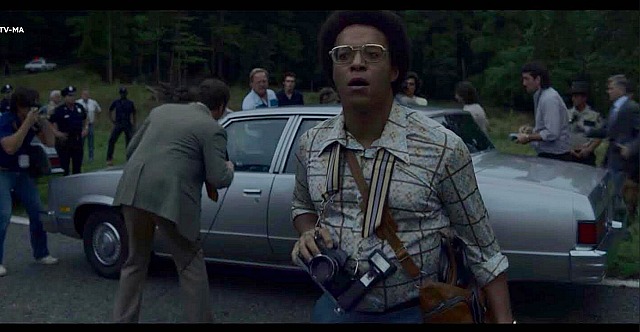
“In episode 6, about 31 minutes in, we see the Atlanta police chief and Holden on the side of the road where a massive search is taking place for new bodies. A group of reporters/photographers chases down the chief. When he gets into his car, the reporters turn and see Holden walking away, the giant yellow letters FBI leaping off his windbreaker. The throng chases him down. He calmly gets into his car and shuts the door.

“And then something weird happens…

At the very end of the shot Holden’s car is surrounded by reporters and photographers, and one of them suddenly spins toward the camera, right in the foreground. He’s got a camera around his neck. He looks around and runs out of frame, as if trying to find another bit of the action to focus on, scanning the area for a Pulitzer-prize winning snapshot. It happens fast and is made to feel random, like another part of the chaos.

“But anyone who’s watched Mindhunter knows that it’s extremely deliberate: the shot selection, the editing, the camera movements, the acting. No one is Method Acting here, no one is holding court: you say your lines with clarity and honesty, and please shit-can the histrionics. Camera movements are usually slow and deliberate, if they occur at all. And the action is staged with almost robotic precision.

“So when a guy in the foreground spins toward the camera and rips the viewer’s attention away, you can bet it’s deliberate.

“I’m not saying I jumped from my chair and screamed, “That was the killer…that was Wayne Williams!” but the moment stuck with me.

“It felt odd, out of place, a red flag, a mental coupon to be tucked away and cashed in later.

“And then when they showed Wayne Williams after they pulled him over on the bridge (50 minutes into episode 8), that’s when I jumped out of my seat in triumph.”

Read more

Never Again

Last weekend I made the mistake of taking Tatyana to dinner at Moonshadows Mailbu. I hadn’t been there in decades, but it’s a famous Malibu mainstay as well as the place Mel Gibson got drunk in before being arrested for DUI in July ’06. It will always appeal to gawking tourists and Lookie Lous because of the surfside location.

I took an instant dislike to the place, and when I got home I made a list of the reasons why. There were five of them. (1) Too many loud people congregated in a tight setting and generating so much conversational racket that I had a headache almost immediately; (2) Too many unattractive people who were either over-dressed or lacked that certain je ne sais quoi X-factor coolness that everyone needs to project when they’re out on the town; (3) Seriously ugly decor (baby blue seating booths with small and kitschy amber-toned lamps); (4) Decent but far from phenomenal food; and (5) A bizarre table-seating policy that may or may not have involved some kind of unsavory arrangement.

All I know is that the hostess declined to seat us next to an oceanview window, and when Tatyana asked why the hostess explained that a certain table in question was being held for a party of four that hadn’t yet arrived. In the politest terms I could muster I asked, “Well, are they royalty? What’s the special dispensation? We’re here in good faith and money in our pocket, and we’d like to sit at that open table so why can’t we exactly?” The hostess said that the party in question has paid a thousand bucks to Moonshadows so they’d always get a windowside table when they ate there.

Me (slightly agog): “Really?” Hostess: “Yeah. A thousand sounds like a lot, I agree, but…”

For the rest of the dinner I couldn’t think of anything else except this alleged thousand-dollar payoff. I was wondering how it worked exactly. Was it a thousand a year or twice annually or…? We asked our friendly waiter but he didn’t know of any such arrangement. I called the next day and spoke to a manager, a guy who said he’s worked at Moonshadows for many years, and he also said he was unaware of any such system.

All I can tell you is that the hostess said what she said, and that I didn’t imagine it.

I will never, ever go to Moonshadows again. I would rather eat a hot dog while sitting on the beach. I would rather go to Jack in the Box. On top of which Pacific Coast Highway is such an aggressive, high-speed thoroughfare. They say that the ocean is calming and restorative but not out there. I’ve been to beachside communities all over the globe, and Malibu is easily the worst of them. It has no sense of peace or tranquility.

https://www.infoelba.com/island-of-elba/beaches/marina-di-campo-beach/

Shocker

Hot Sundance films are fizzy highs in the Wasatch mountains, but they often seem to become something flatter and less transporting when they arrive in urban, sea-level plexes. This is one of the oldest truisms around. I’ve been writing articles about this syndrome for a good 20 years.

Variety‘s Rebecca Rubin has checklisted the latest manifestations of this cultural disparity, but she can’t quite bring herself to blurt out the phrase “no-star wokester indie flicks don’t usually fly with Joe and Jane Popcorn.”

I’m not allowed to infer that “movies about brilliant chubby girls struggling with personal or professional issues” constitute a problematic sub-category, but one could at least argue as much.

It’s too early to say if Paul Downs Colaizzo‘s Brittany Runs a Marathon (Amazon, 8.23) will swim or sink. (An 84% Rotten Tomatoes audience score is a positive indicator.) But Geremy Jasper‘s Patti Cake$, Nisha Ginatra‘s Late Night and Olivia Wilde‘s Booksmart all qualify, and they all underperformed.

I was mostly taken by Gurinder Chadha‘s Blinded By The Light, but it didn’t connect all that broadly after opening on 8.16. No stars, British Pakistani culture, father-son conflict, etc. Warner Bros. acquired the Springtseen-themed musical in Park City for $15 million, but since opening in 2207 theatres it’s only made $8,103,492.

The one big narrative breakout hit is A24’s The Farewell (because it’s an excellent, well-acted film that delivers the emotional goods), and the only documentary hit so far is Apollo 11 with $9,039,891 thus far.

After five weeks in theatres HE’s own David Crosby: Remember My Name has only accumulated $459,880. Easily one of the best docs of the year and an emotional truth drug movie second to none. Why the lethargy?.

Rubin excerpt #1: “Netflix bought Extremely Wicked, Shockingly Evil and Vile, a drama from the perspective of Ted Bundy’s girlfriend, for a reported $8 million, but it’s not clear yet whether it will mount an awards push.” HE clarification: An awards push is unlikely.

Rubin excerpt #2: “Amazon’s The Report likely won’t be breaking any box-office records, since it will land on Prime Video two weeks after it it opens in theaters.” HE clarification: Not happening.

Dregs of the Gene Pool

I saw Oliver Stone‘s Natural Born Killers three or four times in the late summer of ’94, but that was because it had been originally written by Quentin Tarantino (here’s a draft of it) and I was chasing the Tarantino glamorama. Reservoir Dogs (which I’d seen at the 1992 Cannes Film Festival) and True Romance were part of the recent backlog. Pulp Fiction had premiered in Cannes in May of ’94 but wouldn’t open until October, and I was getting to know producers Don Murphy and Jane Hamsher at the time. It was all kind of swirling together.

Stone‘s lightning-hot streak of the mid to late ’80s — Platoon, Salvador, Wall Street, Talk Radio and Born on the Fourth of July — had given way to a respectable if slightly less incandescent run of ’90s films — The Doors, JFK, Heaven and Earth, Killers, Nixon, U-Turn, Any Given Sunday — but his Bill Clinton-era output certainly demanded everyone’s attention. If you ask me Sunday is the one of the greatest football films ever made.

But honestly? I always quietly hated Natural Born Killers. I didn’t see it as a tongue-in-cheek media satire but as a scurvy, low-rent, multi-media death flick — a blood-and-splatter show. Right now I can’t think of another film I’d rather re-watch less. Let me say clear and straight that I will never, ever sit through this ugly-ass film again .

For some reason Variety‘s Owen Gleiberman wrote about NBK yesterday, but my recollections of the nihilism of this quarter-century-old film — just the recollections! — is enough to make me throw up.

From Gleiberman’s Movie Freak: “The tingly audacity of Natural Born Killers, and the addictive pleasure of watching it, begins with the perception that Mickey and Mallory experience not just their infamy but every moment of their lives as pop culture. Their lives are poured through the images they carry around in their heads. The two of them enact a heightened version of a world in which identity is increasingly becoming a murky, bundled fusion of true life and media fantasy. It works something like this: You are what you watch, which is what you want to be, which is what you think you are, which is what you really can be (yes, you can!), as long as you believe.”

From the Variety article: “What form does this kind of belief take? It’s a word that applies, in equal measure, to the fan-geek hordes at Comic-Con; to the gun geeks who imagine themselves part of a larger ‘militia’; to the gamers and the dark-web conspiracy junkies; to the people who think that Donald Trump was qualified to be president because he pretended to be an imperious executive on TV. It applies to anyone who experiences the news as the world’s greatest reality show, or to the way that social media is called social media because it’s about people treating every facet of their lives as ‘media’ — as a verité performance.

Read more

Panned & Slammed

Variety‘s Jessica Kiang and The Hollywood Reporter‘s Jordan Mintzer have posted reviews of Woody Allen‘s A Rainy Day in New York. As you might expect, the judgments are on the hand-wringing side.

They’re both basically saying that while Allen’s film is watchable and occasionally diverting here and there, it’s a relic of another time. It’s a nimbly plotted, present-tense story set in a well-heeled, tweed-jacket Manhattan but abounding in mindsets, attitudes and references that could have arguably been criticized as out of step with the times even a half-century ago — weirdly old-fashioned in almost a time machine-like way.

Which, of course, is a familiar complaint. And especially regrettable because the problem could probably be arrested or perhaps even remedied if Allen wanted to change his modus operandi.

From my capsule review of Melinda and Melinda, posted 14 and 1/2 years ago: “It’s not one of his very best, and he’ll probably never get back into Manhattan or Crimes and Misdemeanor-land until he hooks up with a co-writer, preferably someone a good 25 years younger. Allen is almost 70 and he just isn’t getting the world as sharply as he used to. He needs a younger guy (or woman) to challenge him and give his scripts some topical zippity-doo-dah, and that’s not a tough pill to swallow. He partnered with Marshall Brickman on Annie Hall and with Douglas McGrath on Bullets over Broadway, so it’s not like this is a new concept.”

Kiang’s expansive, nimbly-phrased review is a slightly better read than Mintzer’s, IMHO.

And at the risk of driving HE readers nuts by hitting the same piano key over and over, Mintzer needs to be reminded that the Moses Farrow essay (“A Son Speaks Out“) is the testimony to consider in assessing Woody’s guilt or innocence in the wake of Dylan Farrow’s repeated accusation of molestation when she was 7 years old, in 1992. Moses, Moses, Moses…what will it take?

Kiang’s review says she saw A Rainy Day in Manhattan on Sunday, 8.25 at “Kinpolis, Poznan, Poland” — a presumed reference to one of two Cinema City Kinepolis entertainment plexes in Poznan, which is Poland’s fifth-largest city. It’s located 240 kilometers (150 miles) east of Berlin.

Is Hollywood Elsewhere still determined to catch Allen’s film in Tijuana on 10.25? Kind of, yeah. Perhaps not so much over the film’s anticipated pleasures as an excuse to re-visit Mexico. I’m actually thinking of taking the Pacific Surfliner down to San Diego and then the San Diego Trolley to the border.