Couldn’t Cut It

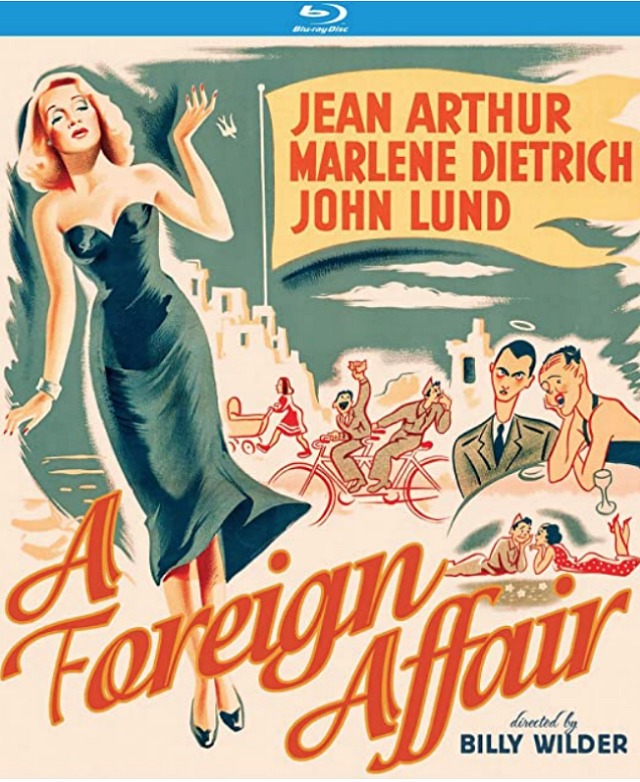
I’ve never wanted to see Billy Wilder‘s A Foreign Affair (’48) and I probably never will see it for one basic, fundamental reason. Male lead John Lund isn’t good enough to romance (i.e., have carnal relations with) Marlene Dietrich or Jean Arthur. Yes, it’s that simple.

When I say “not good enough” I mean he’s not an A-lister. Clark Gable, Gary Cooper, Gregory Peck, Frank Sinatra, Gene Kelly, Kirk Douglas or John Wayne would’ve been acceptable, but not Lund. I will never patronize a film in which a B-level actor (especially one with a Gable-like moustache) gets down with an A-level actress. Bad for morale, bad all over.

Lund, who died in 1992 at age 81, was eulogized in a London Times obituary as follows: “[His] film career was cut to a familiar pattern: the young actor imported to Hollywood after a big success on Broadway begins by playing the handsome guy who gets the girl, then descends by gradual degrees to being the male lead in minor westerns and occasionally, in major films, being the handsome guy who does not get the girl because he lacks the spark of the hero who does.”

Read more

Ignorant As This May Sound…

Until I read about this morning’s landmark Supreme Court decision, I didn’t realize it was legal in more than half the states to fire workers for being gay, bisexual or transgender. But no longer!

Workplace protections to millions of LGBTQs have now been extended, and what a surprise that Justice Neil Gorsuch, a shit-heel Trump appointee, joined Chief Justice John Roberts and Justices Ruth Bader Ginsburg, Stephen G. Breyer, Sonia Sotomayor and Elena Kagan in rendering this decision.

“An employer who fires an individual merely for being gay or transgender defies the law,” Gorsuch wrote for the majority.

Hollywood Elsewhere approves and applauds.

Celebration Time, C’mon!

I’m still wearing my USA flag mask and washing my hands like Howard Hughes, but out in the big West Hollywood world people were congregating and celebrating and basically saying “fuck it…enough!” I was rumblehogging up and down the Sunset Strip around 5 pm yesterday afternoon, and you should have seen the outdoor crowds and the capacity-filled tables and sensed the general merriment…the relief! It was like being in Arkansas or Arizona or, better yet, Paris! Just about every significant cafe and eatery was open to capacity business. (Outdoors, at least.) Urth Caffe, Pink Taco, Mel’s Drive-In, Wahlburgers, Coffee Bean. And you know what percentage of the customers were wearing masks? Maybe 15%, if that. Okay, 20%.

Read more

Most Wowser Oscar Year Ever

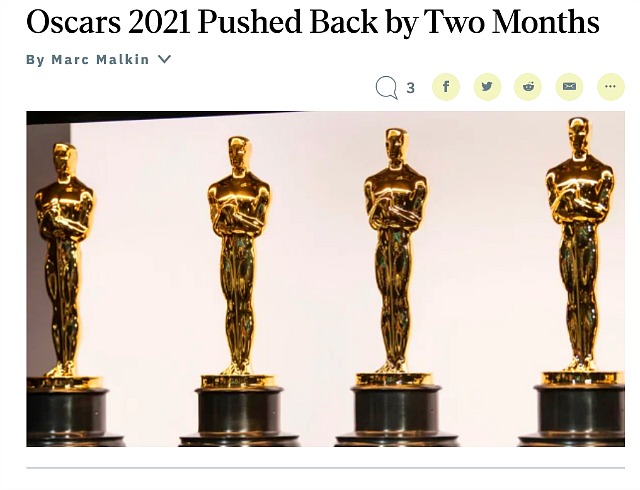
In yesterday’s “Oscars in April ’21…But Of Course!” piece, I speculated (and not all that brilliantly) that with the Sunday, 2.28 Oscar telecast expected to be postponed “by as many as eight weeks,” the new Oscar date will either be 4.18.21 or 4.25.21, which of course are both Sundays.

It was announced this morning that the Oscar telecast will indeed air on 4.25.21, and that the 2020 release year will be extended for a full two months, or until Sunday, 2.28.21. I’m assuming that the Academy voting deadline will come a week or so before 4.25. Let’s say Friday, 4.16 or Monday, 4.19. That will leave roughly seven weeks of campaigning between 2.28.21 and the voting cut-off.

What will this mean as far as the Phase One (pre-Oscar nomination) and Phase Two (post Oscar nomination) mindsets are concerned? I’ll tell you what it means. It means there will be two (click!), two (count em!), two Phase Ones and one Phase Two.

It also means that with the Telluride, Toronto, Venice and N.Y. film festivals sticking to their usual early fall dates, we’re looking at an extended award season that will last nearly eight months instead of the usual five-and-a-half or six (Labor Day to late February).

This is a one-off situation, remember. It’ll be back to business-as-usual for the ’21 and early ’22 Oscar year. We’re in uncharted territory, yes, but it’s not that hard to figure the angles and strategies.

To repeat, Phase One is not going to be shortened or pushed back — it’s going to expand. Remember that a good portion of the Oscar contenders are still going to “open” (even if that means a streaming debut) by 12.31.20. Today’s announcement is about accommodating the overflowers whose post-production skeds have been delayed by COVID.

But there won’t be any backing away from the traditional Phase One promotions of November and December. Parties and promotion-wise, people are 100% accustomed to Oscar season happening in November and December, partly if not largely because the holiday period is when the non-devotional dilletantes go to the movies (along with the summer).

So the traditional Phase One (call it Phase One A) will still happen in November-December, and then the brand-new Phase One B (which will naturally include some Phase One A repeats and redoublings) will kick off in late January and February.

And then, after the nominations are announced in early to mid-March, Phase Two will kick in, lasting from mid March to roughly April 16th or 19th, give or take.

So to summarize, we’ll be seeing two Phase Ones followed by a two-months-later-than-usual Phase Two. And then comes the most glorious Oscar telecast of all time on 4.25 — a Night of a Thousand Superstars with an up-with-Hollywood, “America needs movies and movies need America!”, rally-round-the-flag-boys esprit de corps that will be awesome to behold.

Read more

Tough All Over

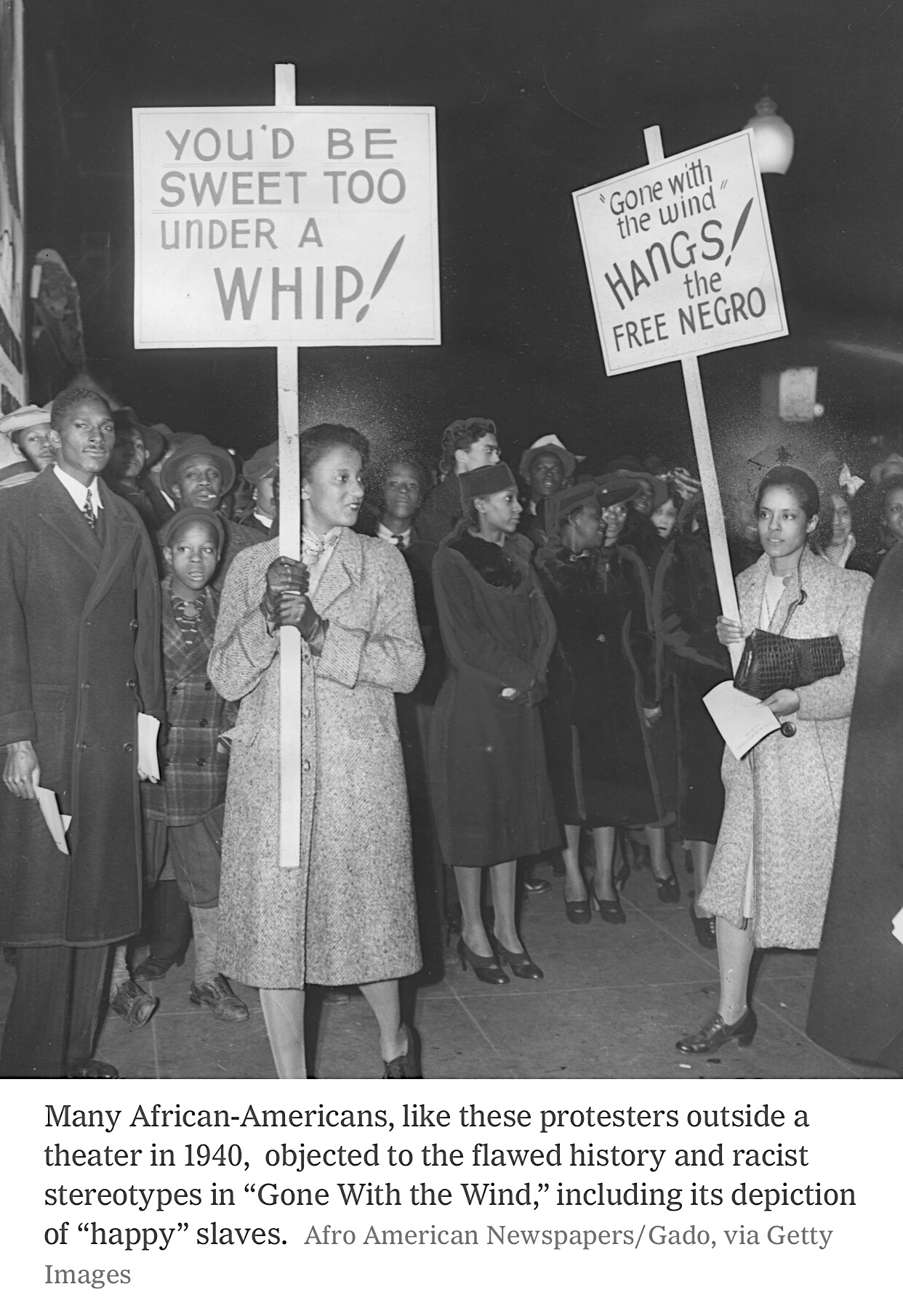
Jennifer Schuessler‘s “The Long Battle Over Gone With the Wind,” a perceptive and mostly fair-minded summary of the varied reactions to David O. Selznick‘s 1939 classic over the decades, appeared in yesterday’s N.Y. Times.

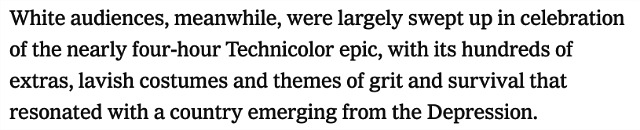
I felt conflicted about paragraph #24, which says that when GWTW opened “white audiences…were largely swept up in celebration of the nearly four-hour Technicolor epic, with its hundreds of extras, lavish costumes and themes of grit and survival that resonated with a country emerging from the Depression.”

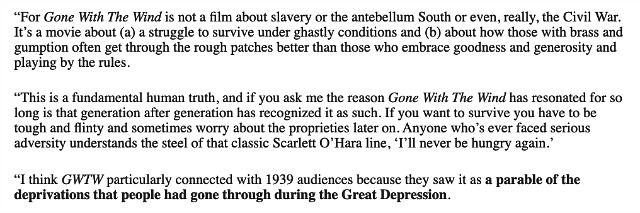
I said roughly the same thing in my 6.9 piece about reactions to the film (“A Minor Point At Such A Moment“). As a parable about the deprivations of the Great Depression, I wrote, GWTW “is fundamentally about how life separates the survivors from the victims when the chips are down, and about the necessity of scrappy, hand-to-mouth survival under the cruelest and most miserable of conditions…it basically says ‘only the strongest and the most determined survive.'”

But how was this something that only “white” audiences understood?

True, African Americans have long dealt with far more hardships and uphill situations than whites, and especially during the 1930s, but grit and steel are necessities within any tribe or culture in any time period. “Survival of the toughest” is a recognized rule all over the world.

From Schuessler’s essay:

From “A Minor Point At Such A Moment,” posted on 6.9.20.

Monday Morning Davidson

Presumably a fair-sized percentage of the HE community saw Judd Apatow and Pete Davidson‘s King of Staten Island over the weekend. So what’s the verdict? I wasn’t sure during the first 45 or so, but then I realized it was dealing honest cards and became a staunch fan, especially after catching it a second time.

There’s almost a 20 point disparity between between critics and Joe Popcorn on Rotten Tomatoes (71% critics, 90% ticket buyers). What are critics missing that ticket buyers aren’t? Say what you want, but I believed every word of it…every line, emotion, situation, character.

HE reaction, posted on 6.8.20: “You can give the side-eye to The King of Staten Island all you want. You can say it’s too oddball fringe-y, too lower-depths, too submerged on its own weed planet and too caught up in nihilism and arrested development to connect with Joe and Jane Popcorn. But because it’s funny and plain-spoken and doesn’t back off from an unusual milieu and mentality, and certainly from Pete Davidson‘s ‘Scott’, a layabout for the ages, I strongly disagree.

KOSI made me smile and guffaw and even laugh out loud several times (highly unusual for an LQTM-er). It’s peddling sardonic humor that doesn’t feel schticky, although I guess it is. The tone is low-key raw, kinda nervy, certainly unpretentious and almost entirely bullshit-free.”

Monday Morning “Bloods”

Presumably a fair-sized percentage of the HE community saw Spike Lee‘s Da 5 Bloods over the weekend. So what’s the verdict? I was moderately down with it, one or two reservations aside, and I recognize that those who enjoyed and/or admired it are very impassioned. Then again there’s still a significant disparity of reactions between critics and Joe Popcorn on Rotten Tomatoes and the IMDB.

From a sporting perspective it has to be acknowledged that Lee and Netflix have either (a) lucked out from a sociological perspective, given the events of the last three weeks, or (b) played the marketing brilliantly by reminding viewers that echoes of our current malaise are reflected in the film. Or a combination of the two.

I respect the apparent fact that Delroy Lindo‘s performance has become a potential Oscar contender, although there’s some dispute as to whether he belongs in a lead or supporting category. As the film is basically an ensemble with no real leads, I think he belongs in supporting.

As much as I’m personally disappointed in Spike for failing to mention uncontested facts in his initial defense of Woody Allen last Friday, I don’t hold it against him for apologizing when #MeToo wokesters pressured him. His initial support for Allen was phrased in a way that seemed to under-appreciate the seriousness of sexual assault, and he had to correct that.

It’s just too bad that he didn’t state plainly and simply that there’s no basis for believing that Allen is guilty, especially if you read the Moses Farrow essay.

Read more