Presumed Killed by House Cat

Criterion’s 4K digital restoration of The Incredible Shrinking Man (’57) is now out and about. Cheapskate that I am, I decided instead to watch the YouTube version. I’ve always respected the bargain-basement trick photography and physical effects that make this modest black-and-white film work as well as it does, and it was fun to once again relish the good parts.

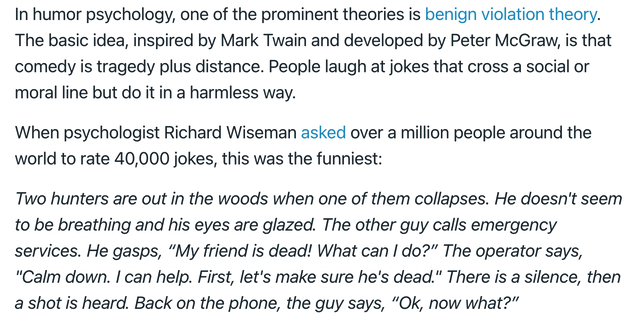
But I’d forgotten there are two scenes that flirt with unintentional humor. The first comes when a TV news anchor reports that Robert Carey (Grant Williams), famed for a strange ailment that has caused him to get smaller and smaller, has been killed by his cat. He hasn’t been, in fact, but the anchor reports the news so grimly and with such lathered-on emotion that you can’t help but chuckle. The idea of an adult, mouse-sized human being crushed and bloodied by a house cat…I’m sorry but it’s oddly funny.

There’s a second scene in which Carey’s wife, Louise (Randy Stuart), is talking to her husband’s older brother (Paul Langton) about how horrible it must have been to be mauled and chewed to death, and again you can’t help but smirk. Why is it vaguely chuckle-worthy? I don’t know but it is.

Either you “get” cruel humor or you don’t.

Sons of Sahl

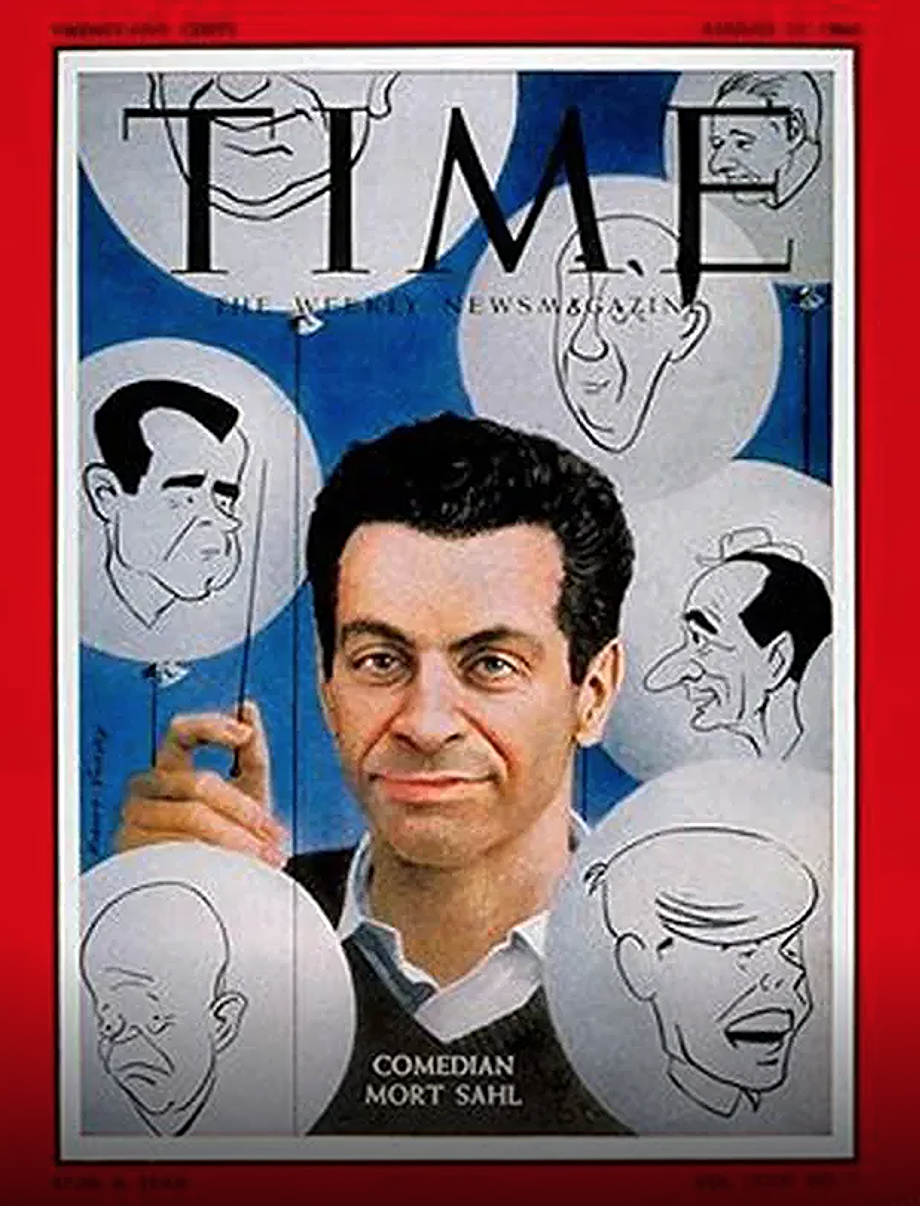
Mort Sahl, one of the greatest, sharpest and most influential conversational comedians of the mid 20th Century, whom I was honored to interview at the Beverly Glen shopping plaza 18 or 19 years ago, has passed at age 94.

Saul was an iconic, whipsmart Jewish wit who focused on social trends and politics (he always carried a rolled-up newspaper in his hand). He rose and peaked in the era of Lenny Bruce, Steve Allen and Jackie Mason but hung in there and kept gigging for many decades to come.

Sahl was a Kennedy liberal in the early ’60s, then he became a Dealey Plaza assassination conspiracy buff, then segued into becoming a jocular Reagan Republican (chummy with Al Haig). I forget why I called him in ’02 or thereabouts, but I was delighted when he suggested a sitdown.

Sometime in the late ’70s a girlfriend and I caught a Sahl set on the North Shore. I forget the name of the club but it was in Revere, Swampscott, Lynn…one of those towns. We arrived 15 minutes before showtime, and my heart stopped — the room was one-third filled, if that. I felt so badly for the poor guy, but you know what? Sahl came out and did his show as if he was playing to a packed house at Carnegie Hall. Which deeply impressed me. As I sat and listened and laughed, I was thinking “wow, nothing but class…this is how a professional plays to a nearly deserted room.” Grace under pressure, never say die, the show must go on.

Heres a 2008 James Wolcott Vanity Fair profile called “Mort The Knife.”

Read more

Bad Director Names

I’ve riffed before about directors whose names sound right, and those that don’t.

Sidney Lumet, Ridley Scott, Jacques Tourneur, Howard Hawks, David Lean, Spike Lee, Samuel Fuller, Quentin Tarantino, Stanley Kubrick, George Roy Hill, Akira Kurosawa, John Huston, Ingmar Bergman…these are names that suggest character, chutzpah, cultivation, grand visual schemes and a certain force of personality.

But other names lack that special schwing, that association with arthouse refinement and elegant educations and verve and riding to hounds, and I’m sorry but Ari Aster and Robert Eggers, easily two of the finest younger directors working today, are among them.

Robert Eggers sounds like the last name of a construction foreman or a rugged craftsman of some kind, maybe a middle-range divorce attorney or a carpenter from White Plains or a landscape architect who wears courduroy sport jackets, or maybe a builder of early American furniture.

Ari Aster sounds like a Jewish tailor with a storefront in Brooklyn…maybe a sharp jewelry salesman or a dressmaker or a mob attorney or a bookmaker. He just doesn’t sound like a guy who hangs with the rich and famous and owns bitcoin and has a blonde girlfriend with rich parents.

Two and two-thirds years ago I complained about the 1930s and ’40s “house” director Clarence Brown. Victor Fleming, Michael Curtiz, Rouben Mamoulian, Mervyn LeRoy and even John Ford sounded like guys who played golf in the best country clubs. Clarence Brown sounds like an uncle of Alfalfa or Spanky in The Little Rascals series. Or the name of a wheat farmer, auto mechanic or grocery store owner.

In this sense Brown is a kindred spirit of Chad Stahelski, director of the three John Wick movies. Stahelski is the last name of an electrician, a surfer, a pool-maintenance guy, a hot-dog chef at Pinks, a garbage man (excuse me, a sanitation engineer) or a guy whose grandfather worked in the same New Orleans factory as Stanley Kowalski.

Posted on 8.19.08: “If I were Saul Dibb, director of The Duchess, I would have changed my name the day I decided to become a filmmaker.

“Saul Dibb could be an architect, a restaurant owner, a tailor, a stockbroker, the owner of a roofing company, a garment-district clothier, a cab driver or even a stage director, but something doesn’t feel quite right about a guy with that name delivering an upscale period piece aimed at the ladies. It seems to somehow diminish that sexy, elegant 18th Century vibe that films of this sort are supposed to deliver.

“No comment on the film itself, mind — I’m just saying that ‘Dibb’ rhymes with ‘bib,’ ‘fib” and ‘squib.’ I wouldn’t want to see a Barry Lyndon-era romance directed by Maury Schlotnik, Sidney Schwartz, Lenny Bruce or Mort Sahl either.”

Seitz’s Gadsby Proclamation Has Faded

Hannah Gadsby was trending yesterday after Dave Chappelle said she’s “not funny.” God knows how many tens of thousands of Average Joes and Janes were suddenly asking each other “who is this unfunny Hannah Gadsby?” or words to that effect.

This will prove but a minor speedbump for the Australian, Jim Broadbent-resembling comedian, but she has taken a hit.

In a 7.12.18 Vulture piece Matt Zoller Seitz announced that Bill Maher‘s brand of standup comedy was over and that Gadsby’s act represented the future. Maybe so, but right now millions are on Team Chapelle and not so much with Gadsby-Seitz.

“Dune 2” Greenlight Is About Perception Smoke

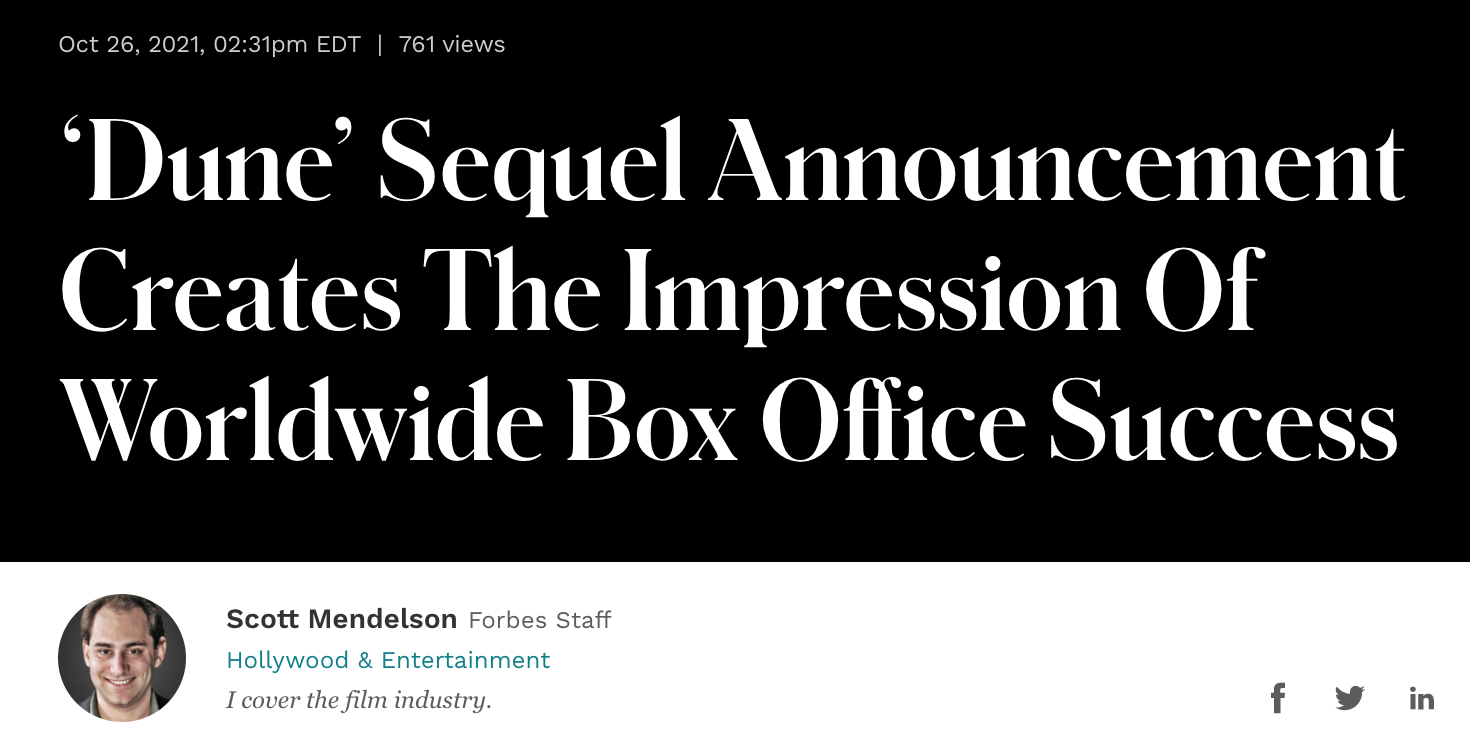
Forbes Scott Mendelson has explained the Dune 2 greenlighting as follows:

(1) Warner Bros. and Legendary think that Dune 2 will perform better theatrically amid more conventional circumstances than the presently-playing Dune, which is still likely going to end up with $375 million-$405 million worldwide;

(2) Announcing a sequel creates the impression of success (think Jungle Cruise 2 and Cruella 2) and encourages folks to check out the movie without fear of ending on a cliffhanger;

(3) Legendary perhaps wants to put itself in a rosier position to get purchased by a conglomerate;

(4) Whether or not Dune makes money theatrically is less of a concern as long as it’s perceived as a Covid-era theatrical success and/or a launching pad for HBO Max television shows.

Other Artsy-Fartsy Movie Titles?

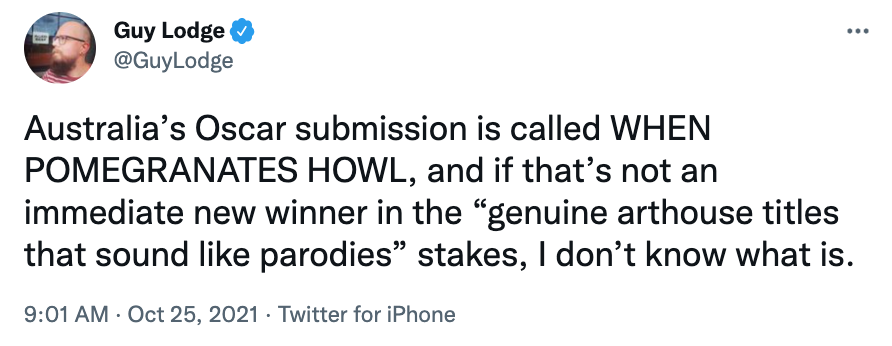
Titles, I mean, that seem so deeply embedded in the hole of precious that they sounds like satires.

When Pomegranates Howl may be Australia’s Oscar submission, but this 2020 film is actually (a) an Afghan-Australian co-production, (b) written and directed by Granaz Moussavi, an Iranian woman, and (c) set in Kabul, which of course is a whole different (one could say horrific) thing now.

Convert Into Glass

Denis Villeneuve has decided to make cinema for a global audience. Dune is smooth, vitrified, spherical. (…) The production design comes before everything else; in fact, it compensates for everything. The result is plasticized, a constant grayish metallic glaze, a screen saver.” — Cahiers du Cinema.