No “Five Came Back” Access

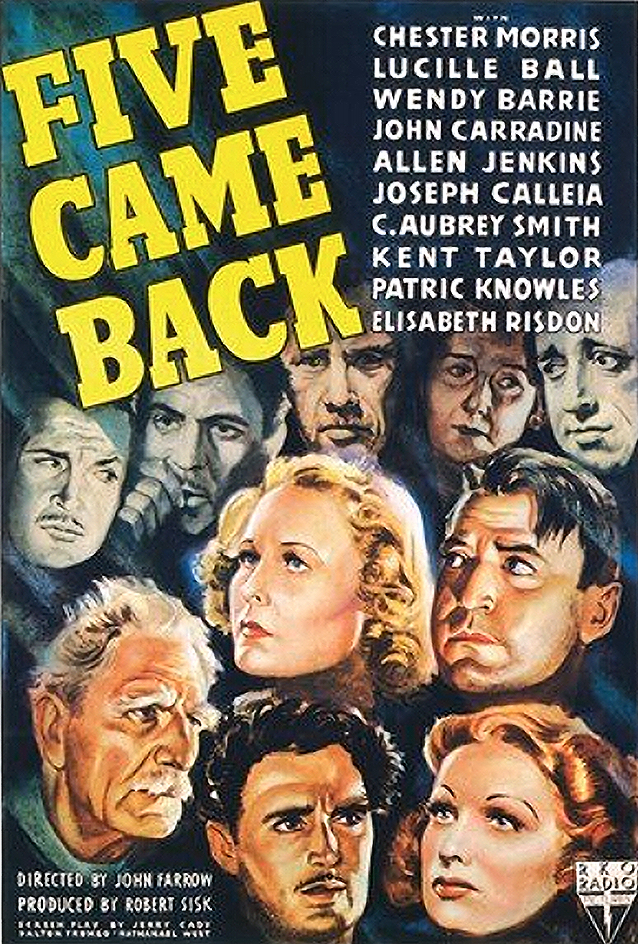
After writing a few weeks ago about that John Farrow doc and with Aaron Sorkin‘s Being The Ricardos screening this weekend, I was in a mood last night to watch Farrow’s Five Came Back (’39).

It’s just a programmer — a 73-minute RKO drama about a plane crash-landing somewhere in Central America, and nine passengers (including the 28 year-old Lucille Ball) trying to figure some way of getting back to civilization.

I saw it on the box when I was 12 or thereabouts, and it’s no masterpiece. On the other hand it’s a decently made B-movie (all Farrow films are respectable productions), and I especially recall the ending with the “bad” guy (Joseph Calleia) shooting an older couple (C. Aubrey Smith, Elisabeth Risdon) to spare them the horror of being eaten by cannibals. Yes — Panamanian or Costa Rican cannibals.

Five Came Back began shooting in late March 1939, finished principal photography on 4.26.39, and opened in theatres less than two months later — 6.23.39. It cost $225,000 to produce and earned $721,000 in ticket sales.

Anyway you can’t stream Five Came Back. You can only buy the DVD for $28 on Amazon. Too much — why don’t they just do a HD scan and stream it as a purchase/rental?

Read more

Honest Reactions Sought

All along I’ve been fretting that even with the “work” she’s had done, Nicole Kidman (who turned 54 last June) will look too old to play Lucille Ball in her early 40s. But the Being The Ricardos trailer that popped earlier today alleviates all such concerns.

I don’t know how it was done (not through prosthetics, I’m told) but Kidman looks much younger here. Like she did in Eyes Wide Shut, I’d say. My first presumption is that the same kind of digital finessing that de-aged Robert De Niro in The Irishman was used here. That or Kidman has had some fresh work done, and of a very high order.

Aaron Sorkin‘s Being The Ricardos happens over a dramatically compressed one-week period in the early ’50s that actually spanned four years — the launch of I Love Lucy in 51, the “Lucy once registered as a Commie” thing in ’53, the January ’55 Confidential cover story that asked “Does Desi Really Love Lucy?,” etc.

Read more

I’m No Commoner

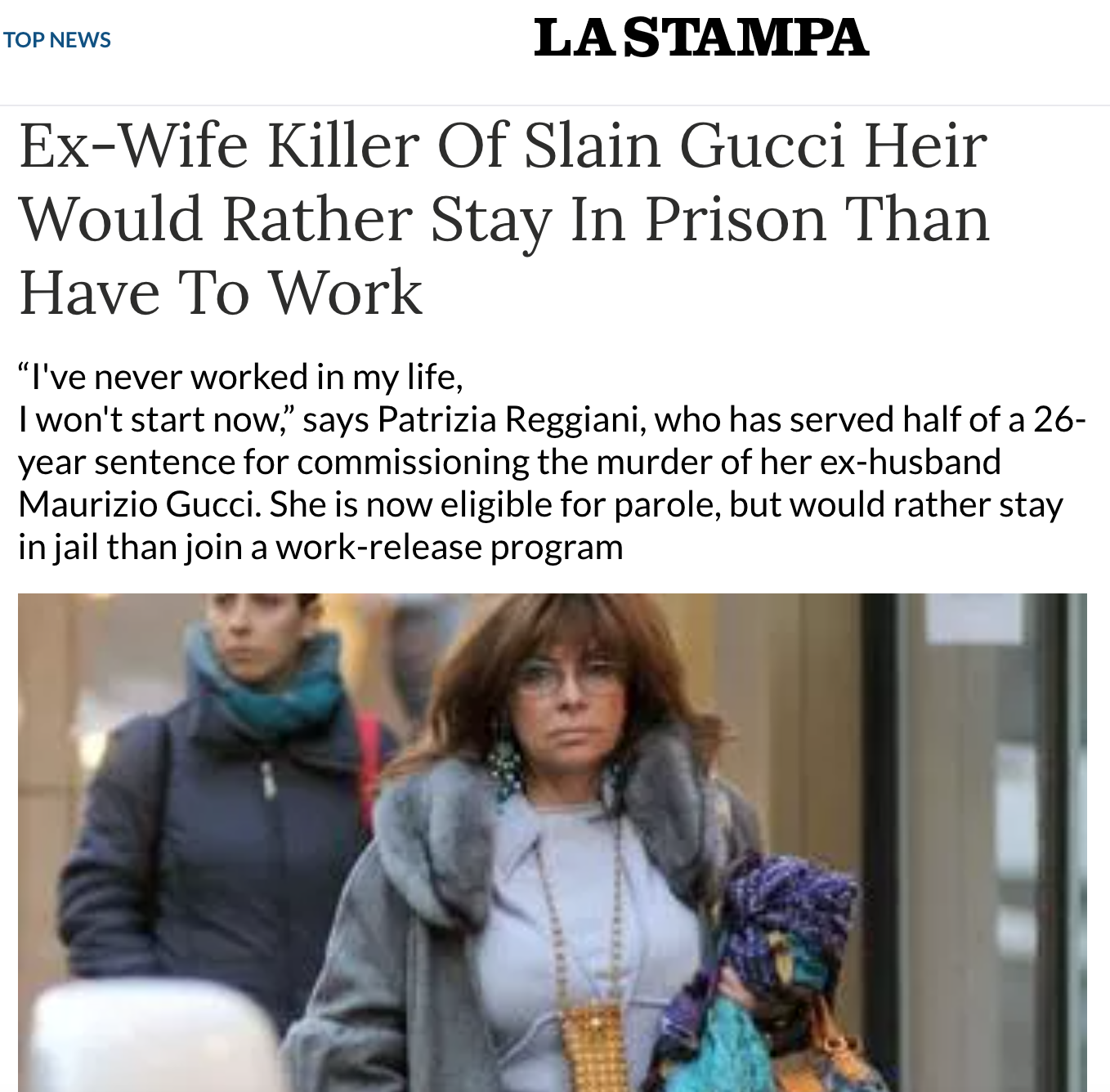
In 2011, after serving half of her 26-year sentence for conspiring to murder her husband Maurizio Gucci (Adam Driver), Patrizia Reggiani (Lady Gaga) was given a chance to get out of prison if she would submit to a work-release program. According to La Stampa, Reggiani said “I’ve never worked in my life, [and] I’m certainly not going to start now.”

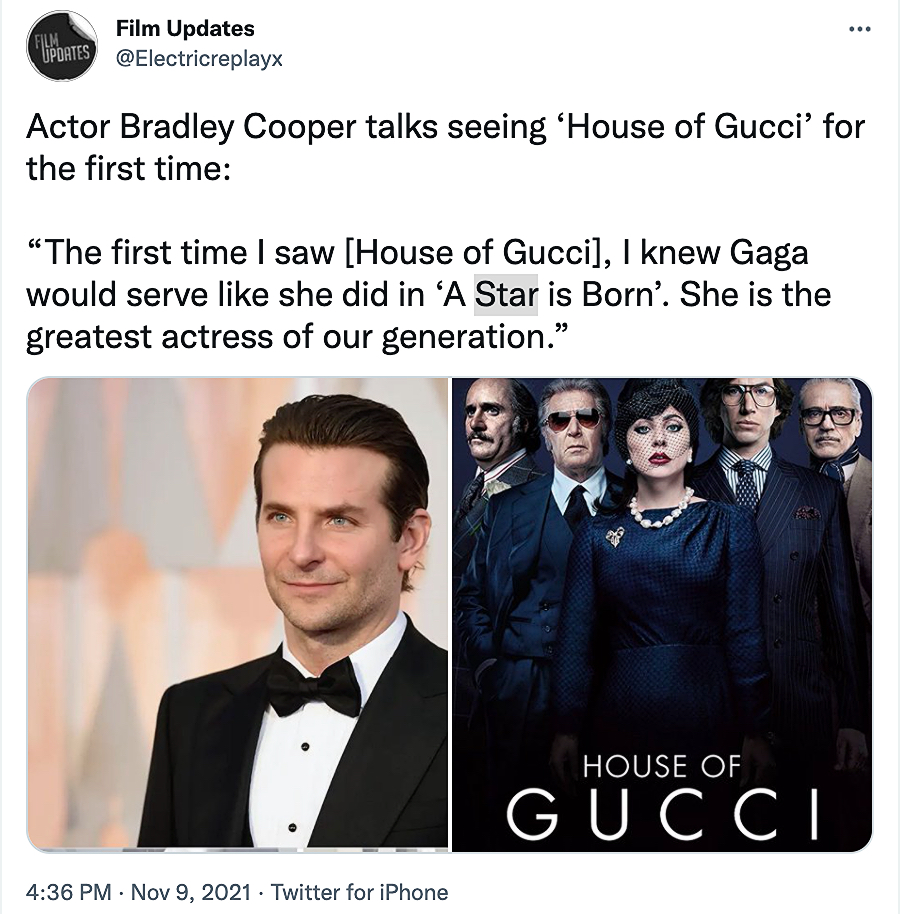
C’mon, that’s a great, self-defining line! Easily as good as “no wire hangers!” or “don’t fuck with me, fellas!” or “Christina, get the axe!” But unless I was snoozing and somehow missed it, Gaga never says this line in House of Gucci and the quote doesn’t appear in an epilogue crawl. What does that tell you about where Ridley Scott‘s film is coming from? I’ll tell you where it’s coming from. It’s trying to cut Patrizia a break.

Reggiani was paroled in 2016.

Read more

She’s Bad, But Understandably So

Wall Street Journal snippet: “Gaga explained that she took into account how her long-time friend Tony Bennett ‘feels about Italians being represented in film in terms of crime’, and aspired to ‘make a real person out of Patrizia, not a caricature.'”

What’s left is a carefully measured ensemble piece that isn’t especially emotional or crazy or anything in that realm. House of Gucci isn’t a bad film — I was engrossed as far as it went — but right now only the whores are calling it a hoot. A Best Actress nomination for Lady Gaga, okay, but I wouldn’t bet on a Best Picture nomination. It might get there, but it’s a little too modest and carefully measured to qualify as any kind of envelope-pushing romp.

“Gucci” Wants You To Feel Her Pain

Ridley Scott‘s House of Gucci (UA Releasing, 11.24) is a cool, muted, decently made docudrama about how the Gucci family business gradually went downhill in the ’80s and ’90s, and how the 1995 murder of Maurizio Gucci (Adam Driver) by killers hired by Maurizo’s ex-wife, Patrizia Reggiani (Lady Gaga), seemed to signify this decline.

The problem for me was one of expectation. Goaded by the trailers and that Patrizia Reggiani-slash-Lady Gaga money quote — “I don’t consider myself to be a particularly ethical person, but I am fair” — I was expecting Gaga to deliver a ruthless, high-camp, carniverous dragonlady — a new version of Joan Crawford in Mommie Dearest.

Alas, despite what Team Variety and the fawning Twitter whores are saying, that’s not what this movie is. It’s not out to make Reggiani some kind of fang-toothed pit viper. It’s actually about trying to portray her in a half-sympathetic light. And so House of Gucci is basically about how an admittedly ambitious woman reacts when she’s scorned and bruised and cast aside.

Beware of Bad Acting

I don’t believe Kyle Rittenhouse‘s tearful breakdown for one single second. I don’t think this is the first time he’s related the facts of the shootings, and I’m certain he’s reviewed and rehearsed his testimony with his defense attorney[s] several times. “Excessive” is not the word for this Proud Boy’s crying on the stand — it’s embarassing. He’s a terrible Midwestern actor, and certainly an insincere one.

In His News Anchor Prime

After 28 years with NBC and at 61 years of age, MSNBC’s Brian Williams could keep going for at least another 15 years, and yet the New Canaan, Connecticut resident has announced that he’s stepping down “to spend more time with [his] family.”

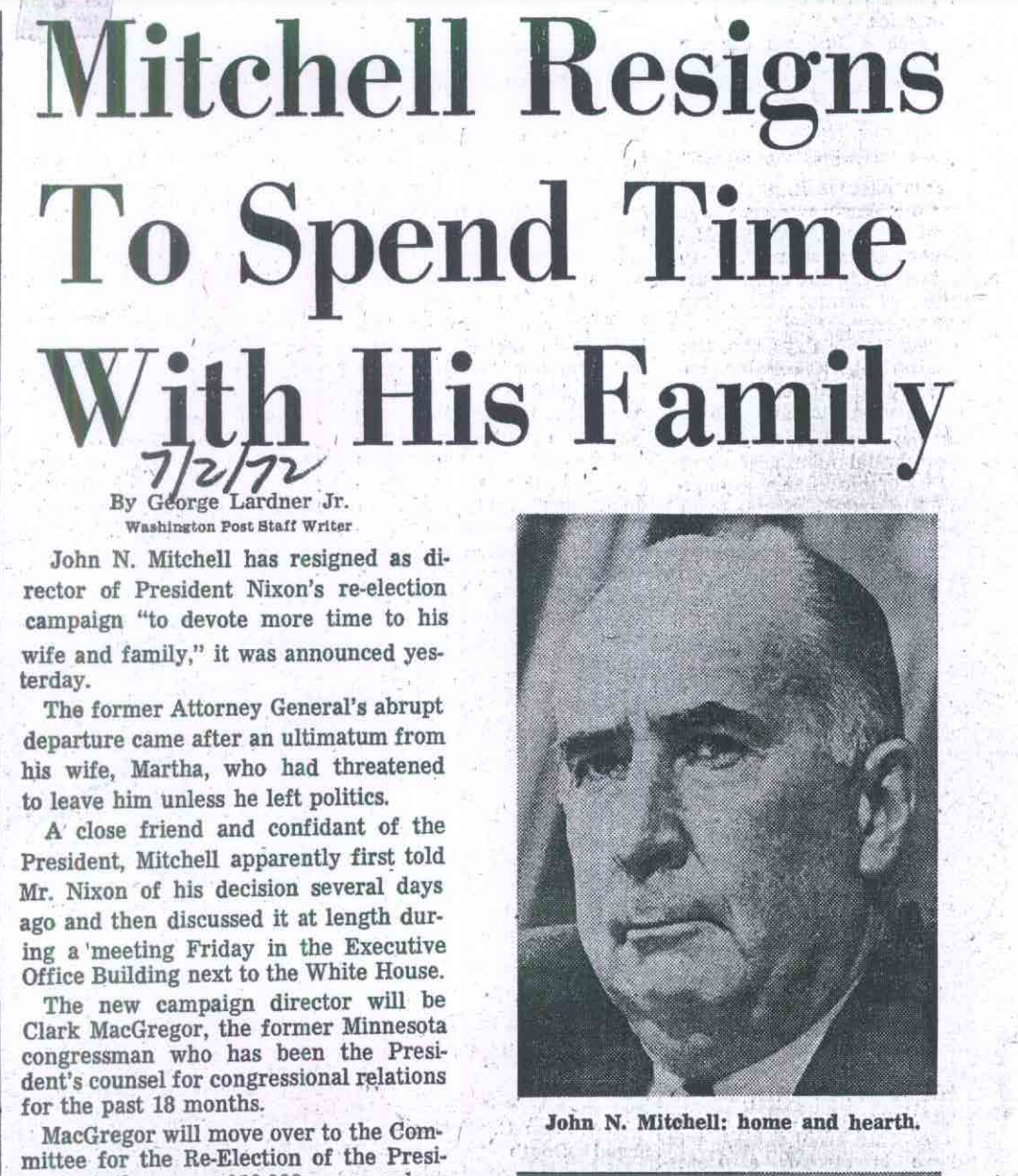
I don’t know what’s really going on here. The wealthy Williams is certainly entitled to do whatever the hell he wants. But since John Mitchell announced in July 1972 that he was resigning as Attorney General to spend more time with the family, that excuse has been universally derided as complete bullshit.

Williams knows that, of course. So using the words “spend more time with family” forces us to interpret it as a kind of code message. Williams is obviously telling us that the real reason is something else. I hope it’s not health-related.

Bellbottoms Must Be Stopped

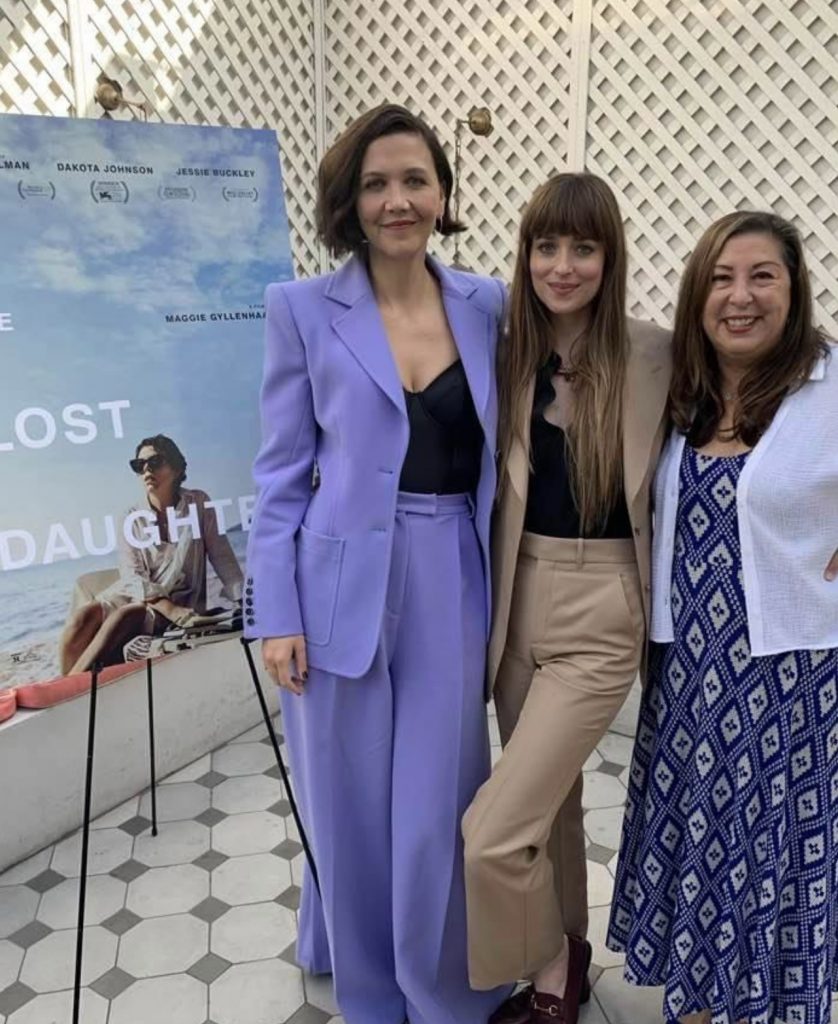
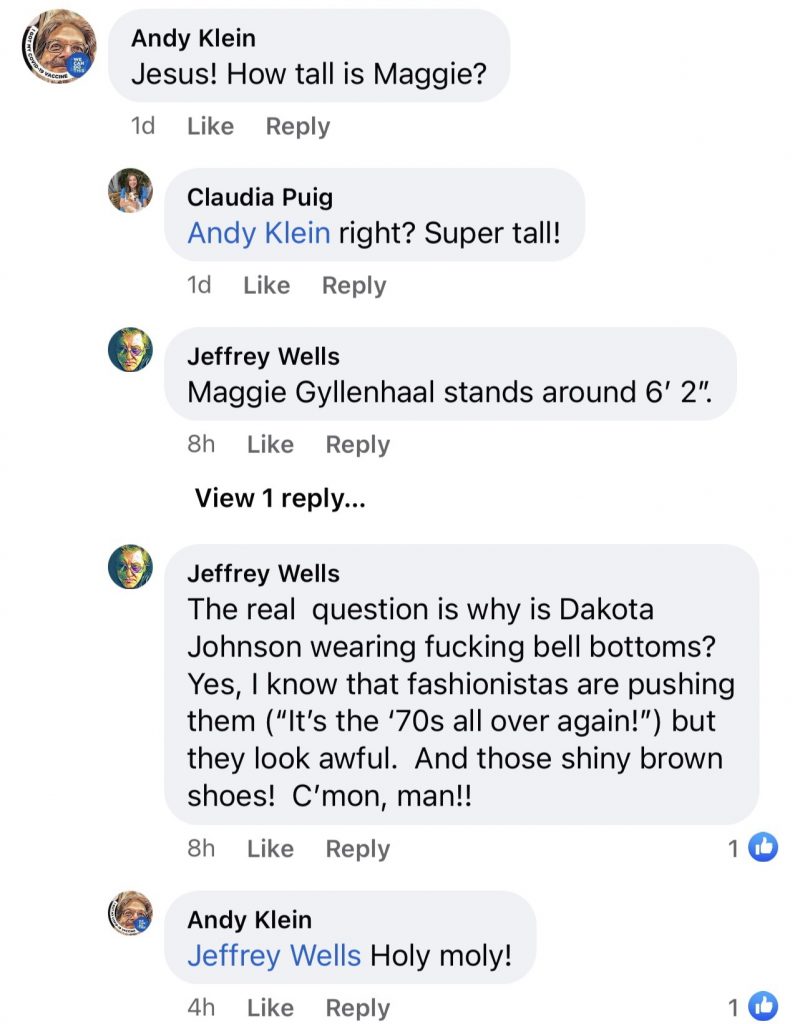
It’s not Maggie Gyllenhaal and Dakota Johnson‘s “fault” — tens of thousands of fashion-conscious women blindly follow the dictates of avant-garde designers. And now, unfortunately bell-bottoms (aka ’70s-retro flares) have caught on. Two of the perpetrators are Gucci and Ganni Plissé-Georgette.

HE to Gyllenhaal, Johnson: Please don’t — they look awful. Not to mention Johnson’s ghastly super-wide jacket lapels.

Read more

Posters That Are Better Than The Film

Hats off to whomever designed this poster. Cool and classy, excellent poise and balance, a suggestion of tragedy. Kristen Stewart doesn’t wear a black outfit of any kind in the film, but that’s okay. The poster is the poster and the film is the film, and Spencer doesn’t live up to what the poster conveys or promises.

What are some other instances in which a poster was much more exciting and engaging than the film it was selling?

Always Meant To Watch It

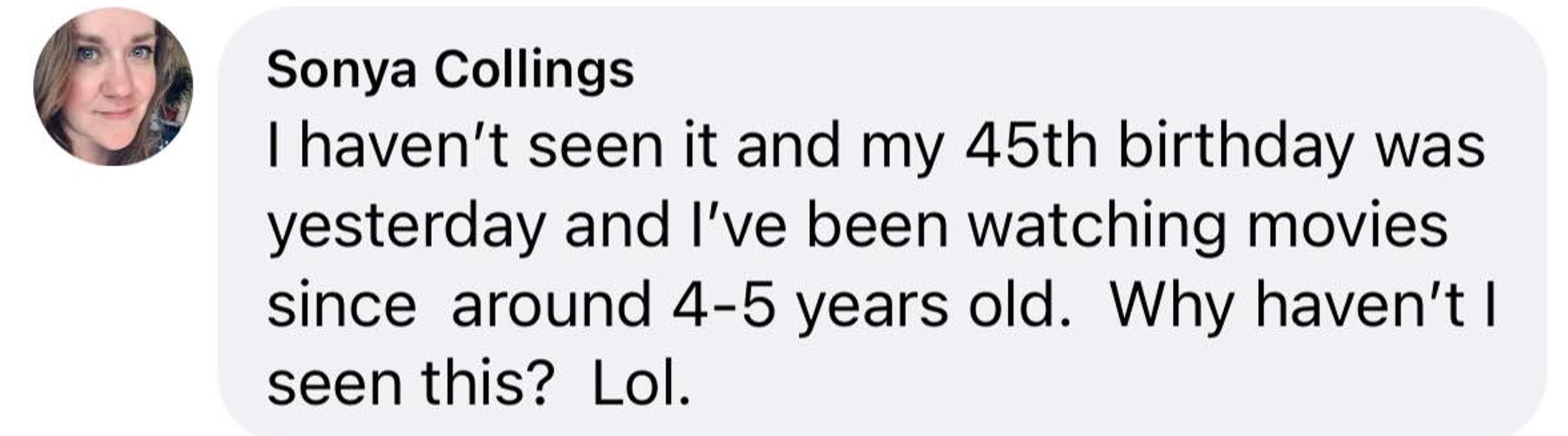
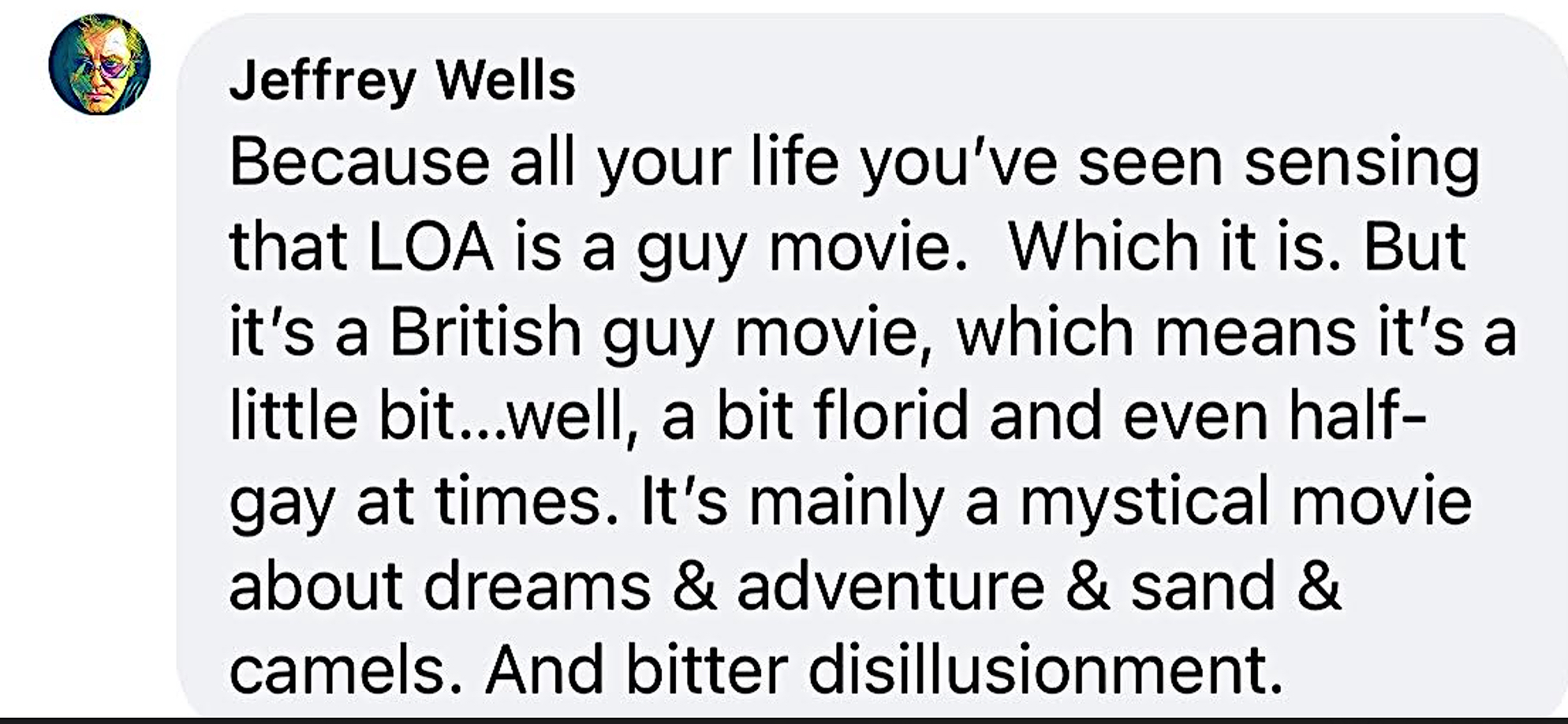
Tatiana has seen some of Lawrence of Arabia, but not all of it. And the portion that she’s seen, she’s never been enthusiastic about. Because she has some kind of blockage about the dusty Middle Eastern milieu or something. I’ve heard of other women having similar reservations, just as some guys might have concerns about seeing an all-female flick.

I spoke to one reluctant viewer, Sonya Collings, on Facebook this morning:

An excellent Peter Sellers story about the shooting of the Prince Feisal tent scene begins at 21:45

Read more

“Unless You Stop Clicking Your Heels Around Here!”

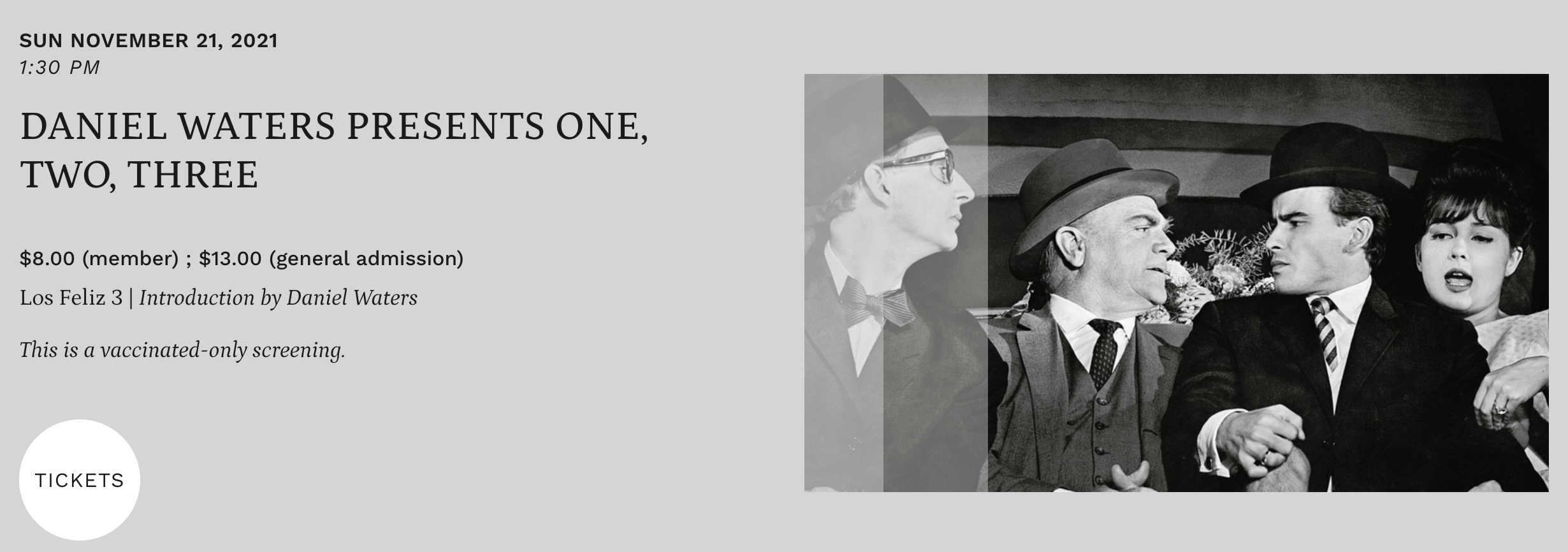
“I’ve never understood why Billy Wilder’s One, Two, Three doesn’t get half the love that Some Like It Hot does. I will bravely defend this gem a week from Sunday (Nov. 21) at the Los Feliz American Cinematheque. Humor and satire so fast and brash that it makes His Girl Friday feel like The Tree of the Wooden Clogs!. Come on down!” — Daniel Waters on Facebook.

I’ll tell you why it doesn’t get half the love that Some Like It Hot does. Because some of it is dated, some of it isn’t funny, and one or two scenes are dreadful. (Don’t ask.) But Act Three, which is all about James Cagney‘s C.R. MacNamara, a ruthless Cola Cola executive, changing Horst Buccholz‘s Otto Ludwig Piffle, a scruffy, revolutionary Communist, into a monacle-wearing dandy in a three-piece suit within two or three hours, is dead perfect. Especially….

Cagney to Buccholz: “Is that all the gratitude I get for getting you out of jail?”
Buccholz to Cagney: “You got me into jail!”
Cagney to Buccholz: “So we’re even.”

I would love to watch this 1961 classic with an enthusiastic crowd, but I’m worried about the AC’s intention to show a 35mm print. I have the Bluray, and it looks absolutely exquisite. Why don’t they just show a digital version? Film is over-rated.

Read more

I’ve Always Been Unstuck In Time

A couple of weeks ago I saw Robert Weide‘s Kurt Vonnegut: Unstuck in Time (IFC Films, 11.19), a decades-in-the-making portrait of the late beloved novelist, whose novels Weide fell for a long time ago. And then he met Vonnegut and bonded with him, and began filming the doc back in the early ’80s (or something like that), and now, 40 years hence, it’s finally done.

I’m a Vonnegut fan and therefore partial, but Weide’s film is an intimate and devotional portrait of a fascinating, very special Great Depression and WWII-generation writer…a guy who became an inspirational cult figure for God-knows-how-many-hundreds-of-thousands of youths in the late ’60s and ’70s and beyond the infinite and all the way to Tralfamadore.

I’ve almost always been “somewhere else”, all my life. Hence the name of this column.

At any given moment I’m back in Paris or Prague or Hanoi, or in junior or senior high school or suffering through my tweener years, or tapping out a piece on my IBM Selectric in either my West 4th Street or Bank Street apartment, or hitting the Mudd Club in the early ’80s, or getting bombed or doing drugs with my friends in the early to mid ’70s or listening to David Bowie‘s “Beauty and the Beast” on a friend’s bedroom stereo in the late ’70s. Or traipsing around a wintry Park City during the hey-hey Sundance years (’95 to ’15).

Occasionally I’ll pay attention to people I’m talking to or events I happen to be witnessing or places I happen to be, but most of the time I’m Billy Pilgrim.