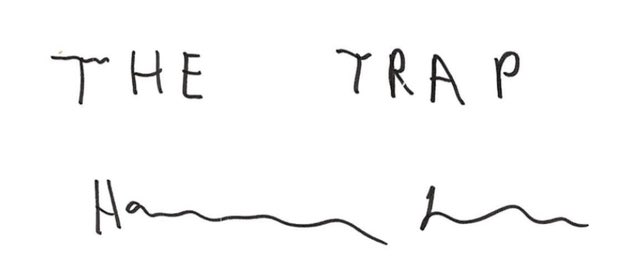
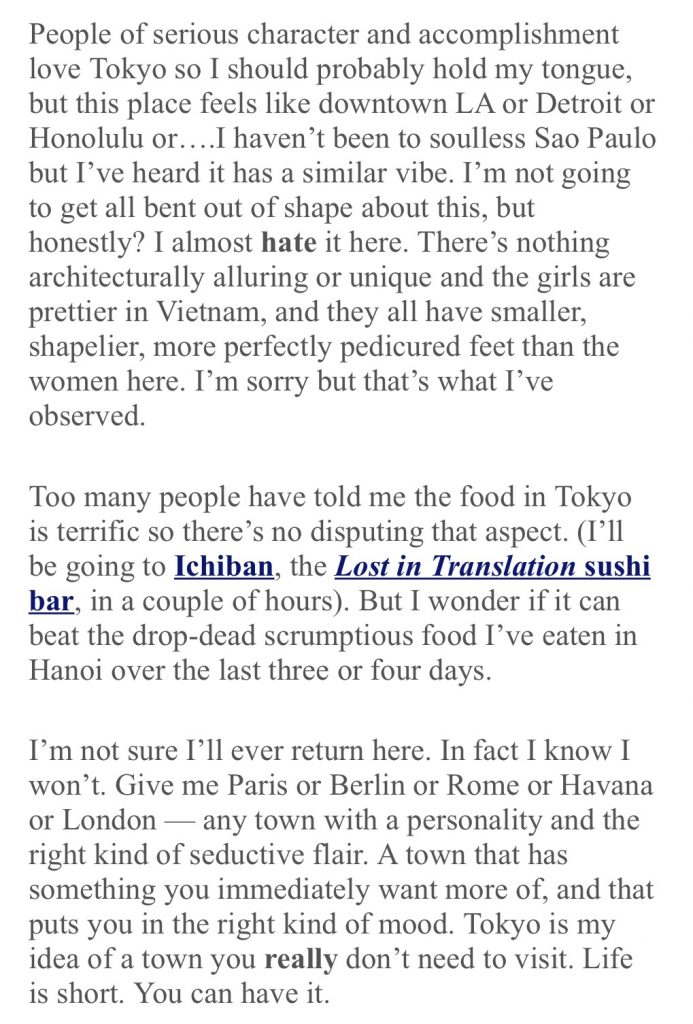
An eight-year-old draft of The Trap, a never-shot movie written by Harmony Korine, appeared in my inbox. Just one of those things on gossamer wings. Korine’s most recent film was TheBeachBum (‘19), a meandering Florida keys stoner mood-trip with Matthew McConaughey. What impresses me here is Korine’s almost completely undisciplined signature. He manages a traditional H and a small a before dissolving into a kind of overdose scrawl. Not into structure. Fascinating.
Postscript: I decided to delete the erotic photo over fear of copyright lawsuits. There are too many velociraptor attorneys out there who are ready to pounce at a moment’s notice.
Many, many people are delighted by the prospect of another tongue-in-cheek Thor film. I am not one of them. Thor: Love and Thunder (Disney, 7.8) costars Chris Hemworth, Tessa Thompson (as the bisexual Valkyrie), Natalie Portman, Christian Bale, Chris Pratt, Dave Bautista, etc. Plus I am not a fan of director Taika Waititi. I probably never will be. Post-Jojo Rabbit (which Jeff Sneider had a great time with, chuckling and guffawing) my Waititi attitude became caveat emptor. I know mine is a minority opinion. I hope everyone has a great time with it.
On 1.23.07, or 15 and 1/4 years ago, the 2006 Oscar nominations hit like an impact grenade. Many blogaroos went into shock; almost everyone in the award-season loop was speechless. For on that darkly historic morning, Bill Condon‘s Dreamgirls — one of the most heavily hyped Best Picture contenders of all time — failed to be Best Picture-nominated, and it was like “Casey at the Bat” times ten. It gathered eight Oscar nominations but not for Best Picture.
And So A Question: That was then, this is now. Sometimes time and fresh perspectives can shed new light upon a film’s reputation. Who in the HE community has recently re-watched Dreamgirls…okay, within the last five years, say — and how does it play?
Here’s how I put it minutes after the announcement: “Dreamgirls, the musical that many, many people (David Poland included) had predicted would win the Oscar for Best Picture, hasn’t even been nominated for Best Picture….double, no, triple-strength shocker!…an omission that will live in the annals of Oscar nomination history.”
“The clouds hanging over the Dreamgirls camp right now are extremely dark and Cecil B. DeMille-y. For what it’s worth, my sincere condolences to Bill Condon, Larry Mark, Terry Press, Nancy Kirkpatrick, David Geffen and the gang. I never hated Dreamgirls or rooted for its demise. While we all knew it couldn’t win the Best Picture Oscar, I honestly thought it would at least be nominated.”
If anyone in the community was thrown for a loop it was Poland, one of Dreamgirls‘ most impassioned and tireless allies for months on end: “For those of you desperate for me to say ‘I was wrong’, I was wrong,” Poland wrote. “If you think [this is] a big deal for me, you have missed my reality completely.”
I was also deeply disturbed that Alfonso Cuaron‘s Children of Men, my personal hands-down choice for the year’s finest film, was also blown off in terms of a Best Picture nomination. Easily one of greatest films of the 21st Century (and featuring three of the most innovative action sequences in movie history), and not even nominated.
Condon didn’t get nominated for a Best Director Oscar, and yet United 93, arguably the most gripping and skillfully made disaster film ever, resulted in Paul Greengrass snagging a nom in that category.
There were only five Best Picture nominees that year — The Departed (brilliant), Babel (sad, meditative, cosmic, heartbreaking), Letters from Iwo Jima (hasn’t aged well), The Queen (ditto) and Little Miss Sunshiner (a near-perfect family comedy).
Posted on 2.20.07: “The defeat of Dreamgirls was a thunderclap moment along the lines of Roman Polanski winning the Best Director Oscar for The Pianist.
It was the Academy members saying en masse, “You guys can hype Dreamgirls all you want but we don’t really like it that much. It was diverting and energetic, of course, but not good enough for the Oscar big-time…the third act was weak, Beyonce‘s character amounted to almost nothing, that moment with Jamie Foxx looking at Jennifer Hudson‘s kid at the very end — throw it all together and the ticker tape read, ‘Not bad, pretty good but no cigar.'”
HE’s top seven 2006 films, in this order: Children of Men, United 93, The Departed, The Lives of Others, Volver, Little Miss Sunshine, Babel.
Before last night I had watched David Fincher‘s Zodiac seven or eight times, give or take. Two press screenings of the shorter theatrical version (157 minutes), and the Bluray director’s cut (162 minutes) five or six times.
But last night’s viewing was different. For the first time I watched it with subtitles start to finish, and it seemed to make a profound difference. It felt more granular, more “police blotter” on some level. I know each and every scene of the 162-minute version backwards and forwards, and yet I found it spellbinding, especially the last 45 minutes or so.
The Zodiac Wiki page says “an early version of Zodiac ran three hours and eight minutes.” 26 minutes longer than the directors cut! It breaks my heart that the Director’s Cut Bluray didn’t present this version as an option.
HE to Fincher: Given that Zodiac‘s rep has grown exponentially since it opened 15 years ago, I would think that you might want to offer the 188-minute version (if in fact it exists) as a streamer. Have you ever considered this?
I’m still annoyed that research-screening audiences said they didn’t like (a) the two-minute news + music blackout montage that suggests the passage of four years, and (b) especially the scene in which three cops — Mark Ruffalo‘s Dave Toschi, Anthony Edwards‘ Bill Armstrong and Dermot Mulroney‘s Captain Marty Lee — report their findings about Arthur Leigh Allen (John Carroll Lynch) over a speaker phone in order to obtain a search warrant.
Yesterday I heard from a journo pally who’s seen all ten episodes of The Offer, the making-of-The Godfather miniseries that begins streaming on 4.28.
“The Offer obviously has a huge ensemble cast,” I said, “but who, if anyone, delivers the stand-put performance?”
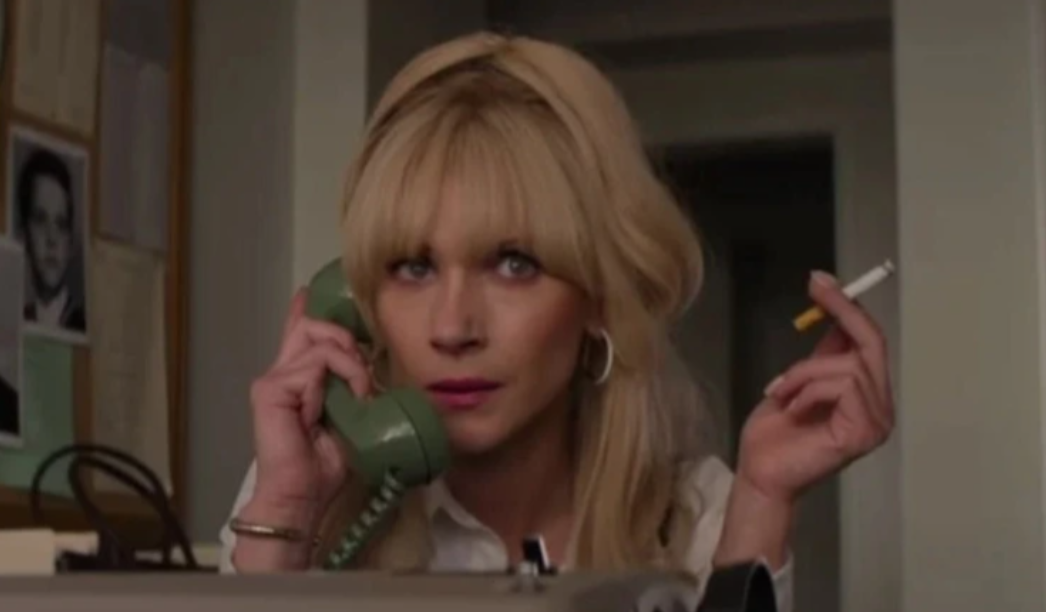
Journo pally was unequivocal — the performance that you’ll remember is Juno Temple‘s as the real-life agent and manager Bettye McCartt, who worked as an assistant to producer Albert Ruddy (Miles Teller).
McCartt, he said, is the touchstone figure — the neutral observer who supplies sensible commentary about the various egoistic goings-on.
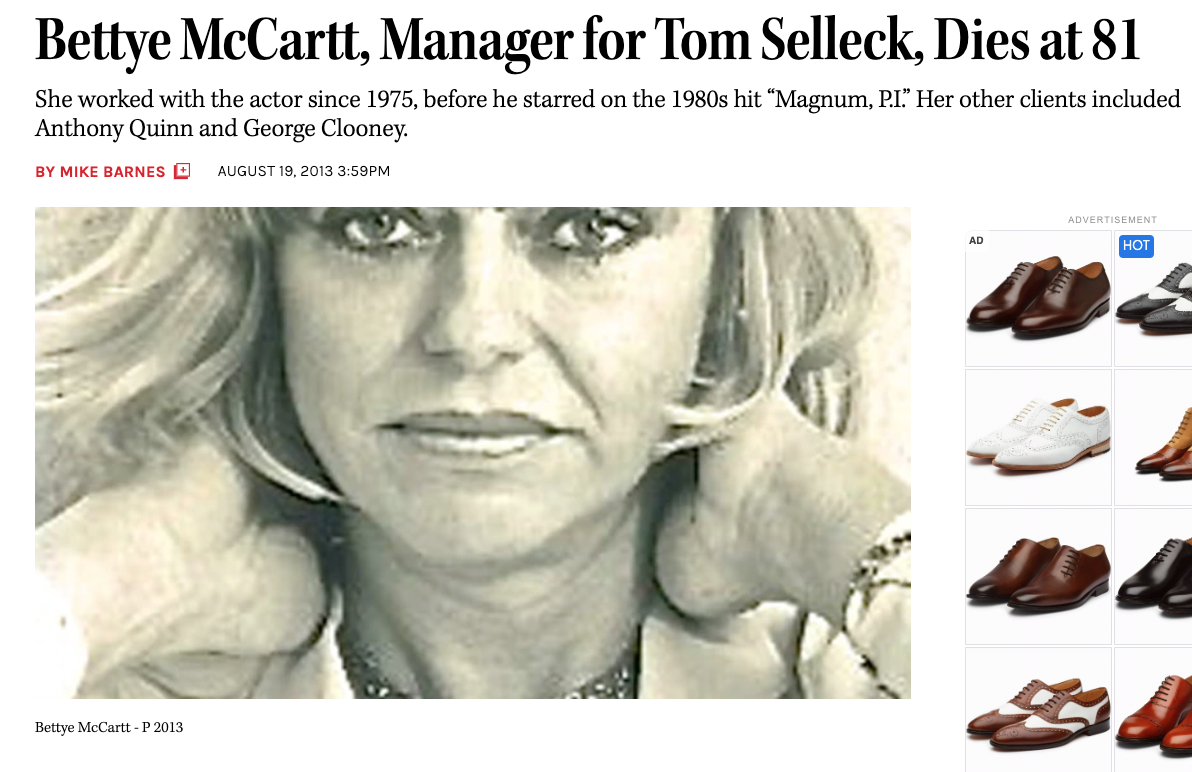
An Oklahoma native who moved to Los Angeles in the early 60s, McCartt began as a publicist for 20th Century Fox. She was in her early 40s during the period of The Godfather and The Longest Yard (’74), which Ruddy also produced.
From 8.19.13 THR obit: “As owner of Agency for Artists and as a partner in the McCartt, Oreck & Barrett Talent Agency, her many clients also included actors Maureen O’Hara, Anthony Quinn, Wilford Brimley, George Clooney, Billy D. Williams and Brian Austin Green; authors Louis L’Amour and Henry Miller; and TV director Tony Wharmby (JAG, NCIS).
“McCartt started working with Tom Selleck as both his agent and manager in 1975. When the actor signed with CAA in 2008, she continued as his manager until her death [in August 2013].”
Another pleasant hang. We’re all accustomed to Piers Morgan being a tart, adversarial figure, but here he’s entirely personable and relaxed.
At the 31:30 mark, Maher blanks on Thomas Mitchell, the actor who played Scarlett O’Hara‘s father in Gone With The Wind. Mitchell’s two best performances — “Kid” Dabb in Only Angels Have Wings and Mayor Jonas Henderson in High Noon, who stabs Gary Cooper in the back.
Maher: “[Gone With The Wind], by the way…entertaining as fuck, and the people who need a disclaimer [about the 83-year-old racist content]…this is the problem, you fucking babies. Can’t you just see by the film stock that things were very different back then? History in general, we evolve. Just celebrate that we are not [as] racist any more. This generation [Millennials] needs a trigger warning and a Klonopin to get through an episode of [something or other].”
Around the 34-minute mark they talk about victim culture and “the end of the empire, what happens to successful civilizations, they get soft and mushy in the mind….weakness is celebrated and the stiff-upper-lip and resilience is now to be condemned.” And they get into pronouns around the 40-minute mark.
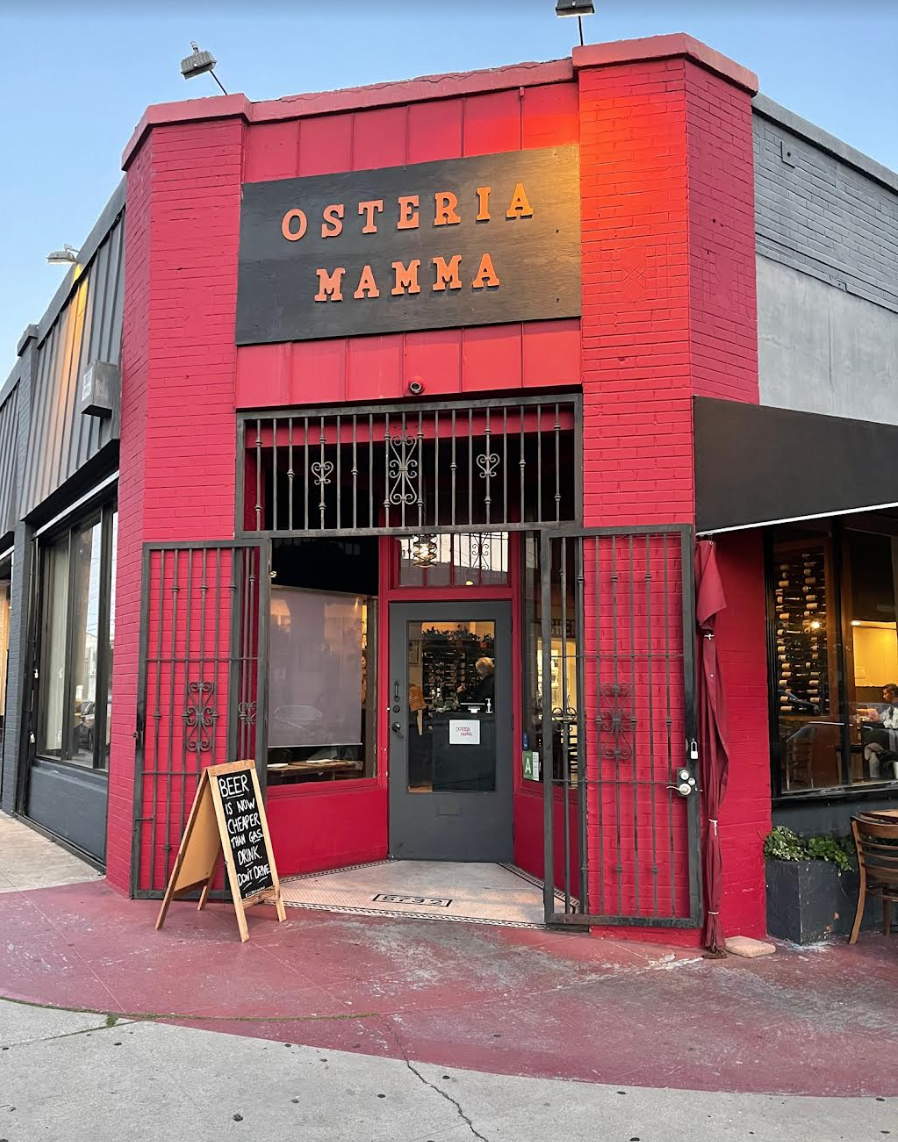
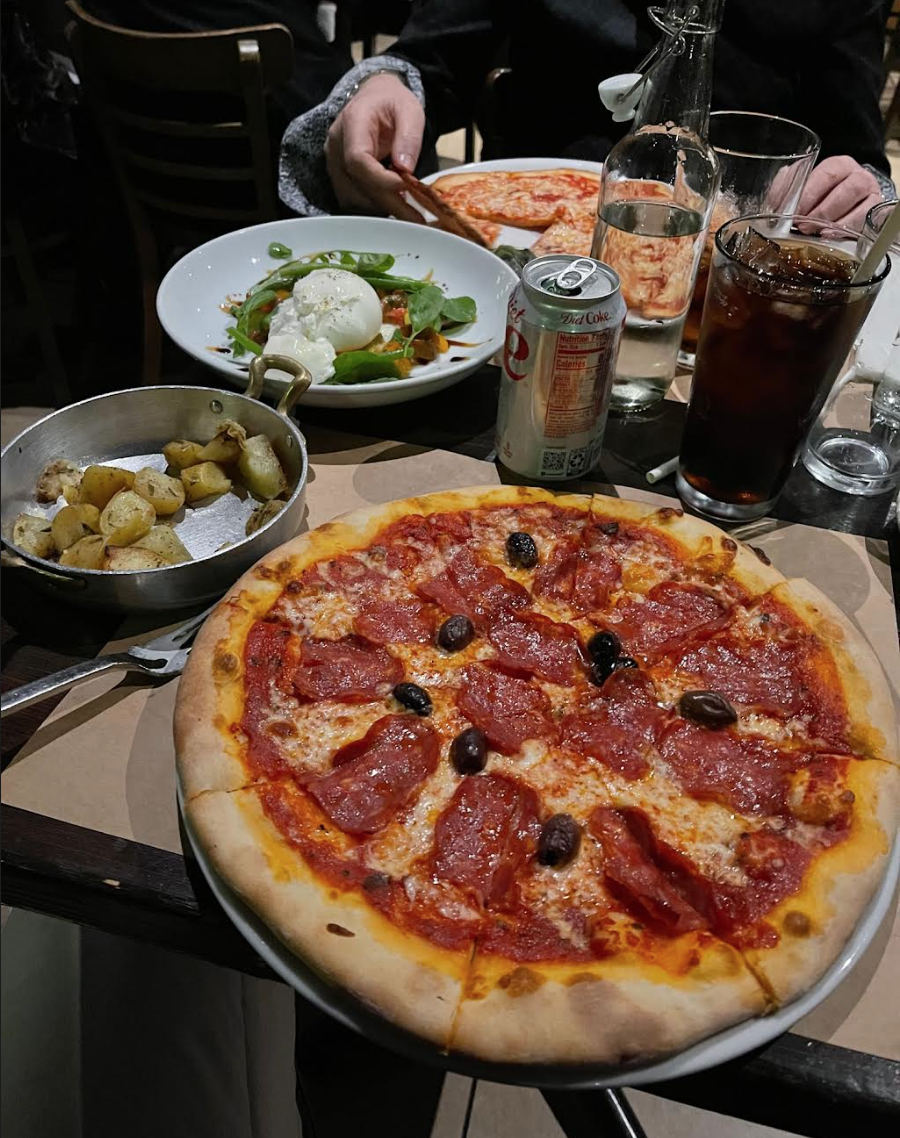
The key thing when you dine at a place like Osteria Mamma is not to anger your waiter. Don’t send too many things back, I mean. I sent back a puree-like green soup because it wasn’t exciting enough. Then I added insult to injury by asking the waiter to please re-heat the potatoes. So I was pushing it.
For a half-second I saw the waiter looking at me sideways and I knew…I didn’t think it was likely that he would spit in my one of my dishes, but the thought occured to me that if I don’t stop sending stuff back something like that might happen.
That said, he was a very nice and polite guy, and he spoke with a genuine Italian accent. The bill was split in half and we (i.e., attorney friend Mark and myself) tipped him 20% each. I know, I know…some waiters might seethe and mutter to themselves “fuck you…why didn’t you tip me 25%?” But I took a chance with 20%.
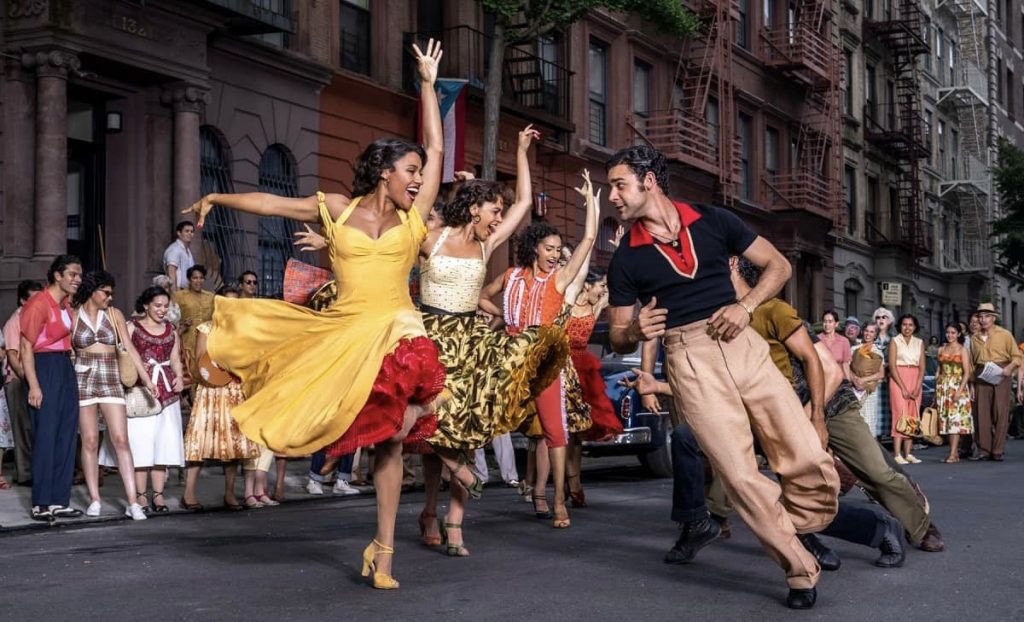
Here’s a West Side Story riff from last November, paywalled from the get-go. The basic point was that while the rooftop “America” song was the highlight of Robert Wise’s 1961 version, the same number in the 2021 Steven Spielberg version is arguably the least transporting and most bothersome. Here’s how I explained it:
In Robert Wise’s 1961 West Side Story as well as innumerable stage versions performed over the decades, the dance scenes are never acknowledged by passersby, much less performed for them. In fact, passersby barely exist.
The basic West Side Story rule is that each dance number happens in the hearts and minds of the Jets or Sharks. And one other thing about the Wise version: Except for the opening sequence (i.e., ballet-like daytime street fighting), the dancing happens in a restricted space of some kind (dance hall, tenement rooftop, back alley, dress shop, drug store, rumble under a highway), and always among Jets or Sharks and their immediatekin or sympathizers.
The dancing, in short, is restricted to the immediate “family.” Neighborhood civilians never notice or acknowledge that any carefully choreographed activity is going on. The dancing is rigorously intimate — members only.
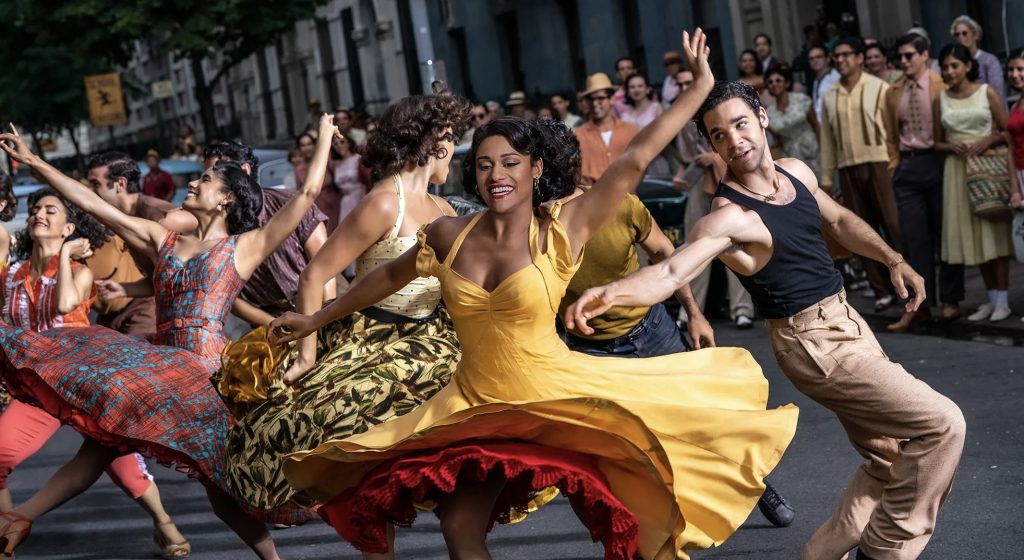
Which is why Spielberg’s “America” scene with Ariana DeBose (Anita), David Alvarez (Bernardo) and friends in Steven Spielberg’s West Side Story is allwrong. Because sidewalk neighborhood residents are clearly watching Anita and Bernardo and their friends “cut a Latin rug”, so to speak. And, one presumes, are enjoying the “show.”
The problem is that according to the rules, there is no “show”. Not as far as casual neighborhood residents are concerned. If Spielberg had decided to have the entire neighborhood sing along with Anita and Bernado, fine. But he didn’t. He just had them stand and watch and chuckle…”why, they’re dancing in the street, and with such professional aplomb!”
Again: Neighbors watching the singing and dancing of “America” is a violation of a basic West Side Story rule.
Roughly nine months ago I explained the basic ground rules when it came to flirtatious older guys and younger women in the year 2021. It’s now 2022 and things haven’t changed. I explained it as carefully as the English language allows, and in only three paragraphs. It was completely free (not a paywall post) and easy to find. And what happened?
Here’s what I said last July: “Some older white guys — the stupid, clumsy ones, I mean — don’t seem to realize that they’re deer, and that it’s deer hunting season out there right now. Because a decent percentage of urban progressive women (teens to mid 30s and perhaps beyond) would just as soon explode their lives into smithereens as look at them. If old guys want to be dead all they have to do is give the ‘hunters’ a reason to get out their high-powered social media rifles and fire at them.”
Here’s what Langella did wrong, according to TMZ: “As for what exactly happened, a source close to production tells us the 84-year-old actor allegedly made an inappropriate joke that was sexual in nature. Our sources also say in the context of his performance, possibly during rehearsal, he touched the leg of a female costar, and further drew attention to the action when he jokingly said something like ‘Did you like that?'”
“Second, I think what we’re seeing isn’t another Harvey Weinstein-level predator. Langella was known for decades as a Warren Beatty-level ladies man. He never engaged in Weinstein-like behavior because, let’s face it, he was a gorgeous dude who didn’t have to. He loved women and he loved getting laid. And did. Among his conquests was an off-and-on relationship with Jackie O. for a number of years, a lady who was renowned for not being attracted to ‘nice guys.’
“This is my point about how this brand of guy, from the Mad Men era, was rewarded for their behavior. ‘Swaggering alpha male who goes after what he wants’ equaled ‘self-confident, strong man,’ and this behavior was rewarded by society and the world’s most spectacular women alike through my generation. It’s how things were, whether you feel it was “right,” or not.
“[Langella’s] ‘inappropriate touching’ might not have been viewed as such 20 or 30 years ago, prior to his being an old man. It might’ve been welcomed. Perhaps the real issue is [that] Frank [has] never came to terms with the fact that he’s gotten old. If his career truly is over, I shall miss him. He was always a fascinating actor to watch weave his magic.”
Friendoto HE: “When are you planning to engage with TokyoVice?”
HEtofriendo: “I tried but couldn’t get past episode #1. I didn’t ‘dislike’ it but I found it chilly, and the characters curt and brusque. And yet I believed it. It feels authentic. It emphasizes what a grueling ordeal it is for a young American to understand and merge with Tokyo culture and gain admittance to a top-tier Tokyo newspaper in the ‘90s.
“My basic reaction was ‘yes, this is interesting and obviously exotic and the narrative is necessarily complex and labrynthian, but do I really want to be here?’ The honest answer was ‘not really.’
“I’ll keep trying with subsequent episodes but so far I’m feeling conflicted, to put it mildly.
“I thought Ansel Elgort’s performance as Jake Adelstein, the real-life reporter whose same-titled book is the basis of this limited series, was fine. I believed him, felt good about his company.
“I really liked the pretty Anglo blonde (Rachel Keller) he talks to in the bar but then he can’t afford her. But all those cold faces, thosescowlinganddisapprovingfaces, that sullen feeling of gradually becoming a part of a complex, shut-off culture but at what cost? It feels like a place for suppression and stifling, almost a form of hell.
“Have you ever been to Tokyo? Ispent36hourstherein2012, did some walking around, sampled some of the food, etc.. Absurd as this sounds, I found it boring and even numbing, certainly from an architectural perspective. Huge and sprawling and lemme-outta-here. Many different neighborhoods and districts. But destroyed during WWII and very little sense of history remains. Has the same kind of urban corporate personality as Seoul or Shanghai or Dubai or Atlanta.