From Scott Feinberg…

From Scott Feinberg…
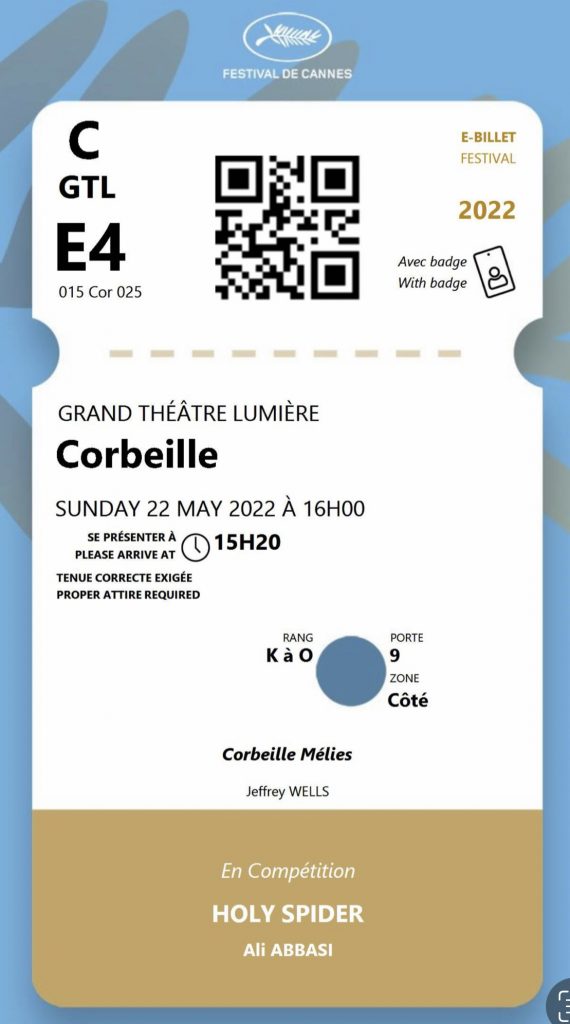
Set 21 years ago in Masshad, Iran, Ali Abassi’s Holy Spider is a disturbing (to put it mildly), fact-based drama about Saeed Hanaei (Mehdi Bajestani), a serial killer of prostitutes.
The murders are ghastly enough, but a double-down comes when, post-capture, Hanaei is bizarrely supported by fanatical zealots who believe he has done Allah’s bidding.
The first half is pretty much a straightforward crime drama. After graphically depicting two of Hanaei’s grisly killings, it follows an intrepid female reporter (Zar Amir-Ebrahimi) who risks life and limb to bring about his arrest.
I can’t call this section any more than decent — efficient and good enough, but not exactly brimming with style or suspense or cinematic flair.
The diseased social reaction among his fans in the second half is what grabs you. You’re left thinking “really?…a sizable contingent of Mashhad citizens cheered a serial killer because he was helping to rid the streets of streetcorner hookers? Who thinks like that? What kind of diseased culture?,” etc.
But then of course, this is Iran and the Masshad faithful were the country’s chief bumblefucks.
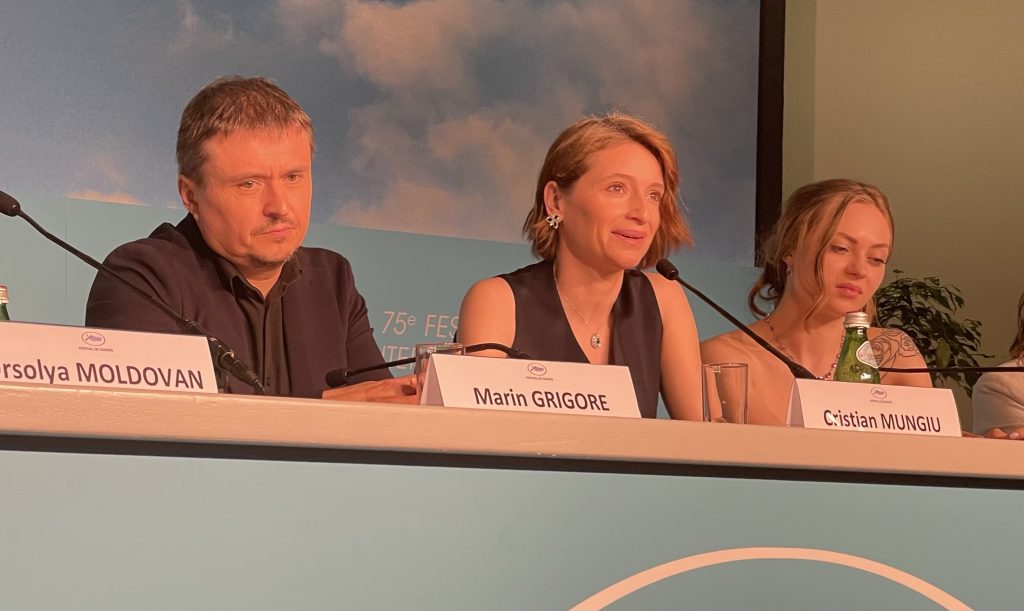
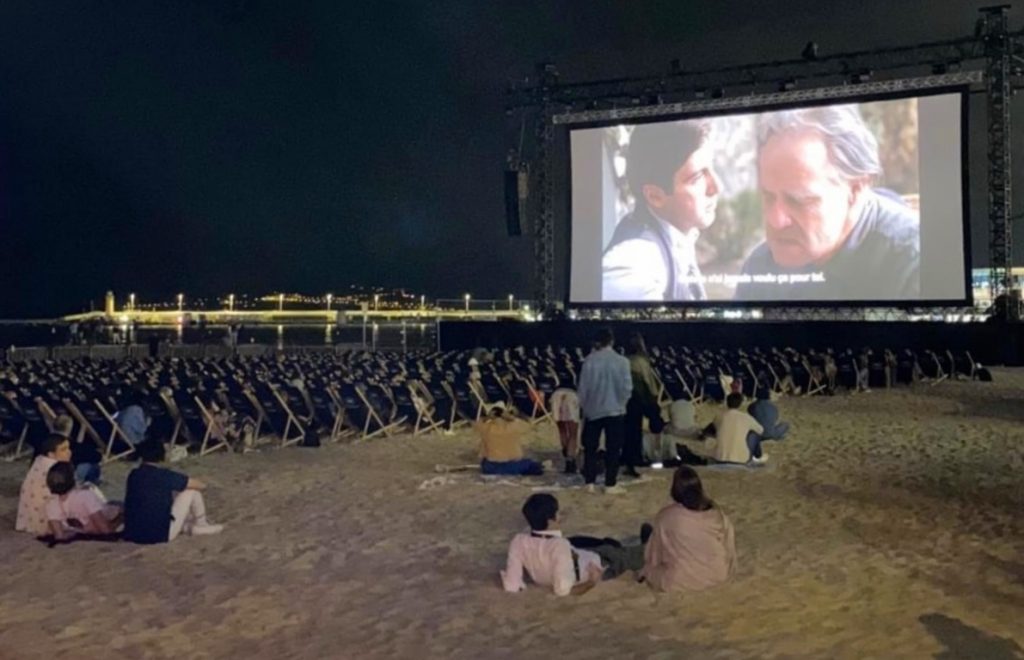
The meaning of the title of R.M.N., the latest film by the great Romanian auteur Cristian Mungiu, is never revealed, or it wasn’t to me during last night’s Salle Debussy screening.
The Wiki page says that Mungiu “named the film after an acronym for rezonanța magnetica nucleara ** (‘nuclear magnetic resonance’) as the film is ‘an investigation of the brain, a brain scan trying to detect things below the surface.'”
So the film is basically about scanning the small-town minds of the residents of Recia***, a commune located in Transylvania, which most of us still associate with Dracula.
But the underlying focus isn’t vampires but racist xenophobes who fear Middle Eastern immigrants and more specifically two gentle fellows from Sri Lanka who’ve been hired to work at a local bakery.
It takes a while for the racism to emerge front and center, but a metaphorical representation is the nub of it — a phantom that lurks in the surrounding woods and more particularly within.
It manifests three times — (a) in the opening scene in which the small son of Matthias (Marin Grigore), an unemployed slaughterhouse worker, is spooked by its off-screen presence while walking in the woods, (b) in the third act when a significant characters hangs himself (also in the woods), and (c) at the very end when four or five bears are spotted by Matthias after nightfall (ditto).
R.M.N. is a meditative slow-burn parable that you’ll either get or you won’t, but there’s no missing the brilliance of a one-shot town hall meeting in which the locals are demanding that the Sri Lankans be expelled from the community.
The shot lasts for roughly 17 minutes, and it’s all fast, bickering dialogue, simultaneously burrowing into the ignorance of the townies while building and deepening and man-oh-man…it’s so fucking great that I said to myself “this is it…this is what my Cristian Mungiu fixes are all about, and thank the Lords of Cannes for allowing me, a traveller from the states, to absorb this in my well-cushioned theatre seat.
The build-up narrative is about Matthias and his mute son Rudi (Mark Blenyesi), his resentful ex-wife Ana (Macrina Bârlădeanu) and Csilla, a passionate, kind-hearted bakery manager and cello player (Judith State) whom Matthias has an undefined sexual relationship with. He never says he actually “loves” her although he keeps returning to her home for solace and whatnot.
Secondary characters include the bakery owner, Mrs. Denes (Orsolya Moldován), and the local priest, Papa Otto (Andrei Finți), and a sizable gathering of anxious, agitated citizens who are basically the local reps of the Mississippi Burning club.
I was going to throw a little snark by alluding to Gene Wilder’s description of the townspeople of Blazing Saddles — “Simple people, people of the land, common clay…you know, morons.”
Except they’re representative of millions of native Europeans right now who are clearly unsettled by Middle Eastern immigrants who’ve been taking root and are changing the traditional character of what they’ve always regarded as “their” culture and homeland.
Xenophobic nationalism reps an un-Christian way of thinking and behaving, to put it mildly, but…I don’t know what to conclude except that it’s fundamentally cruel. Nonetheless this kind of rightwing pushback is manifesting all over. Make of it what you will.
That’s all I need to say. R.M.N. and particularly that town-hall scene are going to reside in my head for a long time to come.
** The English language term is MRI.
*** The film was mostly shot in Rimetea.
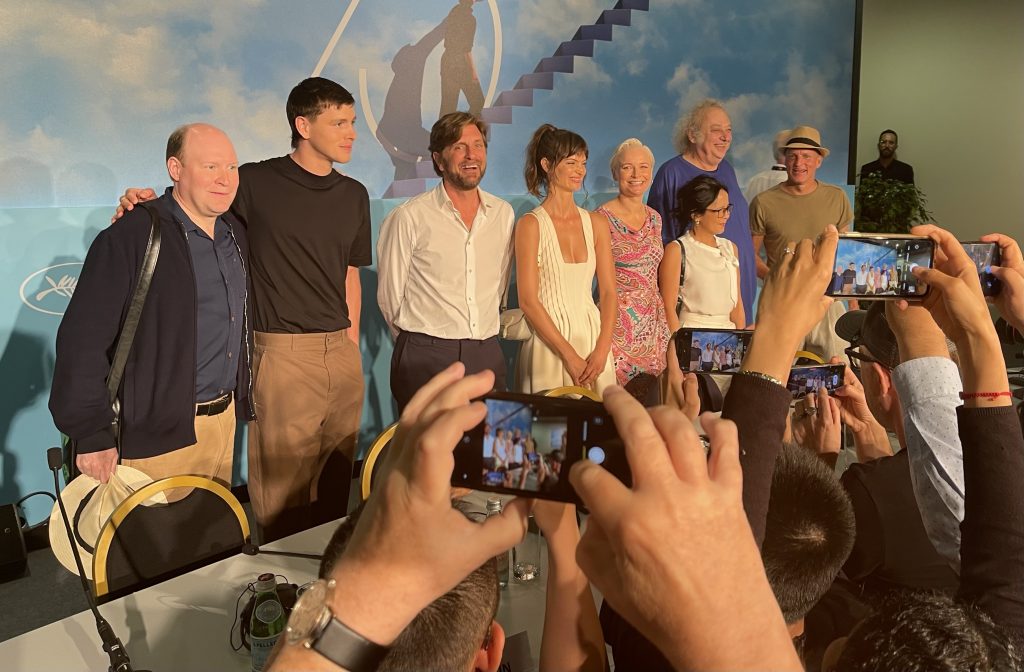
During this morning’s Triangle of Sadness presser, director Ruben Ostlund and costar Woody Harrelson announced they’ll reunite for a film called The Entertainment System Is Down. Great news, but there’s a better title to be discovered.
Unasked Ostlund questions: (a) what is your sense of the woke-terror climate at this time? Is it thriving, gaining, receding?; (b) out of all the thousands of splendorful super-yachts in the world, how did you happen to rent the Christina O, which Aristotle Onassis owned in the ‘60s and ‘70s?; (c) to what extent (if any) was Swept Away in the writing of Triangle of Sadness?
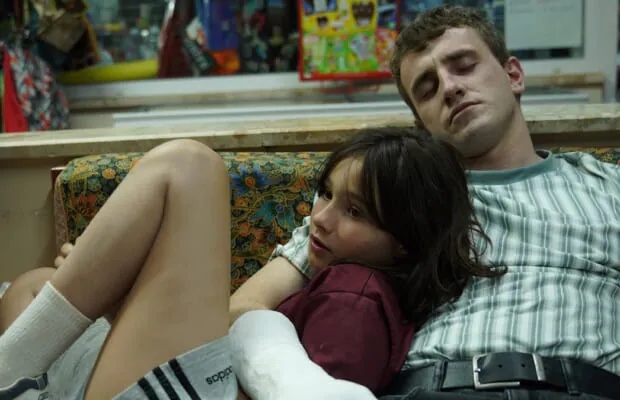
Cannes critics have lost their minds over Charlotte Wells’ Aftersun, a laid-back, edge-of-boredom, fly-on-the-wall father-daughter vacation flick, set in Turkey sometime in the late ‘90s. I didn’t mind it and it’s not a painful endurance test, but it’s certainly lethargic as fuck.
Where’s the pulse? Where’s the intrigue or story tension or the proverbial second-act pivot or any of that stuff? Sorry, Jose.
11 year old Sophie (Frankie Corio) and her young-looking, divorced dad (Paul Mescal) are staying (bonding) at a midrange coastal hotel. Swimming pool, video games, camcorder footage, puppy love, golden sunlight, distant hazy forests, dad grinning like an idiot. etc.
A dozen or so little things “happen” (including a curious weeping scene and a mystifying moment when Sophie succumbs to the romantic advances of an overweight gamer) or are more precisely observed. but the whole time you’re thinking “Guy Lodge and Carlos Aguilar did backwards somersaults over this?“