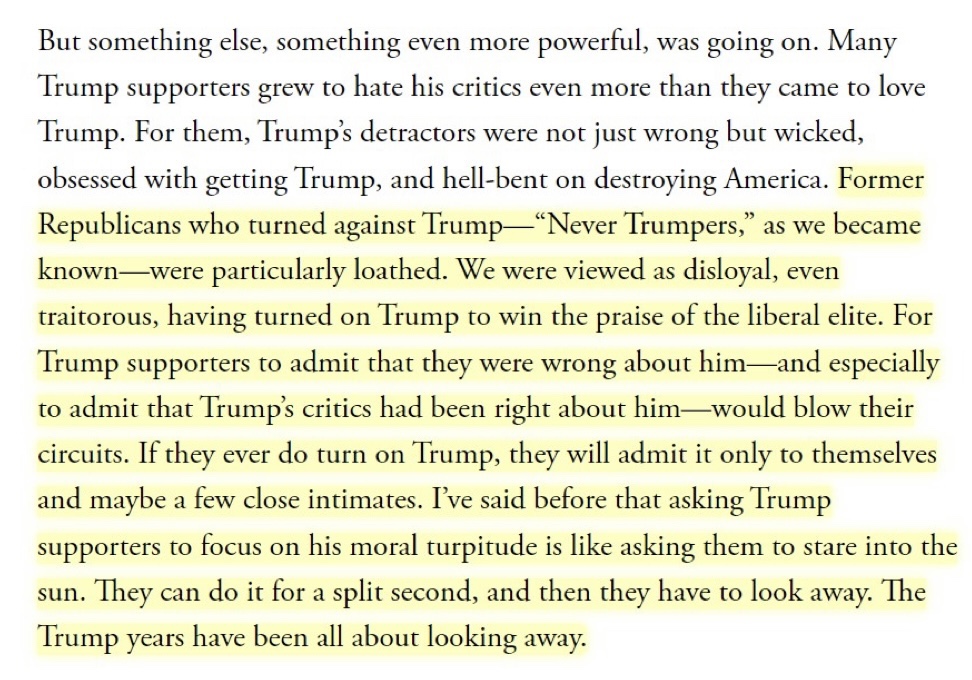
From Peter Wehner’s “Why They Still Support Trump,” The Atlantic, 7.13.22:

“A massively scaled and interoperable network of real-time rendered 3D virtual worlds that can be experienced synchronously and persistently by an effectively unlimited number of users with an individual sense of presence and with continuity of data, such as identity, history, entitlements, objects, communications and payments.” — an improvised, off-the-cuff, extremely loose-shoe definition of the metaverse, shared by one Clem Kadiddlehopper while regarding a traveling display of John Deere equipment in Garden City, Kansas, on Saturday, July 9th. and with a piece of hay between his teeth.
Seriously — the above definition, posted on 7.14.22, is from Puck’s Matt Belloni.
Fascinated by the suburban faces wandering through The Mall at Short Hills. Many if not most — a good 65% to 75%— look like characters from The Sopranos. Members of Tony’s golf club, friends of Carmela’s, diners at Artie Bucco’s, prosecutors, attorneys, customers at Bada-Bing and Satriale’s, etc.

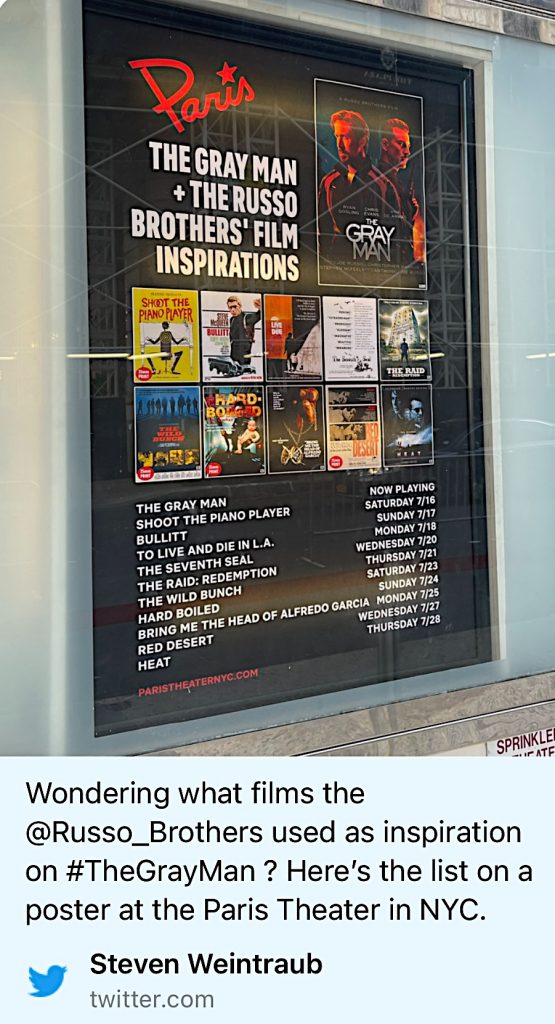
…but also having avoided writing my review, I’ll just say that a director (or directors in this instance) can list several classic films as influences, and that’s fine. But given the Russo Brothers list, it’s fair to note the seeming presence or absence of traces of these films in The Gray Man itself. All I can say is “wow.” Okay, I’ll say more than this. Influence–wise, The Gray Man contains not so much as a hint of a trace of a whisper of Francois Truffaut’s Shoot The Piano Player (‘62). Ditto Michelangelo Antonioni’s Red Desert (‘64). There is one and only one noticable influence upon this film, and that is the Bourne franchise…finito, mike drop, over and out.