Will Joyce Carol Oates follow the example of James Patterson in the end? Will she humbly apologize for calling out woke terror in the publishing world?
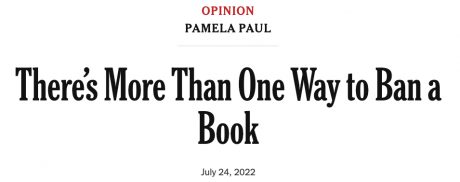
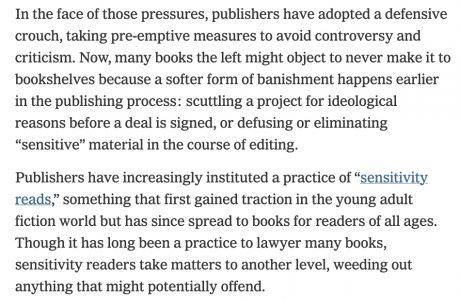
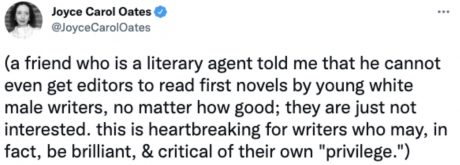

Will Joyce Carol Oates follow the example of James Patterson in the end? Will she humbly apologize for calling out woke terror in the publishing world?
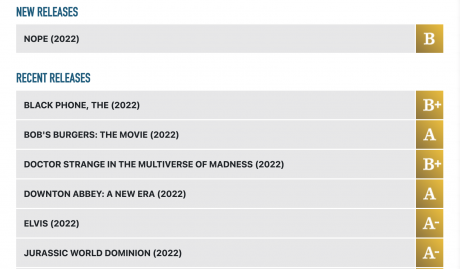
Wait…they gave The Black Phone, which is absolutely substandard, a B-plus? They gave the abysmal Jurassic World Dominion an A-minus? Do they ever give anything a C or a D, or at least a B-minus?
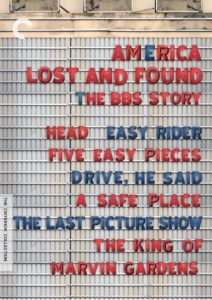
The late Bob Rafelson‘s finest directing achievement will always be Five Easy Pieces (’70). He will also be remembered for seven other films he helped to produce as a partner in BBS Productions (an acronym standing for himself, Bert Schneider and Steve Blauner) — Easy Rider, The Last Picture Show, The King of Marvin Gardens, Head, A Safe Place and Drive, He Said.
Rafelson’s second best work as a director is Stay Hungry (’76), a rural, rompy, free-spirited film about bodybuilding, self-discovery and fiddle-playing. Two or three times I’ve called it one of the best family movies ever — one of the gentlest, warmest and funniest.
Hungry was honestly the last Rafelson-helmed film that I really liked. Eight films followed (The Postman Always Rings Twice, Modesty, Black Widow, Mountains of the Moon, Man Trouble, Blood and Wine, a TV film called Poodle Springs, and finally No Good Deed). But you can’t take those early glory years away from Rafelson, and who would want to?
Rafelson died on 7.23.22, at age 89.

Last night I managed to stream Jean-Jacques Annaud’s Notre Dame On Fire, which opened in France last March and in England two days ago, and will apparently play on U.S. IMAX screens before long.
It’s just a workmanlike docudrama — a this-is-how-it-happened disaster flick that summarizes the events of 4.15.19, when a fire almost destroyed the 800-year-old Notre Dame cathedral in Paris.
The first half is pretty good as far as this kind of thing goes (the blending of recreated moments along with genuine footage is perfect), and the second half — when things got heavy and scary and a few heroic firemen had to step in and save the day within a 15-minute window — is excellent. Seriously, the last half-hour is worth the price of admission in itself.
I’m thinking I’d like to see it again in IMAX — last night’s viewing was on the 65″ Sony, and in 720p.
There’s a little too much sentimental attention paid to the cathedral’s spiritual aura as well as rescuing priceless artifacts (including, we’re told, the original crown of thorns worn by Jesus on his day of crucifixion and even a vial of his blood) and there are infuriating passages when key players are stuck in Paris traffic (get out of the car and hop on a motorcycle) but this is life when tragedy strikes — mistakes are made, banal stuff gets in the way, etc.
In some ways it’s similar to John Guillermin and Irwin Allen‘s The Towering Inferno (’74). There’s no Richard Chamberlain villain who creates conditions that lead to disaster, but the fire is initially ignored by way of carelessness and laziness, as it is in Inferno. No characters are emotionally conflicted and no one (thank fortune) falls to their deaths, but there’s a kind of Paul Newman-type architect character who knows the cathedral and saves the crown of thorns, and there’s definitely a couple of Steve McQueen-type firemen heroes who climb up and into the twin bell towers and manage to finally put the fire out with only a few minutes to spare. Which is what McQueen and Newman accomplished in the final stretch of Inferno.
Plus there’s footage of French president Emmanuel Macron, not speaking but obviously “playing” himself.
Donald Trump is made fun of for tweeting that helicopters should dump water on the burning church from the air, but that’s exactly what I was thinking when it happened. Vacuum water from the Seine into tanks, and then fly over the cathedral and releases dozens or even hundreds of gallons at a pop. Perhaps that kind of drenching might have threatened the Notre Dame structure, but it seemed to make sense at the time.
HE’s Top Ten Greatest Films (and I hate doing this because when you make a greatest-ever list all you think about are the films that you didn’t mention): (1) Paths of Glory, (2) Dr. Strangelove or: How I Learned To Stop Worrying and Love the Bomb, (3 & 4) The Godfather & The Godfather, Part II, (5) Blow-Up, (6) The Graduate, (7) Zodiac, (8) On The Waterfront, (9) The Best Years of Our Lives, (10) Shane.

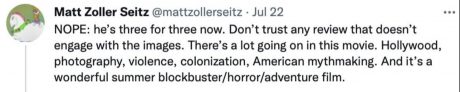
Like I said two or three days ago, I’ll buy the notion of the Nope aliens being a metaphor for white oppression. Nice and clean, works for me.
The last time I checked colonization was defined as “the action or process of settling among and establishing control over the indigenous people of an area.” Trust me — there is nothing in Nope that even remotely resembles colonization. Not even satirically or idiosyncratically.
Wokeness isn’t just about embracing and indeed celebrating the historically marginalized American super-trio — race, gender and sexual identity. It’s also about identifying and persecuting anyone who doesn’t regard these groups with appropriately sacred reverence.
Herewith films that have always made me seethe with hatred, twitch with revulsion and convulse with contempt. I’m naturally excluding films that are merely dull or excessive or appalling…or so bad they’re funny (Irwin Allen‘s The Swarm).
1. Richard Curtis‘ Love Actually (’03).
2. Frank Darabont‘s The Green Mile (’99)
3. Peter Jackson‘s Lord of the Rings franchise, especially Return of the King (’03).
4. Stephen Sommer‘s The Mummy (’99).
5. Joel Schumacher‘s Dying Young (’91).
6. Sir Lew Grade and Jerry Jameson‘s Raise The Titanic (’80).
7. Jerry Jameson‘s Airport ’77 (’77).
8. Josie Rourke‘s Mary, Queen of Scots (’18).
9. Ridley Scott‘s Prometheus (’12).
10. Randall Kleiser‘s The Blue Lagoon (’80).
11. Steven Spielberg‘s Hook (’91).
12. George Stevens‘ The Only Game in Town (’70).
Special bonus: The animatronic baby scene in Clint Eastwood‘s American Sniper (’14).
The closest competitors are Charlie Meadows (aka “Madman Mundt”) in Barton Fink (’91) and, of course, Walter Sobchak in The Big Lebowski (’98). But the heroin-addicted Roland Turner in Inside Llewyn Davis (’13) is nastier and snarlier, and therefore funnier.
Goodman: “Well, if you make a livin’ at it, more power to ya. (beat) Solo act?”
Isaac: “Yeah, now.”
Goodman: “Now? Used to…what? Work with a cat? Every time you played a C-major he’d puke a hairball?”
Isaac: “Used to have a partner.”
Goodman: “What happened?”
Isaac: “Killed himself off the George Washington Bridge.”
Goodman: (beat) “Well, shit, I don’t blame him. I couldn’t take it either, havin’ to play Jimmy Crack Corn every night. Uh, pardon me for saying so but that’s pretty fuckin’ stupid, isn’t it? George Washington Bridge? You throw yourself off the Brooklyn Bridge…traditionally. George Washington Bridge? Who does that? What was he, a dumbbell?”
Isaac: “Not really.”
…as Elvis Presley. A sweatin’, hard-workin’ performance start to finish. No one will deny this. I said that from the get-go.
Bruce Campbell, who portrayed Elvis Presley in 2002's "Bubba Ho-Tep," shares his reaction to Austin Butler's work in #Elvis: "He tried, didn't he? He sure tried hard." pic.twitter.com/McooRmCqr3
— Variety (@Variety) July 23, 2022