For decades I tried to catch the most highly-regarded Manhattan plays, and I’m very grateful that I made the effort. We all realize that the last Broadway era for great playwriting ended between 20 or 25 years ago. It’s all musicals now, and damn the sappy tourists for making this happen.
For me the mid ’70s to mid ’80s was close to a golden stage era. Which isn’t to say it was the greatest by the measure of any Broadway-veteran perspective, but simply a time when I was living near or in Manhattan, or often flying there from Los Angeles. Things were happening and I knew I had to get what I could.
It was a time in which certain well-reviewed plays (and one glorious musical, Sunday in the Park With George) seemed to speak directly to me and my experience…written by the youngish lions of that era (David Mamet, Simon Gray, Harold Pinter, Tom Stoppard, Peter Shaffer) and focused on anxious, unsatisfied white guys whose situations seemed to echo my own…taunted by various urban anxieties, ambitions…by aloneness, sex/love, existential voids, “who am I?”, “what’s it all about?” and “will my life always seem this much of an uphill thing?”
It almost makes me weep to reflect on that period, which for me began in ’76 and started to wind down in ’85. (I lived in Manhattan for a bit more than five years — ‘early ’78 to ‘mid ’83.) Film-wise and quite sadly for many of us, the last third of the ’70s marked the beginning of the end of the “Easy Riders, Raging Bulls” period, and the early ’80s would became known as an era in which “the bottom [had] fallen out of badness in movies,” to borrow from Andrew Sarris.
But the quality of the plays seemed wonderful; ditto the culture (mostly pre-AIDS) itself. Life was hard, of course (my finances were mostly a shambles until ’87) and the wrong people were in power and writers were stuck with typewriters and white-out, but compared to today it almost seems as if I was living a kind of half-charmed life. I could live and work and run around (my batting average was around .400, give or take**) and write without fear of wokester death squads, for one thing.
I wouldn’t say that my future seemed especially rosey or brilliant back then, but it certainly lay ahead. You don’t know what you’ve got ’til it’s gone.
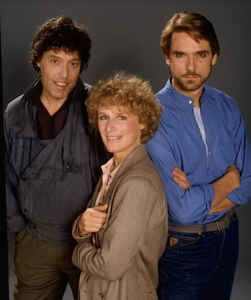
The Reagan-era play that lifted me up and melted me down like none before or since was Tom Stoppard‘s The Real Thing (’84). Sappy as this sounds, it made me swoon. Okay, not “swoon” but it struck some kind of deep, profound chord. Partly because I saw it at a time when I believed that the right relationship with the right woman could really make a difference. That was then and this is now, but I was in the tank for this stuff in ’84. The play used the Monkees’ “I’m A Believer” as mood music, and I pretty much was one at the time.
I’m speaking of the original B’way production, of course, directed by Mike Nichols and costarring Jeremy Irons and Glenn Close. My admiration for Irons’ performance as Henry, a witty London playwright who resembled Stoppard in various ways, was boundless. Close, whom I was just getting to know back then, was truly magnificent as Annie. N.Y. Times critic Frank Rich called it “not only Mr. Stoppard’s most moving play, but also the most bracing play that anyone has written about love and marriage in years.”
(I went to see the 2000 B’way revival and was bitterly disappointed by Stephen Dillane‘s uncharismatic lead performance, which wasn’t even close to what Irons had brought.)
I was also floored that same year by James Lapine and Stephen Sondheim‘s Sunday in the Park With George, which opened at the Booth theatre on 5.2.84. It was one of the few B’way musicals that really reached inside, and it still makes me choke up when I watch it on YouTube.
I’m just going to list some of the plays that really hit the sweet spot between ’76 and ’85…I’m bypassing a few but here we go regardless:
Peter Shaffer‘s Equus, which I saw in London in the early summer of ’76. The great Colin Blakely was magnificent in the lead role of psychiatrist Martin Dysart (and better, I have to say, than Richard Burton was in the Sidney Lumet film version). I saw Anthony Perkins play the role in a B’way production of Equus in ’77, and I’m sorry to say that he underwhelmed.
A Broadway production of David Mamet‘s American Buffalo in early ’77. Directed by Ulu Grosbard with Robert Duvall, Kenneth McMillan and John Savage costarring. Four years later I saw it again (twice) at the Circle in the Square with Al Pacino as Teach. Pacino wasn’t a robot — he played certain lines and scenes a bit differently at times…experimentally, if you will. I was in heaven.
Read more