“The Son” Blisters

Friendo who’s seen Florian Zeller’s The Son (Sony Pictures Classics, 11.25): “So we face madness in this film, right in the eye. It’s like watching a burning house implode. And it’s harder to look away than to stare. Mesmerizing.

Hugh Jackman is a man with everything — a beautiful, much younger second wife (Vanessa Kirby), a gorgeous new baby boy, a fabulous job, beautiful home, money in the bank. So what’s wrong with this picture? Laura Dern as the first wife — dumped for her younger replacement. And the teenage son (Zen McGrath) who was abandoned like a cold leftover.

“Hugh seems eager to help with his first son’s dark, mute depression at being the starter child left behind, but it’s not until we see Hugh with his own father — Anthony Hopkins in a perfectly chilling single scene — do we understand that the self-serving seed of pure narcissism was sown in Hugh long ago. And that those seeds have already taken root in his first born and will not be torn out without collateral damage.

“I applaud Florian’s bravery in showing what divorce does to children — not a popular topic for your classic self centered American adults. It also takes you a minute to realize that Jackman’s character is a self-centered ass because he seems so (superficially) well intentioned.

“But when you meet his serpent of a father (Hopkin), you realize how screwed up they all are and how this pathological myopia is passed down through the generations. The Hopkins-Jackman scene is short but deadly.

“And it’s hard not to like Jackman because he’s such an affable movie star, while we’re supposed to feel for the kid, who’s kind of a weird anti-social nerd.”

HE comment: I haven’t seen The Son but I already hate McGrath…fuck that guy.
Gothams Spit On Joe & Jane Popcorn

The 2022 Gotham Award nominations popped today. I’m sorry but I don’t think anyone outside of New York or Los Angeles cares about these damn indie awards.

They’ll be presented at Cipriani Wall Street on Monday, 11.28.

The non-gender acting categories are a drag, and the only film nominated for Best Feature that has any real precision or power is Todd Field‘s Tar.

Friendo: “It’s a best-of-the-year list for coastal elitists who hate the average moviegoer.”

The Gothams couldn’t be bothered to nominate James Gray‘s Armageddon Time for best feature — bad call.

Ten outstanding gender-free lead performance noms and…do I understand only one winner will be chosen? This is ridiculous. Tar‘s Cate Blanchett will probably take it, but that means The Whale‘s Brendan Fraser (also nominated) can’t win, which seems a shame. Not to mention Everything Everywhere All At Once‘s Michelle Yeoh.

Eight nominations for outstanding gender-free supporting performance, and the only one that got to me was Nina Hoss‘s performance as Cate Blanchett‘s neglected wife in Tar.

The Gotham committee actually nominated Mark Rylance‘s performance as a suburban cannibal oddball in Bones and All? C’mon!

No Love for “Endearment”

Way back in ’84 (38 years ago) hotshot movie guy Lewis Beale wrote a piece for L.A. Times “Calendar” about his loathing for James L. BrooksTerms of Endearment (’83). The piece isn’t accessible online, Beale explained, but it boiled down to the following:

1. Aurora Greenway (Shirley MacLaine) was a horrible (read: headstrong, egoistic) person who treats her daughter Emma (Debra Winger) dismissively or otherwise like dirt, and only becomes involved in Emma’s life when she’s dying of cancer, and because of this we’re supposed to like her because she’s Somebody’s Mother.

2. The film covers 30 years and takes place in three cities, but has no sense of time and place. At all. [HE to Beale: It primarily takes place in Houston and in a mid-sized university town in Nebraska. The New York visit is brief and basically doesn’t count.]

3. Emma whines all the time, then Brooks puts her in a New York restaurant with three or four bitchy career women to make her look good and them bad. [HE to Beale: Emma whines when her husband Flap (Jeff Daniels) starts cheating on her. She doesn’t whine at all when she gets cancer.]

4. Cancer is to the 1980s what consumption was to the Victorians — the province of hacks. [HE to Beale: Cancer happens to unlucky younger people. It’s not common, but it happens.]

5. Sloppy pacing, sitcom structures, characters introduced for no reason (Danny DeVito‘s), etc.

Beale also mentioned that two of America’s foremost critics, Pauline Kael and Andrew Sarris, also hated the film.

The piece got tons of negative mail. Beale’s editor Irv Letofsky loved the piece, and the negative reaction.

HE comment: The movie is saved by Jack Nicholson‘s Garrett Breedlove. Without him Terms would have been unbearable.

4.27.06 article fr5om Houston during my last visit there (and probably my last): “There are good people all over this town but with the exception of a visit Wednesday night to River Oaks, where the really rich folks live and where the oak trees are huge and the grass is moist and fragrant, Houston seemed less than abundant with down-home charm. And if you’ve been to New York or Paris or London or Rome, it feels lacking in cultural refinement.

“To me, it’s an arid corporate hee-haw town. Not enough sidewalks. Cavernous malls. Lots of middle-aged guys with monster beer bellies. Expensive cars tearing around like they’re in the Monte Carlo Grand Prix, and all those revolting glass-and-steel towers. Not enough trees. Women with vaguely predatory vibes and long jaws. And the strip clubs — strip clubs! — as prominent and well located as the better restaurants, music stores and markets…nothing covert about them.

Cherry Kutac told me before I came that Houston is like L.A. but without the soul, and I think that just about nails it.

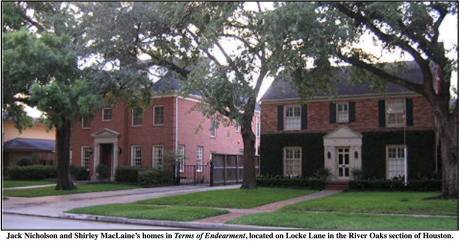
“Early tomorrow morning I’m going down to the courthouse where the Enron trial is happening. And then I’ll drive by St. John’s, the private school where Wes Anderson shot Rushmore, and maybe visit MacLaine’s Terms of Endearment home.”

Need A Little Help

Without being specific, I’m having trouble with a recently opened drama and I need some assistance from the HE community.

Let’s say we have an older musician (in his late 60s or early 70s) suddenly deciding to do away with all the banality and boredom in his life and devote himself more seriously to the playing of folk music. He knows he only has another decade or two left and wants to make the most of it, and the way to do that is to devote himself entirely to fiddle-playing and, during the quiet moments, hanging with other musicians.

Life is short and getting shorter by the day, he’s finally realized, and he ain’t wastin’ time no more.

But a pesky old friend doesn’t like the new devotion, and won’t stop trying to engage the musician in friendly small talk. The musician becomes more and more angry about the friend’s obstinacy, and finally, to make a point that cannot and absolutely will not be ignored or denied, the musician decides to mutilate himself in order to get through to the obstinate friend…”leave me the feck alone for the rest of my life.”

The irony, of course, is that this mutilation destroys the ability of the musician to play music.

Recap: Enough with the small talk because I intend to completely devote myself to fiddle-playing, and if you don’t stop trying to talk to me I’m going to fecking fix it so I can’t play the fiddle any more….that‘ll show ya!

Can someone please explain how this tale makes even a tiny lick of sense?

Do Paranoid Films Have To Be Thrillers?

A friend recently said that he found the faint but distinct current of paranoia in Tar to be the film’s most arresting aspect.

I zeroed in on this during my last viewing of Todd Field’s film, and now I agree — once the paranoid stuff begins to manifest, it becomes stronger and stronger until Lydia Tar’s downfall.

My favorite definition of paranoia is one attributed to Willam S. Burroughs — “knowing all the facts.” But what exactly defines paranoia in films?

Most of us would say it’s a vague but persuasive feeling that something undefined but threatening is approaching or waiting around the corner. This feeling gathers strength as the film progresses, but the superior paranoid films hold off at the climax…the prickly vibes linger after the payoff.

I never really thought about paranoid currents in movies until reading about Alan Pakula‘s paranoid trilogy — Klute, The Parallax View and All The President’s Men. I’m actually not so sure about Pakula’s journalism docudrama but the first two are paranoid masterpieces.

In my book the most striking or penetrating paranoid films are, in fact, thrillers — The Conversation, Rosemary’s Baby, The Witch, It Follows, The Innocents, Taxi Driver, Three Days of the Condor, Repulsion, Cutter’s Way.

What films (if any) feel paranoid without conforming the usual scheme of thrillers?

Commendable Fiennes Again Defends Rowling

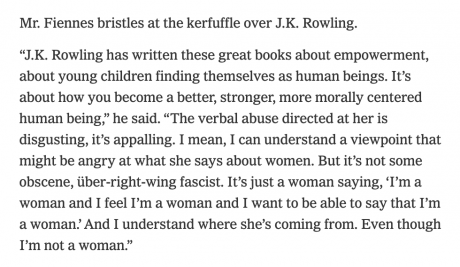
In a 10.22 N.Y. Times interview, “Ralph Fiennes, Master of Monsters,” the 59 year-old star of David Hare‘s Straight Line Crazy has, to his immense credit, once again defended J.K. Rowling in the face of trans hate:

For the record, Fiennes said roughly the same thing to Telegraph theatre critic Dominic Cavendish on 3.17.21.

“I can’t understand the vitriol directed at [Rowling]. I can understand the heat of an argument, but I find this age of accusation and the need to condemn irrational. I find the level of hatred that people express about views that differ from theirs, and the violence of language towards others, disturbing.”

Here are HE’s choices for Fiennes 11 greatest performances, be they lead or supporting…if your performances ring true, the amount of screen time matters not:’

1. Monsieur Guystave H. in The Grand Budapest Hotel. Fiennes has a classic line about graceful aging and adjusting one’s appetites. Gustave is telling Tony Revolori‘s Zero Moustafa, a Grand Budapest hotel bellboy, that he Biblically “knew” Tilda Swinton’s recently deceased Madame D. Noting that she was “great in the sack,” Fiennes explains that “in your youth it’s all fine filet but as you get older you have to settle for the cheaper cuts.” Or words to that effect.**

2. Amon Goth in Schindler’s List — a performance that spoke for itself from the get-go. I interviewed Fiennes in the fall of ’93 for a regular Sunday column I did for the N.Y. Daily News — the piece called “The Reich Stuff.”

3. Harry Hawkes in Luca Guadagnino‘s A Bigger Splash. For the “Emotional Rescue” scene alone.

4;. Charles Van Doren in Quiz Show.

5. Laurence Laurentz in Hail Caesar!

6. Heathcliff in Emily Brontë’s Wuthering Heights.

7. Dennis “Spider” Cleg in David Cronenberg‘s Spider.

8. Count László de Almássy in The English Patient (though I find his performance a bit labored, a bit of a slog).

9. Coriolanus in Coriolanus.

10. Maurice Bendrix in The End of the Affair.

11. Justin Quayle in The Constant Gardener.

I have to add that I’ve always half-admired Fiennes for that 2007 seven-mile-high episode aboard Quantas Airlines. Only good-looking movie stars get away with this kind of thing, and I had to chuckle with I first read about it. Fiennes had most of his hair back then and his natural good looks were still untouched my middle-aged crease, and Quantas steward Lisa Robertson had loved him in The English Patient so he was in like Flynn.

** That’s generally true if you’re not married, but for the middle six months of 2013 I was utterly blessed by a relationship with an exquisite, marbled, grass-fed filet mignon, to go with the metaphor. God smiled, and I will never forget His generosity. Despite the woundings at the end I caught an amazing break.