Cheering Artists Equity, The Affleck-Damon Movie Outfit

Artists Equity , a Ben Affleck-Matt Damon production company, was annnounced a few days ago, but HE has its own schedule.

Affleck-Damon are to be congratulated for planning to make five ’90s-style movies a year — appealing to semi-smart people, hopefully no guilt or virtue signalling, no kneejerk woke shit, etc. Excellent!

The flaw in the plan, of course, is that the audience stupidity factor is so overwhelming that it could choke several horses per day. Given a choice between Cocaine Bear and Artists Equity’s first film, an ’80s flick about Nike and Air Jordans, most people would probably choose the former. Am I wrong? I wish I was.

Artists Equity sounds like a 21st Century version of United Artists, which was founded in 1919 by D.W. Griffith, Douglas Fairbanks, Charlie Chaplin and Mary Pickford in the pursuit of artistic independence, and First Artists (’69 to ’80), which made films for Barbra Streisand, Paul Newman, Sidney Poitier, Dustin Hoffman and Steve McQueen.

Affleck: “I see no differentiation between commercial and quality. You ask [Netflix CEO] Reed Hastings, ‘Hey well, we went for quantity.’ I’m sure that established a footprint, I’m sure there’s some wisdom in that, and I’m sure they had a great strategy, but I would have said, ‘How do you make 50 good movies a year?’ How is that possible? There is no committee big enough. You just can’t do it. It’s a thing that requires attention and dedication and work and it resists the sort of assembly line process.”

“There’s just so much to see [these days]. There’s a lot of investment that’s gone into a lot of people my age, around that age. My wife, who’s 53, the most famous, admired, spectacular woman in the world, there weren’t 53-year-old stars in the 1940s and ’50s. That was it. And there weren’t really for men [either]. Paul Newman was kind of old at 37. You read about Newman at 37, 38 and they were like, ‘Well, as you move into the sunset of your life, Paul, after Towering Inferno….’ And now people are much more familiar with this group of people. They’ve kept that name recognition in a marketplace that is so diffuse where it’s more and more and more valuable to be able to attract eyeballs, to be ab

What’s up with Affleck’s voice? I know his precise tone and timbre, and it sounds like he’s recovering from strep throat.

Read more

Silent Submissions of “Jeanne Dielman”

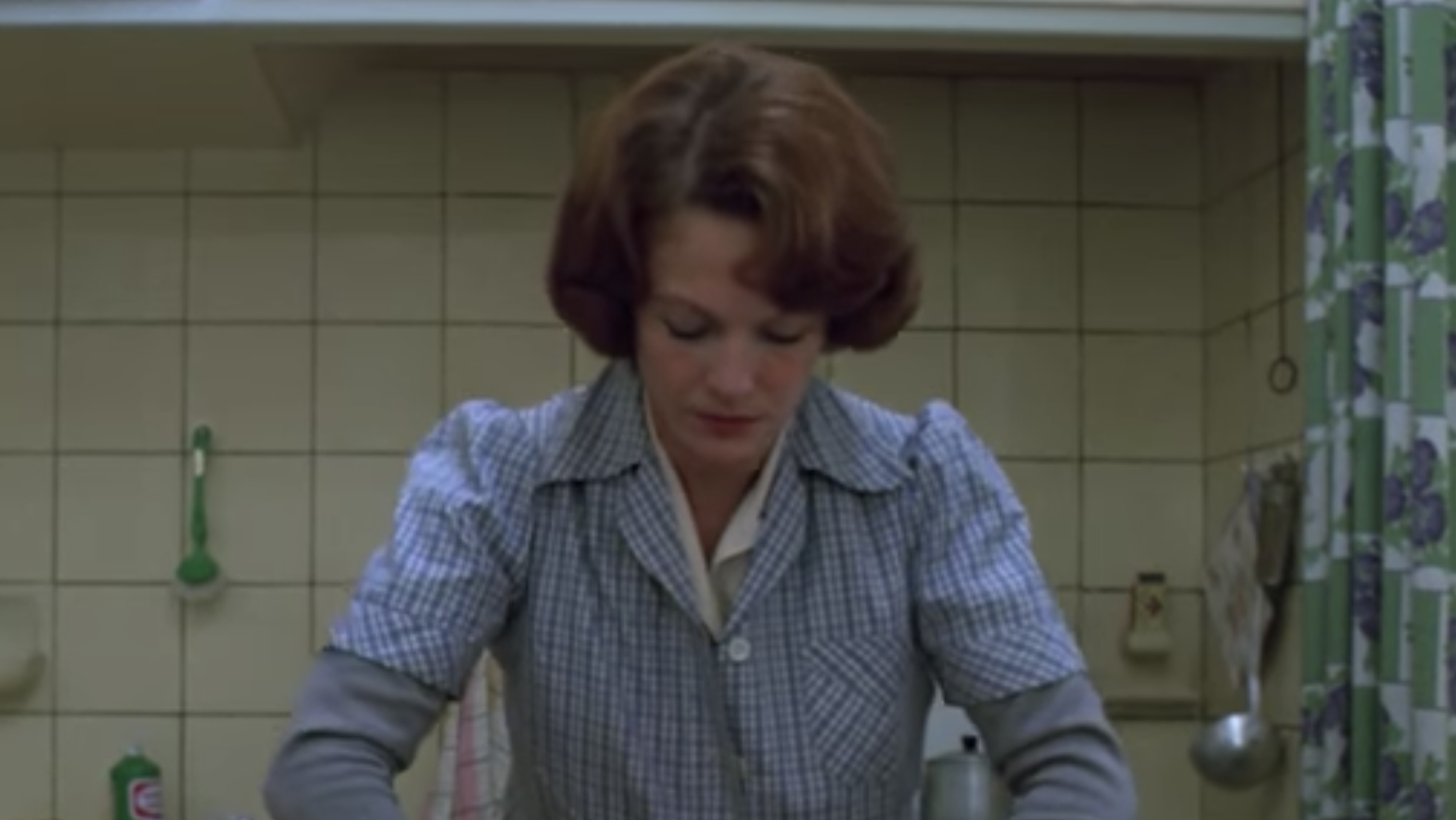
In the wake of Chantal Akerman‘s Jeanne Dielman, 23 quai du Commerce, 1080 Bruxelles (’75) topping the BFI Sight & Sound poll, I had to give it another shot. So I watched it on the Criterion Channel, on my Macbook Air. Most of it, I should say. I made it through the first 90 minutes the hard way (i.e., without cheating), but then something inside me began to wither and crumple, and I began to watch ten-minute portions. But I missed nothing.

Jeannie Diulman is a statement, all right. Three hours and 21 minutes of torpor, tedium and depression. Such a sad, suffocating and listless film. (Yes, that’s the point but c’mon.) It’s about a life of a prim and proper sex worker (Day of the Jackal’s Delphine Seyrig) that’s mainly about servitude and the renunciation of joy and the suppression of the spirit. A film about regimented motherhood and the raising of a dull, homely, tragically obedient son whose life is doomed to the same kind of repetition, the same dutiful stiflings and silences and submissions.

Seyrig is Spartacus in the kitchen — a sex-hating sex gladiator without a sword. A slave who endlessly prepares meals and adheres to regularity, regularity and more regularity. She never breaks out of Capua, so to speak, and we never see her having sex except at the very end, and in an odd, ugly and curious way at that. But we do see her prepare many dinners.

Duty, diligence and desperation, partly due to very little money and partly due to having nothing inside. A film about being numb and experiencing a form of daily resignation and death. A woman who owns no record player and hardly ever listens to music on her shitty radio and of course never sings or even hums along. The film simulates emptiness, nothingness, endless mediocrity. A woman who’s obviously smart and discerning and disciplined enough to hold down a decent job but has decided instead on a life of miserable prostitution and sporadic infant care.

Grunting pig that I am, I found the chaste bathtub scene (and Seyrig’s glorious, half-glimpsed nudity and the slight, tantalizing ripples of middle-aged flab) the only respite, and thank God for that and Delphine Seyrig in general! But I came to deeply despise Seyrig / Dielman’s son, whose stifled life is so dull and deflated that he’s almost a figure of evil. I wanted to reach into the screen and give this wimp a good slap across the chops.

The second-to-last scene is the only one that shows Seyrig having it off with one of her homely, pathetic johns. It concludes with a sudden, impulsive and unconvincingly depicted murder of a certain ugly fellow — a scissor stabbing in the neck. Followed by a final scene in which Seyrig meditates about her life and this murder and the certainty of being freed from her agonizing life by being sentenced to prison (or, if she’s lucky, to life in a mental hospital).

So after submitting the viewer to a form of torture for three hours, Seyrig / Dielman finally “breaks out of Capua,” but she never revolts in a full, satisfying or expressive way. For Jeanne Dielman is the anti-Belle du Jour. A flatline version. Such a tragic meditation, but despite what the film’s many admirers seem to believe, it’s not a profound (much less an illuminating or transcendent) thing to subject viewers to this much pique and boredom.

Read more

Ends With Good Visual Gag

Harrison Ford‘s digital de-aging looks pretty good, I must say. It certainly looks better than Robert De Niro‘s de-aging in The Irishman.

Indiana Jones and The Dial of Destiny sounds like a game show.

Sight & Sound Highbrows Lean Wokey

The 2022 Sight & Sound poll popped earlier this afternoon, and we all knew what the results would reflect, right? Not so much with films directed by older white guys (especially OWG directors with a somewhat dicey or shady reputation), and up with films directed by women and POCS. And so Chantal Akerman‘s Jeanne Dielman, 23, quai du Commerce, 1080 Bruxel, a 201-minute film about duty, survival, sex working, regimentation and repetition, and which ends with a “john” getting stabbed in the throat with a pair of scissors, was named #1.

In other words, (a) down with the insensitive asshole patriarchy, (b) up with chopped onions carefully mashed into ground beef, and (c) hooray for Delphine Seyrig finally having an orgasm.

In 2012 Jeanne Dielman ranked #36 on the BFI list…fine. But how did it manage to suddenly vault up to the #1 position? Admired films tend to move up gradually, no? It feels to some of us like Dielman won because of an organized campaign among feminist-minded critics. If Dielman had landed in the 10th or 12th spot in the 2012 poll, today’s win would have seemed more of a natural thing. But to go from 36th place a decade ago to #1 in ’22? It seems to me like the fix was in.

You can’t argue or complain with the BFI critics, who are primarily a bunch of highbrow snoots trying to out-snoot each other.

If you ask me the BFI Directors Greatest Films of All Time list is a lot more grounded and sensible.

So 60th-ranked Moonlight has edged out Casablanca (#61), Goodfellas (#62) and The Third Man (#63). I’ve seen all four, and I’m telling you straight from the shoulder that there’s no way Moonlight deserves, deliberately or haphazardly, to be ranked above the other three…NO WAY ON GOD’S GREEN EARTH.

Alfred Hitchcock‘s Vertigo is now ranked second, and I honestly thought it would take a bigger hit than that. I figured the legend of Hitch having allegedly made Tippi Hedren‘s life hell during the making of The Birds and especially Marnie…okay, let’s drop it, but I’m slightly surprised.

Three indisputably great 20th Century films about conflicted white males dealing with disillusionment and corruption — David Lean’s Lawrence of Arabia (’62), Roman Polanski’s Chinatown (’74) and Sam Peckinpah’s The Wild Bunch (’69) — were booted off the critics’ list of the top 100. Polanski had to pay for his sexual indiscretions of the ’70s and ’80s, I suppose, and Peckinpah had to be banned for his notorious misogyny. But why did the saga of T.E. Lawrence get the shaft? What exactly did Lean or Lawrence do to earn the heave-ho? Was it the old arrogant British imperialism thing, or the fact that women are barely seen and certainly not heard seen in that classic desert epic?

1. “Jeanne Dielman, 23, quai du Commerce, 1080 Bruxel” (Chantal Akerman, 1975)
2. “Vertigo” (Alfred Hitchcock, 1958)
3. “Citizen Kane” (Orson Welles, 1941)
4. “Tokyo Story” (Ozu Yasujiro, 1953)
5. “In the Mood for Love, Wong Kar-wai, 2001)
6. “2001: A Space Odyssey” (Stanley Kubrick, 1968)
7. “Beau travail” (Claire Denis, 1998)
8. “Mulholland Dr.” (David Lynch, 2001)
9. “Man with a Movie Camera” (Dziga Vertov, 1929)
10. “Singin’ in the Rain” (Stanley Donen and Gene Kelly, 1951)

Read more

Loathsome Farce For Low-Rent Goons

A large Tyrannosaurus Rex might be be able to smash a cheaply-made bedroom door by shattering the door frame, but a big bear wouldn’t be able to do that…sorry. So right away the credibility is out the window. Plus the CG stinks. If only Werner Herzog had written and directed this…seriously.

Cocaine Bear (Universal, 2.23) stands ready to fling damp fecal matter upon our cinematic temple and lower the levels of cultural discourse. It’s the new Snakes on a Plane, and that piece of cheap exploitation blew chunks to begin with.

The tone, obviously, is one of absurdist action humor of the lowest possible order.

There’s clearly no opportunity to buy into the fantasy — every shot in this trailer says “don’t believe this crap!…are you a moron because only stoned morons would derive the slightest enjoyment from a film this idiotic and ludicrous. I mean, it’s not even good enough to be called perverse.”

Universal Pictures, director Elizabeth Banks and screenwriter Jimmy Warden aren’t the core problem here. They’re just looking to make a buck and pay the bills. The skeevy, scurvy, bottom-of-the-barrel chumps out there in megaplexland who find this live action-meets-Wile E. Coyote-type humor funny or even slightly amusing…they’re the problem.

An actual Georgia-residing bear (a guiltless creature of basic instinct and no ulterior motives) died of self-ingested cocaine poisoning in 1985, and 37 years later a movie company has made a dark comedy out of this…A COMEDY!! If this isn’t a searing indictment of a thoroughly rancid and morally corrupted lower-middle-class culture, I don’t know what could be.

You know who’s going to like this film and tweet about it endlessly? Trumpies!

I’ve changed my mind — Banks and Warden need to answer for this. After Cocaine Bear is released and streaming to great profitability, they’ll need to check themselves into a moral rehab facility.