“Absolute Madness”

I’m not fully understanding what’s causing all the “chaos” on the shoot of Francis Coppola‘s Megalopolis, at least as described by The Hollywood Reporter‘s Kim Masters, Scott Feinberg and Aaron Couch.

Apparently the trouble has to do with the visual effects either costing too much or not being good enough to satisfy Coppola, or a perhaps a combination of the two.

The piece says that Coppola, whose lack of experience with effects-heavy shooting suggests he could have used the counsel of someone like James Cameron, “fired almost his entire visual effects team Dec. 9” — a month ago — “with the rest of that department soon following.”

Mark Russell (In the Heights, The Wolf of Wall Street) was the film’s top visual effects production supervisor. Production designer Beth Mickle and supervising art director David Scott have also flown the coop, the story says. A source says the $120-million budgeted film “now has no art department.”

The futuristic Megalopolis “has descended into chaos,” the story claims, citing “multiple sources.” Roughly halfway through shooting in Atlanta and with filming expected to finish in March, Megalopolis has already been tagged as a mess, giving off “severe Apocalypse Now vibes.

A production source has told the THR trio that “it’s unclear whether the production can go forward as planned.”

Coppola’s reps haven’t said anything to anyone, but his movies have always been fraught with financial anxiety and general uncertainty.

World of Reel‘s Jordan Ruimy has posted a significant insider quote: “Coppola’s movie is definitely in trouble. He’s shaking down people to get extra cash. grips are pissed. Dude is taking money from his own budget and is siphoning cash from things like costume, make-up, and production design accordingly.”

I’ll tell you this much. Joe and Jane Popcorn aren’t going to be very enthusiastic about paying to see Megalopolis when it hits theatres, which, knowing Coppola, probaby won’t happen until sometime in ’24. The film just sounds too labrynthian, too complex, and certainly not primitive enough for the Millennial and Zoomer ADD crowd.

Harris Shivs Paramount’s 4K “Death Wish”

In his recent Home Theatre Forum review of Kino’s forthcoming 4K Bluray of Michael Winner‘s Death Wish (’73), restoration guru Robert Harris has used a kind of double-edged sword.

One one hand he describes it as a substandard 4K release that’s not worth the price, and says that the 40th anniversary Bluray version (released in 2014) is a better deal overall. On the other hand he’s calling the 4K version something new on hi-def market — 2K UHD.

Harris: “I’ve been giving the 4K Death Wish situation some thought, and the answer is simple — it represents a new format.

“It’s a 4k UHD release derived from a 2k master. [It therefore doesn’t] in any way take advantage of an actual 4K resolution, but rather simply [goes] for the HDR/DV ‘pop’ that will be seen on OLED panels.” In HE terminology, Harris is referring to a “4K bump.”

Kino is distributing the 4K version, but the actual work has been performed by Paramount.

“The question is that since [the 4K Death Wish] doesn’t actually carry true 4K resolution, what to call it? I’d go with ‘2K UHD’.

“How to market 2K UHD releases? First, try and explain [what they are] to consumers. How to price them? A few dollars above Bluray.

“The 2K UHD variant already exists, but has not been recognized as such.

Continuing: “I’ve now compared the Bluray variant with the 4K, and they’re quite different.

“While they both seem derived from the same master, which appears to be an older image harvest from an interpostive and not the original camera negative, the Bluray disc has a more natural grain structure.

“The 4K UHD disc has highly reduced grain, and a very awkward digital grain pattern that seems to clump, and at times appears to have mold embedded in the film element.

“The 4K [version] has very little relationship to film, while the 2014 Bluray has a more natural appearance.

“I’d be equally happy with a Bluray derived from the same newer master, but those who purchase 4k should be on notice before they place an order, that they are not receiving true 4K, and merely the HDR pop.”

In All Sincerity

“You must read this book. And then watch The Shining again the second you put the book down. And I don’t care if you’ve seen it 50 times, you will never see it the same way again. It’s going to change everything.” — Alleged excerpt from Steven Spielberg‘s forward to Taschen’s limited-edition tribute book about Stanley Kubrick‘s landmark horror film.

An intriguing prospect, I’ll admit, but given how much I know about The Shining and considering my having seen it at least 20 times and contemplated it sixteen or seventeen ways from Sunday over the last 40 years, I’m not sure I’d buy this book if it cost $150. I might lay my money down if it was sale-priced at $15.00 or thereabouts, but $1500 dollars?

HE is hereby offering to tap out a paywalled 1500-word piece about the innards ands gizzards of The Shining, and the cost will only be…uhm, $100. Okay, $75. I don’t know what I’ll say but I can probably cook something up.

“Whatsa Matter With You?”

If the 31-year-old fashion model Emily Ratajkowski has been around in ’54 and had decided to extend some of that breathtaking largesse to a morally ambivalent, seen-better-days Hoboken longshoreman named Terry Malloy…that I could understand. If HE was banging out a daily column for the Hoboken Gazette, I could report this happy news without so much as a hiccup or raised eyebrow.

She’s Doing This Guy?

The Daily Mail‘s Justin Enriquez is reporting that comedian Eric Andre, 39, has recently become one of the recipients of Emily Ratajkowski‘s experimental largesse. Andre is to be congratulated for what any realistic person would call a truly extraordinary quirk in the cosmic scheme of things. Ratajkowski is just sampling, of course, so this isn’t analogous to, say, Shirley Jones marrying Marty Ingels in 1977.

Read more

Not Necessarily “The Bad Guys”

But in addition to their sometimes well-grounded, highly perceptive praising of stellar filmmaking and performances, the New York Film Critics Circle has (be honest) been in the grip of woke theology over the last four or five years. Most of us understand this, and the NYFCC honchos and spokespersons will deny it to their dying day.

For decades a NYFCC award was a gold-standard honor — a classy, triple-A stamp of irrefutable big-city approval. But since ’18 or thereabouts the NYFCC members have sought to integrate notions of quality with “the sacralization of racial, gender and sexual [identity],” as Matthew Goodwin put it in February 2021. In short, they’ve become known as a contender for the most reliably eccentric, woke-flakey critics group, neck and neck with the occasionally wokejobby Los Angeles Film Critics Association. (Note: HE has agreed on certain occasions with LAFCA award calls, hence the term “occasionally woke-jobby.”)

For me the syndrome seemed to begin in 2018 when the NYFCC handed their Best Actress award to Support The Girls‘ Regina Hall. For me there was no contest among the Best Actress contenders that year — Melissa McCarthy‘s performance in Can you Ever Forgive Me? was heads and shoulders above Hall’s, and yet the NYFCC allowed themselves to be guided by identity politics. They disputed this, of course.

IndieWire‘s Eric Kohn, a leader of the NYFCC’s Hall support group: “There is no groupthink to the NYFCC voting process. The rules are right there on the site. Nobody’s ‘using’ any single award for their private agenda.”
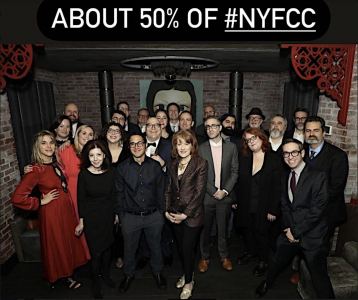
The following year the NYFCC handed their Best Actress trophy to Us‘s Lupita Nyong’o for no apparent reason other than her woke identity credentials. Posted on 12.14.19: “Seriously? Honoring Lupita Nyong’o’s performance was eight parts wokester virtue-signalling, and two parts serious regard for a noteworthy performance…trust me. The NYFCC used to be the NYFCC — now it’s an organizational ally of IndieWire‘s wokeness crusade. Good as she was in Jordan Peele’s interesting if underwhelming horror flick, Lupita basically delivered an intelligent, first-rate, Jamie Lee Curtis-level scream-queen performance with a side order of raspy-voiced predator doppleganger.”

HE believes that the NYFCC’s grand-slam wackadoodle happened in 2020, when they gave their Best Film award to Kelly Reichart‘s First Cow (a baffling, eccentric call for eccentricity’s sake), and their Best Actor prize to Da 5 Blood‘s Delroy Lindo, who played an furiously unstable Trump supporter (and in so doing beat out Judas And The Black Messiah‘s Lakeith Stanfield, who was far more deserving, not to mention The Father‘s Anthony Hopkins, Minari‘s Steven Yeun, The Sound of Metal‘s Riz Ahmed and Mank‘s…okay, let’s forget Gary Oldman).

Plus their Best Actress award went to Sidney Flanigan (Never Rarely Sometimes Always), basically for quietly weeping during an interview with a Manhattan-based abortion counselor after zero emoting throughout the entire film. They also gave their Best Supporting Actor award to Da 5 BloodsChadwick Boseman, basically because the poor guy had tragically passed a few months earlier, and their Best Supporting Actress: trophy to Maria Bakalova (Borat Subsequent Moviefilm), which was based upon nothing other than the fact that she played a spunky woman from a small Eastern European village who wound up hoodwinking Rudy Giuliani in a hotel room.

How wackadoodle were their 2022 choices? I for one was…I was about to say flabbergasted when the NYFCC handed their Best Director award to RRR‘s S. S. Rajamouli — a virtue-signalling gesture if there ever was one, and a head-scratching accolade for a film that many of us regard as “flamboyant garbage…ludicrous, primitive crap that believes in ridiculous extremes and heroic absurdities.” But I wasn’t surprised given what the NYFCC has turned into. They also went for Everything Everywhere All At Once‘s Ke Huy Quan (“Short Round”) for Best Supporting Actor — strictly an identity call + a nod to the popularity of EEAAO among Millennials and Zoomers — and Nope‘s Keke Palmer for Best Supporting Actress…an award that made no sense as all given that Palmer merely flaunted her Millennial diva spunkitude.