Vulnerability, Buried Pain In Her Eyes

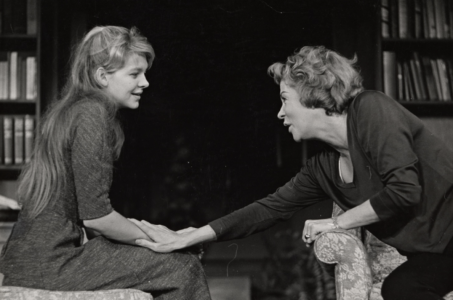
I’m very sorry about the passing of Melinda Dillon, who was quite the vulnerable mainstay in several stand-out films from the ’70s,’80s and ’90s — Slap Shot, Close Encounters of the Third Kind, Absence of Malice, Bound for Glory, A Christmas Story, The Prince of Tides. I somehow never read about her having landed a Tony nomination in 1963 (when she was 23 or 24) for her performance in the Sandy Dennis role in the original B’way stage production of Edward Albee‘s Who’s Afraid of Virginia Woolf?. This isn’t a profound observation, but the way Dillon called out for her young son (Cary Guffey) in CE3K — “Bahhahhhrrreeee!” — has been lodged in my memory ever since.

Tough Racket

Toxic correspondent: “As a wiser man than either of us put it, ‘By his works we shall know him.’ You’re the guy who thinks it’s funny to try to put ‘fuck you, Danielle Deadwyler‘ words into Andrea Riseborough’s mouth.”

HE to Toxic Correspondent: “In my rendition Andrea Riseborough didn’t say ‘fuck you’ to Danielle Deadwyler. She said ‘look, I’m sorry but I caught a surge or a wave or however you want to put it, and unfair as it may seem to you (and I definitely hear you, being a fan of your formidable Till performance)…unfortunately my surge meant that somebody who appeared to be among the most likely five contenders…one of those five had to get bumped. I’m sorry but it’s a tough game. Just don’t blame me because I didn’t do this to you personally. I’m a friend and a fan.”

Last Year’s “By The Measure of Howard Hawks”

My assessments of the strengths and weaknesses of last year’s Best Picture nominees, posted on 1.7.22, didn’t align with the Academy vote tallies. I don’t think I was right and they were wrong — I know it.

Once again: Every year Hollywood Elsewhere subjects the leading Best Picture contenders to the Howard Hawks measuring stick. The legendary director is famed for having said that a good movie (or a formidable Oscar seeker) always has “three great scenes and no bad ones.”

Hawks also defined a good director as “someone who doesn’t annoy you.” I wouldn’t want to sound unduly harsh or dismissive but I’m afraid that Kenneth Branagh‘s direction of certain portions of Belfast and particularly his decision to open with that vibrantly colorful prologue…’nuff said.

How do the leading 2021 Best Picture contender films (numbering nine) rate on the Hawks chart? Here we go…

Jane Campion‘s The Power of the Dog: I’m sorry but despite the fine performances, the feeling of 1920s open-range authenticity, handsome visual compositions and carefully-honed pacing, this 126-minute film has no great scenes. There are a few intriguing moments, but none I would even begin to call highly impactful, much less “great.” You keep waiting for a killer scene (or two or three) to arrive, but it never does. Dog is more about the overall than this or that peak moment.

Reinaldo Marcus Green, Will Smith and Zach Baylin‘s King Richard: I could go on and on, but this 2021 Warner Bros. sports drama has more than a trio of stick-to-your-ribs scenes. One, the persistent Richard (Smith) persuades elite tennis coach Paul Cohen (Tony Gpldwyn) to check out Venus and Serena’s exceptional skills, and within a couple of minutes Cohen gets it. (“You taught ’em this?”) Two, Richard takes offense when Andy Bean‘s Laird Stabler, a colleague of the cigar-smoking Will Hodges (Dylan McDermott), tells him he’s done “an amazing job” in training his daughters. Three, the kitchen argument scene between Richard and wife Orascene (Aunjanue Ellis). There are at least two or three others (the Oakland tennis match finale, Richard comes perilously close to shooting a Compton gangsta, refusing the initial endorsement deal, etc.).

Kenneth Branagh‘s Belfast. Again, a few diverting scenes but none that could be called outstanding or great. Branagh’s real-life dad may have been an appealing crooner who could dance fairly well, but Jamie Dornan‘s singing and dancing scene struck me as cloying and insincere and untrustworthy. It therefore qualifies, no offense, as a “bad” scene.

Steven Spielberg‘s West Side Story. One, the opening shot of tear-down rubble and ruination on San Juan Hill, and how that feeds into the brilliant “Jets Song” sequence. Two, Corey Stall‘s dismissive rant about how the Jets represent the “can’t make it and haven’t moved to Long Island” crowd, and that in a very short while high-rise luxury apartment buildings will be hiring Puerto Rican door men, etc. Three, the neighborhood Scherzo sequence as Maria tries to make it seem as if she’s slept all night in her bedroom. If these aren’t great scenes they’re certainly damn good ones.

Paul Thomas Anderson‘s Licorice Pizza has one great scene — the finale in which Alana Haim and Cooper Hoffman finally embrace like they mean it. Otherwise the film is a bit spotty and meandering, but I respect the courage that Anderson showed when he included those two scenes involving John Michael Higgins‘ Jerry Frick and his two (i.e., successive) Japanese wives. Anderson knows the climqte out there, and had to realize that wokesters would come after the film for engaging in what some regard as crude racial stereotyping. But Anderson kept it in, partly because he was drawing on his own SFV experience and partly because he doesn’t believe in presentism, or so it seems.

Denis Villenueve‘s Dune. A captivating visual scheme and impressive production design elements do not, in and of themselves, constitute what anyone would call great cinema. Okay, perhaps on an overall aesthetic sweep basis but certainly not in terms of this or that scene.

Sian Heder‘s CODA has two appealing supporting performances (Troy Kotsur‘s randy dad, Eugenio Derbez‘s singing tutor), but no exceptional scenes per se, and certainly no great ones.

Joel Coen‘s The Tragedy gf Macbeth boasts excellent performances (Denzel Washington, Frances McDormand, Alex Hassell, Kathryn Hunter) and of course an impressionistic sound-stage environment blended with the classic Shakespeare text. At the same time I can’t honestly think of any particularly great scenes in the Hawks sense of the term. It’s an honorable film at the end of the day, certainly, but there’s no ducking the fact that it’s far less of an undertaking than Roman Polanski‘s 1971 version.

Maggie Gyllenhaal‘s The Lost Daughter falls more under the heading of “highly respectable, especially coming from a first-time director” than “a film which contains three great scenes and no bad ones.” Honestly? The scene in which Ed Harris visits Olivia Colman in her condo but doesn’t say boo about the doll lying on the patio table, except to note that it has water inside it. The missing doll is a huge thing on the island (reward money, posters stapled to trees) so Harris’s curious indifference to Colman being a doll thief is an odd call — I think it’s fair to argue that its a “bad” scene.

In sum, the only Hawks finalists are King Richard and West Side Story.

Dargis Crosses The Feminist Rubicon

It is my earnest opinion that N.Y. Times critic Manohla Dargis used to be one of the very best in all respects. I’m a serious longtime fan, as I first began savoring her critiques when she wrote for the L.A. Weekly. And I still get the tingles when I re-read her N.Y. Times review (8.6.04) of Michael Mann‘s Collateral. But time passed, Trump came along, #MeToo was born, a domestic version of China’s Great Cultural Revolution of the ’60s kicked in, and Dargis turned woke.

I won’t present a chapter-and-verse dossier that shows exactly where Dargis seemed to turn the corner, but it was roughly around the time when the Times seemed to ease up on its commitment to redefining or re-enforcing its sterling Gray Lady reputation and instead became a woke activist newspaper committed to progressive change. The publishing of the 1619 Project, the resignation of James Bennet and Bari Weiss, the firing of Donald McNeil Jr. and so on.

I’m certainly no final arbiter, but to me and others, Dargis (along with co-critic A.O. Scott) seemed to increasingly side with the wokes.

Friendo: “Woke…yup. Her and Tony. And so we no longer trust them as critics. We don’t trust their lists, their reviews, etc.”

I’m mentioning this because eight days ago (1.26) the Times posted a long Dargis essay titled “For the First Time Ever, I’m Optimistic About Women in the Movie World.” It was basically a celebration of the increasing presence of women filmmakers…fine. 12 years ago “women comprised 7 percent of all directors working on the Top 250 films of 2009,” according to an annual report on women in film from researcher Martha M. Lauzen, and now, according to Lauzen’s 2022 study, “women accounted for 18 percent of directors working on the Top 250 films.”

Which is obviously encouraging, although that percentage could and should be higher, providing, I should add, that future women-directed films are at least partly in the region of Kathryn Bigelow‘s game-changing The Hurt Locker, say, and less in the camp of Sarah Polley‘s Women Talking.
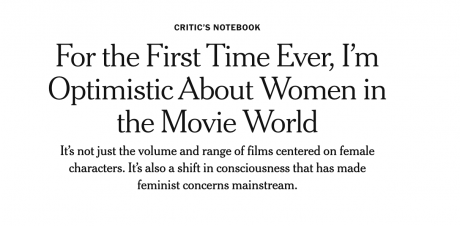
But as I read the Dargis piece I began muttering to myself, ‘This is basically a pep-rally manifesto…an article that says “yay team, hooray for our side, we’re gaining in power and influence…representation!’

It felt less like an essay by a brilliant film critic whose primary allegiance was to the Universal Church of Cinema — something personal, soaring, nervy, revelatory, exacto-knifey — and more like an eloquent political pamphlet piece…a political speech that might have been delivered by Dargis at a recent Women in Film gathering, say, or submitted as a possible chapter in an anthology book about the growing community of brand-name women filmmakers.

Do film critics have to constantly criticize or take down or scold? No — it’s not only fine but necessary, most of us would agree, to celebrate what seems like positive or at least hopeful change in the film industry. Same deal if Andrew Sarris or Pauline Kael had written a 1969 Film Comment piece about the exciting new energy coming out of Hollywood since the smash success of Easy Rider, say. All to the good.

But Dargis’ cheerleader piece really didn’t feel like the Dargis of yore. It felt wokey-wokey and perhaps even Elmer Gantry-ish on a certain level. (Not in a hucksterish sense but with a certain fundamentalist revival-tent feeling.)

It almost seemed as if Dargis was saying in subtext, “I’m not just feeling good about the increasing power of women filmmakers, but also…I want to say this carefully…I’m also sensing a primal change within myself. I feel as if I’ve crossed over in a Malcolm X-meets-#MeToo sort of way…I used to be a disciple of Elijah Muhammad and the Nation of Islam, to to speak, but three of four years ago I began to gradually convert to the Sunni faith, and my spirit has led me in new directions.”

In other words, Dargis seemed to be saying “I used to be a ‘film critic but since 2019 or thereabouts — and I mean this in the manner of Thomas Becket‘s admission to Henry II by way of Jean Anouilh — I have become introduced to greater responsibilities.”

Hauser vs. DargisScott Eccentricity,” posted roughly a year ago.

Over the last three or four years Dargis and Scott’s critical judgments, to borrow a phrase from Scott’s 2001 Pearl Harbor review, have been “strenuously respectful of contemporary sensitivities.”

Many of the comments about Dargis’s piece were, as you might expect, strident: “Very confused why the N.Y. Times needs to take 2,500 words to tell me I should feel optimistic that ‘in 2022 women accounted for 18 percent of directors working at the top of their field.’ So 1/2 of the population getting to speak for 1/5 of the time gives us the healthiest and most dynamic picture of modern life and reflects a value system we don’t actively have to worry about, for now…forgive me for still being worried.”

Only One Hothouse Flower

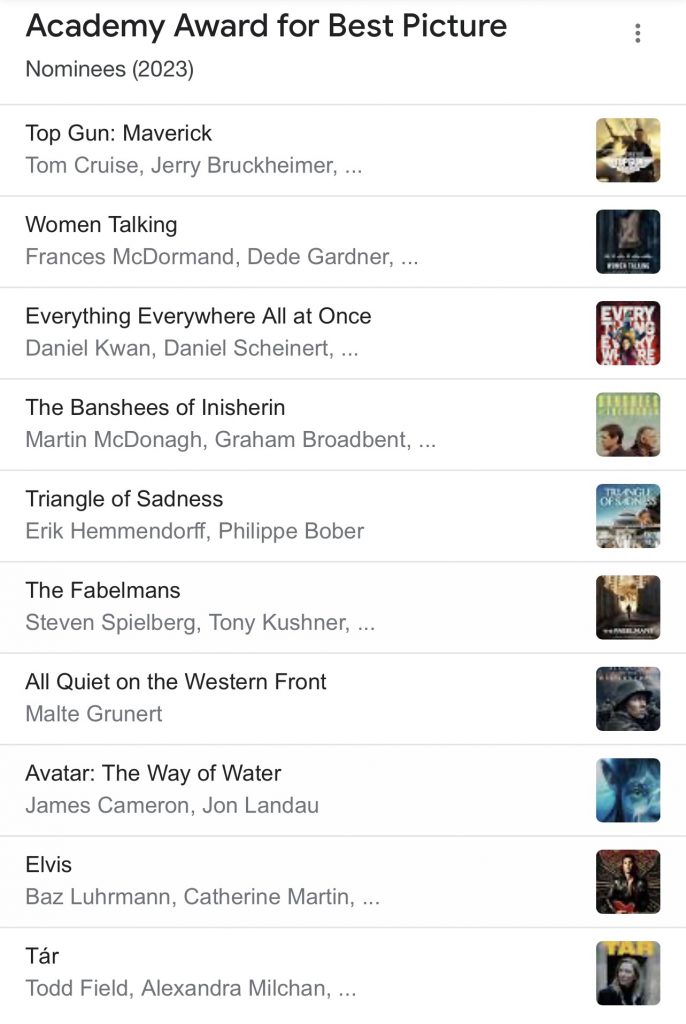
The only hothouse flower among the current Best Picture contenders, arguably, is Sarah Polley’s Women Talking, and we all know that hayloft talkathon never had a snowball’s chance in hell — it was nominated purely for the sake of #MeToo tokenism.

Nobody Wants To Remember

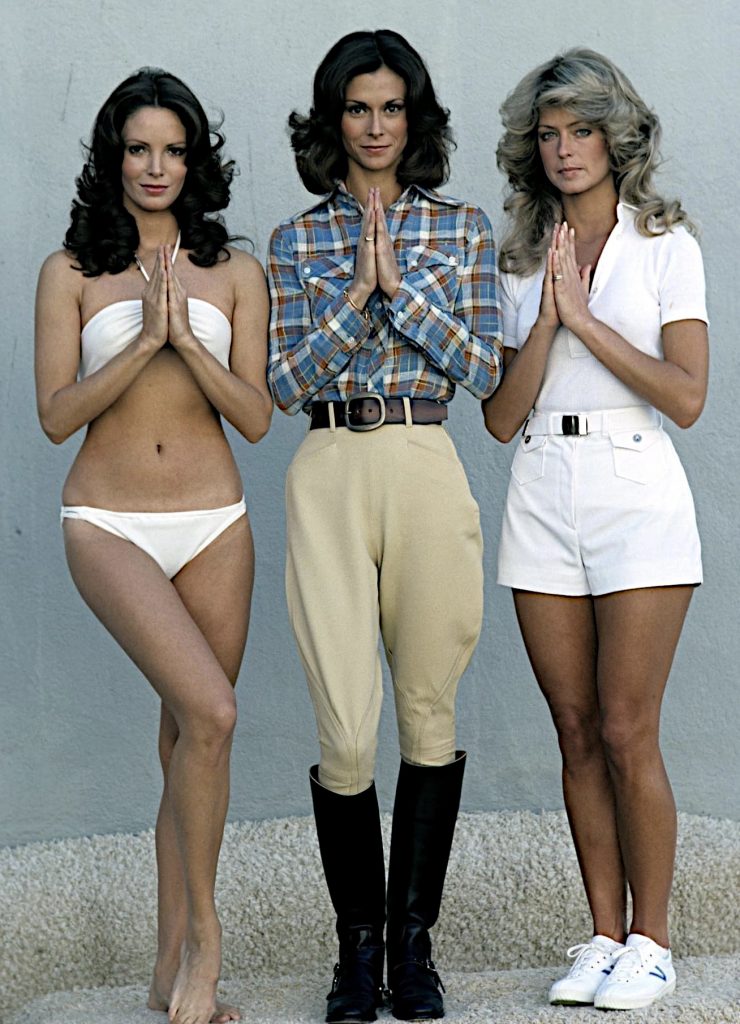
…and the Charlie’s Angels hey-hey peaked 45 years ago so it doesn’t matter to under-40s or anyone else for that matter, but my God, that show was beyond reprehensible in its absolute disregard for even a semblance of realism of any kind, and its general embrace of sterility/puerility. It was Velveeta, and that didn’t stop anything. It ran between ‘76 and ‘81.

If only Aaron Spelling had instead produced Quentin Tarantino’s Fox Force Five. Ironically, I mean. With QT- level dialogue.

Marlowe In A Pot Haze, A Bit Lazy and Distracted But Going Through The Motions

I stopped getting high in 1974, and that decision came none too soon. It was time to get real and focused and stop farting around, and try to make movie journalism happen.

It took another five or six years to find my feet in that regard, but that’s writing for you — unless you’re a genius (which I’m not) it can take as much as a decade to become even half-proficient at it.

Robert Altman’s The Long Goodbye, which I’ve seen countless times, opened on 3.7.73. Film-wise the glorious ‘70s were still happening, but it all began to change in 1974, and if there’s one film from that fairly turbulent and convulsive year (Nixon resignation, close to the end of the great ‘70s film era with Jaws and Star Wars right around the bend, not to mention the beginnings of disco and punk) that has genuine staying power, it’s this one — a year ahead of schedule.

Altman was a serious pot-head, of course, and his hot-streak films (late ‘60s to late ‘70s) reflect that proclivity as well as the times — deconstructing, alternating, exploring, goofing off and playing it by ear.

The difference on my end was that in ‘73 I was starting to think about shirking all that and cleaning out all the closets. So I wasn’t really on Altman’s wavelength, and yet I love The Long Goodbye for all the ways that it captured in amber what the early to mid ‘70s felt and sounded and smelled like.

Altman’s primary motivation wasn’t to deride and dismiss Raymond Chandler’s hard-bitten shamus. He merely decided, quite sensibly, to make a private detective film within the realm of ‘74 (counter culture giving way to Me Generation narcissism, Nixon collapse, hash brownies, sinking into cynicism, anti-traditional you-name-it) and that meant, obviously, that the 1940s version of Phillip Marlowe (as interpreted by Humphrey Bogart and Dick Powell) no longer existed and had to be jettisoned.

What took its place was something vaguely stoned and misty — dry mockery and improvisation and a laid-back Zen cat attitude on the part of Elliott Gould. It all added up to “all those hard-boiled, tough-guy cliches no longer apply…maybe they never did…everything is shifting, devolving, being re-defined.”

Altman was always about poking the bear and trying to catch the wind, and he was never into genre stuff. He may have mainly wanted to dig down and deconstruct and have fun, but he also wanted to craft a Marlowe film that would reflect and comment upon what was happening back then — culturally, spiritually, morally.

Altman called The Long Goodbye “ a satire in melancholy.”

Except for the lampooning of gangster tropes by way of those goons who work for Mark Rydell’s Marty Augustine, the satire works. Plus Vilmos Zsigmond’s constantly slow-tracking, circular-arc camera, the 1948 Lincoln Continental, the Malibu security guard with the movie-star impressions, Khoury brand cat food, “Hooray for Hollywood,” etc.

Heavily accented Mexican official: “When did you last speak with the deceased?”

Gould: “The diseased? Yeah, right.”

John Ford Reville

2.1.23 Facebook post by Joseph MccBride: “Today, February 1, we celebrate the birthday (in 1894) of the world’s greatest filmmaker, John Ford, born John Martin Feeney in Cape Elizabeth, Maine. There is no director whose films I return to more often and with more pleasure and insight than those of Ford.”

I Cast You Out, Unclean Spirit

It took me too long to watch Josh Seftel‘s Stranger at the Gate, a 26-minute doc that’s been nominated for a Best Documentary Short Film Oscar.

I finally saw it last night, and I immediately understood. The filmmaking chops aren’t the thing, although it’s an intelligent, well-ordered effort from start to finish. The thing is the narrative — what actually happened with Richard (Mac) McKinney, a former Marine who served in Iraq and Afghanistan, developed PTSD and acute Islamophobia. He was so consumed that he decided to kill dozens of Muslims on a local mosque in his home town of Muncie, Indiana, but it didn’t work out that way.

The why and how of McKinney’s change of heart is what turns the key…what makes the watching of this film fairly close to sublime. Please submit to it — it’s only a half-hour, and it really has an effect by the end.

Read more

Forgiven

I was sometimes a rebellious and hair-trigger type during my senior year in Wilton High School. I goofed around, was given detention a few times. I was busted for smoking once in the men’s room, and also in the women’s room.

The notion in the latter case was that I’d be less likely to be found out if I was catching a smoke wih the girls, who were totally cool with me by the way. But I was popped regardless, and the vice-principal and head disciplinarian, Richard Sell, made a point of carefully interviewing the girls who were in the bathroom at the time, wanting to know if I had behaved in an inappropriate fashion. They all said “nope.”

I nonetheless had a checkered history with Sell, and it all came to a climax sometime in April or May. An altercation of some kind happened. Disobedience over something. Sell startled me by grabbing my arm, and I, being an idiot, pushed back hard, knocking him off balance. You don’t do that to the vice-principal of your high school, but I wasn’t an emotionally mature fellow back then, to put it mildly.

A case could have been made, in fact, that I’d flat-out struck the poor guy, and that wouldn’t have meant suspension but expulsion. But you know what? Dick Sell let it go. With the wisdom of Solomon he graciously and compassionately let me slide. I was filled with enormous gratitude for this, and I’ve never forgotten it. I was facing the electric chair, and Dick gave me parole.