
Please, God…please make something go horribly wrong on Sunday evening. Anything will do. As long as it upsets the applecart.
Day: March 10, 2023
Zappa Was A Serious Artist
“”You have a piece of time and you get to decorate it.”
Life in Los Angeles Is Hugely Unfair
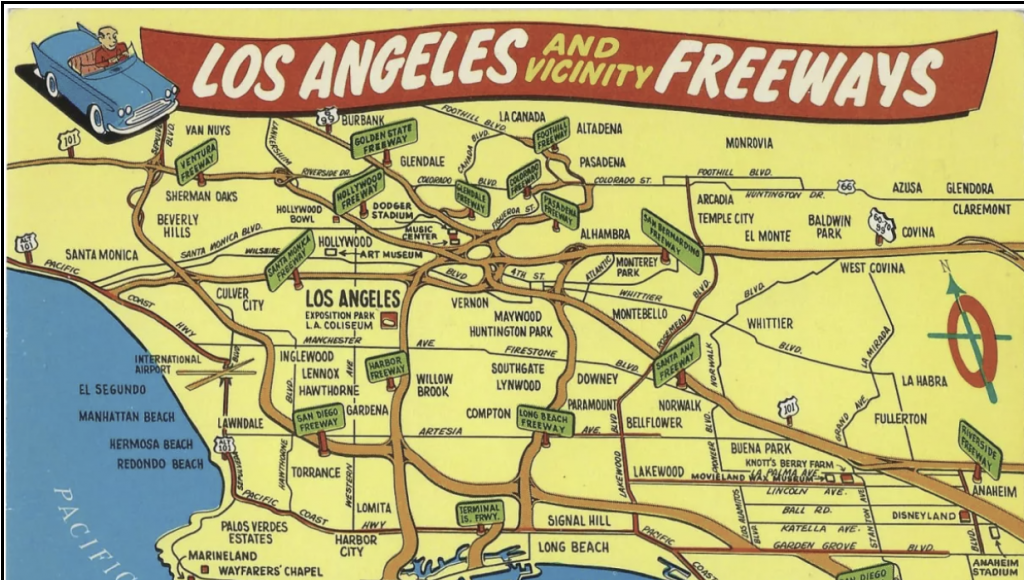
Yesterday (3.9) a Los Angeles Times story by Sammy Roth explained how thoughtless white commuters and city planners of yore have casually worsened pollution of the air breathed by low-income communities of color.
Would it be be fair to use the term “intentional racist pollution of lower-income Los Angeles air“?
“Many residents of the county’s whiter, more affluent neighborhoods — who were often able to keep highways out of their own backyards — commute to work through lower-income Black and Latino neighborhoods bisected by the 10, 110 and 105 freeways and more,” the story explains.
And so residents of these neighborhoods — Baldwin Hills, Compton, Inglewood, Watts, South Gate, Paramount, Huntington Park — breathe shittier air. Because of cavalier white racist commuters who think only of themselves.
Speaking as a former resident of West Hollywood who would occasionally drive on freeways through the crappy areas of Los Angeles, I am completely ashamed of myself. I didn’t mean to cause residents of color to develop breathing problems, but that’s what I wound up doing. Because I was a deplorable white person with a car, although I mostly drove a rumblehog.
If this was a Woody Allen film made in the early ’70s, it would end with men dressed in white uniforms chasing Roth down the street with huge mosquito nets and forcing him into a straightjacket.
Bad Career Move
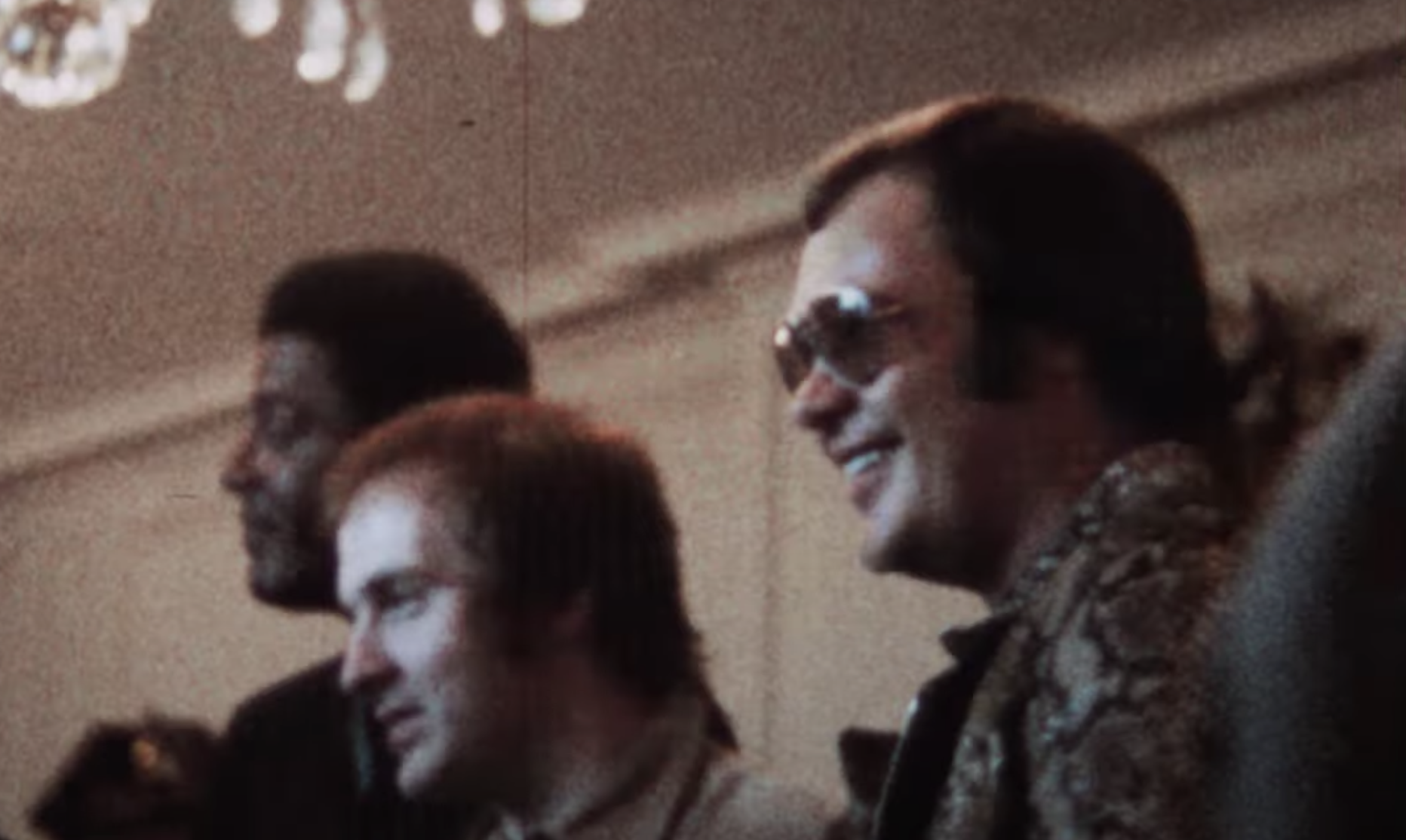
John Scheinfeld‘s What The Hell Happened to Blood, Sweat & Tears? (Abramorama, 3.24) is not a biography of the band, and basically has zip to do with Al Kooper‘s version of it (late ’67 to late ’68).
It’s about the David Clayton Thomas incarnation (’69 to ’71), I’m told, and more particularly about “a moment in time when BS&T found itself in the crosshairs of a polarized America, as divided then as it is now. It really is a political thriller with great music in it, not a music doc.”
Another description: A doc about how Blood, Sweat & Tears was pressured into sacrificing their cred with a sector of their audience that considered itself hip and anti-establishment.
Wiki: “In May/June ’70 the jazz-fusion band went on a United States Department of State-sponsored tour of Eastern Europe. Voluntary association with the U.S. government was highly unpopular with New Lefty-influenced fans at the time, and BS&T was criticized for this. It is now known that the State Department subtly pressured the group into the tour in exchange for a U.S. residency permit to Clayton-Thomas, who had a criminal record in Canada and had been deported from the U.S. after overstaying his visa.”
The Soviet bloc tour was compounded by BS&T accepting a lucrative gig at Caesars Palace on the Las Vegas Strip — another extremely uncool thing to do at the time.
There’s actually a section of the doc in which Kooper appears (including a rare piece of audio from back in the day), but he’d left the band more than two years before the events depicted in the film.
Tip of the Hat to Ross Douthat

…for alluding to “online haters” of Everything Everywhere All At Once in a 3.10.22 N.Y. Times piece called “Why Everything Everywhere Will Probably Win Best Picture.” There is no online columnist in any country in the Engiish-speaking world who has spat and shrieked at this infuriating A24 release more than myself…I am half Diogenes and half Captain Ahab in this realm.
Friendo: “Douthat didn’t even touch the woke thing, which is the key to all of it. EEAAO is a perfect embodiment of the woke ideology in a movie. It’s basically about an older Chinese businesswoman grappling with an unhappy marriage, an IRS audit and gnawing discomfort about her chubby gay daughter.”
Doesn’t Get It
if a film has debuted under the Cannes Acid section, that’s an automatic concern. Plus if I’m going to immerse myself in a hetero erotic drama of some kind, at least one of the partners have to be suitably attractive. 99 Moons is now playing at Manhattan’s Quad…no interest.
HE’s Scott Wilson Encounter (i.e., One More Time)
The fanciful bond between Robert Blake and Scott Wilson has been pretty much carved in stone for decades, hence today’s reposting of a time-worn Wilson anecdote. I last mentioned it after Wilson passed on 10.6.18 at age 76.
Initially posted on 12.22.11: In the summer of ’81 I had a special Scott Wilson moment. It happened (or more precisely didn’t happen) in a hip West Hollywood dive bar on Santa Monica Blvd. (I can’t recall the name but it was between Sweetzer and Harper, and favored by actors at the time.) I was with a lady, and the first thing I noticed after entering the main room and ordering a drink was Wilson sitting at a table with a friend.
Wilson had played murderer Dick Hickock in the 1967 film version of In Cold Blood, and this was foremost on my mind. After mulling it over I told my girlfriend that I wanted to go over and get Wilson’s autograph and (this was crucial) ask him to write “hair on the walls” below his name.
The phrase came from Truman Capote‘s nonfiction novel and the film version of same. Prior to their late-night visit to the home of Kansas farmer Herb Clutter, Hickock promised his dark-spirited accomplice Perry Smith (Robert Blake) that no matter what happens “we’re gonna blast hair all over them walls.” I thought it might be ironically cool to persuade Wilson to acknowledge that.
But I wimped out, thinking he’d probably be offended. That was probably the right thing to do, but I’ve felt badly for years about this. The things that won’t leave you alone later in life are the ones you chickened out on.
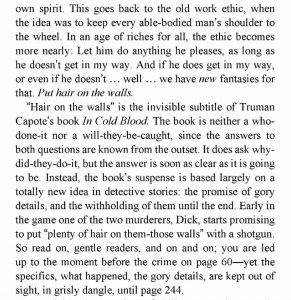
Blake’s Life + “Cold” Reappraisal
In last night’s death-of-Robert Blake post (“Blake’s Epitaph“), I mainly focused on a 1983 stolen Vespa scooter episode that involved Blake. The 50-year-old actor had found my stolen scooter abandoned on the concrete L.A. river bed near Magnolia Blvd. and reported it to the fuzz. I met Blake around dusk and thanked him, etc.
Blake was always a fascinating, first-rate actor, but the truly worthy films that he starred or costarred in were relatively few.
His most fully realized performance was a somewhat sentimental capturing of the real-life Perry Smith, a sadly abused, frustrated and emotionally constipated mass murderer, in Richard Brooks‘ In Cold Blood (’67). His second strongest performance was as a Native American fugitive in Abe Polonsky‘s Tell Them Willie Boy Is Here (’69 — unavailable to stream), opposite Robert Redford and Katharine Ross. At age 14, the cherubic Blake was spot-on as a Mexican lottery-ticket seller in Treasure of the Sierra Madre (’48) –= his third most vivid performance.
Blake played affecting supporting roles in Pork Chop Hill (’59), Town Without Pity (’61) and This Property Is Condemned (’66). I somehow never got around to seeing James William Guercio‘s Electra Glide in Blue (’73). I never wanted to see Busting (’74) because of my general loathing of director Peter Hyams. And I never saw Hal Ashby‘s Second Hand Hearts (’81) in which Blake costarred with Barbara Harris, as the word of mouth was awful. And I never saw a single episode of Baretta, the colorful cop series (’75 to ’78) in which Blake starred, and which made him fairly rich.
Blake was impressively creepy, of course, in David Lynch‘s Lost Highway (’97).
Originally posted on 8.30.15: “The older Richard Brooks‘ In Cold Blood gets, the more Hollywood-ized it seems. Much of the film has always struck me as an attempt by Brooks (who once sat right next to me in a Manhattan screening room during a showing of his own Wrong Is Right) to almost warm up the Perry Smith and Dick Hickock characters (played by Robert Blake and Scott Wilson) and make them seem more ingratiating and vulnerable than how they were portrayed in Truman Capote‘s nonfiction novel.
“You can always sense an underlying effort by Brooks and especially by Robert Blake to make the audience feel sorry for and perhaps even weep for Perry Smith. That guitar, the warm smile, the traumatic childhood. Take away the Clutter murder sequence and at times Blake could almost be Perry of Mayberry. Scott Wilson‘s Dick Hickock seems a little too kindly/folksy also.
“These are real-life characters, remember, who slaughtered a family of four like they were sheep. I realize that neither one on his own would have likely killed that poor family and that their personalities combusted to produce a third lethal personality, but I could never finally reconcile Blake and Wilson’s personal charm and vulnerability with the cold eyes of the real Smith and Hickock (which are used on the poster for the film).
“In Cold Blood is nonetheless a striking, reasonably honest, nicely assembled re-telling of the Smith & Hickock story. I respect it. I worship Connie Hall‘s cinematography. I love the editing. Quincy Jones‘ blues combo score is partly haunting and even mesmerizing and partly laid on too thick at times. The film is certainly a cut or two above mainstream fare of the ’60s. But it’s not a great film. It feels a bit too cloying and manipulative too often. Those memory and dream sequences (the sound of the mother’s voice going “Perrrry!”) are a bit much.