No More Riseborough-Style Campaigns!

This afternoon the AMPAS Board of Governors announced new campaign promotional rules and regs in order to prevent any further Andrea Riseborough-style guerilla campaigns.

The sore-loser contingent took great exception to the Risebourough insurgency, and so the Academy has announced rules that will make it harder for such a grass-roots campaign to manifest or be effective.

Members “may encourage others to view motion pictures”, and they “may praise motion pictures and achievements.” But they may not “share their voting decisions at any point. And they may not discuss their voting preferences and other members’ voting preferences in a public forum. This includes comparing or ranking motion pictures, performances, or achievements in relation to voting.

This also includes speaking with press anonymously” — a reference to those Honest Academy Ballot articles that Scott Feinberg and Anne Thompson have posted for years.

Note: Academy members have always known they aren’t supposed to talk to journos like Feinberg and Thompson, but they’ve done it anyway, and will almost certainly continue to do so.

Furthermore, Academy members “may not attempt to encourage other members to vote for or not vote for any motion picture or achievement,” and they may not “lobby other members directly or in a manner outside of the scope of these promotional regulations to advance a motion picture, performance, or achievement.”

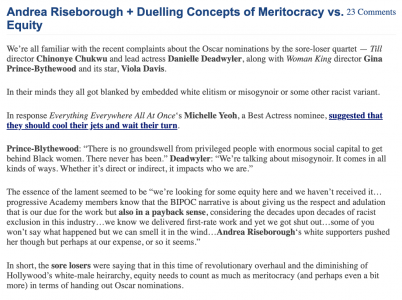
Andrea Riseborough + Duelling Concepts of Meritocracy vs. Equity,” posted on 2.15.23:
Read more

Songs That Fit A Film Perfectly & Vice Versa

Marriages between an exceptional film sequence and a great pop song can make for very special combustions.

I’m talking about the use of one or more songs (either acquired or originally composed) that have enhanced and deepened the emotional value of a non-musical film. And a certain film that, after merging with the right song or songs, acquires a certain dimensionality or legendary quality for itself.

A situation, in short, in which both the movie and the music experience a major mutual upgrade.

Example #1: Berlin‘s “Take My Breath Away” was not only written for Top Gun — it was forever welded to the legend of that film and vice versa.

Example #2: That blues number (I don’t even know the title!) performed by the Mighty Joe Young Blues Band in Michael Mann‘s Thief (’81). I’ve never forgotten that song, and Thief was hugely amplified by it. Performed at The Katz & Jammer club on Chicago’s North Side.

Example #3: Phil Collins‘ “In The Air Tonight” was one thing when it popped in January ’81, but it became a whole ‘nother thing when it was used for that sex-on-a-train scene sequence in Risky Business, which opened two and half years later (August ’83).

HE Picks: (1) “Moon River,” Breakfast at Tiffany’s; (2) Blondie‘s “Call Me”, American Gigolo; (3) Bob Dylan‘s “Knockin’ on Heaven’s Door,” Pat Garrett and Billy The Kid; (4) “The Power of Love,” Back to the Future; (5) “Up Where We Belong”, An Officer and a Gentleman…the list goes on and on.

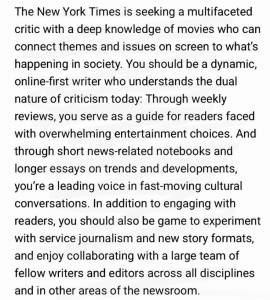
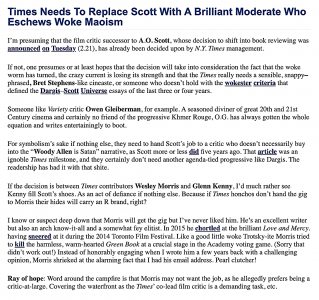
N.Y. Times Seeking Woke Maoist Film Critic?

Or someone less agenda-driven?

I’m presuming that this recently posted N.Y. Times want ad for a full-time senior film critic slot (i.e., an invitation for qualified persons to apply) is essentially bullshit. They have a pretty good idea who they’re going to hire, I’m guessing, and it won’t be some sensible centrist type with amiable popcorn tastes. They almost certainly want a woke Maoist. The ad is about Times management needing to demonstrate that they’re an equal opportunity employer.

I wonder if this means that Wesley Morris has passed on the job?

Update: I’m told that the ad isn’t entirely bullshit as the Times hasn’t yet hired a replacement.

Two and a half months ago (2.21.23) I posted a piece about who might replace outgoing N.Y. Times film critic A.O. Scott. It was called “Times Needs To Replace Scott With A Brilliant Moderate Who Eschews Woke Maoism.”

Sian Heder Is Suddenly Cool

Three things about Sian Heder‘s CODA: (a) It’s an audience-charming confection that dealt sincere cards with a little too much heart sauce, (b) it was obviously more likable than Jane Campion‘s doleful Power of the Dog so I understood why Academy members gave it the Best Picture Oscar, and (c) it wasn’t saved by the Best Supporting Actor Oscar-winning Troy Kotsur but by Eugenio Derbez, who played the Latino singing teacher.

In short I’ve respected Heder’s work as far as it goes, but I never thought of her as being all that hip or edgy. Until last night, that is, when I caught her cameo in episode 4 of Barry (“it takes a psycho“). Now I really respect her. Because the scene she’s in satirizes the syndrome of indie-level directors taking paycheck gigs on superhero movies. (Chloé Zhao directing the much-maligned Eternals, Ryan Coogler helming Black Panther, etc.)

Playing herself, Heder appears in a Hollywood sound-stage scene, directing a Wonder Woman-ish fantasy flick called Mega Girl. Sarah Goldberg‘s “Sally Reed” is helping Ellyn Jameson‘s “Kristen” prepare for a big monologue scene, and she spots Heder almost immediately.

Sally: Hi…hi, you’re Sian Heder.
Heder: Hi.
Reed: I’m Kristen’s acting coach.
Heder: Great.
Reed: CODA is a masterpiece.
Heder: Thanks.
Sally: It’s incredible. I mean I could cry just thinking about it.
Heder: I’m clearly switching gears on this one. On CODA I worked with committed actors to tell a deeply personal story, and now I’m working with models in Halloween costumes fighting over a blue glowy thing.
Sally: Well, that’s exciting.
Heder: Yeah, it’s gonna be a good movie…I think. I think when people see Mega Girl, they’re gonna think ‘whoever made that, made CODA.”

Read more