“Asteroid City” Sticks to Anderson Template

I wrote earlier today that Wes Anderson‘s Asteroid City (Focus Features, 6.16) would almost certainly be “another signature tableau exercise in WesWorld irony — zero emotion, wit, whimsy, staccato dialogue, a darkly humorous attitude, etc.”

Add in the other familiar signatures — formal framings, immaculate and super-specific production design, etc. — and that’s pretty much what Asteroid City is…surprise!

Having been a conflicted Anderson fan for over 25 years and an Anderson friendo since ’94, it breaks my heart to say this once again, but Asteroid City is a whole lotta fun to splash around in, eye-bath-wise, but there’s almost nothing going on except the Anderson troupe reciting their lines just so.

Immaculate style (in this instance ’50s kitsch) mixed with bone-dry humor and not much else.

Yes, Asteroid City features a meaningless, blink-and-you’ll-miss-it Scarlett Johansson nude scene (nothing remotely close to that buck naked Lea Seydoux posing-for-Benicio del Toro scene in The French Dispatch).

And a delightful musical sequence featuring some wonderful Oklahoma!-like polka dancing, performed by Maya Hawke and Rupert Friend.

And a cartoonish, silly-looking alien with 1950s Warner Bros. animation department bug eyes who, in 1955, twice pays a visit to Asteroid City, the small-town site of a Junior Stargazers convention. Except the alien does nothing (no threats or love or anything in between) and has nothing to say or to teach like Michael Rennie did four years earlier…zip.

The song-and-dance sequence, which ignites with the joyful spirit of choreographer Agnes DeMille, indicates that Wes feels real affection for musicals. Perhaps if he had filmed Asteroid City as a sung-through opera?

But of course, he didn’t and probably couldn’t. Because (and again, it really hurts to say this) he’s been wrapped so tightly in his WesWorld aesthetic — dry sardonic humor, deadpan line readings, somber philosophical musings — that he can’t seem to bust out of it or has lost interest in doing so or whatever.

Remember when Wes’s characters went through actual human difficulties and occasionally expressed emotion? The kind you could relate to, I mean? Certainly in Bottle Rocket (Luke Wilson‘s glorious love for Inez, the motel maid) and Rushmore (romantic obsession, jealous rage) and more recently in Grand Hotel Budapest (bittersweet nostalgia for a certain elegant, old-world way of life that’s been washed away by time).

What is Asteroid City attempting to deal with, metaphorically or adult-behavior-wise or what-have-you?

The best I can figure is that it’s about complacency — several highly attuned, obviously intelligent characters who are, of course, nominally aware of the alien’s visit and are taken aback by this world-shaking event but can’t say or deduce or conclude anything of substance. Nothing means nothing, but they sure are surrounded by a lot of drop-dead southwestern nothingness (fake mesas in the distance, a huge tourist-attraction crater), and the film sure is an eyeful to look at. It’ll probably give you an occasional chuckle or, more likely, an LQTM moment.
Read more

Mid ’50s Visitation

Wes Anderson‘s Asteroid City (Focus Features, 6.16), a quirky ensemble piece set during a Junior Stargazer convention in 1955, will screen today at the Salle Debussy at 5:30 pm.

We all know what it will actually be, which is another signature tableau exercise in WesWorld irony — zero emotion, staccato dialogue, informed by a darkly humorous attitude.

Asteroid costars Jason Schwartzman, Scarlett Johansson, Tom Hanks, Jeffrey Wright, Tilda Swinton, Bryan Cranston, Edward Norton, Adrien Brody, Liev Schreiber, Hope Davis, Steve Park, Rupert Friend, Maya Hawke, Steve Carell, Matt Dillon, Hong Chau, Willem Dafoe, Margot Robbie, Tony Revolori, Jake Ryan and Jeff Goldblum.

Pic was shot a little less than two years ago in Chinchon, Spain (between August and October 2021).

Shattered Into a Thousand Pieces

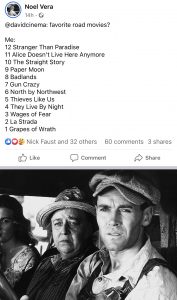
Late this morning I spent more than an hour tapping out a piece about HE’s ten favorite road films. It was called “Road Movies As Existential States of Mind.”

I’d been inspired by Ilya Povolotsky‘s Grace, a somewhat gloomy mood piece about a father and teenaged daughter drifting through Russia’s outlying regions and screening outdoor movies to small-town congregations.

When we sat down the other night Povolotsky emphasized that Grace is much more in the tradition of Wim Wendersroad trilogy than, say, Federico Fellini‘s La Strada (’54), which Grace bears a certain resemblance to but is far less emotional than.

I then wondered if it was fair to categorize road films into two groups — movies in which travellers seem to have succumbed to the idea of roaming around as a permanent state of being with no particular goal or destination in mind, and other road flicks that are defined by a single quest and a single journey that has a beginning, middle and end.

I then spent a long time deciding which are my favorite road films of the last 60 or 70 years, and then deciding on their proper order and whatnot and including links for all ten.

And then I saved the piece and my online connectivity somehow ruptured or collapsed. The article had failed to be acknowledged on the other end and was sent down a black tunnel-like hole, never to be recaptured. 90 minutes of hard work destroyed. I shrieked and wept like a nine-year-old boy whose dog had just died. I pounded on the armrest of a couch I was sitting on. I was so furious and distraught that it took me a good hour to recover and start over. But I’m on a clock and I can’t create another list with links…not now.

I know that The Last Detail was #2 on my list, and La Strada was #3 or #4. Easy Rider and Planes, Trains and Automobiles were somewhere in the top ten.

Note: Obviously Alice Doesn’t Live Here Anymore is NOT a road movie.

Absence of Daniel Day Lewis Gene

Which well-known, big-name actors today have more or less admitted what Peter O’Toole‘s Alan Swann character shouted out in My Favorite Year — “I’m not an actor, I’m a movie star”?

Actors, in other words, who’ve acknowledged that they’re very good in a certain type of role but that’s all? Actors who’ve said in so many words that they’re not Daniel Day Lewis or Laurence Olivier and are more or less cool with this?

Perhaps not as baldly or bluntly as Steve McQueen copped to decades ago, but actors who’ve said they’re good within a certain perimeter, playing a particular kind of film and conveying a certain mode or mood or attitude, and have decided this is good enough and that it’s better not to step outside their zone?

Clark Gable was one of these — excellent playing Gable-type roles but careful to stay within his perimeter. Alan Ladd, Jean Arthur, Humphrey Bogart, Bette Davis, Robert Redford, Owen Wilson…pretty much all movie stars have figured out what their big-screen persona is and have boiled it all down and figured what works best for them.

Catching Up With Roxborough

In a recent CNN interview, The Hollywood Reporter‘s Scott Roxborough obediently laments the presence of Johnny Depp during the opening-night festivities for Jeanne du Barry. We all understand that Depp’s louche, arrogant behavior (inflamed by alcoholism) was a factor in his turbulent marital relationship with Amber Heard, but wokesters should at least acknowledge the judgment of the jury in the Virginia defamation case, and allow for the possibility that Depp and Heard’s relationship was toxic from both sides and that she threw as many grenades as he did.

Roxborough says that the Cannes Film Festival “has a long way to go” in terms of gender parity, or a belief that an equal humber of male and female directors need to be represented on all the slates. Which means that celebrating quality isn’t as important as enforcing progressive political goals.

While choosing 19 films for the main competition, it’s conceivable that 12 goodies might be directed by women and 7 by men. Parity says that 3 female-directed goodies have to fall by the wayside (i.e., go to Directors Fortnight or Un Certain Regard) to make room for 3 slightly less satisfying films made by men.

Roxborough also pronounces Cannes like kick the can or can of sardines. It shouldn’t be pronounced with an “auughh” sound but with a middle-ground “Cahnnes.”

Betrayal, Restoration of Trust

“It’s not a whodunit — it’s a who-didn’t-do-it?” — Martin Scorsese‘s press conference description of Killers of the Flower Moon.

Scorsese and Robert De Niro hadn’t attended Cannes together since the ’76 premiere of Taxi Driver — 47 years ago.

Lily Gladstone: “It wasn’t so much me finding the role as it finding me.” Her voice has an Indiana housewife sound…guttural, a bit twangy…she leans into her “rrrs” and pronounces golden like “gouhllduhn.”