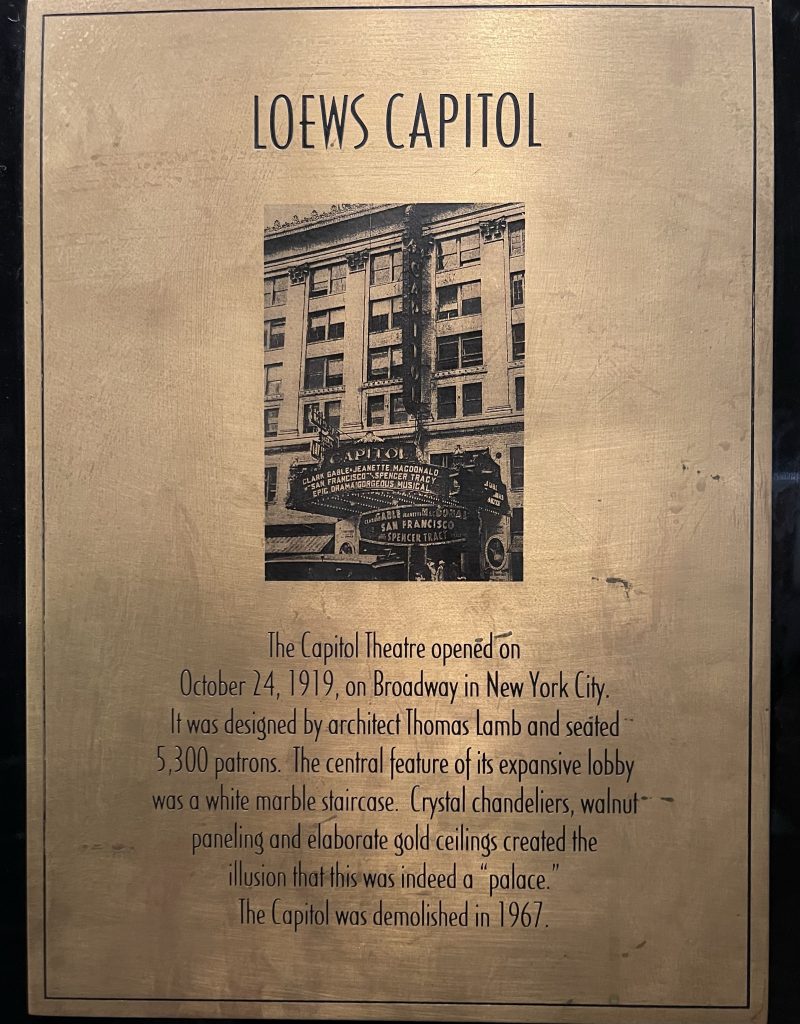
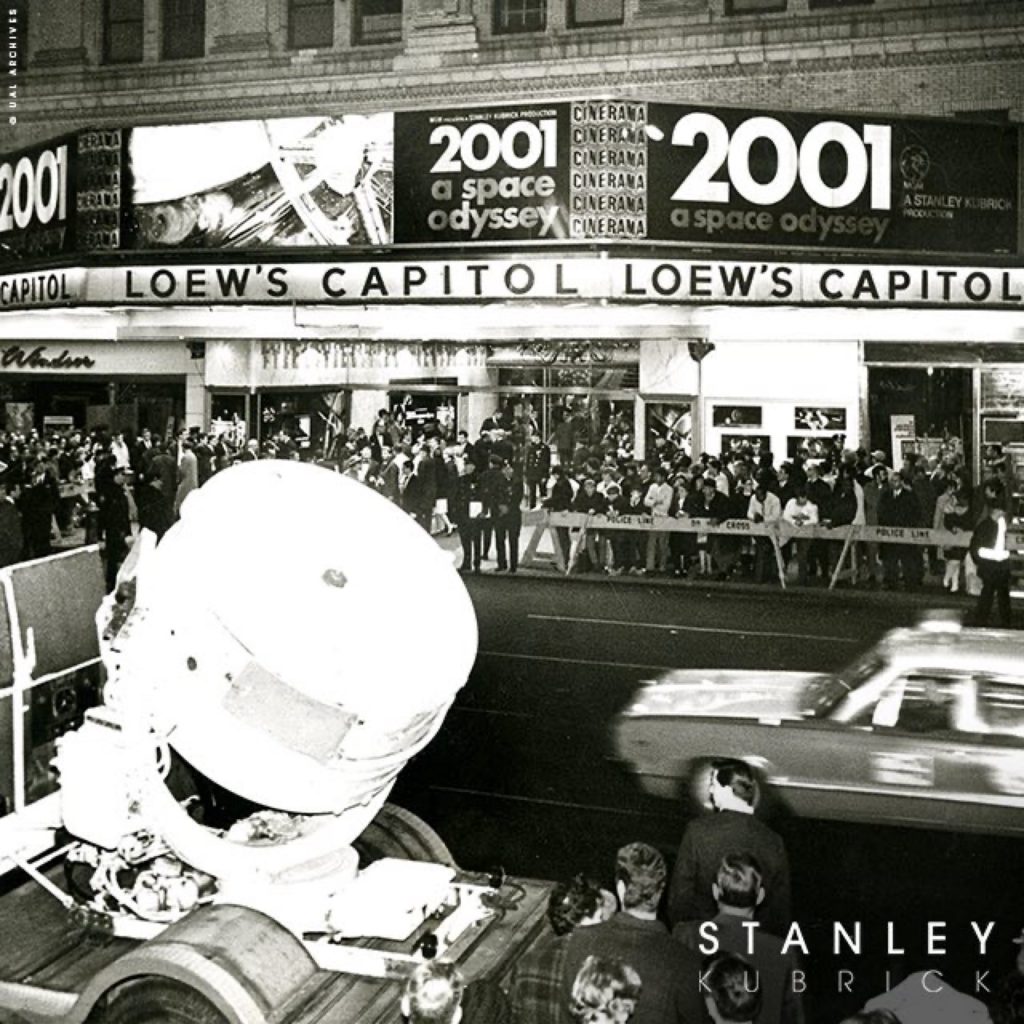
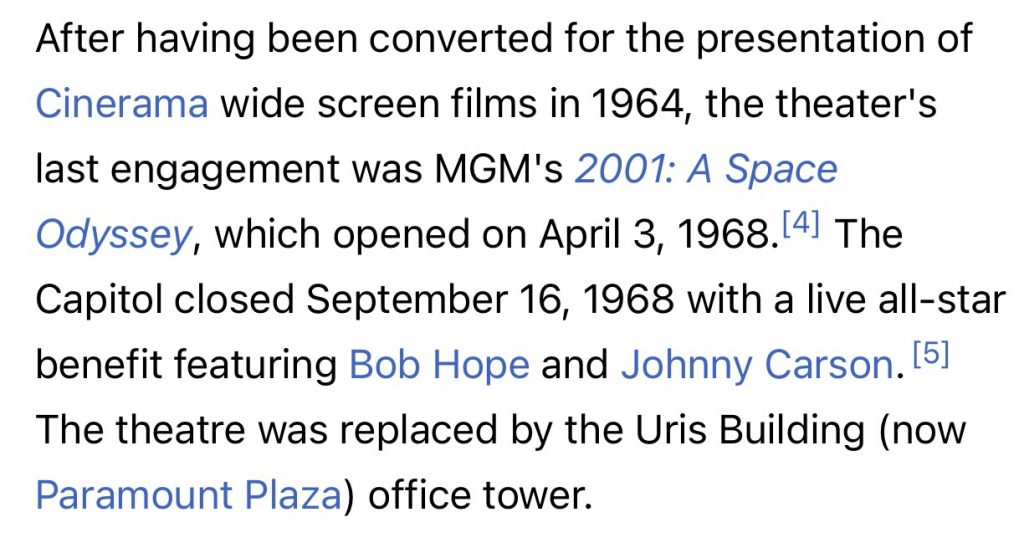
A bronze wall plaque inside Loews’ Lincoln Square (where I saw Celine Song’s PastLives in the late afternoon) commemorates the late Loews’ Capitol theatre (B’way at 50th or 51st). Built in 1919, the 5000-seater gave up the ghost in September 1968. For some reason the plaque says it was torn down in ‘67. 2001: A SpaceOdyssey opened at the Capitol on 4.3.68.
Harrison Ford is profiled in the current Esquire. Written by Ryan D’Agostino, the longish article is titled “Harrison Ford Has Stories to Tell.” About halfway through Ford articulates a feeling about the emotional, spiritual and even psychological nourishment that the best films provide.
It is this very nourishment factor, of course, that 95% of big-screen attractions don’t provide. Movie theatres used to be regarded by certain devotees (i.e., “film Catholics”) as churches, but over the last 15 or 20 years they’ve become gladiator arenas. They cater to animals.
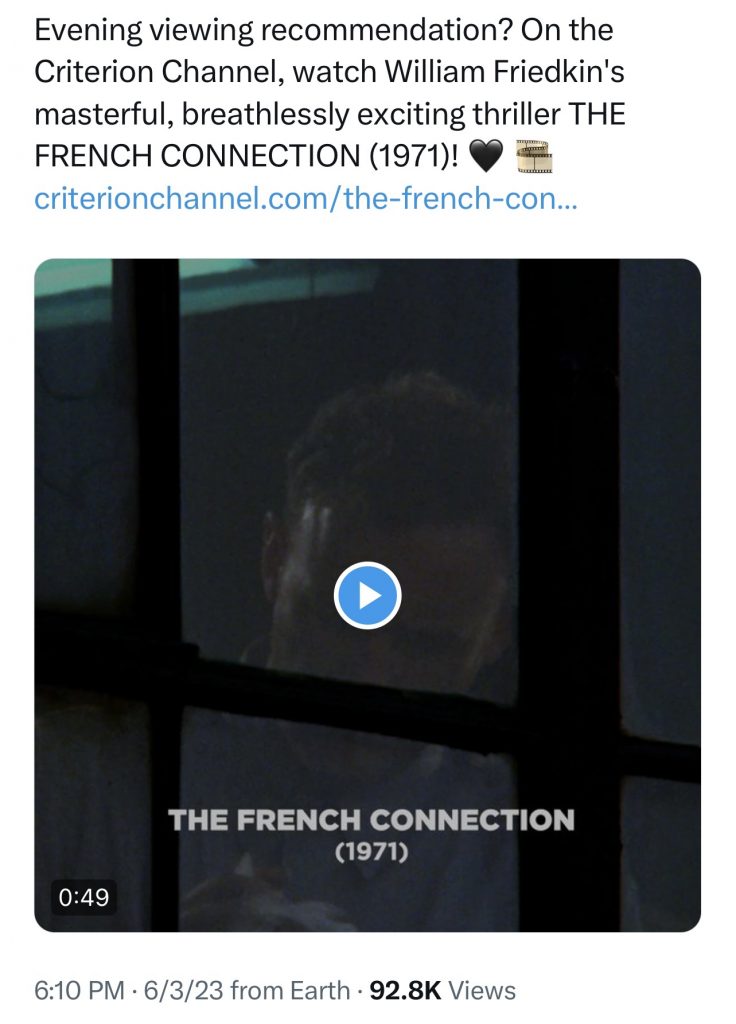
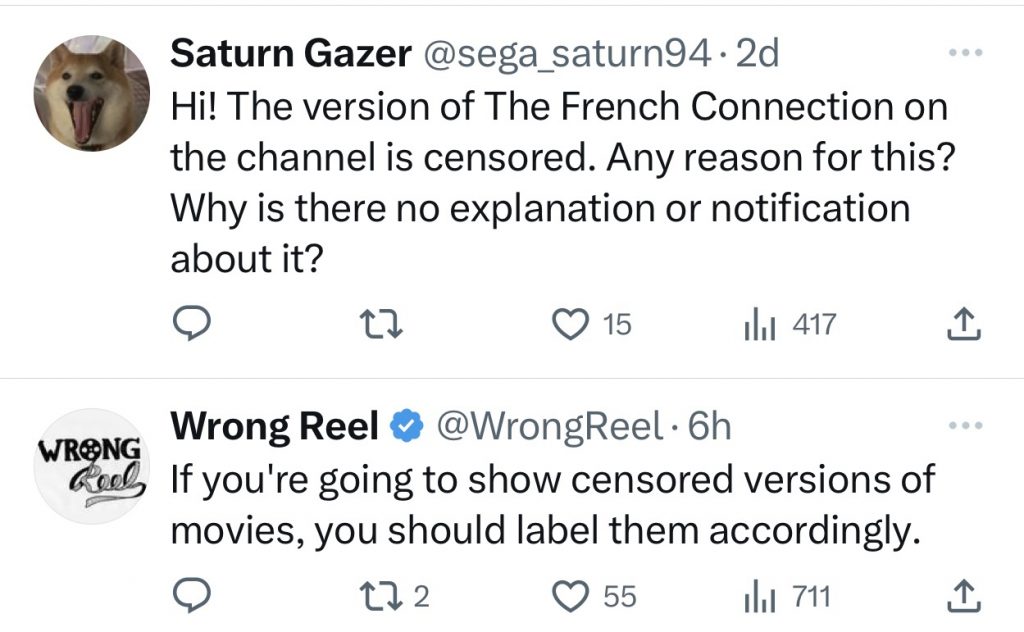
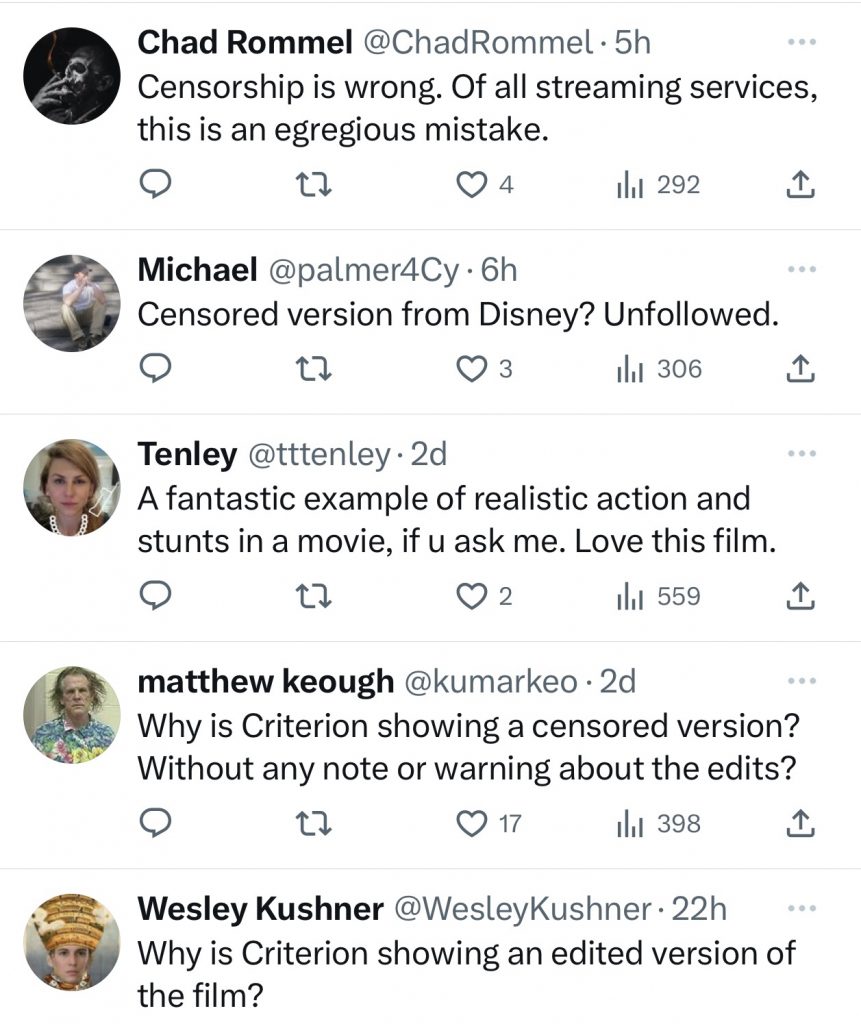
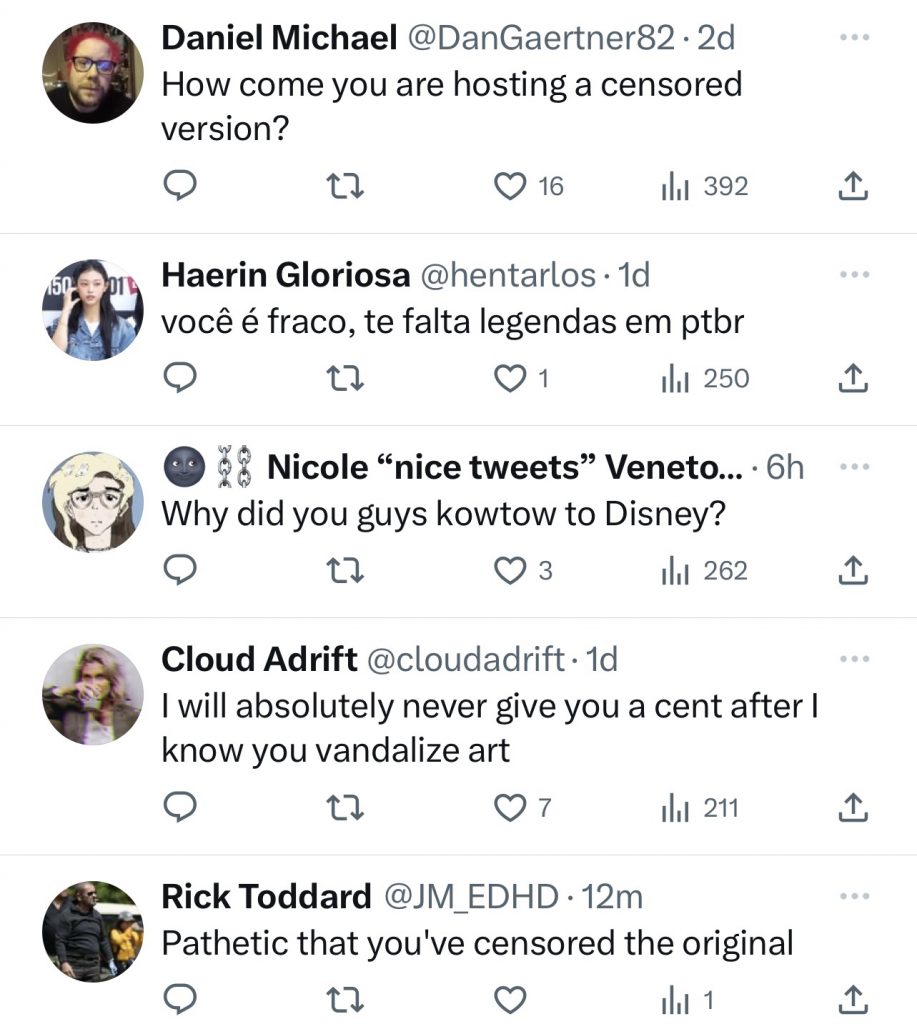
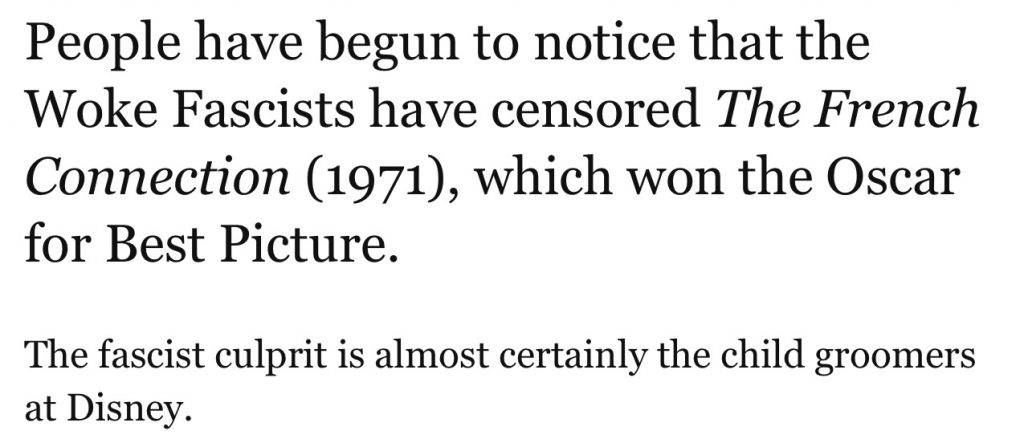
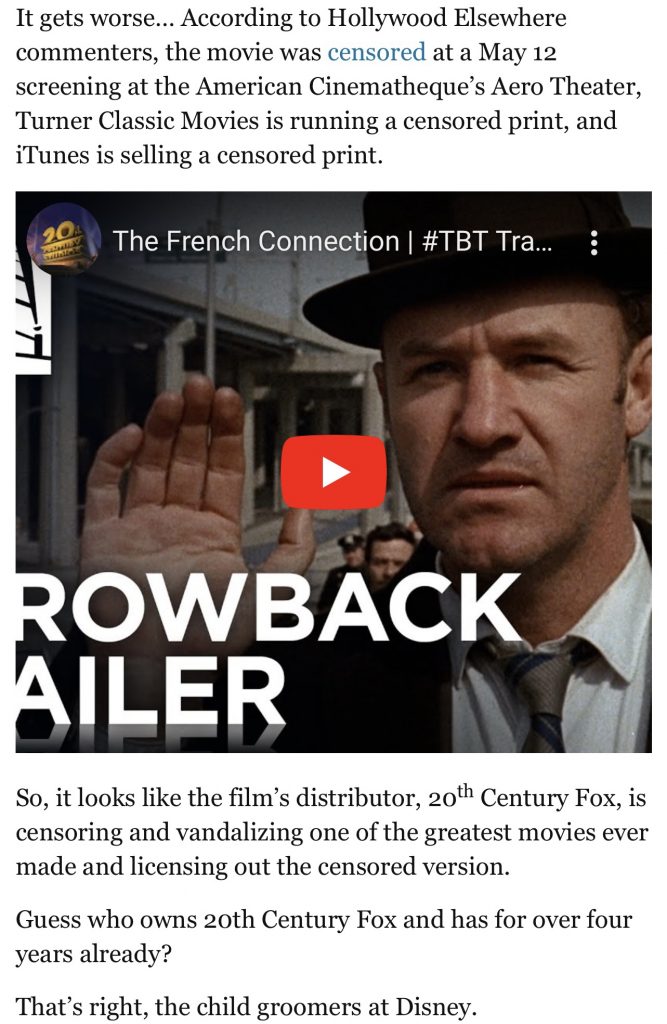
The censored version of the 1971 Oscar-winner is currently streaming all over (Criterion Channel, TCM, iTunes) and was shown at Santa Monica’s Aero theatre on 5.12.23.
Three days ago (Saturday, 6.3) I posted about the censoring of a six-second sequence in William Freidkin’s TheFrenchConnection, apparently by rights holder Disney over concerns about Gene Hackman’s ruthless cop character, Popeye Doyle, using the N-word. The next day I refreshed and summarized same (6.4).
This is obviously a hugedeal, and yet no columnist or critic has said a DAMN THING since last Saturday. Are they afraid of complaining about the deleting of an ugly word in a classic film? Most likely, yeah. Are they holding themselves in check because they feel obliged to be “goodGermans” inthewokesenseofthatterm? You betcha.
There’s also the possibility that they don’t want to give me any credit for raising a stink, and that personal animus means more to them than calling out woke censorship as it affects what is arguably the finest urban-cop thriller ever made.
Until this morning (6.6), that is, when Breitbart’s John Nolte postedapieceaboutsame. Draw your own conclusions. Mine, as noted, is that others (including certain filmmakers) are too chicken to say anything. That or their pettiness knows no bounds.
Paul Stanley and Harry Kleiner‘s Cry Tough (United Artists) opened in August 1959, when steamy, semi-nude sex scenes were all but absent from mainstream American films.
Cry Tough was mainly a crime film about Puerto Rican gang activity in Spanish Harlem, but between 39:00 and 43:53 there’s a fairly provocative bedroom scene between John Saxon, 23, and the Argentinian actress Linda Cristal, 28.
Saxon and Cristal died almost exactly a month apart in 2020 — 7.25.20 and 6.27.20 respectively.
HH to NWJ: “Corporations and individuals are well within their rights to cut films apart to their delight, you say Corporations are well within their rights to do many terrible things — so? Again, look at all the ink you’re spilling over insisting on the editorial rights of Disney whilst spilling essentially none about what’s happened to The French Connection (let alone why it’s happened).
“You would’ve made a fine useful idiot for the studios when they took Greed, The Magnificent Ambersons, Brazil, Dune, Margaret et. al. away from the filmmakers.
“I never again want to hear you bitch about this site needing to get back to talk of cinema, because you’ve revealed here how little you actually care about the artists who create that cinema and how quick you’re willing to make the sanctity of a filmmaker’s vision secondary to a semantic nitpicking that would help maintain your ideological entrenchment and not have to confront why this has happened/keeps happening.
“Why DO you think this happened, by the way? Why DO you think the studio chose to exercise its ‘rights’ in this case?
“Don’t ever again tell us Jeff has abandoned cinema when this is a far more egregious and repugnant abandonment by you.”
Finessed synopsis: “Fanny (Lou de Laage) and Jean (Melvil Poupaud) are an ideal couple: financially flush and professionally fulfilled, they live in a magnificent apartment in [one of] the high-end districts of Paris and seem to be as in love as [they were on] the first day they met.
”But when Fanny crosses, by chance, Alain (Niels Schneider), a former high school friend, she is immediately hooked. They see each other again, and, very quickly, get closer and closer…”
I’ve just watched the riveting, highly charged French-language trailer for Woody Allen‘s Coup de Chance, but of course it has no English subtitles. Any bilinguals who could possibly help with an English-language transcript of the dialogue?
The trailer announces that Coup de Chance is opening in French-language territories on 9.27.23. It will probably be previewed in Venice or San Sebastian or perhaps both. As we speak no U.S. distributor has found the balls to release the film stateside. I will be attending the Telluride Film Festival a little less than three months hence. It goes without saying I would love to see Coup de Chance play there.
A couple of months ago I reported about an early April screening of Coup de Chance in Manhattan. Resturateur Keith McNally and columnist Roger Friedman raved. If another advance NYC screening is slated for sometime this summer, I’d sure like to attend!
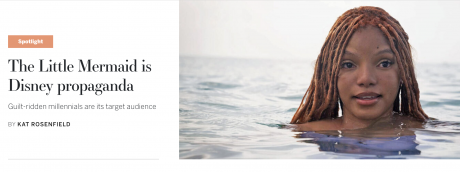
According to “The Little Mermaid is Disney Propaganda,” a 6.5 Unherd article by Kat Rosenfeld, old-fashioned, shamefully un-woke Disney cartoons and animated features on Disney + “come affixed with a hectoring title card that you cannot fast forward through.”
“This program includes negative depictions and/or mistreatment of people or cultures,” it reads. “These stereotypes were wrong then and are wrong now. Rather than remove this content, we want to acknowledge its harmful impact, learn from it and spark conversation to create a more inclusive future together.”
“This Oscar-winning film, initially released in 1971, includes negative depictions and/or mistreatments of African Americans. These depictions were wrong then and are wrong now. Rather than remove this content, we want to acknowledge its harmful impact, learn from it and spark conversation to create a more inclusive future together.”
Why didn’t Disney simply choose this option? Nobody would’ve squawked if they had.
“It is nonetheless astonishing that the Criterion Channel is running this version of Friedkin’s Oscar-winning film (Best Picture, Hackman for Best Actor, Friedkin for Best Director, Best Film Editing, Best Adapted Screenplay) without an explanation of some sort.
“This deletion seriously harms the Criterion brand, which has always been about honoring and representing the original artistic intentions of filmmakers. The deletion was apparently Disney’s doing, but Criterion can’t just sit idly by.
“Criterion’s streaming version of The French Connection needs to include a three-point statement, to wit: (a) the following film has been altered from its original state; and (b) is therefore not altogether the same film that opened in 1971 and subsequently won five Oscars, although (c) the alteration was not implemented by the Criterion Channel but by the Walt Disney Company, which owns the distribution rights to the film.”





 />
/>