“A Lot of Hoo-Hah For a Key”

Friendo: “I too have now seen MI:7 twice. One of the things that jumped out at me was that maybe, just maybe the AI ‘Entity’ had evolved to the point where it surmised that war is unnecessary (like the computer in John Badham‘s War Games) and therefore in the beginning sequence in the Russian submarine it’s trying to kill itself and bury the sub.

“It wouldn’t surprise me if that’s the payoff in the sequel.

“I also enjoyed the nod to Silence of the Lambs when Tom Cruise calls out Haley Atwell‘s “Grace” for trying to compensate for her “orphaned background with fine clothes and blah blah”, sort of like Anthony HopkinsHannibal Lecter chiding Clarice Starling about ‘your good bag and your cheap shoes…you look like a rube…a well-scrubbed, hustling rube with a little taste.’

“And I know you loved that moment when Cruise and his motorcycle leapt over a wall in a field, just like Steve McQueen in The Great Escape.

“After it ended I polled a few audience members and they were mostly happy, although some said they weren’t sure they needed to see the sequel. ‘That’s a lot of hoo-hah for a key’, one guy told me. ‘They got it. Now what…they’ll have to go and find the lock?”

Kundera’s Life and Legacy

The great Milan Kundera (“The Unbearable Lightness of Being,” “The Book of Laughter and Forgetting“, “Immortality”) died yesterday at age 94.

As a highly influential, world-renowned, Czech-born writer who moved to Paris in ’75, Kundera’s peak influence years were in the ’70s and especially the ’80s, which is when Philip Kaufman‘s The Unbearable Lightness of Being (’88) was released.

Having read and adored Kundera’s 1984 novel I was vaguely…actually more than vaguely disappointed with Kaufman’s film. There was so much more to the book than what Kaufman and co-scenarist Jean-Claude Carrière chose to focus upon. (I felt the same way about Kaufman’s The Right Stuff (’83) — Tom Wolfe’s 1979 book was ten times more interesting and engaging.)

The only thing I liked about Kaufman’s Unbearable Lightness were the performances by Daniel Day Lewis and the newly arrived Juliette Binoche, who was only 23 or 24 during filming.

I’ve always regarded Kundera’s prose style as immaculate and elegant. Pared to the bone, nothing extraneous or superfluous but with a certain oxygenated quality…a feeling of aliveness. In my estimation his writing has always existed in the same realm as Joseph Conrad‘s.

Along with Tom Wolfe, Hunter S. Thompson, Jerzy Kosinski, Jim Harrison**, William Faulkner, Norman Mailer, William Safire and Russell Baker, Kundera has long been a major influence upon my own meager scrawlings.

Kundera was apparently a hound in his actual life (and so his semi-fictional characters followed suit), and I’m sorry but I really worshipped that special erotic current that sometimes permeated.

Kundera was something of a chauvinist, okay, but those sensual and sexual atmospheres were…I don’t know what to call them except cultured and tingly and fascinating on several levels. But it was all subordinate to those wonderfully honed sentences and that curiously magnetic sense of impermanence and vague anxiety and unsuppressible delight in the here-and-now.

I’ve just read a brief obit by The Hollywood Reporter‘s Scott Roxborough, an apparently obedient wokester who ends his article by noting that “Kundera’s depiction of personal, amoral behavior and sexual politics as a metaphor for the inherent absurdities of life in Czechoslovakia under communism drew widespread praise but also criticism, particularly from feminists who detected an inherent misogyny in his work.

“Kundera himself rarely gave interviews, and none of his books after ‘Unbearable Lightness’ achieved similar international success or acclaim.” Here’s the kicker: “[Kundera’s] final novel, perhaps fittingly titled ‘The Festival of Insignificance’, was published in 2015.”

As an occasional writer of none-too-flattering or too-honest obits, I was immediately disgusted by Roxborough’s final sentence.

Imagine Roxborough writing something similar if, God forbid, the great Clint Eastwood were to pass tomorrow — “None of Eastwood’s films over the last 15 years achieved the success or acclaim that he managed during the ’90s and early aughts — Unforgiven, A Perfect World, The Bridges of Madison County, Million Dollar Baby, Gran Torino. He hasn’t been a director of serious consequence since the beginning of the Obama administration, and perhaps it’s fitting to acknowledge that.”

Did Roxborough skim Daniel Lewis’s N.Y. Times obit before writing his own?

I don’t want to sound rash or overly condemning, but it seems to me that Roxborough is some kind of grovelling woke toady….”do you see who I am, #MeToo vanguard feminists? Do you see how I diminished Kundera-the-chauvinist in my final sentence? Do you guys approve of this? Do I get a gold star?”

Read more

Just Saw MI:7 Again

And right in the middle of the Austrian dangling train car scene, arguably the biggest wowser super-climax in the whole damn 27-year-old franchise, a 40something beefalo who’d almost certainly been gulping a 36-ounce soft drink, bolted out of his seat to run to the bathroom. He ran back in just when the last car has fallen and everyone was safe. Brilliant timing!

Thigh Slapper

The 2023 New York Film Festival will kick things off with Todd HaynesMay December, which costars Natalie Portman and Julianne Moore. The opening night selection will screen on 9.29 at Alice Tully Hall.

May December Feels Strained, Clumsy,” posted from Cannes on 5.21:

May December struck me as awkward and even silly at times. Haynes tries for a tone that mixes satiric whimsy and overheated emotional spillage while channeling Bergman’s Persona, but scene after scene and line after line hit me the wrong way.

“It’s about a famous actress, Elizabeth Berry (Portman), paying a visit to the pricey Savannah home of Gracie Atherton (Moore), a somewhat neurotic and brittle 60something who runs a dessert-cooking business. Elizabeth’s plan is to study Gracie as preparation for a soon-to-shoot film about her once-turbulent life, which involved a scandalous sexual affair with a minor and a subsequent prison term. Elizabeth naturally wants her forthcoming portrayal to deliver something truthful, etc.

“For her part Gracie is cool with the arrangement but at the same time a wee bit conflicted and anxious. She’s calculated that she’ll come off better in the film if she invites the pissing camel into the tent**.

“Seemingly modelled on the late Mary Kay Letourneau, a former school teacher who was prosecuted and jailed for seduced a 13 year-old boy named Vili Fualaau, Gracie is married to Joe Yoo (Charles Melton), a 36 year-old half-Korean dude who was also 13 when Gracie technically “raped” him while they were working together at a pet store, and with whom they now have two or three kids. (This is one of those films in which the exact number of kids in a given family is of no interest to anyone…zip.)

“If I didn’t have a Salle Debussy screening of Karim Ainouz‘s Firebrand breathing down my neck, I would list the eight or nine things that especially bothered me last night. Suffice that my basic reaction was one of exasperation. I literally threw up my hands and loudly exhaled three or four times. I groaned at least twice. I’m pretty sure I muttered “Jesus!” a couple of times. I also recall slapping my thigh.

“For what it’s worth Letourneau and Fualaau insisted from the get-go that their relationship was consensual; ditto Gracie and Jo in May December‘s backstory. After serving her prison term Letourneau married Fualaau and soon after had kids with him; same deal with Moore and Melton’s pretend couple.

** Exact Lyndon Johnson quote: ‘It’s better to have your enemies inside the tent pissing out, than outside the tent pissing in.'”

Read more

If You’ve A Heart, You’ll Double-Down For “Oppenheimer”

Even if, you know, it doesn’t quite manage to do the thing that you might want it to do.

See how this works? In the space of a single day Oppenheimer has suddenly become a more sympathetic contender in the Barbenheimer equation because everyone knows it won’t perform as well. It’s now The Little IMAX Engine That Could.

Barbenheimer Is Not A Contest,” posted today by Awards Daily‘s Sasha Stone:

Whacky “Wonka”

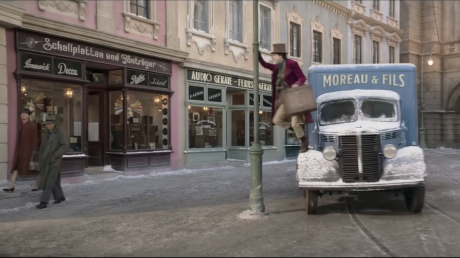
Paul King‘s Wonka (Warner Bros., 12.15) is obviously an exercise in charmed whimsical fantasy. But it is, apparently, set in 1950s England. (Clearly indicated by the cars and clothing worn by extras.) It serves as a prequel to Roald Dahl‘s 1964 novel “Charlie and the Chocolate Factory.”

It’s not really 1950s England as it actually was, of course. It’s 1950s England by way of diverse presentism. And only a truly foul and poisoned person would even mention this obvious fact.

Timothee Chalamet, Keegan-Michael Key, Rowan Atkinson, Sally Hawkins, Olivia Colman, Hugh Grant and Jim Carter.

Read more

Oppie’s Big Day in Paris

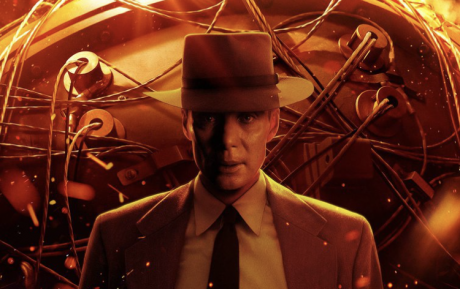
Everyone who cares about first-rate, upscale, drop-your-pants cinema will soon be seeing Oppenheimer (Universal, 7.21), and the vast majority will almost certainly love it for various smart-guy reasons — the intense Nolan-esque focus, the mindblowing visual scale, the fierce ambition, the psychological intensity.

I’m certainly not expecting it to be any kind of financial shortfaller, although I suspect it will register with a fair percentage of the viewing public as not escapist enough but that’s fine — who wants brainless escapism from an effete aesthete like Chris Nolan?

But I had to laugh this morning when I read a one-word comment on Jordan Ruimy’s World of Reel site…written by a guy I don’t know (and probably don’t want to know) called “Hannibal Lolocaust”.

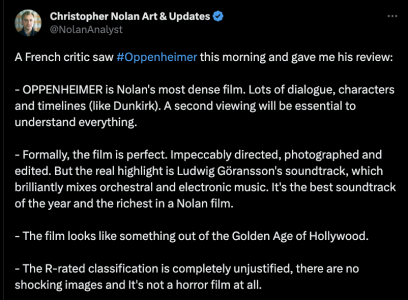
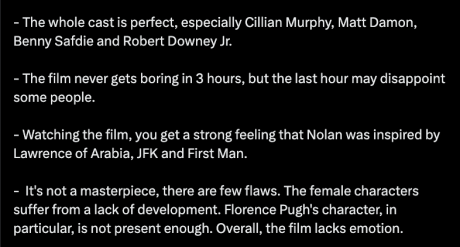
The morning actually started with two dismaying Letterboxd grades from a couple of French critics who saw Oppenheimer in Paris this morning, named “peachfuzz” (i.e., Emmanuel van Elslande) and Nathanael Bentura. The former gave it 3.5 stars out of five; Bentura gave it 3 stars. Obviously the opinions of two small-time French guys is statistically insignificant, but if I were Nolan I’d be going “hmmm.” Just a little bit. Especially when you add that tweet from Sean Nyberg.
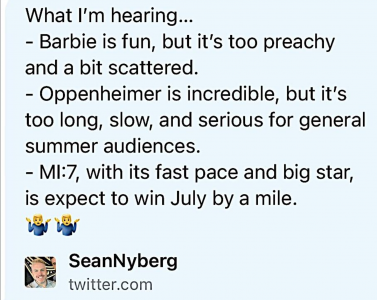
Why isn’t someone saying it’s an ecstasy pill…a profoundly fascinating journey? I know, I know — Kenny Turan was very impressed.

Here’s another fellow who was favorably impressed: “It is very destabilizing. It’s very long with multiple movies in one, but in the end it’s pure Nolan. Quite fascinating. I don’t want to oversell it either, but it’s at the top of the basket of Nolan films, I would say.”

What does “very destabilizing” mean, I wonder? Not following a clean narrative line or something?

Turan: “Arguably Nolan’s most impressive work yet in the way it combines his acknowledged visual mastery with one of the deepest character dives in recent American cinema, Oppenheimer demanded to be explored on its own [terms] with as much depth as possible.”

HE to friendo: “What the hell is Kenny actually saying? Deep character dive. What, in a submersible?”

Friendo to HE: “It’s largely a character study, apparently.”

HE to friendo: “Jesus, now it’s starting to sounmd like a chore to sit through. From everything I’ve read and watched J. Robert Oppenheimer has always struck me as a gifted genius physicist, but deep down he was a strand of overcooked fettucini. Sensitive to a fault. Who wants to hang out for three hours with a guilt-stricken weeny?”

Friendo to HE: “The embargo lifts at 5:30 pm today. Right after the Paris premiere.”

HE to friendo: “Pack your bags, kids! We’re all going on a long Oppenheimer guilt trip…a deep dive into the Cillian Murphy guilt swamp…splashing around in that swamp like Bela Lugosi in Bride of the Monster…just kidding. And yet, as I’ve said two or three times, WITHOUT showing what actually happened, horrifically, in Hiroshima and Nagasaki on 8.6.45 and 8.9.45. What about the incidental fact that the Japanese bad guys, obstinate and fanatical to an agonizing fault, had to be defeated, and as ghastly and horrific as the atom bomb was, those two homicidal explosions ended the war with Japan? Naahh, the Murphy guilt swamp is more compelling.”

Friendo to HE: “I don’t think Nolan just focuses on the A-bomb. He zeroes in on Oppie’s destructive obsessive nature as a man.”

HE to friendo: “Yeah, I’m getting that.”

Friendo to HE: “Allegedly there’s full frontal nudity. Murphy and Florence Pugh as Jean Tatlock, an off-and-on lover of Oppie’s in the late ’30s and a Communist party member who came to an unhappy end.”

“The Wind Was Blowing Hard…”

HE to friendo: “I’ve chatted with Jim Caviezel a couple of times — once during a junket for The Thin Red Line, and another time in a Park City restaurant during Sundance around 21 or 22 years ago — and I can tell you that up close he’s a very nice and gentle and courteous fellow. But in this clip he seems like a very eccentric Christian dude. No offense but a little bit whacked. I love what he’s saying about the utter painlessness and the peace of death…the heavenly transition and all that. I’ve had mystical notions myself along these lines, as I was a stone Bhagavad Gita mystic when I was 19 and 20. But he also seems a tiny bit weird.”

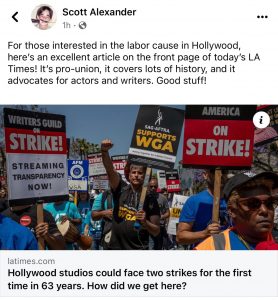
SAG Strike Imminent

Variety‘s Matt Donnelly is reporting that a SAG strike is not only imminent but hours away. If there’s no deal by Wednesday then forget it — the whole industry shuts down. No more promotional appearances by talent (including appearances at the Venice, Telluride, Toronto and New York film festivals) as well as a halt of all film and TV productions. “It would be a miracle at this point” to reach a deal by this Wednesday, one producer told Donnelly. As with the WGA strikers, the key issue appears to be about the sharing of streaming revenues. I don’t know anything but this is what’s being reported as we speak.

More of a Ritter Than a Kittridge Man

When Mission: Impossible — Dead Reckoning Part One opens tomorrow, audiences will rediscover Henry Czerny‘s Eugene Kittridge, playing not just the IMF director but one of the great all-time, upper-level, intelligence community dickheads.

If you’re any kind of fan of this franchise, you know that Kittridge, who’s been absent since his debut appearance in Brian DePalma‘s Mission Impossible (’96), is a near carbon copy of Czerny’s original upper-level intelligence community dickhead — CIA deputy director Robert Ritter in Phillip Noyce‘s Clear and Present Danger (’94).

While Ritter and the ’96 version of Kittridge were two peas in a pod — identical appearance, brusque, cynical, bespectacled — the present version of Kittridge is a slightly different species. Gray-haired, a bit heavier and with a sense of the absurd about the high-end intelligence car-chase and train-wreck racket, as some of his lines register in a deadpan humor vein.

HE is more of a fan of Ritter than Kittridge as Ritter would never, ever fuck around — he meant every damn word and never considered any sort of black-humor perspective.

What am I really saying? Clear and Present Danger played it straight and for the most part unironically while Mission: Impossible — Dead Reckoning Part One is a double tracker — mostly an ace-level thriller but partly (or at least at times) a Buster Keaton action film, as some of the action hijinks summon titters and guffaws.