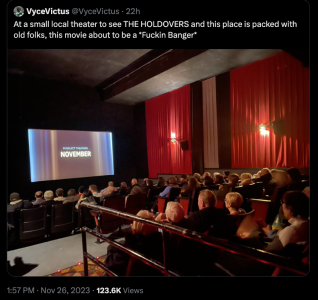
“Total Banger”

The VyceVictus praise is yet another measure of proof that Alexander Payne‘s The Holdovers (which begins streaming tomorrow) is happening with slightly older Average Joes. That doesn’t mean the assisted living crowd but anyone who thinks and feels outside the realm of Millennials and Zoomers…people in their 40s, 50s, 60s, etc. Or X-factor under-40s, who exist in certain pockets. All hail ’70s filmmaking chops, which are just as great now as they ever were.

Post-Thanksgiving Oscar Poker…Yowsah!

Sasha Stone and I recorded the latest Oscar Poker on Sunday, 11.26, around 1:30 pm. Here’s a link.

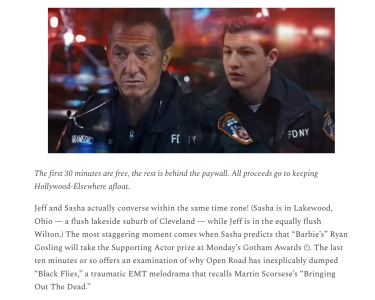
Incidentally: Hollywood Elsewhere continues to take exception to the strange absence of Black Flies, which Open Road has obviously yanked from its previously-slated late November release date.

An assaultive, high-velocity, rough and tumble capturing of the lives of Emergency Medical Technicians in Brooklyn, Black Flies may not be a great, earth-changing film but it’s certainly a respectable one while being a close relation of Martin Scorsese‘s Bringing Out The Dead (’99). We discussed this situation towards the end of the podcast.

Again, the link to the latest.

Read more

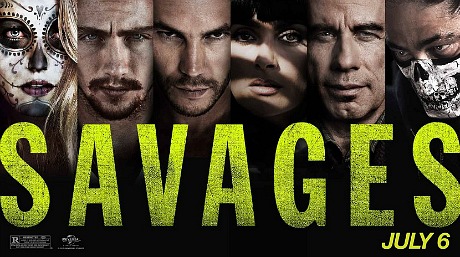
Who Remembers “Savages”?

Another recent re-watch was Oliver Stone‘s Savages. I panned it 11 years ago, but for some reason it didn’t go down all that badly two nights ago. It didn’t greatly bother me, and I really enjoyed Benicio del Toro‘s cartel enforcer, “Lado” Arroyo.

Posted on 7.6.12: Savages is about a couple of youngish, very flush Laguna Beach pot dealers (Taylor Kitsch‘s “Chon”, Aaron Taylor-Johnson‘s “Ben”) somehow failing to grasp the obvious when a Baja crime cartel tells them they want to distribute their potent product and split revenues 80-20. Which basically means “game over” and “time to move to Indonesia” because the Mexicans are fiends who will chew them up and spit them out one way or the other.

John Travolta‘s character, a corrupt DEA guy, explains that the cartel, run by Salma Hayek‘s “Elena” and enforced by Benicio’s “Lado”, is basically Walmart and that “they want a Ben and Chon section on aisle three.”

The guys intend to make a run for it while pretending to play along, but Elena smells duplicity and orders their girlfriend Ophelia, a.k.a. “O” (Lively), kidnapped. And once that happens it’s war — theft, hijackings, frame-ups, burnings, counter-kidnappings, etc.

I made a point of reading Don Winslow‘s “Savages” before catching the film, and was fairly taken with it. I love Winslow’s tight sentences and smack-dab phrasings, and the way it reads like a screenplay. So despite the beating Savages has taken on Rotten Tomatoes and Metacritic, I was hoping for at least a modicum of satisfaction. Some of the book had to rub off.

To me, that didn’t happen. At all. I felt assaulted and trapped and underwhelmed all through Savages. Almost nothing but pique. The first thing I said to a friend as I left the theatre was “why did they even make this thing? Who could possibly like this or recommend it with any enthusiasm?”

I was “directing the movie” as I read Winslow’s book, of course, and in my version the action was fast and brutal, like in real life, but I didn’t wallow in it. And the actors didn’t “act” — they read their lines flat, fast and straight. They just about threw them away, which is what you more or less have to do when you’re dealing with “I think we’ve struck gold” and “I had orgasms — he had wargasms.”

Stone does the opposite, for the most part. He whips up the visual energy every which way, glossing and flashing it up like there’s no tomorrow. And flaunting the spilt blood, gougings, torturings. All you want is for the killing and the sadism to ease up a bit, for Stone to go the “less is more” route. A touch of suggestion, imagination…not a chance. And the three leads — Taylor Kitsch, Aaron Johnson, Blake Lively — drop their on-the-nose lines like spoonfuls of mashed potatoes on the kitchen floor, “acting” with their eyes and smiling too much and pretty much murdering the potential coolness at every turn.

Narration is almost always a bad idea, but especially so with an action film. Lively is the narrator here, and her opening line — “Just because I’m telling this story doesn’t mean I’m alive at the end of it…it’s that kind of story” — is, no offense, terrible. I bought Joe Gillis narrating his own Sunset Boulevard saga from the morgue, but Lively saying she may or may not be dead at the end…forget it.

Read more

Son of New York Theatre Stories

Posted six and a half years ago6.17.17:

“There were brawls. I had guys die. You know, the show would end and someone’s still sitting there and then you realize they’re never getting up. I had a projectionist die one time in the booth. I heard the crowd booing, and then the movie’s off the screen. This is when there were carbon arc projectors, so a lot of times these projectionists would just fall asleep or they’d be screwing somebody up there and they’d forget to change the carbon arc.

“So I go up there…and the guy’s dead on the floor. I called the cops, and then I thought — this is how sick you’d get after being in New York for a few years in those days. I thought, ‘This is my big chance to actually shame a New York audience.’ So I went into this theater and I looked at them, and I said, ‘I’m very sorry for the inconvenience [but] the projectionist has passed away. We have someone going up there now, and your film will be on shortly.’ And they booed me!” — Savages author Don Winslow recalling a Times Square movie-theatre gig in the ’80s, reported by Bilge Ebiri in the Village Voice.

True story #2 (i.e., my own): I worked as a Brooklyn theatre manager sometime in ’79 or early ’80. I honestly forget the name of the theatre, but it was a midsize house that played mainstream films. I remember telling the guy who’d hired me that I’d been a licensed projectionist in Connecticut and that I’d worked at the Carnegie Hall and Bleecker Street Cinemas under Sid Geffen, which was true.

So I got the gig, but I became bored with the job very quickly. On top of which I was never all that reliable about keeping track of ticket sales and whatnot. I wasn’t skimming — I just wasn’t an efficient mathematical type. And then I decided to play Warren Zevon‘s Excitable Boy over the theatrical sound system before the show began. And I didn’t play it quietly — I had the sound levels up to at least 7 or 8. I was eventually canned, of course. The story of my life from the time I was 17 to the launch of Hollywood Elsewhere in August ’04 was “and then I got fired.”

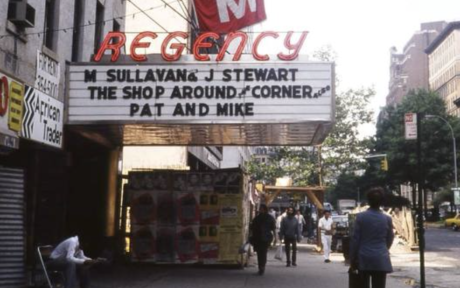
True story #3: I once led a small rebellion inside the old Regency Theatre (1987 Broadway, New York, NY 10023). It happened in the late ’70s. It was during a weekend showing of North by Northwest. Cary Grant and Eva Marie Saint were on the train from New York to Chicago, and then the projectionist skipped a reel and suddenly Grant was in the cornfield dodging bullets from the biplane. Or something like that.

I was up in a flash and running upstairs to the booth. I knocked sharply on the door…’Yo, hello?’ (rap, rap, rap). Two more guys came up to join me, and then a third and a fourth. No response from inside so another guy stepped up and knocked on the door with me. The projectionist came out, saw the angry crowd and freaked. He was like The French Connection‘s Marcel Bozzuffi when he was cornered by that MTA official on the speeding subway car…’Get back!…get back!’ We told “Marcel” about his error (he obviously hadn’t been watching the screen). He eventually calmed down and fixed the problem.

Disney Admits Woke Content Has Diminished Earnings

In a just-released SEC report, Disney has acknowledged that the woke political and social agendas contained in its creative product have cost the company dearly and drained the value of shareholder stock.

It all boils down to a lack of “consumer acceptance,” or more particularly general consumer perceptions “of our efforts to achieve certain…social goals, often differ widely and present risks to our reputation and brands.”

The Hill‘s Jonathan Turley: “Disney has reportedly lost a billion dollars just on four of its recent ‘woke’ movie flops, productions denounced by critics as pushing political agendas or storylines.

“Yet until now, the company has continued to roll out underperforming movies as revenue has dropped. What’s more, Disney stars persist in bad-mouthing its fabled storylines and undermining its new productions. The company admits that it has suffered a continued slide in ‘impressions’ (that is, viewership) by 14 percent.

Hurley excerpt #2: “You can bring movies to the public, but you cannot make them sell. Once an unassailable and uniting brand, Disney brand is now negatively associated with activism by a significant number of consumers. The company is now even reporting a decline in licensing revenue from products associated with Star Wars, Frozen, Toy Story and Mickey and Friends — iconic and once-unassailable corporate images.

Hurley excerpt #3: “The question is how long Disney (or its shareholders) can tolerate falling revenues tied to its ‘misalignment with the public.’ A massive corporation, Disney can lose billions before facing any truly dire decisions. Yet even Disney’s CEO, Bob Iger, now appears to be seeking to ‘quiet things down’ after years of culture wars.”

Joaquin’s Wacko Routine Has Been Run Into The Ground

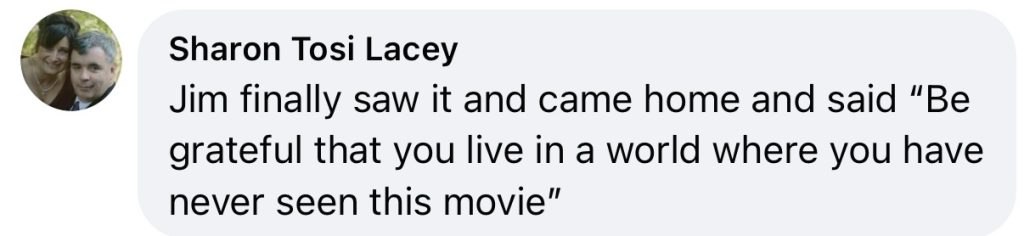
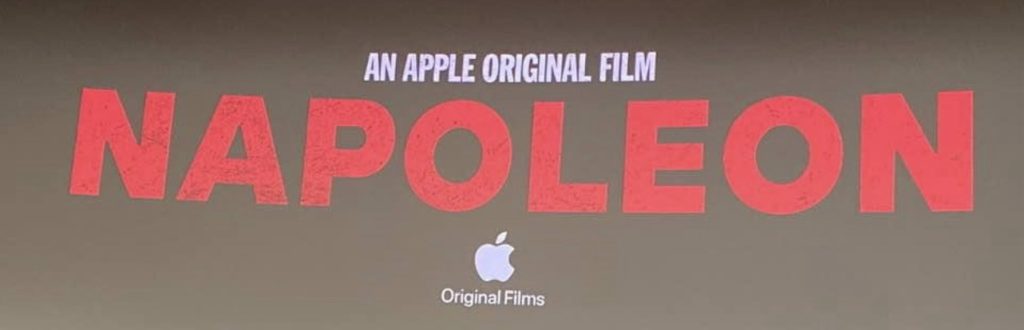
With the overwhelmingly negative reaction to his lead performance in Napoleon, Joaquin Phoenix is hopelessly stuck between a rock and a hard place — people are sick of watching him play weird and sullen wackos but they also won’t accept any attempt he might make to play normal. His doleful nut persona can no longer be used without spurring mass derision on the part of Joe and Jane Popcorn.

Joaquin Phoenix’s One-Man Cult of Depressive Method-Acting Vanity,” posted by Variety‘s Owen Gleiberman:

“Joacquin Pheonix’s character in I’m Still Here is an actor who replaces performance with the actorly exhibitionism of mental illness. And that, in a way, has become the story of Joaquin Phoenix as an actor.

“Whether he’s taking on the role of one more morose everyman dweeb, a Batman villain, or Napoleon, he plays severely damaged people, but what he’s really doing is projecting the dramatic image of himself as an actor reaching into the lower depths.

“On occasion, he transcends the self-focused gloom and brings off something miraculous. I thought he was genuinely great in Joker, in part because the director, Todd Phillips, knew how to build and sculpt Phoenix’s performance; let’s hope that he helps Phoenix bring off a comparable feat opposite Lady Gaga in Joker: Folie à Deux.

“But as films like Napoleon and Beau Is Afraid reveal all too clearly, Joaquin Phoenix has become an actor who needs to be rescued from his worst impulses. Too often, he sinks into his own torpor, steamrolling his movies with the depressive wacked song of himself.”

Fairwell, Sergio….Never Again

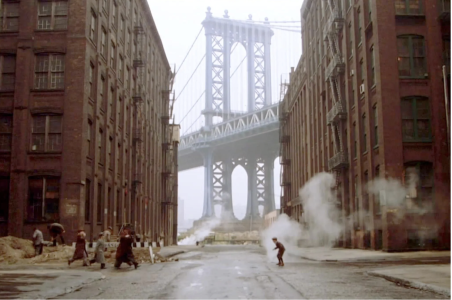
For some reason I began to watch Sergio Leone‘s Once Upon A Time in America, which I’d seen twice in ’84 — the truncated 139-minute Ladd Company version, which was moderately awful, and then the sadder, more meditative 229-minute version, which played (and still plays) much better**.

Last night’s viewing, alas, didn’t go as well. I mostly felt bored and repelled, and then I started fast-forwarding from time to
time, and then more frequently. I eventually gave up.

My primary blockage was due to feekings of absolute loathing for the main characters…Robert De Niro‘s Noodles (imagine grappling with that absurd nickname throughout your life) plus all the other weaselly gunsels and thugs (James Woods, Joe Pesci, Burt Young, Treat Williams, Danny Aiello, James Hayden and especially the repulsive William Forsythe).

I hated the two gratuitous rape scenes, both perpetrated by Noodles with poor Elizabeth McGovern and Tuesday Weld suffering the assaults. Ennio Morricone wrote a moving, melancholy score, but I just felt bored and soiled by the damn thing…having to suffer the company of so many ugly and distasteful animals and sleazoids.

The 269-minute version deserves a certain “respect,” but I will never, ever re-watch this film at any length…life is too short. It’s a beast.

The version that screened at the 1984 Cannes Film Festival ran 251 minutes…imagine.

Read more

Has Anyone Seen Plummer’s Barrymore?

Posted on 9.10.11: Christopher Plummer‘s beguiling performance in Mike MillsBeginners (i.e., a 70ish dad who decides to come out and live his waning years as a gay man) has looked like a strong contender for Best Supporting Actor Oscar all along.

But after seeing Plummer charm and electrify and ham it up and speechify in gloriously boozy Shakespearean fashion in Barrymore, which I saw a couple of hours ago at the Bell Lightbox, I’m all but convinced he has the Oscar in the bag.

Barrymore basically captures (and visually enhances to some extent) the stage show that Plummer performed in New York and Stratford in the mid ’90s, and lately performed again in Toronto earlier this year.

As long as the Academy sees this low-budgeted Canadian film, that is. Once they all see it, the game will be pretty much over. Because Plummer isn’t just portraying the late John Barrymore, and is so doing reanimating all the flamboyance and lamentations and exaltations of a once-great actor’s career in his last year of life, he’s also playing, in a sense, himself. There are, after all, certain parallels.

Add this performance to Beginners plus Plummer’s turn in David Fincher‘s The Girl With The Dragon Tattoo, and he’s going to be awfully hard to beat.

Read more

I’m Not Seeing Much Erotic Intrigue Here

I’m thinking of Woody Allen’s remark about the face of one his aunts looking “like something you’d find in a live bait store.” Woody knew that the funniest jokes are the cruelest and that every joke had to have a point. He was saying that life was grim and suppressive in ethnic, working-class Brooklyn, where they sure didn’t breed them for beauty.

Ditto to a somewhat lesser extent in Westfield, New Jersey, where I suffered through my childhood and mid-teen years.

When I was young almost all of the older people I ran into (suburban parents, teachers, merchants, civil servants) were not, shall we say, abundantly attractive. Certainly compared to the on-screen talent. None of them looked like Kirk Douglas or JFK or Dirk Bogarde or Jean Simmons or Elizabeth Ashley or Tony Curtis or Jeanne Moreau or Burt Lancaster.

I’m not saying our adult-aged neighbors were generally ugly but they certainly seemed homely and stessed and spiritually downcast and hardened by age or drink or cigarettes. Whatever glow or promise they had as youths had certainly been ground out of them. Well past their prime.

The men looked just as morose and imprisoned and regimentally dressed as the women. They were tidily or correctly attired and drove nice cars, but to me they seemed to behave like inmates of some huge, sprawling suburban concentration camp.

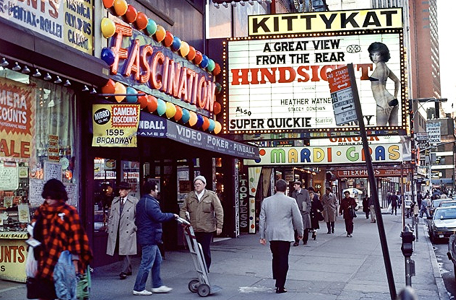
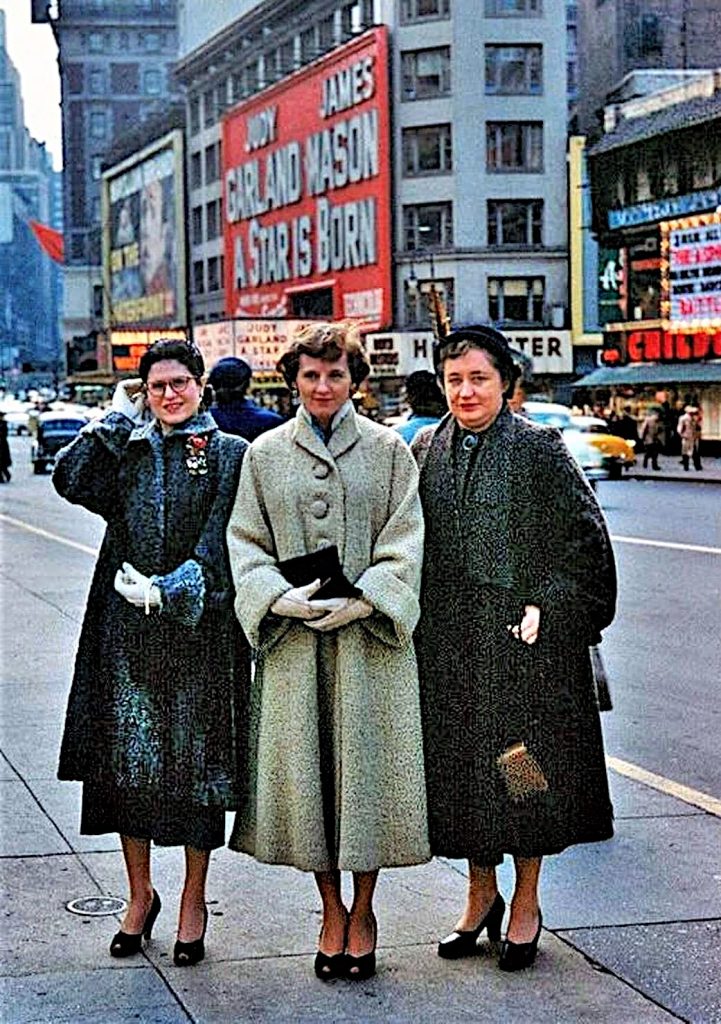
I was struck by this Times Square photo because this is what so many mothers, teachers and grandparents dressed like. (The Pat Nixon-like woman in the middle is clearly a Republican.) The idea seemed to be “our faces might look grim and puffy or hardened and resigned to an unwelcome fate, but our frumpy department-store clothing completes the effect.”

it was enough to put you off the idea of growing up and becoming an adult yourself.

From my gloomy, lemme-outta-here, eight-year-old perspective the deal seemed to be “if you study hard and follow the rules and obey your parents and get into a good college you too can grow up to look hemmed-in and compromised and dress frumpy…when you grow up you too can develop homely, chubby faces and adhere to the dreary social order of things…but only if you work hard and get really good grades. You don’t want to be left behind!

Don’t Marsh Around

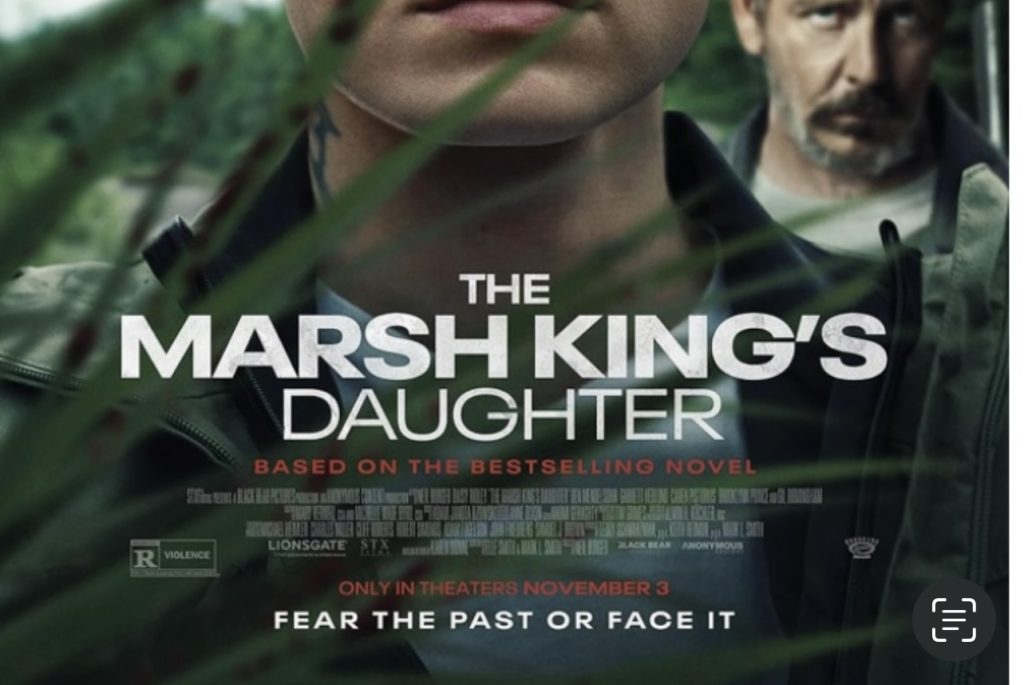
Friendo: “Neil Burger’s The Marsh King’s Daughter (Lionsgate/Roadside, 11.3) is ostensibly a thriller, and I love thrillers. Good director, talented stars — but Bezos wants $19.99 to RENT the damn thing.”

HE to Friendo: “The combination of Daisy (‘who’s Cary Grant again?’) Ridley and Ben Mendelsohn plus that awful title (who would want anything to do with a marsh king, much less his daughter?) sounds lethal.”

Supporting player #1: “So this guy rules the marshlands, you’re saying? Residents pay tribute, owe him their lives, work for him, fear him?”

Supporting player #2: “Yeah, pretty much.”

Supporting player #1: “I’m taking a film crew into the marshlands next month. We have permits from the state film commission but…what are you saying, we also need permission to shoot in this guy’s territory? We need to butter him up, pay him off?”

Supporting player #2: “I wouldn’t recommend not doing that. He’s a ruthless, powerful cat. You need to show obeisance.”