I’ve seen Takashi Yamazaki‘s Godzilla Minus One, and I mostly agree with the praise from director Joe Dante and all the critics who’ve been swooning over this recently-released, Toho-produced, English-subtitled, Japanese import that Yamazaki made for only $15 million…amazing!
It is indeed the most emotionally resonant, well-grounded, human-scale kaiju flick I’ve seen in decades, except I mostly hate Japanese monster movies and avoid them like the plague so my perspective doesn’t count for much. But others (genre fans) feel this way.
I “liked” (i.e. enjoyed goofing-on or hate-watching) the two Warner Bros. fatzilla films — Gareth Edwards’ 2014 Godzilla reboot and Adam Wingard’s 2021 Godzilla vs. Kong. Both were about totally obese monsters destroying cities and whatnot.
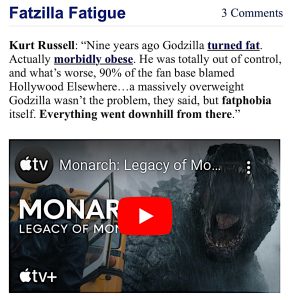
I haven’t seen the Kurt Russell Godzilla TV series, (Apple’s Legacy of Monsters) but that monster also appears to be a treadmill-avoider, judging by trailers.
But those were huge wallop monster spectacles while Yamazaki’s film is primarily an intimate, mid-1940s period piece that invests in a human saga about post-WWII struggle and reconstruction, family love and community, honor and devotion to country, etc.
Godzilla is a major “character”, of course — a metaphor for the mass murder of tens of thousands in Hiroshima and Nagasaki in August ‘45 and therefore a reptilian manifestation of J. Robert Oppenheimer and Gen. Leslie Groves. But the humans are just as important and actually a bit more so. It’s an ensemble piece.
The lead is a Japanese kamikaze (i.e., suicide) pilot named Kōichi Shikishima (Ryunosuke Kamiki). Despairing over Japan having lost the war, we meet Koichi as he is abandoning his kamikaze mission. Two years later in a bombed-out Tokyo, Koichi has sexlessly teamed with a young substitute mother named Noriko Ōishi (Minami Hamabe) while coping with intense survivor’s guilt (i.e., why didn’t I pointlessly sacrifice my life at the tail end of the war?).
Then the Godzilla threat manifests big-time (the monster, trust me, is not the star but a huge-big-noise supporting character). Before you know it almost total Tokyo destruction is happening all over again, and then Noriko is apparently killed by Godzilla’s wrath.
Down the road it’s eventually up to Koichi and a team of spirited pals who’ve been tasked with destroying war mines off the coast of Japan…one of these fine fellows (forget who) eventually brainstorms a special atyical bomb device that will kill Godzilla.
And you know that the climax will focus on Koichi being the guy who needs to fly a plane right into Godzilla, kamikaze-style, and thereby erase his survivor’s guilt.
I’m not going to spoil the last 20 minutes but boy oh boy, does this movie cop out! Not just regarding Koichi but another significant character. Total happy endings-ville. No balls, no hardball commitment, no accepting the occasionally brutal terms when the chips are down…we just want everyone to live and be happy!
I should report that Yamazaki’s monster is a somewhat leaner fellow than the WB fatzillas — he’s not as lean and “in shape” as Ishirō Honda‘s original monster in 1954’s Godzilla, but at the same time Yamazaki’s newbie looks like a sumo wrester who’s gone on a crash diet and consequently still has rolls of lingering belly and boob fat clinging to his upper body.
Most weirdly the newbie has breasts — I know the designer intended the chest mounds to look like male pectorals but they look like breasts for nursing, I swear.
Like Dante I too felt moved when we hear passages from Akira Ifukube‘s original 1954 Godzilla score.
Godzilla Minus One is probably the best written and most humanistic Godzilla film since the original. It’s about characters you actually come to know and care about, and about Godzilla secondarily.
It has no balls in terms of who dies and whatnot, but genre filmmakers like Yamazaki (he’s 59 as we speak) don’t respect death’s honesty — none of them do.