Spite Voting

There are millions of MAGA morons out there who actually think Donald Trump would somehow make this country a better place if re-elected. But there are many more millions on their side of the argument who understand who and what Trump is — a salivating dog, a sociopath, a criminal scumbag, an anti-democratic authoritarian — and plan to vote for him anyway.

Why? Because they absolutely hate progressive lefties, and are convinced Trump will make their lives miserable and may even undo some of their drastic social measures. Trump may destroy American democracy while doing so, but they don’t seem to care. They just want to stick it their cultural enemies, and for the cynical Trumpies nothing else matters.

MAGA spite voters despise wokesters for pushing an anti-white cultural narrative (i.e., all whites are evil, all people of color are beautiful), and for the atmosphere of political intolerance on college campuses today, and the pro-Palestian protests and the toppling of statues of Thomas Jefferson and removing of Abraham Lincoln‘s name from schools, an educational system that values DEI over merit and is stacked against smart kids who get excellent grades, a general adherence to fluid multi-gender wokethink, the teaching of gay and trans propaganda to soft-clay minds in elementary school classrooms, not to mention drag queens…pregnant men, sex change surgeries, trans men in women’s bathrooms, upscale department store shoplifting by hoodie gangs, six-foot-four trans dudes competing in swim meets against bio-females…all of that insane shit that has turned portions of this country into a left lunatic asylum over the past six years.

Obviously voting to spite the other side is a nihilist thing…unwise, adolescent, stupid, submental. I’ve never voted to spite the other side, and I never will.


James Bond Enjoys The Boys

Luca Guadagnino’s Queer, an adaptation of William S. Burroughs’ early ‘50s novel that will star Daniel Craig as a “top” roaming around Mexico, will debut at the 2024 Cannes Film Festival.

I’ve been given a copy of the script but have only read two pages so far — a scene in which Craig’s “Lee” character is fucking a young Mexican lad.

This is why I’ve said Craig is playing a top but what do I know? I know that “Lee” is self-portraiture — a stand-in for the guy Burroughs was 70-odd years ago, presumably after his Junkie period.

Read more

Coulter Hasn’t Paid Attention

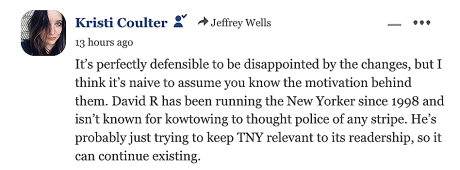
In the comment thread for “Chang Elbowing Lane Aside,” Kristi Coulter attempted to cast doubt upon the indisputable woke mindset of New Yorker editor David Remnick, who has drop-kicked Anthony Lane in order to bring in Justin Chang as senior film critc,.

Coulter: “David R has been running The New Yorker since 1998 and isn’t known for kowtowing to thought police of any stripe. He’s probably just trying to keep TNY relevant to its readership, so it can continue existing.”

HE to Coulter: It might be better if people who comment on The New Yorker actually read The New Yorker, as I do.

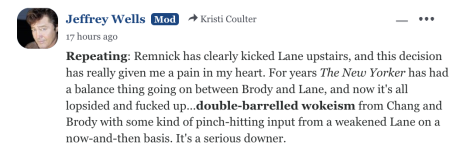
Excuse me but Remnick ‘doesn’t kowtow to the thought police’? The New Yorker has become one of the main branches of Woke Central over the last seven years. Remnick’s shift in that direction has been particularly egregious because The New Yorker is one of the few places that would have the freedom to resist it.

The more I think about this, the more riled I am by the fundamental shifting formation of the film-critic world that’s taken place over the last two months — the instillation of the light-touch Alissa Wilkinson at the N.Y. Times, and now Justin Chang at The New Yorker.

Both are 40ish Millennial orthodox art-head disciples who do not rock the boat.

The drop-kicked Anthony Lane wrote a mixed review of Flowers of the Killer Moon. Can you imagine Chang or Wilkinson doing that? Not on this earth. The opportunities for that kind of dissenting view coming from a powerful place in mainstream media are, like, vanishing.

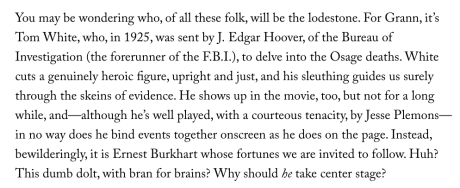
Excerpt from Lane’s Killers of the Flower Moon review:

Imagine A Live Orchestra Performance

…inside Geffen Hall while the film runs without the standard 1959 mono track. Tracks #33 through #48 comprise a grand mood symphony…anxiety, suspense, tingling dread, thundering uncertainties…all in one movement.

Might Be A Good Idea

…for HE to post regular recollections of what the film business looked, sounded, felt and tasted like before the terror — i.e., before 2017 but mostly focused on the glorious ‘90s (the indie revolution), the aughts (last stabs before superhero plague) and the early to mid teens (Zero Dark Thirty, 12 Years A Slave, Drive, The Social Network, Moneyball, Carol, Manchester By The Sea).

In other words: rather than overdose on cursing and condemning the present darkness (although I will never abandon this hard but necessary duty) it might be better to invest more energy into shining a light upon the above-mentioned good times (‘90 to ‘17 or just shy of three decades) and thereby possibly inspire a longing for films that aspire to more than just delivering “content” as well as persuading at least some of the fiercely progressive descendants of Maximilian Robespierre and Josef Stalin to possibly ease up on their social justice crusades and just…you know, try to make good movies that are less “instructive”?

Then again I wouldn’t want to descend into the pit of too-much-nostalgia…all right, fuck it, I’m not changing the game.

“Primary Colors” Drops The Ball

Last night I rewatched Primary Colors (’98), the Mike Nichols-directed roman a clef that was adapted from Joe Klein’s same-titled 1996 book about Bill Clinton‘s 1992 campaign. It was well reviewed but Joe and Jane Popcorn recoiled and it financially flopped. Everyone was mystified but now I understand.

Six words: Too much poison in the well.

The story basically treats Bill’s hound-dogging as a manifestation of demonic evil that eclipses every rancid saga of political corruption you’ve ever heard or dreamt of. Jesus, the Clintons weren’t this dirty and depraved.

The same passion that propels charismatic politicians to electoral success is tied on some level to compulsive sexual hunger and adventurism (i.e., the JFK syndrome), and it’s not that awful to indiscriminately have it off with babysitters, colleagues and willing volunteers on the campaign trail. It goes with the territory.

The film starts out as a cynical but light-hearted dramedy about the rough and tumble of waging and winning elections, but it swerves too hard into dark melodrama toward the end. The problem is basically Kathy Bates‘ “Libby Holden” character, a hard-boiled political operator who knows all about the ropes, dirty tricks and buried bodies, but suddenly melts into disillusionment and then a mind-boggling violent suicide…c’mon.

I was reminded here and there of Robert Redford‘s The Candidate (Bill McKay‘s sexual appetite doesn’t wind up destroying or even hurting anyone) and mostly of Robert Rossen‘s All The King’s Men (’49), which also ended with a shooting.

The performances hold up pretty well (John Travolta as Clinton or “Jack Stanton”, Emma Thompson as Hillary/”Susan Stanton”, Billy Bob Thornton as James Carville/”Richard Jemmons”, and Adrien Lester as”Henry Burton”, a smart idealist who truly believes in the Stanton charisma. Plus the always reliable Maura Tierney, Paul Guilfoyle, Larry Hagman…everyone delivers in believable, compelling fashion.

But it leaves a bad taste. Too much heavy sauce.

Read more

Best Moment in “Truth or Dare”

Amiable Guy to Madonna: “Do you want to talk at all off-camera?”

Warren Beatty to Amiable Guy: “She doesn’t want to live off-camera, much less talk. There’s nothing to say off-camera, Why would you say something at all if it’s off-camera?”

Alek Keshishian‘s Madonna: Truth or Dare (’91) is a seemingly intimate, fairly interesting chronicle of Madonna’s backstage life during her 1990 Blonde Ambition tour. She was pretty much Taylor Swift back then.

Beatty and Madonna were quite the attractive couple. They had begun their relationship during the making of Dick Tracy in ’89, when he was 52 and she was 31. Their union lasted for roughly 15 months, which is a decent run in that realm. Madonna and Beatty probably had more to say to each other 34 years ago than Swift and Travis Kelce do now.

The second best scene in Truth or Dare was when Madonna simulated giving a blowjob with a water bottle. Swift would never do that, or certainly not for posterity. Plus the fan base wouldn’t approve.

Best Dressed “Club Random” Guest

Martin Short‘s socks are totally killer. The black leather lace-ups (probably Italian) are great also. Nice black suit, olive taupe sweater. Easily the best-dressed Club Random guest in the history of this relatively young podcast. Seriously, the socks are wonderful.

Has Short had any Prague touch-ups? Apparently not.

I immediately dismissed that rumor about Short being involved with Meryl Streep.

I’m 17 minutes into it, and it’s relaxing. Loose-shoe Trump stuff.

Read more

Not A Remake of Huston’s “Asphalt Jungle”

After months and months of floundering around in distribution purgatory, Jean-Stéphane Sauvaire‘s Black Flies has finally landed a theatrical release date — Friday, 3.29.

Except it’s now being called Asphalt City.

John Huston‘s The Asphalt Jungle (’50) was a cooler title.

Exhaustion, screeching brakes, sudden jolts and grubby walk-up apartments, sirens, raw aromas and in-your-face whatevers.

I saw Black Flies in Cannes last May (nine months ago), and have written about it three or four times since.

Black Flies Punches Through,” posted on 5.23.23:

Jean-Stéphane Sauvaire‘s Black Flies (Open Road), a pounding, brutally realistic New York City action drama about living-on-the-ragged-edge paramedics.

It beats the shit out of you, this film, but in a way that you can’t help but admire. It’s a tough sit but a very high-quality one. The traumatized soul of lower-depths Brooklyn and the sad, ferociously angry residents who’ve been badly damaged in ways I’d rather not describe has never felt more in-your-face.

In terms of assaultive realism and gritty authenticity Black Flies matches any classic ’70s or ’80s New York City film you could mention…The French Connection, Serpico, Prince of the City, Q & A, Good Time, Across 110th Street.

And what an acting triumph for Sean Penn, who plays the caring but worn-down and throughly haunted Gene Rutkovsky, a veteran paramedic who bonds with and brings along Tye Sheridan‘s Ollie Cross, a shaken-up Colorado native who lives in a shitty Chinatown studio and is trying to get into medical school.

Rutkovsky is a great hardboiled character, and Penn has certainly taken the bull by the horns and delivered his finest performance since his Oscar-winning turns in Mystic River (’03) and Milk (’08).

And Sheridan is also damn good in this, his best film ever. His character eats more trauma and anxiety and suffers more spiritual discomfort than any rookie paramedic deserves, and you can absolutely feel everything that’s churning around inside the poor guy.

At first I thought this 120-minute film would be Bringing Out The Dead, Part 2, but Black Flies, which moves like an express A train and feels more like 90 minutes, struck me as harder and punchier than that 1999 Martin Scorsese film, which I didn’t like all that much after catching it 23 and 1/2 years ago and which I’ve never rewatched.

Read more

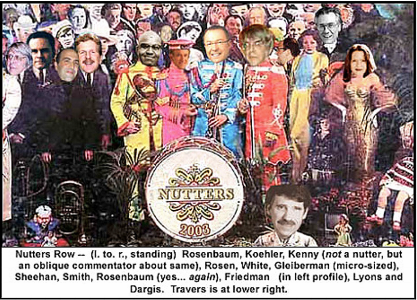
Nutter Critics — A Fresh Look

“The eccentrics are really the only real critics these days. There are so many formerly respectable, self-styled film gurus who’ve just laid down and accepted their hackdom in the last decade. For anyone who prefers serious criticism, the nutters are all we have.” — comment about August 2010 article titled “Nutter Critics.”

It’s still true today. The only critics you can actually trust in January 2024 are the ones who aren’t on the take and are basically running on their own helium gas or spirit fuel. So who are the crazy good guys in today’s realm? Hollywood Elsewhere, of course, but who else?

Posted on 8.23.10: “Nutters are made, not born,” I wrote in 2003. “I’m kind of one myself, but I didn’t start out this way. I came into this racket as a relatively sane, even-tempered youth, wanting only to be spelled and lifted up by those wonderfully crafted confections I’d first seen as a child on late-night TV. Now look at me — delighted by those 20 or 25 movies each year that ring my critical bell, but most of the time oozing acid cynicism and choking from the residue of a thousand crappy films released over the Hollywood downturn period of the last 22 or 23 years.

“You could subject St. Francis of Assisi to the same experience, and at the end of the road he’d be a film critic version of Kirk Douglas‘s character in Ace in the Hole, or else a complete junket-whore sellout.

“One way of not giving in to a Douglas attitude is to isolate and perhaps over-praise any film that comes along that seems the least bit unusual or distinctive. Then, at least, you have something to root for.

“There are two kinds of nutter film critics — the good (i.e., scrappy, finger-poking, irreverent) and the bad (lazy, smarmy, go-alonger). But ask around about the nutters who irritate or tick people off the most, as I did last weekend, and you’ll find that most of them ignore the softies and take aim at the rarified elite. I guess it’s always the oddball malcontents in any society who get singled out for punishment.

“‘Good’ nutters may irritate people, yes, for their high-horse pans of movies many of us have enjoyed or loved, or for their praising of movies that only they and other nutters have seen at European film festivals, but at the end of the day their occasional support of obscure filmmakers and a general willingness to buck the popular tide obviously lives up to the job description of ‘film critic’, and is obviously better for us culturally than not.

“Whereas the easy lays who give passes and sometimes raves to big-studio dreck and whose pulses invariably race at the prospect of taking home another goodie bag…well, fill in the blank.

The leading good nutters, according to a poll that resulted in 30-something responses (i.e., extremely unscientific), were N.Y. Press critic Armond White and the then-L.A. Times critic Manohla Dargis. Runner-ups included, in alphabetical order, included Entertainment Weekly‘s Owen Gleiberman, Variety‘s Robert Koehler, the Chicago Reader‘s Jonathan Rosenbaum, the San Diego Reader‘s Duncan Shepard, and then-New Times critic Luke Y. Thompson.

Dependable Cowardly Whores

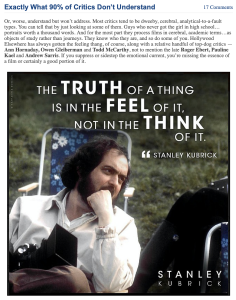
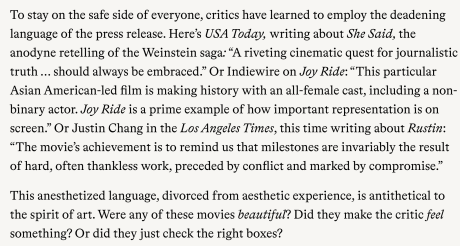
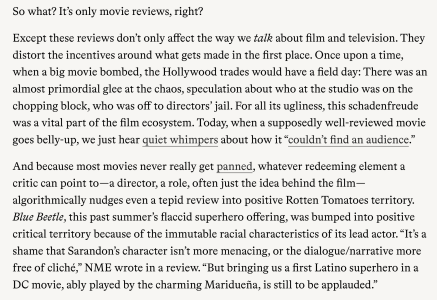
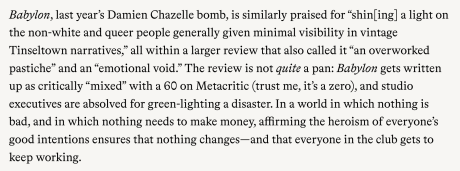
You may have heard that most many film critics are politically subservient cowards and whores…obsequious lapdogs…damp-finger-to-the-wind weather vanes…dweebs who write within an elitist, self-regarding bubble and pretty much for each other…they wouldn’t dare admit to an honest Joe or Jane Popcorn emotion about anything.

Jacob Savage has conveyed all this and more in a 1.29.24 Tablet piece called “The Unbearable Fakeness of Film Reviews“.

“Popular film and television criticism once functioned primarily as an engine of recommendation and secondarily as a means of social and artistic commentary,” Savage writeds. “Increasingly it serves as neither. Lacking secure jobs or professional stature, and existing at the whims of politicized online mobs, today’s movie critics are the opposite of tart-tongued predecessors like Pauline Kael, Vincent Canby and Janet Maslin. Instead of priding themselves on their willingness to stand up for art against the variable tastes of consumers and studios alike, they surrender to the pack.”

Chang Elbowing Lane Aside

It’s definitely not welcome news that departing Los Angeles Times film critic Justin Chang is joining The New Yorker as its senior film critic, or at least as a co-senior bigmouth with Richard Brody (i.e., “the Armond White of the far left”).

Chang is a brilliant, first-rate critic who has passed along many valuable judgments and perceptions over the years. But over the past six or seven annums he’s become a bit of a social justice warrior (at least in my eyes) and something of an identity ideologue. Example: Last October Chang panned The Holdovers over a single depiction of racist cruelty between two minor characters.

The Chang hire means two things, and both are breaking my heart.

One, The New Yorker film desk is now doubly woked-up and, in my opinion, half-fanatical. I’ve been an occasional fan of Brody’s essays, but there’s no forgetting that in his 10.13.22 Tar review he actually doubted the existence of wokeism and cancel culture. That, good sir, is fanaticism.

And two, New Yorker film critic Anthony Lane, hired by Tina Brown 31 years ago and one of my absolute favorite wordsmith smart-asses ever since, has been kicked upstairs by editor David Remnick.

Lane will be “expanding to writing [on] a wider range of topics,” Remnick has announced — a polite way of saying that Lane’s senior stripes have been torn off.

This is not the end of my online New Yorker subscription, but Remnick is downgrading and more or less humiliating one of the very few non-woke (or mostly non-woke) critics of a senior status. Not cool and rather shitty in fact.

Read more