Who Remembers “In The Valley of Elah”?

Posted on 7.11.07…right smack in the downswing of the Iraq invasion, roughly 15, 16 months before Bush became toxic. The same year that saw the release of No Country for Old Men:

Paul Haggis‘s In The Valley of Elah (Warner Independent, 9.21 or 9.28) is more than just a respectable true-life drama, and a helluva lot more than the sum of its parts. I think it’s close to an epic-level achievement because it’s four well-integrated things at once — a first-rate murder-mystery, a broken-heart movie about parents and children and mistakes, a delivery device for an Oscar-level performance by Tommy Lee Jones, and a tough political statement about how the Iraq War furies are swirling high and blowing west and seeping into our souls.

The best films are always the ones that don’t seem to be doing all that much, but then gradually sneak up on you, laying groundwork and planting seeds and lighting all kinds of fires and feelings. Elah is one of these.

It’s a damn-near-perfect film of its kind. There’s one moment at the very end that could have been played down a bit more (i.e., a little less on-the-nose), but others I’ve spoken to don’t agree. I’m trying to think of other potholes but they’re not coming to mind.

Read more

Why Average Joes Despise Woke Hollywood

And why an alarming percentage of them, against all concepts of reason and decency, are talking about voting for The Beast. It’s because of this shit.

There isn’t a single line in this essay (“Identity Politics Is Ruining Entertainment“) that isn’t truthful, and yet the Hollywood Elsewhere community of psychotic reality deniers (Castor Oil, etc.) will almost certainly come after this with a hammer and chisel.

Marley’s Tale

Last night I caught Reinaldo Marcus Green‘s Bob Marley: One Love, a biopic of the legendary Jamaican raggae singer‘s last few years (early to late 1970s). It’s somewhere between half-decent and “soft”, as in worshipful, friendly, appealing and mild-mannered. I didn’t hate it but it never really builds or pays off. It focuses on the spirit behind Marley’s music, which is good and welcome, but it mainly just ambles along. It’s a “hang” film.

The main problem is that Marley and the Wailers are all mumble-talking in standard Jamaican-rasta style, mon, and I couldn’t understand very much. Okay, an occasional word or phrase but not much more than that. At first I was thinking “what the fuck are they all saying?” but I soon relaxed into the idea that this is native and real-deal, of course. I sure as shit didn’t want Marley to talk like me or Bill Maher or some middle American dude — I wanted him to sound authentic, and he does as far as his theatrical effort goes. But I’m gonna have to rewatch this thing with subtitles.

Most of the critics won’t mention this, of course. They don’t want to be accused of being xenophobic so they’re all going to pretend they could hear the dialogue perfectly.

Kingsley Ben-Adir‘s performance as Marley is good and genuine. He’s much better looking than Marley ever dreamed of being, and more muscular. Plus he’s prettier than most of his female costars. I would be down with Ben-Adir being hired as the new 007. He’s audience-friendly.

The film deals with Marley’s cancerous big toe but doesn’t dramatize the poor guy’s death at age 36. Marley could have saved himself by amputating the damn toe but he refused. And the film barely glances at his vigorous womanizing. 11 kids! This is typical music superstar behavior, of course. And it doesn’t really drill into the political currents. It’s one of those films that you need to research on your phone after watching it.

Bob Marley: One Love not a top-tier biopic at all, and perhaps not even a second-tier biopic, but it’s moderately okay for the most part. It didn’t try my patience or piss me off or prompt me to cover my face with my hands.

The thing that interested me was the curious genesis of Marley’s Exodus album. Sometime during ’76 one of the Wailers is shown entering Marley’s home with the soundtrack album for Otto Preminger‘s Exodus (’60), composed by Ernest Gold. Somehow this inspires Marley’s Exodus, but why is a 16-year-old vinyl album (initially released in ’60) suddenly of interest to Marley and friends? Plus it’s quite a coincidence that the Gold theme song is used as background music for a bodybuilder show in Bob Rafelson‘s Stay Hungry (’76). Think about it.

me>

Return of “Girlfight,” 24 Years Later

Criterion will be releasing a Girlfight Bluray on 5.28.04. Great film, excellent news.

Before the Sundance Film Festival woked itself to death, it was the indie pathfinder and trailblazer — the greatest-ever springboard for American indie cinema. And in my 24 diligent years of covering that January celebration (’95 to ’18), one of the most exciting Sundance premieres was Karyn Kusama‘s Girlfight on 1.22.00.

A great boxing flick, a first-rate relationship drama and the film that launched Michelle Rodriguez, it won the festival’s Grand Jury Prize and the Best Directing Award in dramatic competition. Produced for $1 million, Girlfight‘s distrib rights were bought by Screen Gems for $3 million.

I saw a proud and tough feminist film, and one that could really connect with Latinas and women of color along with indie film fans.

Girlfight opened eight months later (9.29.00) and promptly flopped. Latinas and women of color stayed away in droves. After a five-week run it had tallied a total domestic haul of $1,565,852 plus a lousy $100,176 overseas. I’ve never understood why this happened. I’ll bet that a fair percentage of HE readers never even saw it.

Two days before pre-production was set to begin Girlfight‘s financier backed out, and so producer Maggie Renzi and director John Sayles coughed up the $1 million themselves. Screen Gems acquired the film for $3 million so at least Renzi and Sayles were made whole.

I’m Sorry, Jesus, But…

I would never wash any man’s feet…never ever, under any circumstances, forget it….even if I had a special squeegee-sponge-on-a-pole that would allow me to wash their feet from a distance of, say, 36 or 48 inches.

I would only wash slender, well-pedicured women’s feet, which means I would politely and respectfully decline if I was asked to wash the feet of women on the other end of the appearance spectrum.

Imagine if a red-robed Jesus Christ came down from Heaven and brought you to Donald Trump‘s hotel suite and told you to wash his feet as a gesture of universal love, charity and brotherhood. Can you imagine even looking at Trump’s fat, fungus-y pig feet? Jesus, now I can’t unthink this image….help!

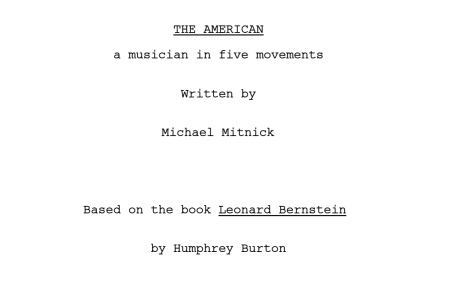
2018 Gyllenhaal-Fukanada Bernstein Script

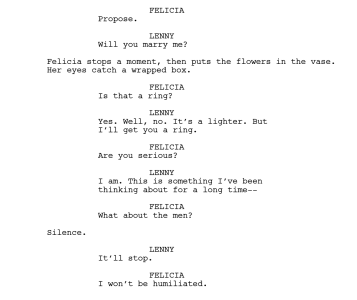
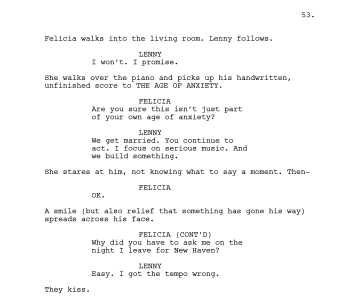
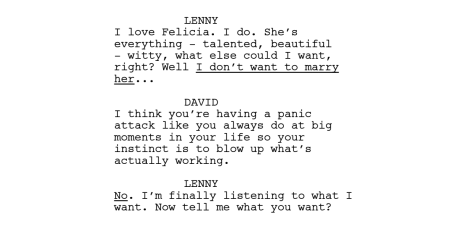
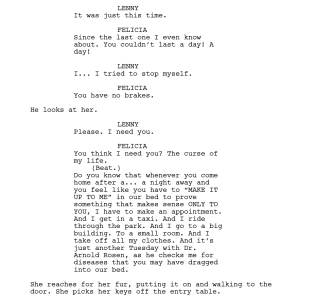
You may have read that roughly six years ago there were two competing Leonard Berstein film projects, Bradley Cooper‘s Maestro and Jake Gyllenhaal and Cary Fukanaga‘s The American, which focuses mostly on Lenny and Felicia Montealegre‘s early years and deals specifically with Lenny’s dishonesty and duplicity about boyfriends along with Felicia’s telling him in so many words that she won’t be humiliated if they marry, etc. Not to mention their break-up and reconciliation.

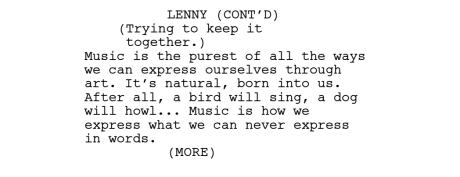
Here’s Michael Mitnick‘s nearly six-year-old draft for the Gyllenhaal-Fukanaga Bernstein project, dated 5.21.18. The subtitle is “A Musician in Five Movements.” And it’s only 89 pages!

The Gyllenhaal project collapsed when Cooper landed the music rights.

Excerpt #1:

Excerpt #2:

Excerpt #3:

Excerpt #4: