Smallish Live-Rock Venues Lasted For Roughly 4 Years (’68 to ’71)…Over a Half-Century Ago…Never To Return

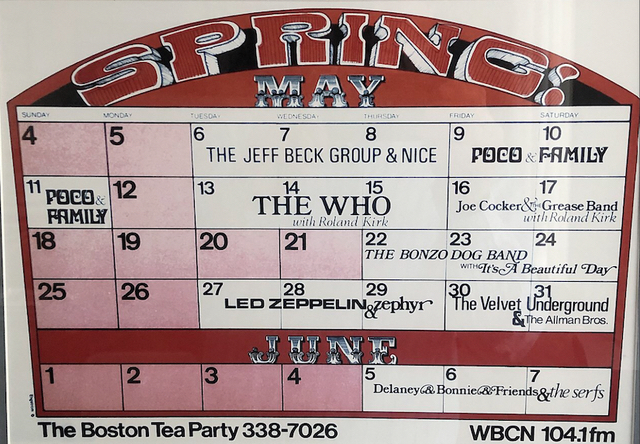
Boston Tea Party (Preferred)“, posted on 1.4.21: The Boston Tea Party, which ran from early ’67 to early ’71, and was really cooking during ‘69 and ‘70, was arguably the most glorious, super-charged small venue for live rock bands ever…smaller than the two Fillmores and with one serious headliner after another, or at least part of the time.

The whole four-year schedule. Three-night bookings for the most part. During one two-night engagement in May ’69 they actually had the Allman Brothers open for the Velvet Underground.

The first BTP venue was at 53 Berkeley St, Boston, MA 02116. In July ’69 they moved to 15 Landsdowne Street, near Kenmore Square.

HE to seasoned rock journalist: “Big-arena concerts allegedly didn’t become a major thing until ‘71 or ‘72 or thereabouts. Small venues like the two Fillmores and the Boston Tea Party flourished during a certain window that began in ‘67 and ended around ‘71, which is when major groups began declining these venues because there was so much more dough in big arenas.
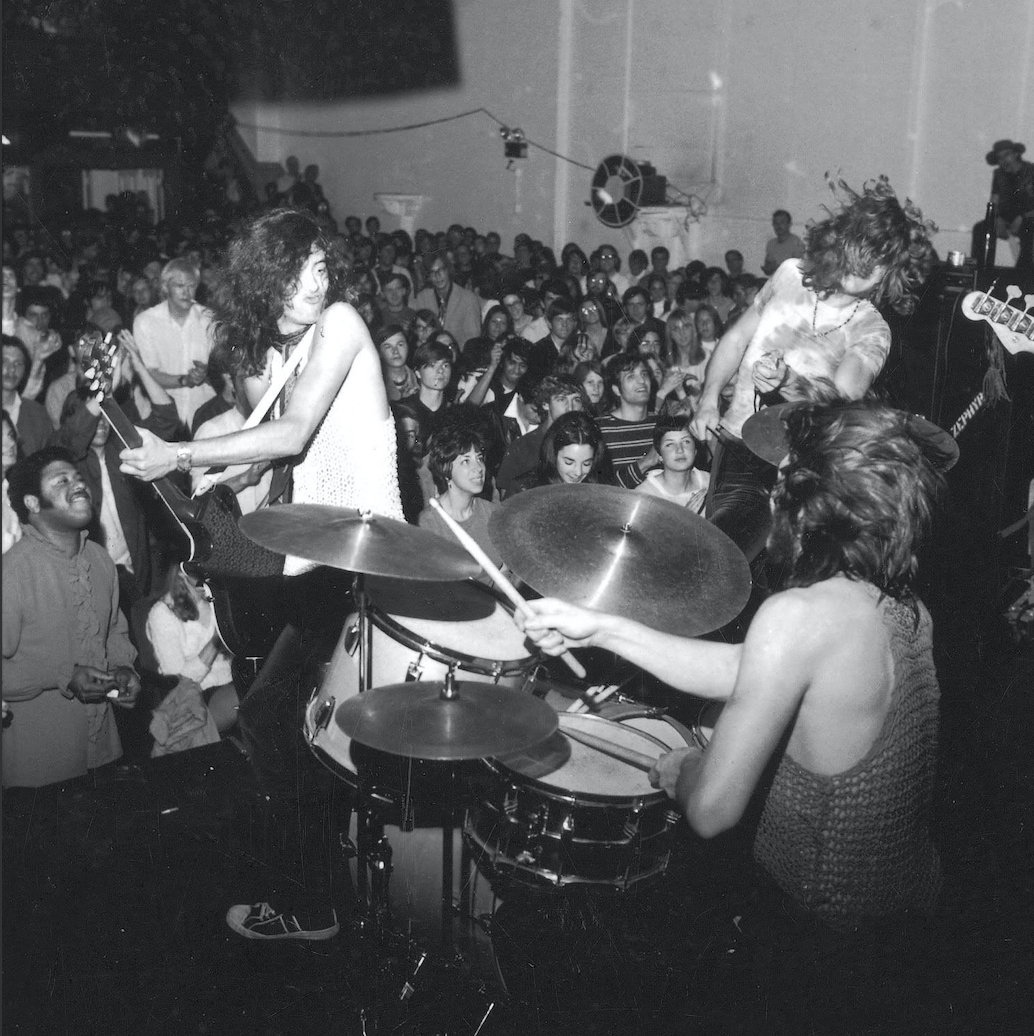

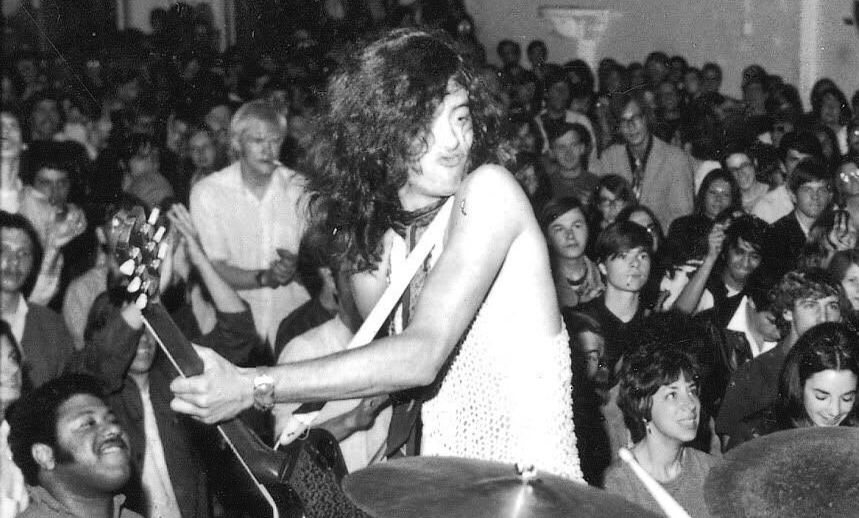
During Led Zeppelin’s January ’69 engagement
“Do I have this right? You were right in the thick of it back then.

“The golden era for the Tea Party was ‘69 and ‘70. My God, look at the acts they had! The BTP was the size of a typical high-school gymnasium. Maybe a tad smaller. I caught three or four shows at the Fillmore East but nothing compared with the sheer physical closeness of the Tea Party…you could get close enough to smell their sweat. It was glorious, tangible, alive.

Seasoned rock journalist to HE: “You’re pretty accurate with this. The big arena shows started around ’69 too, with the Rolling Stones and Led Zeppelin usually being the ones who pushed the envelope into stadiums later, around ’73.

“Tea Party was famously one of the hot places where the audience and band could [groove as one]. The Fillmores, of course. The Grande Ballroom in Detroit was also one of those small, hot places where the British bands would often play…bands like Jeff Beck Group and they’d blow the roof off. Santa Monica Civic on the West Coast was in between, a little bigger, but amazing for crowd/music/intimacy, like David Bowie’s first show there.

“Also one of the small rooms that bands loved was the Warehouse in New Orleans, home of many explosive small-room nights. The Allman Brothers Band would tear it up at a place like that. Basically, even through the mid-70’s, you might catch a big band playing one of those smaller places just to blow off steam and have a no-pressure gig or record something live with a smaller, great crowd.”

From BTP archive:

“The BTP closed it in early 1971 as the face of rock & roll was changing to larger venues. The Tea Party’s demise followed that of Philadelphia’s Electric Factory and shortly preceded the same for the two Fillmore’s.”
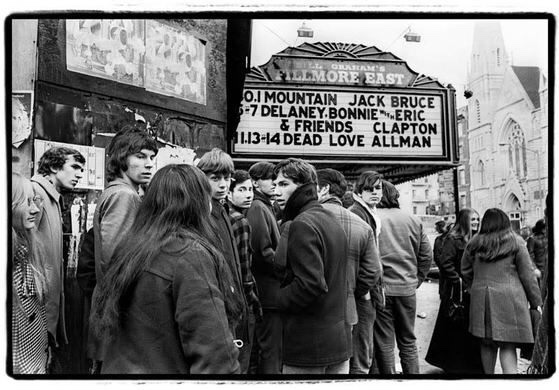
Boston Tea Party Freakout

The second Boston Tea Party (the one on 15 Lansdowne Street, just off Kenmore Square and across from Fenway Park) was in business only a year and a half — July 1969 to December 1970. But man, what a hallowed place, what a holy temple of purification.

I attended several ear-pounding, spirit-lifting sets inside that fabled venue, but my most vivid memory isn’t musical — it’s my LSD freakout episode…a psychedelic meltdown that led to my forsaking hallucinogens forever and eventually renouncing marijuana. Yes, even that.

I was living with a crew of upper-middle-class drug dealers…friends from Wilton who were moving huge amounts of weed, heavy amounts of LSD inside clear plastic bags, and Vietnamese heroin. We lived in a large basement apartment at 467 Commonwealth Ave., and we all felt happy and churning and generally delighted with everything. Plus we were fastidious and flush and wore Brooks Brothers shirts….we had it all down.

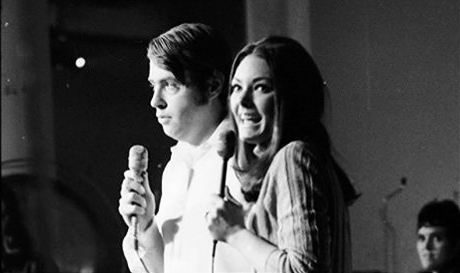
On New Years’ Eve (’69 into ’70) we all attended a Boston Tea Party featuring the Grateful Dead and The Proposition, a Cambridge-based improv comedy group that featured Jane Curtin.

Except before walking over we all passed around a kind of rubber-lined goatskin container of Kool-Aid, which had been liberally spiked with LSD. Too liberally. It was soon apparent that the Kool-Aid was way more potent than anticipated, and roughly an hour into the Proposition set I began to feel increasingly anxious and creeped out, and then full-on paranoid.

I remember several details about the Curtin/Proposition performance as my psyche devolved into pudding. Curtin and and some schlumpy-looking guy played young married tourists from the Midwest who were experiencing Boston’s counter-culture scene for the first time, and feeling disoriented and a bit frightened.

Later in the set a comedy bit struck some kind of cosmic wowser chord, prompting a none-too-bright audience member to exclaim out loud, “Whoa, that’s heavy!” In response to which a Proposition performer looked at the guy and said “yeah, wow, man…too many tabs!”

That was me — too many ground-up tabs in the Kool-Aid had led me me into a place of, like, quaking disorientation. As in “uh-oh….uh-oh.” I began to feel as if I was standing next to a manhole-sized opening, and I knew that if I somehow fell into that hole I would lose my mind and never know sanity again.

Hunter S. Thompson knew this all too well. He called it “the fear.”

I begged a friend for help, and we wound up going back to the pad. He gave me some downers as well as an anal suppository It took a couple of hours but I eventually settled down. I knew after this horrific episode that I would never, ever drop acid again. (And I had tripped a good 15 or 20 times before, mind, and the Bhagavad Gita spirit had always prevailed.) And then a year or two later I discovered that pot highs had the potential of re-awakening “the fear” so I stopped that activity also.

From Thompson’s “Fear and Loathing in Las Vegas“:

“Good mescaline comes on slow. The first hour is all waiting, then about halfway through the second hour you start cursing the creep who burned you, because nothing is happening and then ZANG! Fiendish intensity, strange glow and vibrations…a very heavy gig in a place like the Circus Circus.

“’I hate to say this,’ said my attorney as we sat down at the Merry-Go-Round Bar on the second balcony, ‘but this place is getting to me. I think I’m getting The Fear.’

“’Nonsense,’ I said. ‘We came out here to find the American Dream, and now that we’re right in the vortex you want to quit.’ I grabbed his bicep and squeezed. “You must realize,’ I said, ‘that we’ve found the main nerve.’ ‘I know,’ he said. ‘That’s what gives me The Fear.’

“The ether was wearing off, the acid was long gone, but the mescaline was running strong. We were sitting at a small round gold formica table, moving in orbit around the bartender.

“’Look over there,’ I said. ‘Two women fucking a polar bear.’

“Please,” he said. “Don’t tell me those things. Not now.” He signaled the waitress for two more Wild Turkeys. “This is my last drink,” he said. “How much money can you lend me?” “Not much,” I said. “Why?” “I have to go,” he said. “Go?” “Yes. Leave the country. Tonight.” “Calm down,” I said. “You’ll be straight in a few hours.” “No,” he said. “This is serious.” “George Metesky was serious,” I said. “And you see what they did to him.” “Don’t fuck around!” he shouted. “One more hour in this town and I’ll kill somebody!”

Guadagnino’s Sexual Accusation Meltdown Drama Will Stir Best Actress Talk for Julia Roberts

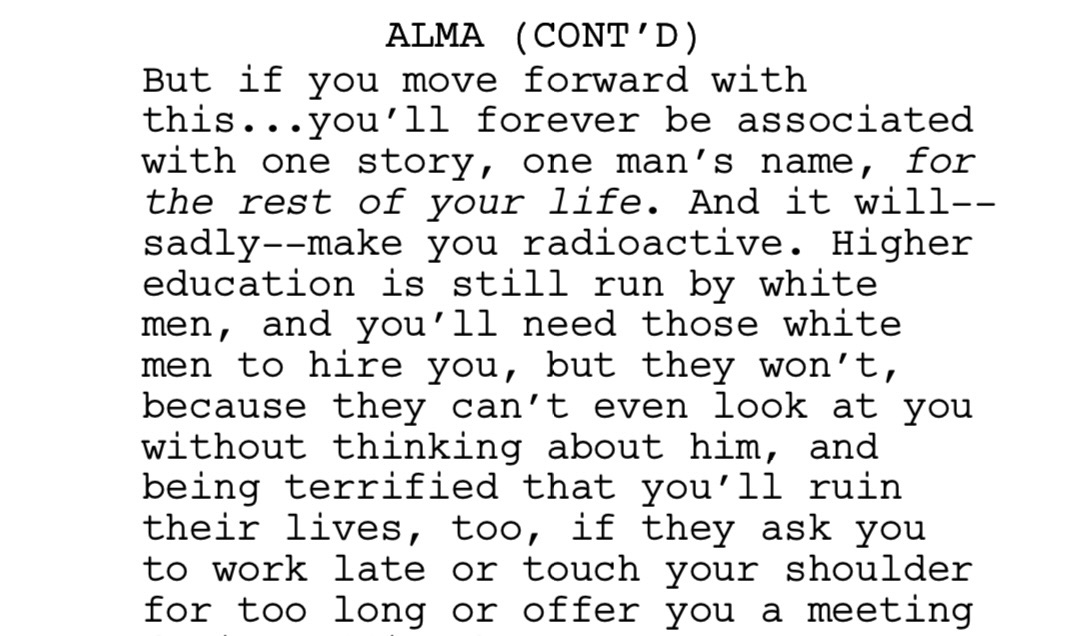
Yesterday I read an early draft of Nora Garrett‘s After The Hunt screenplay, a #MeToo rape accusation drama that feels like a splicing of Todd Field‘s TAR, David Mamet‘s Oleanna and Ruben Ostlund‘s The Square.

It’s the basis of an upcoming Luca Guadagnino film that MGM-Amazon will release on October 10th — a whipsmart, dialogue-driven, pressure-cooker thing with Julia Roberts toplining.

Strong supporting performances from Andrew Garfield, The Bear‘s Ayo Edebiri, Michael Stuhlbarg and Chloe Sevigny will presumably round things out.

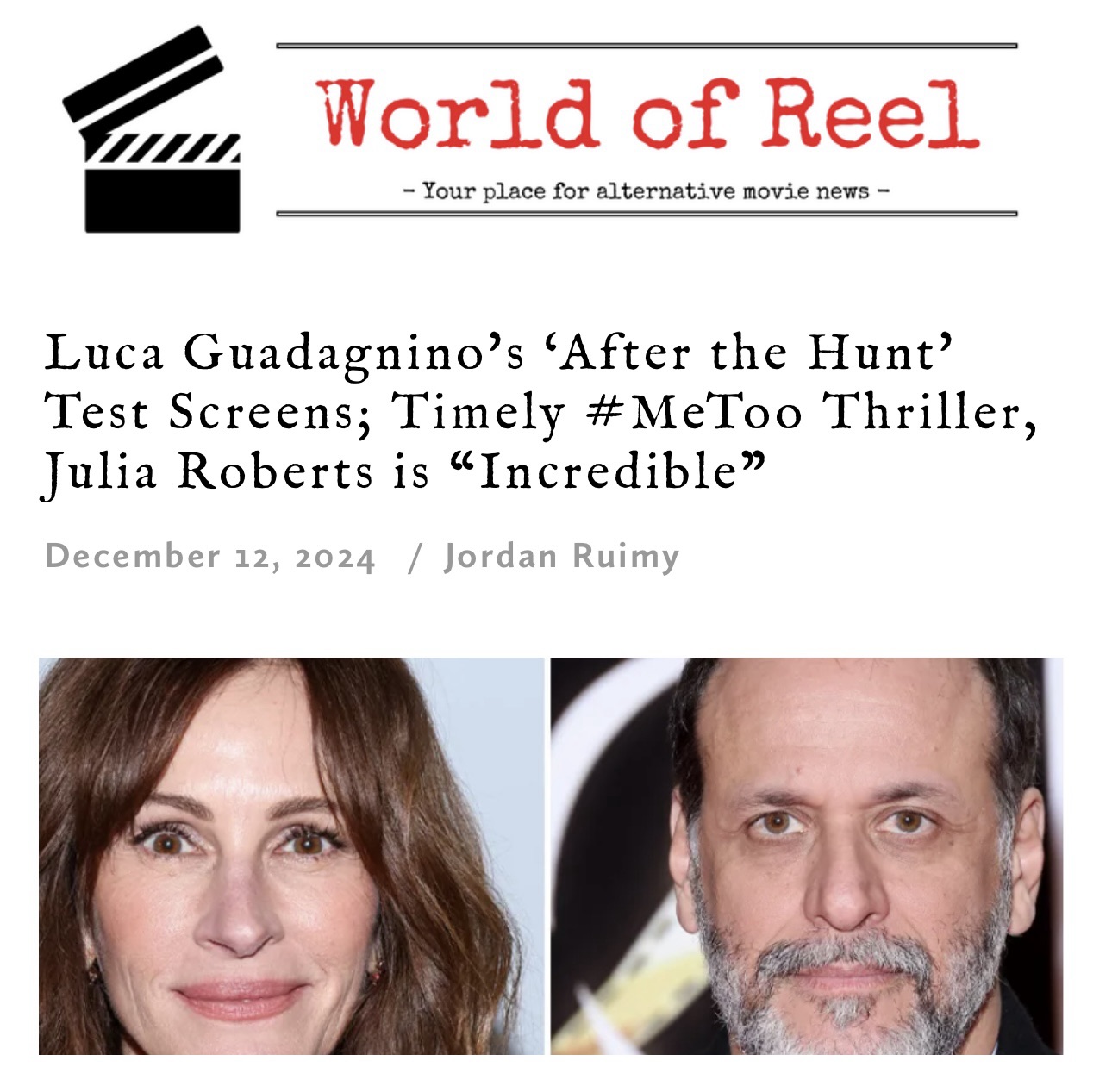
World of Reel‘s Jordan Ruimy recently reported that Hunt had test-screened in early December. He also sketched it out as one of those jarring, controversial, hot-button melodramas that stir the soup among educated audiences.

HE is guessing Hunt will debut six months hence at the Venice Film Festival.

Garrett’s page-turning screenplay (which a friend found on Reddit) vaguely summons the downswirling mood of Frank Perry‘s Diary of a Mad Housewife…if Perry’s 1970 film had been set in the realm of elite academia and concerned a middle-aged female professor (Roberts) on the brink of tenure.

Guadagnino (Queer, Challengers, Call Me By Your Name) made some changes to Garrett’s Swedish-flavored scenario before filming it last summer in London and Cambridge.

That’s as far as I’ll go description-wise, but the screenplay did plant expectations of Roberts’ performance possibly stirring convos about a Best Actress trophy. She’s playing one of those well-sculpted, sturm und drang roles that older actresses have always pined for.