Edwards’ Rep Has Faded Over Time

Late last night I attempted a re-watch of Blake EdwardsS.O.B. (’81), which I was amused and moved by way back when. It’s an inside-Hollywood satire that feels somewhat realistic (Edwards seemed to be going for broke with this one) and was stocked with roman a clef characters (Robert Vaughn as Bob Evans, Marisa Berenson as Ali McGraw, Shelley Winters as Sue Mengers, etc.)

From the mid ’60s onward Edwards had been a celebrated slapstick guy, of course. People actually liked the fact that his films were broad and over-performed. But S.O.B. really didn’t work for me yesterday, and I distinctly recall writing a positive review in late ’81 for The Film Journal, for which I was the managing editor. That was then, this is now. S.O.B. is bruising.

HE’s 12.15.10 obit: I’ve always found most of Edwards’ stuff laborious, in part because so many of his films (certainly beginning in the early ’70s) exuded a square establishment sensibility. A respected auteur, surely, but I always sensed the attitude of a schmaltzy, well-paid, Malibu-colony type of guy.

I never sensed, in short, that Edwards’ film were about anything more than (a) the fact that he had a certain instinct for comic timing and orchestrating pratfalls, a gift that arguably put him in the same realm as Mack Sennett (but nowhere near that of Buster Keaton), and (b) that he enjoyed livin’ the high life and therefore felt compelled for some reason to stock his films with evidence or reflections of this. And I always hated the way his films were lighted and shot in a typical big-studio “house” style.

Edwards had a good run with Peter Sellers, of course, but Sellers’ greatest director friend/ally was Stanley Kubrick, not Edwards.

There are only two Edwards films I really and truly admire (as opposed to liking or tolerating), and they’re (a) both San Francisco-based and (b) were released in ’62. Numero uno is Experiment in Terror (’62), a creepy no-frills noir about a terrorized bank teller (Lee Remick) and an FBI guy (Glenn Ford) trying to protect her. The other is the legendary drama of alcoholism, Days of Wine and Roses, with Jack Lemmon and Lee Remick.

The Edwards films I regard as “fine,” “okay” and/or “relatively decent” are Breakfast at Tiffany’s (except for Mickey Rooney‘s awful performance), A Shot in the Dark (moderately funny at times), The Party (some brilliant portions), Wild Rovers (decent western), 10 (overrated but funny at times), What Did you Do in The War, Daddy? (’66) and the low-budget That’s Life (Jack Lemmon facing old age and male menopause depression — honest and decent).

Chumash Tribes Prevailed in Southern California for 11,000 Years

The beginning of the end of Chumash culture happened in 1769, when the first Spanish soldiers and missionaries arrived in Southern California with the intent of Christianizing the natives and facilitating Spanish colonization.

And then the mean-ass Mexicans arrived in the mid 1830s, and life for the Chumash natives became even worse. The Chumash were driven off the land and enslaved by the new administrators. Many found “highly exploitative” work on large Mexican ranches. After 1849, most Chumash land was lost due to theft by Americans and a declining population, due to the effects of violence and disease.

In 1855, a small parcel of land (120 acres) was set aside for just over 100 remaining Chumash Indians near the Santa Ynez mission. This land ultimately became the only Chumash reservation, although Chumash individdles and families continued to live throughout their former territory in southern California. The Chumash population was between roughly 10,000 and 18,000 in the late 18th century. In 1990, 213 Indians lived on the Santa Ynez reservation.

Nothing lasts forever. The Chumash had their era, and then it ended.

Why is this harmless New Rules video age-restricted?

“Brutalist” Has Passed Into History

Thank God I don’t have to hate on The Brutalist any more. The debate’s over and nobody of any weight or wisdom or professional merit will want to discuss it ever again. Consigned to history’s dust bin.

Whatever the Brutalist want-to-see factor might have been, it was pretty much suffocated by Adrien Brody‘s six-minute acceptance speech. So many millions of viewers were muttering “good heavens, shut up…just shut the fuck up.” If only Timothee Chalamet or Ralph Fiennes had won…

On the other hand it’s not fair to put Brody down over the chewing-gum toss. Before watching the below video I hadn’t realized that Brody’s age-appropriate g.f. Georgina Chapman emphatically told him, gesture-wise, to throw the gum her way.

“Mickey” Morose

Arthur Penn‘s surreal Mickey One (’65) is a black-and-white low budgeter about a hunted, haunted stand-up comic (Warren Beatty) on the bum in Chicago. It’s about paranoia and loneliness and how the game is rigged against the individual. It feels a bit coarse and splotchy at times, but it’s also a kind of loose-shoe, catch-as-catch-can arthouse whatsis with a kind of French nouvelle vague or Italian neorealist vibe (can’t decide).

Is Mickey One a better film than Bong Joon-ho‘s Mickey 17? I never liked Penn’s film all that much, but it feels like a raggedy-ass masterwork compared to the latest Mondo Bongo.

Mickey One is about something that we’ve all sensed or feared at one time or another (i.e., the world is run by predators). Mickey 17 is a woke instructional about the necessity of feeling compassion for society’s lessers or outcasts. Mickey One is an in-and-outer but it’s thematically relatable (at least to existential lone-wolf types). Mickey 17 is about Bong banality.

Marty’s Turbulence-Meets-Depression Period

Martin Scorsese and Isabella Rossellini were married from 1979 to 1982, or during his period of cocaine withdrawal + Raging Bull rebirth, followed by The King of Comedy and the anxiety, uncertainty and commercial failure that provided accompaniment.

The response to New York, New York (’75), one of the biggest cocaine movies of all time + a film that Pauline Kael called “an honest failure“, drove Scorsese into depression.

Wiki: “By several accounts (Scorsese’s included), De Niro saved Scorsese’s life when he persuaded him to (a) kick coke and (b) make Raging Bull.

Mark Singer: “Marty was more than mildly depressed. Drug abuse, and abuse of his body in general, culminated in a terrifying episode of internal bleeding. De Niro came to see him in the hospital and asked, in so many words, whether he wanted to live or die.

“If you want to live, De Niro proposed, let’s make this Jake LaMotta picture.” Artistic adulation and Oscar glory resulted. Then came The King of Comedy (’82).

No marriage could have survived Scorsese’s ’79 to ’82 period.

The Guardian‘s Simon Hattenstone: “After they separated, Marty told Isabella it had been important to him ‘to think that he was in a relationship with Roberto Rossellini’s daughter.’ Family history repeated itself when she and Scorsese divorced; by then, she was pregnant with another man’s child — that of the former model Jonathan Wiedemann.”

Simply Doesn’t Make Sense

Normal sensible thoughts and logical conclusions apparently didn’t factor into the recent deaths of poor Gene Hackman, 95, and his 63 year-old wife, Betsy Arakawa.

This, at least, is what came to mind when I read breaking news about what caused the couple’s deaths.

Santa Fe officials have stated that Arakawa died of Hantavirus, a rare flu-like disease, on or about February 11th.

Hackman, they said, lived with his dead wife’s body for a full week before succumbing to complications from heart problems and Alzheimer’s disease.

Arakawa, repeating, died of Hantavirus on or about February 11th.

Does Hantavirus infection cause death immediately? No, but you can’t be casual or cavalier when it gets into your system. Hantavirus initially causes flu-like symptoms (fever, fatigue, muscle aches) but can lead to difficulty breathing and, if untreated, respiratory failure and shock.

Why didn’t Arakawa contact her primary-care physician or paramedics to explore what might be happening to her? No explanation.

Arakawa expired on the bathroom floor on Tuesday, February 11th.

“She died of the virus likely that day, New Mexico Chief Medical Examiner Heather Jarrell said at a highly anticipated press conference on Friday afternoon,” it says here.

What did Hackman do when she passed? Nothing, according to authorities. He sat or slept or shuffled around the house for roughly a week after his wife stopped breathing. No calls to their doctor or to cops or paramedics, no calls to his neighbors…the poor guy just hung out and did nothing.

He eventually passed from “hypertensive and atherosclerotic cardiovascular disease and from Alzheimer’s,” Jarrell said.

In other words, when he realized Betsy was gone Hackman apparently gave up. He chose not to summon help. He threw in the towel. A sad ending, to say the least.

“In Order To Save Our MAGA Democracy…”

“…we need to not have a woke democracy…sorry but these are tough times.”

HE believes in democracy and that’s final, even if it means that a wokester fanatic is elected President. That said, the chances of a wokester fanatic winning the 2028 Democratic nomination for President are 100% nil. Wokeys have been totally discredited, and have fled into the forest.

“What’s It Like To Die?”

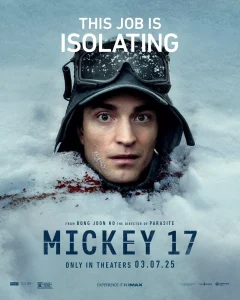
Late yesterday afternoon I tapped out a few Mickey 17 reactions from my Norwalk AMC theatre seat. I was the only one there so no concerns about iPhone glare.

(a) I’m 40 minutes into Bong Joon-ho’s long-delayed, politically fraught follow-up to the over-rated Parasite, and it’s obviously ass…dystopian primitivism, visually dreary, crudely plotted, sadistic characters, physically gross and slimy. Vomiting, brutality, chaos, writhing agony, bodies dropped into molten lava…and it’s a stab at black comedy, of course. The broad, emphatic and profoundly unfunny kind.

(b) I’m the only humanoid in the theatre so I can write all I want. This poor little futuristic allegory, shot entirely on sound stages, is an instant commercial tank. Zero want-to-see. I am the late Earl Holliman back in ‘59…”where is everybody?”

(c) “No multiples! No more re-prints!”

(d) Mickey 17’s lighting is grayish, murky, shadowy, draining. You can make out various visual details but the film is so dark you’re left wondering “why am I even watching this?”

(e) AMC concessions should offer packets of heroin as special coping additives. Sold only to customers with ID verifying that they’re over 45 years of age.

(f) Bong sure loves his creepers! Creepers are fat, insect-like life forms, cousins of Dune sand worms (thousands!), mixed in with a few large, woolly mammoth creepers, but mostly the size of bloated armadillos…despised by Mark Ruffalo’s Trump-like, dental-veneer-wearing leader but in fact benign and Ewok-like in a certain sense, and representing harm to no one.

(g) Creepers, of course, symbolize immigrants or social lessers. This is a movie offering explicit social instruction. Trumpian evil must be eradicated! Wokeys leading a revolution on a Hoth-like snow planet!

(h) RPatz is no longer the young, slender, dishy guy…he’s still thin but now on the brink of middle-age…time cuts no one a break.

(i) The menage a trois scene between Naomi Ackie and the two Pattinsons (the amiable, kind-hearted Mickey 17 and the hostile-aggressive Mickey 18) is the most interesting interlude so far. Superfluous but interesting.

(j) I’m almost at the one-hour mark. Actually the 75-minute mark. A full hour to go. I really do need to snort a little smack. Oh, you have some? Thank you…thanks so much.

(k) Poor Toni Collette….over-acting as Ruffalo’s icy-phony wife…pocketing a paycheck but doing her career no favors.

(l) Ruffalo: “You’d better be on your toes. One false move and you’re man-burger.”

(m) At least Mickey 17 ends happily. The diverse, under-40, white coat or military fatigue-wearing Bong wokeys make things right.