
Belonging

In that recently posted Club Random chat between Bill Maher and Maureen Dowd, Maher shared an unusual anecdote about visiting Ireland. Unusual for Maher, I mean, as he’s not the emotional-sharing type.

Maher’s jet was approaching Irish soil (presumably Dublin airport), he recalled, and just as as it touched down on the tarmac he melted…something took over and he began to cry. Some atmospheric whatever got to him, something that his body or spirit recognized…a homeland vibe.

My ancestral roots are British and not Irish, but I felt almost the same thing when I visited Dublin in the fall of ’88. Maggie and I and five-month-old Jett flew to Dublin from London, and right away I felt something. One of my first thoughts as we left the Dublin region and drove into the countryside was “I could die here.”

Related: A similar thing happened in London in 1980. For the first time in my life I heard my last name pronounced correctly, or at least in a richer, more tonally satisfying way than I myself had ever pronounced it.

It’s an English name, of course, so no surprise that I experienced my “woke” moment when a British Airways attendant said “Mr. Wells?” He said it with a zesty, just-right emphasis on the “ell” sound. (I tend to use an “euhll” sound.) The British Airways guy had it down…made me feel proud of my heritage.

I haven’t spelled it out in so many words, but the Big Memory-Lane Question is this: try to recall a moment on foreign soil when you immediately and perhaps inexplicably felt at home…at peace…welcomed…relieved.

Because of some sudden wash-over feeling…maybe a person or persons you ran into on a bus or subway or an Uber into town…maybe the way the early-morning air or a curbside food stand smelled…some hard-to-pin-down scent or vibe that seeped into your pores and took you back to a place of ease and familiarity or even serenity.

I’m not talking about hotel-brand comfort (“feels just like checking into a Comfort Inn in Pensacola!”)…some travelers take pleasure in familiarity, I realize, but that’s not what this is…I’m speaking of a feeling that snuck up on you, an air-sniff or a Bill Maher-like (or Bill Murray-ish) nudge of surprise…an out-of-the-blue thing in Guatemala or Scotland or Wagga Wagga (west of Canberra) or the southeastern coast of Spain.

Bill Burr Isn’t Having It

Bill Burr to red-carpet journalist who was asking about Luigi Mangione and Elon Musk, prior to Conan O’Brien Mark Train tribute at Kennedy Center (several days ago):

“I don’t think you should be asking a comedian [about this stuff]. You’re a journalist. No, no, that’s weak. That’s you guys passing the buck. You guys need to have balls again. Which you don’t. You guys always say, ‘Should we be thinking this?’ You guys present stuff like that. You need to get your balls back.”

Simmering Monster Vibes

Last night I slammed my way through all four episodes of Adolesence, Jack Thorne and Stephen Graham‘s British miniseries that’s been streaming on Netflix since 3.13.25.

It’s basically about a mood of anti-female malevolence and hostility among young teenage males, and about how it’s all hidden or simmering under the surface, and as such doesn’t feel especially real or recognizable, or at least not to me and my understanding of things.

Yes, teenage knifings have become a thing in England over the last two or three years but the Andrew Tate manosphere — toxic masculinity, bullying, incel inferences — carries a very weird vibe, and I didn’t know what to do with it. What’s wrong with these fucking kids? What’s gotten into their blood? What’s the disease?

All four episodes are “oners” — real time, no cuts. The first thing I asked myself was “how would these episodes play if they’d been shot in the usual way?”, and the answer, I told myself, was that they’d feel more tightly focused and concise and perhaps more dramatically affecting. That’s not to say I found the “oner” approach unworthy or frustrating, but there is a general feeling of cinematic technique exerting more control than the serving of dramatic basics.

The strongest episode by far is part 3, which focuses entirely on a gentle interrogation of Jamie Miller (Owen Cooper), a 13 year old accused murderer, by forensic psychologist Briony Ariston (Erin Doherty).

There’s a fair amount of dodging and denial on Jamie’s part, as the cops have video of him knifing the deceased victim, Katie, so his evasions and whatnot feel decidedly strange as well as futile. The atmosphere intensifies when Briony asks about Jamie’s sex life, which seems odd in itself as he’s slight and kid-like and tweener-ish. One gradually detects currents of suppressed hostility that are rooted in rejection and whatnot. Jamie’s mood fluctuates between amiable and resentful, wich leads to a sudden, standing-up outburst. The session ends with Briony telling Jamie this will be their final meeting, which triggers anxiety and pleading and then another outburst.

Who is this kid? What’s with the lying and denial? Where has all the “red pill” anger, insecurity and rage come from?

What does “nonce” mean again? Something to do with sex offender?

Another Beef About Mendes’ Beatle Biopics

I’ve repeatedly made it clear that I pretty much despise the British actors who’ve been hired by director Sam Mendes to play Paul McCartney, George Harrison and Ringo StarrPaul “hawknose” Mescal, Joseph Quinn and Barry Keohgan, respectively — in his quartet of Beatle biopics.

Only the handsome Harris Dickinson, who will play John Lennon, gets an HE stamp of approval. This despite his towering over Mescal when the actual Lennon and McCartney were both 5’10”.

This may sound disturbing to wokeys and dopeys, but early to mid ’60s pop groups had to have reasonably good-looking members to attract the girls — that was the standard set by the Beatles, Herman’s Hermits, The Dave Clark Five, etc.

Three of the Beatles (McCartney, Harrison, Lennon) were generally regarded as good-looking and then some, which, like it or not, was a key to the group’s popularity. (Ringo’s puppy-dog charm easily overcame his huge honker.)

Keohgan may or may not be able to overcome his evil-warlock features in an attempt to revive that old Ringo spirit, but the hard fact of the matter is that Mescal and Quinn simply aren’t fetching…certainly not in the darkly handsome way that McCartney and Harrison were perceived to be in the early ’60s. They’re a bit funny looking, and during the LBJ administration funny-looking guys weren’t allowed to be pop stars.

Just ask the fellows who made up The Association.

Posted on 9.23.22:

Mid ’60s pop groups had to have reasonably good-looking members — that was the reality of the day. And then along came The Association — a six member group that had two handsome guys and four with the oddest, most homely-looking faces in pop-music history.

The dorkiest was Terry Kirkman, who could have been cast as a college-aged serial killer. Next came Larry Ramos (died in 2014 at age 72), a chubby guy who looked like a typical member of an A.V. Squad. The thick-featured Brian Cole (who passed in ’72 at age 30) looked like a bouncer or a rugby player. Russ Giguere was semi-presentable but couldn’t pass the dishy-pop-star test — too geeky, granny glasses, thin moustache.

Jim Yester and Ted Bluechel were the only ones you could honestly call “good looking.”

Yes, the “they have to be cute” thing quickly went away when the Rolling Stones, the Byrds and The Who became popular, but not in ’64 and ’65 when the Beatles were just catching on. Plus the Beatles were clearly in their mid 20s while there’s no dodging the fact that Mescal, Dickinson, Quinn and Keoghan are 30somethings.

I realize that Mescal is popular with gay guys, but to me he’s Satan’s emissary. His hawk nose is actually a lot like the actual Lennon’s nose, but the McCartney resemblance factor is off the charts wrong/bad. Plus Mescal’s pointy chin resembles that of John Barrymore’s Mr. Hyde.

Since the CinemaCon appearance of the Mendes quartet I’ve developed a new hate thing for Quinn, who will completely fail to convince anyone that he’s George Harrison or is even half-channeling him. The notion that Quinn, who was okay in A Quiet Place: Day One but generically repulsive in Gladiator II, could “be” Harrison is nothing short of ridiculous.

No Forgetting Drew Friedman…Ever

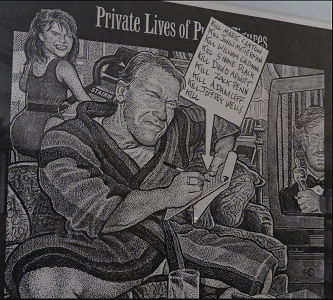
Last weekend Kevin Dougherty‘s Drew Friedman: Verneer of the Borscht Belt screened at the Aero, followed by a q & a with Friedman, Scott Alexander and Larry Karaszewski + various rogues and scalawags.

I’m not understanding the why or how of the Aero screening as the the doc initially surfaced six years ago. But Friedman did me a solid 32 years ago when he inked a Last Action Hero fallout cartoon, which was published in Spy…hence my loyalty and affection.