A producer with a shaved head wore these atrocious, tent-sized tuxedo pants prior to this afternoon’s Directors Fortnight screening of Lucky Lu.
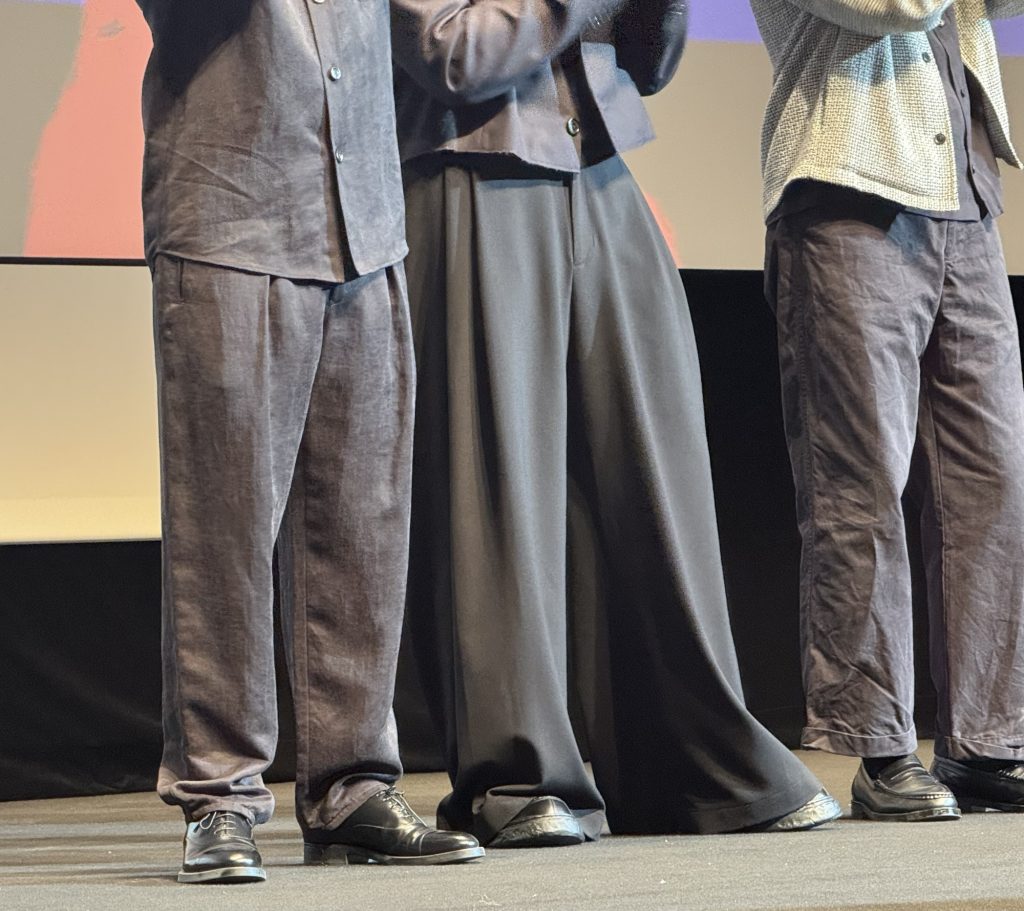




A producer with a shaved head wore these atrocious, tent-sized tuxedo pants prior to this afternoon’s Directors Fortnight screening of Lucky Lu.
I suffered through several mild annoyances while watching Kleber Mendonça Filho’s The Secret Agent, although there’s no disputing that it’s a respectably “good” film in its own curious, unhurried, dark-fantasy way…a meandering, almost lethargic dream trip about living through a climate of political terror in 1977 Brazil.
It’s a half-solemn, half-eccentric ensemble drama set in Recife, the state capital of Pernambuco and a sizable beach town, during Brazil’s heinous military dictatorship (1964-1985).
Story-wise it’s about Wagner Moura‘s Marcelo, a university researcher looking to reunite with his son while gradually getting wind that he has reason to fear for his life.
Alas, he doesn’t learn that a pair of assassins are after his ass until just before the two-hour mark, and that, in my view, is not an especially good thing for the audience.
The last half-hour of The Secret Agent (bad guy assassins, dodging bullets, blam blam) certainly qualifies as a Hithcockian suspense thing as well as an action thriller, but for the first 120 minutes we’re basically stuck with Marcelo, whose actual name is eventually revealed to be Armando, as he sniffs and laments and roams around and recalls his past and discusses the general state of things with this and that friend or former colleague.
The first two hours, in short, are basically an absorption and a capturing of Brazil’s unsettled mood during that anxious era, but with an occasional focus on gay sex and blowjobs (including the straight-person kind!) in particular, not to mention sharks and Jaws and a hairy severed leg.
It must be said that David Rooney‘s 5.18 Hollywood Reporter review of The Secret Agent has overpraised the shit out of this film. Rooney got me so pumped last night, only to feel crestfallen as the actual film unspooled.
“Enlivened by a populous, almost Altman-esque gallery of characters — way too many to mention — played without a single false note, and by the strong sense of a community pulling together for safety from the oppressive forces outside, the movie luxuriates in an inebriating sense of time and place that speaks of Mendonça Filho’s intense love for the setting. It’s a major achievement, and for my money, sure to be one of the best films of the year“….calm down, bruh.
Oh, and I hated the color scheme…bleachy-looking in daytime scenes with heavily saturated yellows and oranges and paint splashings of fierce green and teal-blue…I was hating on this all through the 159-minute running time. Mendonça Filho’s mixture of oppressive yellows plus orange-teal splotchitude had me twitching with discomfort.


I have an 11:15 am screening of Kleber Mendonça Filho‘s The Secret Agent (158 minutes) breathing down my neck, but I can at least file brief reactions to films I haven’t yet posted about, etc.
1. It’s not important or even noteworthy, trust me, to explain the plotline of Wes Anderson‘s exactingly composed The Pheonician Scheme. Because it’s just (stop me if you’ve heard this before) another serving of immaculate style mixed with ironic, bone-dry humor — another signature tableau exercise in WesWorld stuff — wit, whimsy, staccato dialogue, a darkly humorous attitude, faintly detectable emotional peek-outs. Plus the usual symmetrical framings, immaculate and super-specific production design and the Anderson troupe reciting their lines just so.
I’ve written repeatedly over the last couple of decades that Wes needs to recover or re-charge that old Bottle Rocket / Rushmore spirit and somehow climb out of that fastidiously maintained Andersonville aesthetic and, you know, open himself up to more of the good old rough and tumble. Maybe there’s no remedy. Maybe we’re all just stuck in our grooves and that’s that. What’s that Jean Anouilh line from Becket? “I’m afraid we can only do, absurdly, what it has been given to us to do. Right to the end.”
2. Dominik Moll‘s Dossier 137 is a sane, sensible, mid-level drama about an internal investigation of an incident in which a young yellowjacket protestor was seriously injured by a Parisian policeman during a back-and-forth. Lea Drucker plays the chief investigator for the General Inspectorate of the National Police (IGPN); she is tasked with figuring out which cops, if any, acted rashly or irresponsibly. I felt a certain degree of satisfaction all through it, and emerged knowing I’d seen something of moderate substance. No harm, no foul.
3. Oliver Laxe‘s Sirat is a serving of raw 16mm realism, and yet deliberately made without attention paid to certain visual or narrative or logistical basics. 56 year-old Sergi López, an excellent Spanish character actor who probably peaked with his performance as the fascistic Cpt. Vidal in Pan’s Labyrinth, is Luis, an overweight, gray-haired dad searching for his missing daughter in the parched wastelands of southern Morocco. Accompanied by his young son Esteban (Bruno Núñez Arjona) and knowing that his daughter was a nomadic raver type, Luis shows her photo to several like-minded souls but learns nothing of substance. Luis then suffers a horrific trauma about halfway through, and his reaction is such that I inwardly quit the film without a second thought. I’ll explain later but what Laxe chose to show (and more particularly not show) struck me as intolerably bad filmmaking. I’ll let it go at that.
I have a couple of other films to get to but not now…