




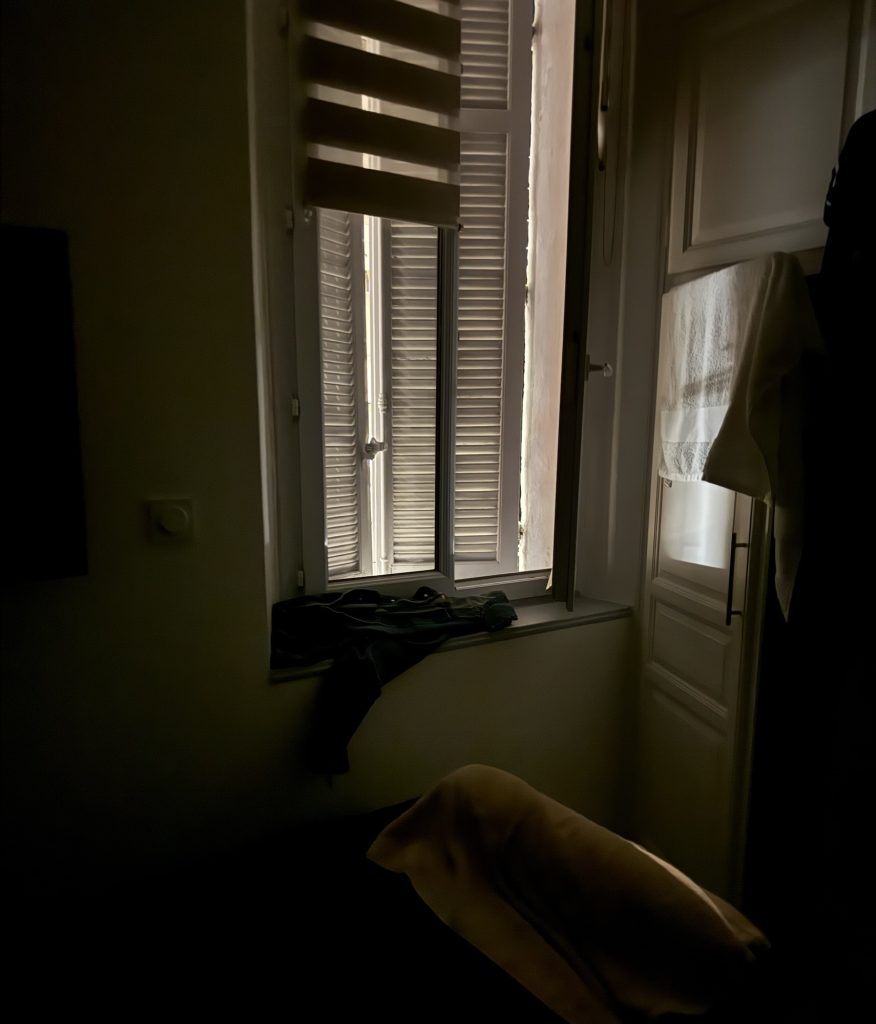
Late last night I was toasting some pita bread in “le pad” (8 Blvd. Montfleury), and the heat caused the pita to crack apart, so it had to be retrieved. I used a kitchen knife to scoop it out….zotz! The entire place went black, no power, nothing.
No breaker box in the place itself, but there are several boxes in the hallway. Off, on…nothing. I texted with exclamation points and called the landlord….flatline, silencio. No wifi, no computers. Smart phone or nothing.
Update: it’s now 8:35 am and the landlord hasn’t called or even acknowledged the problem via text.
What with the Cannes grind, I’m only just gotten around to reading that New Yorker excerpt from Jake Tapper and Alex Thompson‘s “Original Sin” (Penguin, 5.20).


Sergei Loznitsa‘s Two Prosecutors, which I saw last night at the Salle Debussy, is a drably effective tale of bureaucratic cowardice and malevolence in 1937 Russia, during “the height of Stalin’s terror”, as a title card informs.
It’s basically a flat, slowly paced anti-drama about a naive young prosecutor (Aleksandr Kuznetsov) who tries to push for justice in the case of a political prisoner who’s been unjustly persecuted by the NKVD (aka The People’s Commissariat for Internal Affairs).
We know from the get-go, of course, that Kuznetsov’s Kornyev will not only fail in this quest but probably suffer persecution himself. This is precisely what happens in the end, so apart from Loznitsa’s exacting dialogue, Kuznesov’s quietly compelling performance, a much more theatrical one from Aleksandr Filippenko and Oleg Mutu‘s formal framings, there’s really not a lot to write home about.
You’re sitting there saying “Jesus, does Kornyev have any street smarts? He’s putting his own head into a noose and it’s just a matter of time before he’s arrested,” etc.
Loznitsa’s basic idea is something along the lines of “even in Stalinist Russia, there was no stopping a naive young man who wanted to see justice done, even if he knew deep down that he was asking for it.”
I was fine with Two Prosecutors as far as it went, but it could have been a more absorbing thing. No twists or turns, no brief flashes of hope, no unexpected moments. Nothing really happens except for the fact that Kornyev keeps trying to push his case. An intelligent, well-mannered idiot….congrats and enjoy your prison time!
Two Prosecutors was shot in 1.37 to 1…here’s how the Debussy screen looked last night before the lights came down.

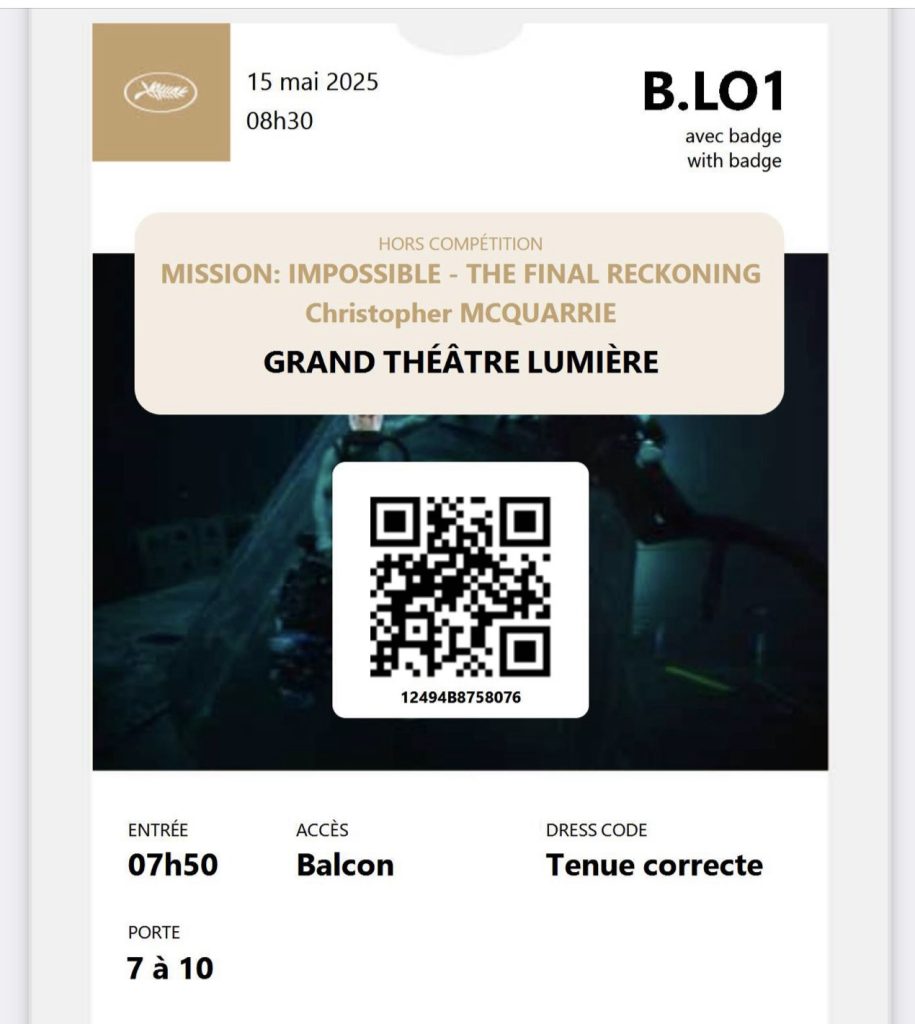
Stateside friendo (received in Cannes late Thursday morning, right after the 8:30 am Grand Lumiere screening of M:I-8 was letting out): “So how was Final Reckoning, Jeff?”
HE to stateside friendo: “It’s a completely nutso, excessively self-regarding, deranged lunatic heebie-jeebie whackathon…an advertisement for itself and its own 30-year legacy…a superflick that welcomely won’t stop explaining and re-explaining the absurdly complex plot, and yet it goes off the rails almost immediately…wait, wait…what is this?…tricking and tap-dancing itself out…too effing show-offy by half…it double- and then triple-backs itself into what struck me as a state of self-satirizing abuse…abusing itself and the audience in the same bargain.
“Ostensibly made by Tom Cruise and Chris McQuarrie but an undeniably assaultive, essentially brutalizing experience that might have been made (and in fact probably was influenced on some level) by ‘the Entity’ itself…it’s a $400 million enterprise that almost feels like a goofball parody of all the Mission-Impossibles we’ve been watching since the original Brian DePalma version (which opened on 5.22.96)…an AI robot movie that will be best appreciated by wannabe AI robots in the audience.”
I felt beaten to a pulp when it ended…beaten, bloody and wobbly in the knees…169 minutes long, and burdened, I felt, by crazy-busy thigamajig plotting (steal this thing in order to unlock this thing and also recover Ving Rhames‘ “poison pill” in order to prevent worldwide nuclear disaster and yaddah-yaddah) that I found much more fatiguing and brain-straining than engaging.
I liked the red-and-yellow-biplane sequence at the very end, but I didn’t love it. I guess I was feeling too fatigued by the time it rolled around.

Plus it’s awfully damn slow to get its act together and shift into passing gear…the first scene that really works (Cruise’s Ethan Hunt explaining to Angela Bassett‘s U.S. president what absolutely needs to be done…no ifs, ands or buts…to destroy the Entity and avert a nuclear catastrophe) happens around the 45-minute mark, and if it takes that long for a film to put oars into the water something is very wrong.
There’s also something hugely eccentric and playfully meta about Cruise-McQuarrie using the theatrical opening date of the original DePalma version — 5.22.96 — as a key plot point. The date is hand-written on White House stationery by President Bassett, alluding to the earlybird hatching of the Entity or something in that realm.
Cruise’s appearance subtly shifts from scene to scene. He looks fit as ever in certain portions — lean and rugged in a creased and weathered way — and then his face puffs up a bit in others. And his hair shifts around also, shortish and moussed and well-styled and then wild and untended. The fact — this is important — is that Cruise is starting to look too old to be performing his usual energizer-bunny stuff.
Remember that most of MI:8 was shot sometime in ’21…right? It was initially set to open on on 8.5.22 but then delayed to 11.4.22, 7.7.23, 6.28.24 and then finally to the current date of 5.23.25. Cruise was 59 or 60 during initial principal photography, but he’ll be celebrating his 63rd birthday on 7.3.25. He’s still in excellent shape, of course — the big climactic biplane sequence is proof of this — but it’s probably time to hang up his six-shooter. The action stuff, I mean.
Remember Cruise’s perfectly-toned physique in that romantic foreplay scene with Nicole Kidman in Eyes Wide Shut? That was over a quarter-century ago. That muscle tone has sagged somewhat, and his midsection is thicker. It happens. Nothing to fret about.
I actually hated the sequence in which Hunt explores the underwater Russian submarine tomb…what’s it called, the Sevastipol or the Antropova? I don’t ever want to watch anyone immersed in arctic-temp seawater again. It made me feel miserable.
I don’t know what else to say except that it hit me this time that Simon Pegg is wearing a hairpiece.
The IMAX site states that MI:8 “includes over 45 minutes of IMAX’s exclusive 1.90:1 Expanded Aspect Ratio….shot wih IMAX-certified digital cameras.” Well, I didn’t notice any IMAX sequences. No IMAX large-format photography, I mean. Real IMAX is ideally shot and projected at a 1.43:1 aspect ratio.
…if I didn’t admit to feelings of trepidation. Five minutes from starting time (8:25 am)…please don’t piss me off…please enthrall…please.
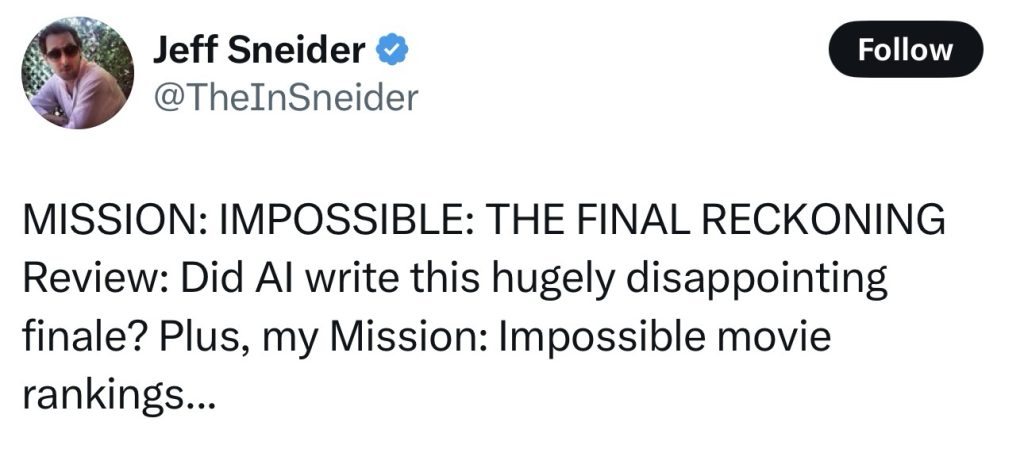


Insult, insult, insult, insult, insult….topped off by a sentimental crescendo of praise. The Denzel (“Why is he here?”) is much better than the Scorsese.
Earlier this afternoon I suffered through most of Mascha Schilinski’s Sound of Falling, and I want credit, dammit, for toughing it out for just short of two hours. (It runs 149 minutes.)
A hellish, multi-chapter, visually dreary, narrative hop-around from the perspective of a few suffering women and young girls at different times during the 20th Century, Sound of Falling brings the grim and the soul-drain in the usual suffocating ways.
You could say that the soft, muddy, under-lighted cinematography is meant to inject the same shitty, misery-pit, lemme-outta-here feeling the women and girls are experiencing at every turn. Sure, I’ll buy that.
Is Schilinski an auteur — a feisty, willful, go-for-it filmmaker with a persistence of artistic vision and a stylistic stamp all her own (albeit a stamp that brings you down, down, down)? Yes, she is that.
Does her film have something to say? You’d better believe it. It’s saying that 20th Century farm women in northern Germany were miserable as fuck, and that the men were either smelly pigs or abusers or both, and that most of them smoked and a few had massive pot bellies.
Sound of Falling doesn’t make you think about dying before your time, but it does prompt thoughts of escape early on.
On top of which I was sitting in the Grand Lumière balcony, scrunched between two women and with no leg room at all, and my thighs and calves were stuck in a kind of purgatory, suspended between numbness and screaming pain.
But I didn’t leave for the longest time. I wanted to but I couldn’t be the first balcony-sitter to bail. I said this to myself — “no quitting until a couple of viewers go first”.
So I hung in there with the patience of Job, waiting for some intrepid soul to man up and bolt the fuck outta there, but nobody did for the first…oh, 100 minutes or so.
And then a woman got up and walked. And then another. Thank you, sisters, and thank you, my sweet Lord…glory be to God!
I stood up with my bag and retreated to the main walkway, and then decided to watch from a standing position. And then another person threw in the towel. And then another. And then a trio of Zoomers left at the same time. Hey, we’re really livin’ here!!!
I’ve never felt such wonderful kinship with strangers as I did at that moment.
Variety’s Guy Lodge, the bespectacled king of the Cannes filmcrit dweebs, has totally raved about Schilinski’s punisher.
I respect Lodge’s willingness to drop to his knees and kowtow to a feminist filmmaker who has the chutzpah to subject viewers to a drip-drip gloom virus, but at the same time I think he’s either left the planet or had simply decided to praise this fairly infuriating film no matter what.
Average Joes and Janes, trust me, are going to hate, hate, hate this exactingly assembled, artistically pulverizing tour de force.

No time to write anything with a 3 pm screening breathing down my neck…


I was mezzo-mezzo, at best, with Amelie Bonnin‘s Partir Un Jour (Leave One Day), which I saw this morning at 9 am. It’s one of those “going back home and sorting through the past” films. I was there but drifting.
And yet I was seriously and repeatedly struck by a remarkable similarity between the star, Juliette Armanet, best known as a French singer-songwriter, and the late Albert Dieudonne, the star of Abel Gance‘s Napoleon (’27).
They have almost the exact same nose…one of those French honkers you can slice roast beef with.


“I have such close feelings for the Festival de Cannes. Especially now when there’s so much in the world pulling us apart, Cannes brings us together — storytellers, filmmakers, fans and friends. It’s like coming home.” — Robert DeNiro during yesterday’s Cannes tribute event.
HE feels exactly the same way. Really good to be here. Plus it’s warm and sunny with blue skies above.


