Being a mostly rational adult, I understand and accept the rationale behind Lorelei Lee-styled money–whoring. Way of the world since time began, the nice things in life, girls just wanna, etc.
But in my heart of hearts and as unrealistic as that Picnic finale may be (i.e., Kim Novak deciding to take a flying leap with penniless William Holden), I want to believe in the unreliable, idealistic, non-transactional coupling of hearts and dreams. Teresa Wright and Dana Andrews at the finale of TheBestYearsofOurLives…that kind of thing.
Money-whoring is to be expected, yes, but it’s bad for the soul.
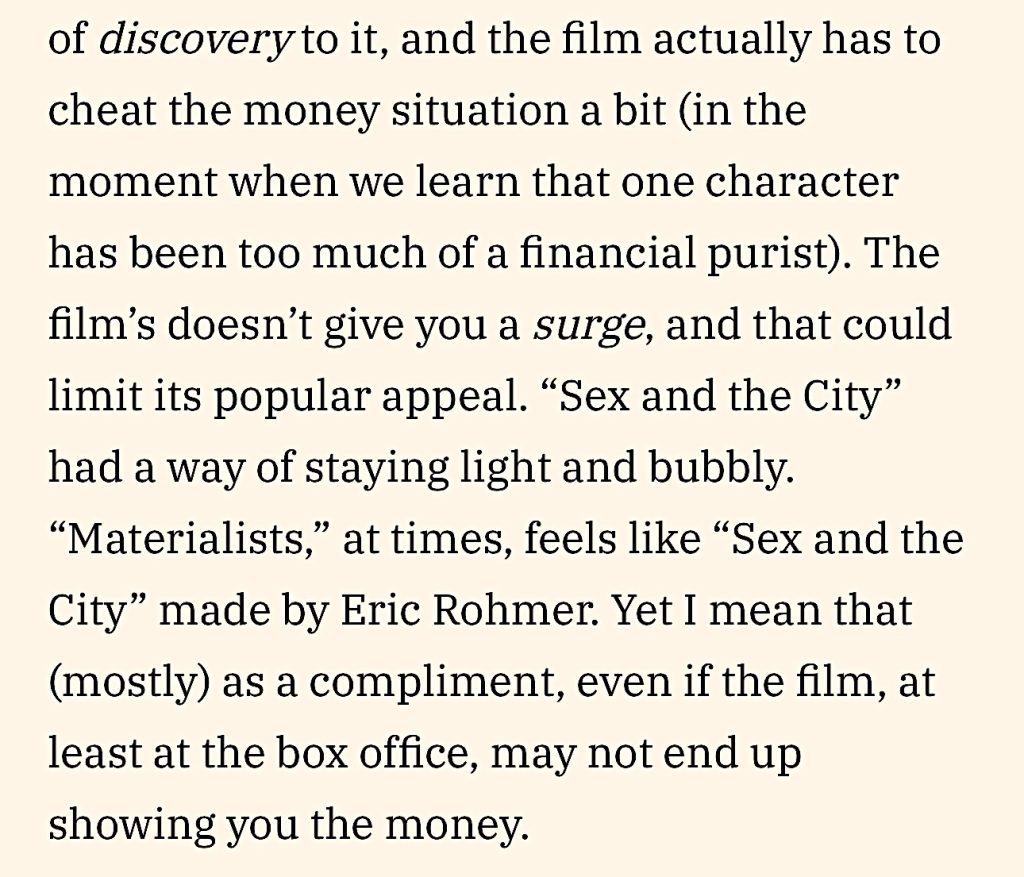
My understanding is that the first motion-picture camera sound blimps (i.e., foam-filled housing attached to a camera which reduces shutter sounds, designed with holes for the lens and viewfinder) began to be used with noisy three-strip Technicolor cameras back in the late ’30s.
Imagine having to work with a blimp of this bulk…it’s nearly the size of a Fiat station wagon.
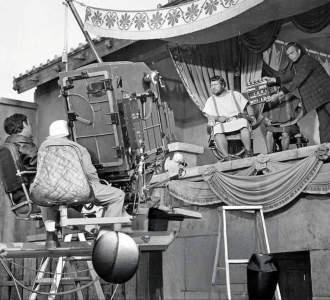
Notice the date on the clapper next to Peter Ustinov in the below Spartacus snap — 4.15.59 or tax day.
One quick question: Why is CNN refusing to allow viewers to stream a recorded version of last night’s live broadcast of Good Night and Good Luck? Millions no doubt missed it and even some who saw it, I’m guessing, might want to catch it again. You can’t even find scene excerpts on Youtube. What’s the problem exactly?
ThoseuglyDisqusadsandlinks adjacent to the comments will be removed as soon as I can find the link to the Disqus billing info. Team Disqus can’t be bothered to make changing your payment info an easy process.
I’ve been saying from the get-go that Joseph Quinn‘s performance as George Harrison in Sam Mendes‘ quartet of Beatles films…I’ve said right from the start that Quinn is the Wrong Guy…a terrible fit in a physical-biological way, starting with his pale freckly complexion and reddish-auburn hair.
Ginger or copper-haired actresses have never had the slightest problem in Hollywood, of course, and a select few have become major stars — Cate Blanchett, Amy Adams, Emma Stone, Jessica Chastain, Nicole Kidman, Julianne Moore, Bryce Dallas Howard, Isla Fisher, Lindsay Lohan, Christina Hendricks plus yesteryear’s Katharine Hepburn, Deborah Kerr, Myrna Loy, Tina Louise, Greer Garson, Rita Hayworth, Lucille Ball, Maureen O’Hara, Carol Burnett, Susan Hayward.
But ginger-haired guys have almost never made it to the penthouse level. Because there’s something about them that Americans just can’t quite settle in with or bow down to…not really.
Michael Fassbender, Lucas Hedges, Paul Bettany, Jesse Plemons, David Caruso, Ed Sheeran, Damian Lewis, Rupert Grint, Alan Tudyk, Brendan Gleeson, Danny Bonaduce, Eric Stoltz, Carrot Top Thompson, David Lewis, Domhnall Gleeson, Rupert Grint, Simon Pegg, Toby Stephens, the great Philip Seymour Hoffman, Chuck Norris, Jason Flemyng, Seth Green, David Wenham…none of them ever made it into the elite winner’s circle, not really. Because people glommed onto that red hair and went “okay, fine, good actor but nope.”
The only copper-ginger guys who became gold-bullion movie stars were James Cagney and Robert Redford.
Quinn will never manage it, period. Harrison is currently fretting and frowning in heaven, pacing back and forth, knowing what’s to come and yet unable to wield any influence on planet earth. Mendes’ quartet will also blow chunks with good old hawknose pointy-chin playing Paul McCartney.
There’s a 4K UHD disc of High Society arriving on 6.24. Forget it. Too schmaltzy. Not worth the candle.
I streamed an HD version of High Society three or four years ago, and despite my knowing the source material (Philip Barry and Donald Ogden‘s The Philadelpha Story) backwards and forwards, I began losing interest very quickly. I wanted to savor Paul C. Vogel‘s scrumptious VistaVision visuals, of course, but the tone and attitude of this 1956 film is flaccid…smug and bland and about as un-peppy as an ostensibly clever society comedy like this could be.
The director…wait, who directed it again? Charles Walters, primarily known for light, glossy musicals (Lili, Easter Parade, Summer Stock) and being a respected choreographer.
The Philadelpha Story (’40), directed by George Cukor, has the non-musical pep! It captures the flush, jaded, fleet-of-mind cynicism that…uhm, I’ve long presumed goes hand in hand with having been born into old wealth.
Katharine Hepburn starred in Barry’s original, tune-free 1939 play as well as the film. Joseph Cotten played the Cary Grant / Bing Crosby role of C. K. Dexter Haven, and Van Heflin played reporter Macauley Connor, conveyed by James Stewart in ’40 and Frank Sinatra in ’56.
Honestly? I turned off the High Society streamer before it ended. Plus Crosby, 53 at the time, was way too old for Grace Kelly, who was 24 or 25 during filming. And Kelly couldn’t hold a candle to Hepburn…sorry.
Has Scarlett Johansson or any hyphenate with her kind of power and popularity ever explored the possibility of producing or directing a feature (or maybe an six-episode miniseries) about influential TV journalist and former actress Lisa Howard? Somebody should look into this.
Howard (aka Dorothy Jean Guggenheim, 4.24.26 to 7.4.65) “was an American journalist, writer, and television news anchor who previously had a career as an off-Broadway and soap opera actress. In the early 1960s, she became ABC News’s first woman reporter, and was the first woman to have her own national network television news show.”
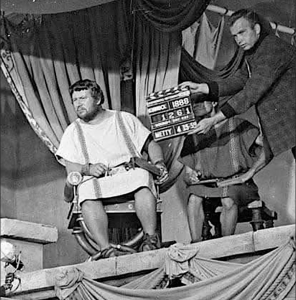
Howard developed a relationship, possibly of a sexual nature, with Cuba’s Fidel Castro, whom she interviewed on camera. The scuttlebutt says she may have also done the slip-and-slide with…let’s not go there.
Howard’s network career went south when she became closely involved in Kenneth Keating‘s U.S. Senate election in 1964 New York. (He lost to Bobby Kennedy.) The following year she killed herself (fact) with an overdose of pain killers, possibly prompted by and then having suffered a miscarriage and depression but who knows?
I know that Julia Ormond portrayed Howard in Part 1 of Steven Soderbergh‘s Che (’08), but I don’t even remember seeing her in that two-part film. Not a word or a shot. And I’ve watched Che three times, once in Cannes 17 years ago and twice with the Criterion Bluray.
In a seven-year-old Politico article, Peter Kornbluh reports that Howard “set up a meeting between UN diplomat William Attwood and Cuba’s UN representative Carlos Lechuga on 9.23.63, at her Upper East Side New York apartment, under the cover of a cocktail party. With Howard’s support, “the Kennedy White House was organizing a secret meeting with an emissary of Fidel Castro in November 1963 at the United Nations — a plan that was aborted when Kennedy died on 11.22.63.”
Oh, I get it — progressive industry women don’t to make a Howard film because a pillow-talk espionage saga is seen in some quarters as demeaning, and committing suicide in ’65 makes for a glum, defeatist ending.
And the aging process, especially after the big six-oh, is rarely a kind or compassionate thing. But it cuts some of us a slight break.
Those favored with good genes, I mean, and who haven’t overly abused their bodies and souls with drugs and alcohol. If you at least half-resemble the person you were at age 21, you have reason to give thanks.
I don’t mean Wicked: For Good (Universal, 11.21), which may or may not be worth seeing. I mean the giggly, gushy Cynthia Erivo + Ariana Grande award-season tour, phase one of which nearly finished me off a few months ago. I’m exhausted just thinking about it.
I’ve been saying for years that franchise movies don’t respect the idea of really and truly meeting your maker…the inevitable, inescapable reality of existence vaporizing like that…a sudden gasp and then nothing…the spirit rising one way or another…no dodging or putting it off.
Which is precisely what big-budget bullshit movies do time and again — they dodge, delay, sidestep or otherwise ignore the grim reaper because they want to keep reaping those Joe and Jane Popcorn dollars so forget all that biological end-of-the-road stuff. Fuck finality.
The “death” of Daniel Craig‘s 007 four years ago was, of course, bullshit — a symbolic gesture for the #MeToo crowd to momentarily savor, and then forget soon after. The Ballerina return of Keanu Reeves‘ John Wick, despite having bought the farm two years ago in John Wick 4: Even More Bullshit, meant nothing one way or the other.
And it’s all basically the fault of the nihilistically-inclined John Carpenter…Carpenter of the late ’70s was the first disser and disrespecter of death, and the idea of a character (male or female, hero or villain) breathing his or her last hasn’t been the same since.
Variety‘s Owen Gleiberman: “In movies, you can trace the trend of what we might call Death Lite back to the moment in 1978 that established the if-it-makes-money-bring-it-back paradigm: the ‘death’ of Michael Myers at the end of Halloween.
“He gets shot six times and falls off a balcony, lying on the ground, joining the ranks of half a century’s worth of movie monsters who are destroyed by the forces of good. Seconds later, though, he is gone; his body has vanished. In essence, that one moment set up the entire arbitrary nature of movie sequel culture. You can draw a direct line from the return of Michael Myers to the resurrection of John Wick, all done in the name of fan service.
“But why does it feel like all this ritual undercutting of killing is killing us? You might say: What’s so bad, really, about taking characters who are this beloved and bringing them back to life?
“In a sense, nothing. Yet the subtle cumulative effect of it has been to create the sensation that a movie no longer has a true beginning and end, that it lacks what the Greeks called the dramatic unity of action. In Old Hollywood, movies had that; in the New Hollywood of the ’70s, they had it as well. But the death-that-isn’t-really-death syndrome feeds the perception that movies are now, more and more, just a perpetual blob of time-killing, with nothing at stake.
“And that has an insidious way of sanding down the inner morality of pop culture, and maybe of our society. In fact, I’d argue that all this ‘miraculous’ resurrection has begun to raise the question: If death in the movies is no longer permanent, if it no longer means anything, then does anything mean anything?”
In Thursday’s riff about the Good Night, and Good Luck CNN telecast (tonight at 7 pm), I explained, for the benefit of the HE commentariat dumbshits, an obvious parallel between the political climates of the red-scare, Sen. Joseph R. McCarthy-dominated 1950s and the recently concluded peak era of woke terror (2018-2024).
Edward R. Murrow’s famous anti-McCarthy expose, which aired on March 9, 1954, ridiculed McCarthy’s argument that if a person disagreed with or called into question McCarthy’s witch-hunt tactics, then he or she must be considered a Communist dupe or sympathizer or perhaps even an actual, card-carrying pinko.
Likewise, if a person had issues with woke fanaticism and the temerity to question its theology between ’18 and ’24 (institutionalized DEI, identity issues above everything else, #MeToo cancellations, fat is beautiful, pregnant men, Lily Gladstone for Best Actress, the power and the glory of being LGBTQ and especially trans (particularly for children of high-profile industry celebrities), the Gothams and Spirits embracing gender-free acting categories, the 1619 Project as absolute gospel, drag shows in elementary schools, presentism or the historically absurd casting of POCs in certain historical settings, Woody Allen labelled a monster, tearing down statues of Abraham Lincoln and George Washington, older straight white guys deemed inherently evil, men competing in women’s sports, half-excusing the George Floyd riots)…if, God forbid, you had problems with any of this you were presumed to be a bad person — perhaps a closet racist or homophobic or transphobic or at the very least a social undesirable, and therefore deserving of political and professional punishment.
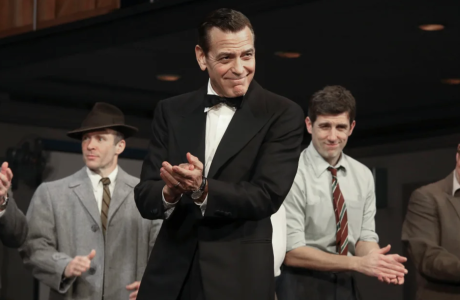
George Clooney‘s head is ummistakably in the right place as far as Good Night, and Good Luck‘s tribute to Murrow’s balls and backbone are concerned, but how did Clooney the industry player respond to the climate of fear and intimidation fostered by Hollywood wokeism over the last few years?
I’ll tell you how he responded to it. He completely capitulated. Clooney and partner Grant Heslov pretty much said aloud to the Stalinist mobthink wokeys, “We’re with you!…we agree!…tell us how we can most effectively grovel!”
Clooney and Heslov showed their inclusion-mandate colors two or three years ago when they cast The Tender Bar. To film a tale about a young lad and fledgling writer, called “JR Maguire” and based on journalist-author J.R. Moehringer (played by Tye Sheridan), who was raised within a German-Irish community in Manhasset, Long island, George and Grant bent over backwards by not casting birds-of-a-feather actors in a couple of key roles — the 10 year-old version of Moehringer and a Fairfield County-residing whitebread lass whom the real-life Moehringer fell in love with while enrolled at Yale.
The basic rule of thumb was “the less white, the more wokey and therefore goody goody.”
In my 10.10.21 review, I wrote that The Tender Bar “is partly undone by a pair of surreal casting decisions, one of which makes the first 40% of the film feel seriously out of whack.
“I’m speaking of the casting of young Daniel Ranieri, a kid who hails from some kind of swarthy Mediterranean heritage, as the 10 year-old version of Tye Sheridan, who, like Moehringer in actuality, is the biological son of a German/Irish paleface couple (Lily Rabe, Max Martini).
“It would be one thing if Ranieri was adopted, but there’s NO WAY IN HELL this kid grows up to be Tye Sheridan.
“And then The Tender Bar doubles down by changing the identity of a wealthy Westport white girl named Sydney, whom Moehringer fell in love with during his time at Yale in the mid ’80s and who represents the unattainable ideal for a working-class kid from Manhasset…Clooney changed Sydney from a blonde, Daisy Buchanan-like character with a small nose, ample breasts and whiter-than-white parents (her father is described by Moehringer as Hemingway-esque) into a ravishing woman of color (Briana Middleton) and her parents into an interracial couple (mom is played by Quincy Tyler Bernstine).
“This is yet another example of casting by way of virtue-signaling, and particularly Clooney, Heslov and producer Ted Hope wanting to groove along with the white-disapproving ethos of progressive Hollywood.
“I grew up in Wilton and Westport, and I personally knew of one couple of color (opera singer Betty Jones, a friend of my mom’s, and her husband) and heard about no interracial couples at all. That’s not to say there were none, but if they existed in the Wilton-Westport-Weston region they were very under-the-radar.
“For a working-class Manhasset kid to fall head over heels in love with a rich, blonde, unattainable goddess from Westport…that works, that fits, I’ll buy that. But Tender Bar’s version of Sydney and her parents is insincere presentism — it has no reality current, certainly in a 35 year-old context.
“And frankly? People from scruffy working-class towns like Manhasset weren’t exactly known for being racially progressive or attuned to color-blind attitudes. This is the ‘70s and ’80s we’re talking about. Those boozy guys in The Dickens would have definitely raised an eyebrow if Sheridan’s J.R. character had shared the particulars about his Yale dream lover. They wouldn’t have ‘said’ anything, but they would have definitely, you know, cleared their throats.”
Boiled down: You can’t kowtow to the wokeys in the early 2020s and then turn around and produce a period play that says “Edward R. Murrow was a hero and a man of bedrock principle for refusing to kowtow to Sen. Joseph McCarthy!”
Nobody seeks out conclusive decisions or indications that a relationship has begun to wind down or run out of gas. Said indications nonetheless have a way of tapping you on the shoulder, whispering in the dark, tugging on your shirtsleeve.
What I’m saying, basically, is that whether the participants want a slow-down or not, some relationships (not the “match made in heaven” kind) have a way of forcing the issue on their own dime or upon their own volition.
I went through this two or three times in my 20s and early 30s, and being the passive-aggressive type when it comes to urgent emotional issues, each time I tended to say to myself “okay, the fires of passion aren’t heating the furnace like they used to, but that doesn’t mean there’s absolutely no choice but to break up…right? Why not just play it by ear and idle along and see what happens? I’m not hugely unhappy with her, just a tiny bit bored. She’s a good, kind person. Maybe things can somehow re-ignite…maybe we can figure it out…who knows?”
It’s different when women start feeling that tug on the sleeve. The fire doesn’t just stop heating the room — they tend to be much more decisive and expressive of their romantic dissatisfaction. They put out vibes that inspire songs like “You’ve Lost That Lovin’ Feelin’“, which is one of the most pathetic love songs ever written because it’s obvious the woman has been telling the dude that things just aren’t happening any more, and his response to these signals is “please, baby, please…baby baby baby baby please please.” God, man!
I was in a marginally spirited, low-energy relationship in my mid 20s. We shared an inexpensive pad in Santa Monica, and we both had jobs, of course.
But one day, being an asshole, I noticed that a really super-dishy blonde was living alone in a building that was maybe 150 feet from our two-story apartment house, and being the weaselly passive-aggressive type (while at the same time not really dealing with what I was feeling deep down) I started a little something with the blonde, who was curvy and buxom and had a Dutch last name.
I can’t recall how I managed it, only that my hormonal impulses wouldn’t take no for an answer. Her name was Carol. I somehow wangled my way into into her place one evening, and oh, Lordy, what happened an hour or two later was wonderful. She was initially reluctant, and then less reluctant and eventually she went with it. Ecstasy and us.
I saw her again the next night, and there was zero reluctance this time. Ding-ding-ding-ding-ding-ding-ding-dinga-linga-ling!
And then Steve, a single guy in my building who may have also had eyes for Carol (he was a fairly serious swordsman), invited her over, offered her a glass of wine and quickly sniffed out the situation. He knew what was up, he told me, when she heard the squeaky brakes on my Volkswagen Fastback and said, “That’s Jeff’s car.” A day or two later he told me I should think twice about “shitting where you eat.”
I didn’t disagree with Steve but my God, the intoxication…the madness I was feeling over Carol…her Northern European Marilyn Monroe-ness and fair white skin, that milky scent, those moaning sounds, etc. It was impossible that any sort of real-deal relationship could happen, of course. A night or two later and wised up by Steve, she told me it had to stop.
My significant other never “found out”, although she hinted soon after that she sensed a certain current in the air and found it so disturbing that she didn’t want to think about it. I lied and pretended, and she let me get away with it. Or something like that.
Many decades have passed and to be perfectly honest I’m still a bit ashamed of my week-long affair with Carol. And yet every now and then I think of her and try to imagine how her life might have turned out, etc.
There are episodes of passion you get into in your 20s that you would probably steer away from in your 30s and 40s and beyond. All I know is that for a few days I went nuts, and that Carol met me halfway and man oh man oh man.
The following 1975 films are, in HE’s view, the most well-liked or highly respected according to the standards of 2025, and not those of 50 years ago. Times change, culture evolves…this is where we are right now.
And I’m a little bit sick of Jaws right now, to be perfectly honest. It’s obviously a very engaging, colorful, well-crafted film in many ways, but it’s stuffed to the gills with annoying or nonsensical Spielberg-isms that simply haven’t aged well.
And Milos Forman‘s One Flew Over The Cuckoo’s Nest does not rate all that highly either, and I’m saying this as one who played Dr. Spivey in a community theatre presentation of Ken Kesey‘s classic play that very same year. Plus I met and talked with Kesey at the Sundance Film Festival sometime in the late ’90s so don’t tell me.
Best Films of 1975 according to 2025 criteria (i.e., how often do I pleasurably rewatch?), and more or less in this order (23):
16. Frank Perry‘s Rancho Deluxe. (“Oh, give me a home, with a low interest loan. A cowgirl and two pickup trucks. A color TV, all the beer should be free. And that, man, is Rancho Deluxe.”
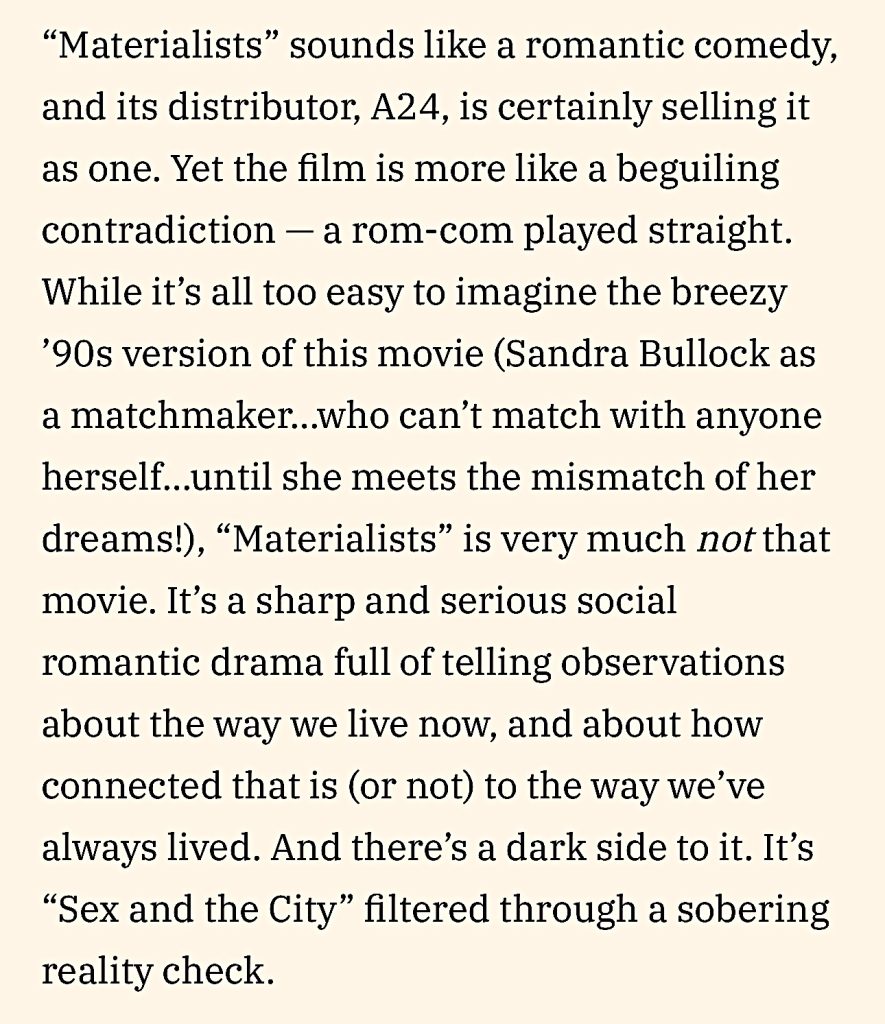
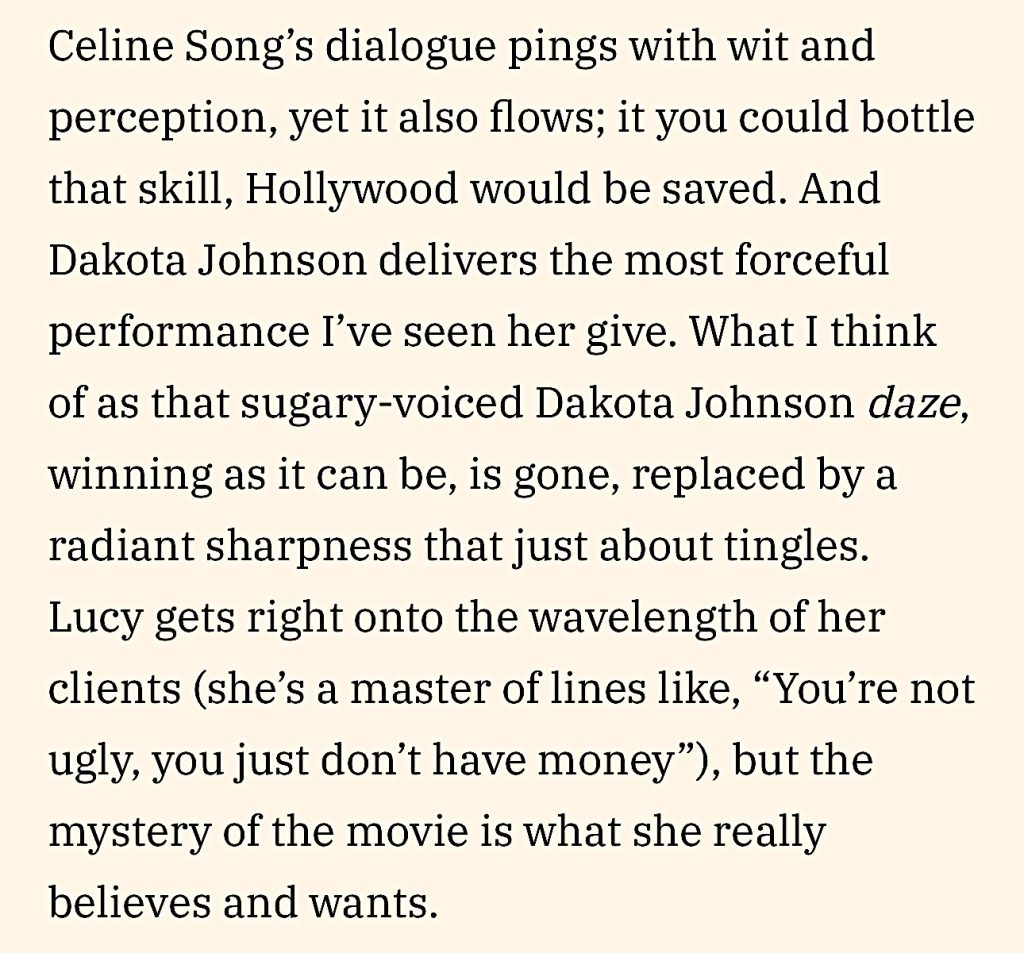
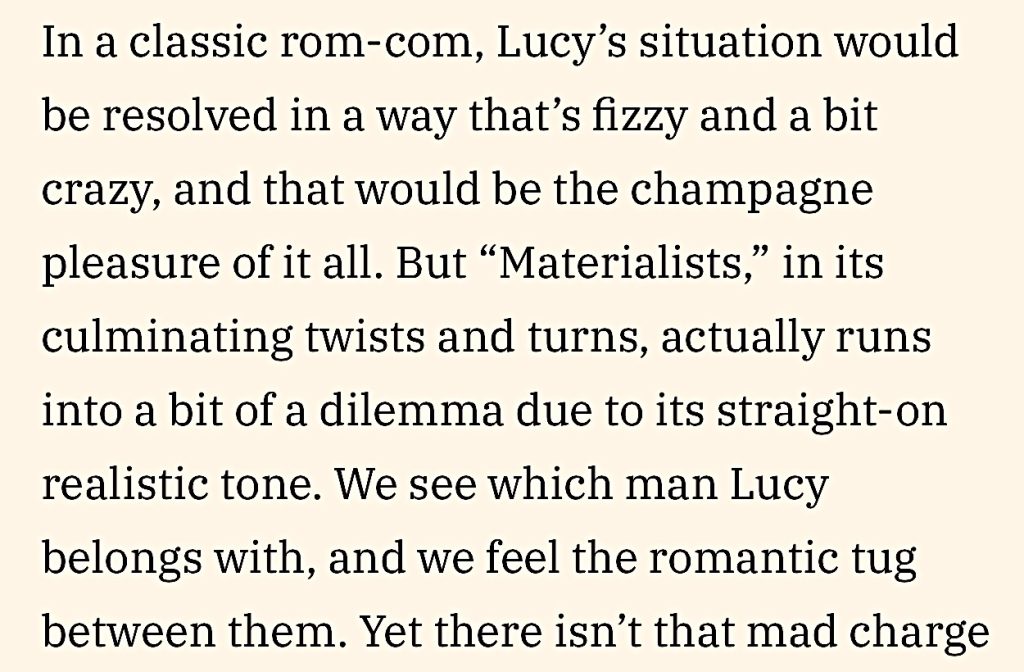
I can’t wait to hate-watch Materialists (A24, 6.13).
“Aren’t you funny? Don’t you know that a man being rich is like a girl being pretty? You might not marry a girl just because she’s pretty, but my goodness, doesn’t it help? And if you had a daughter, would’t you rather she didn’t marry a poor man? You’d want her to have the most wonderful things in the world. So why is it wrong for me to want those things?” — Lorelei Lee (Marilyn Monroe) to Gus Edmond, Sr. (Taylor Holmes), the super-loaded father of Gus Esmond, Jr. (Tommy Noonan), at the very end of Gentlemen Prefer Blondes (’53).
Posted on 5.9.25: “I feel this way because I’m a money whore, and you’ve got a lot of money so…perfection, right?” — Dakota Johnson‘s Lucy to Pedro Pascal‘s Harry Castillo in Celine Song‘s The Materialists. Okay, this isn’t an actual quote.