
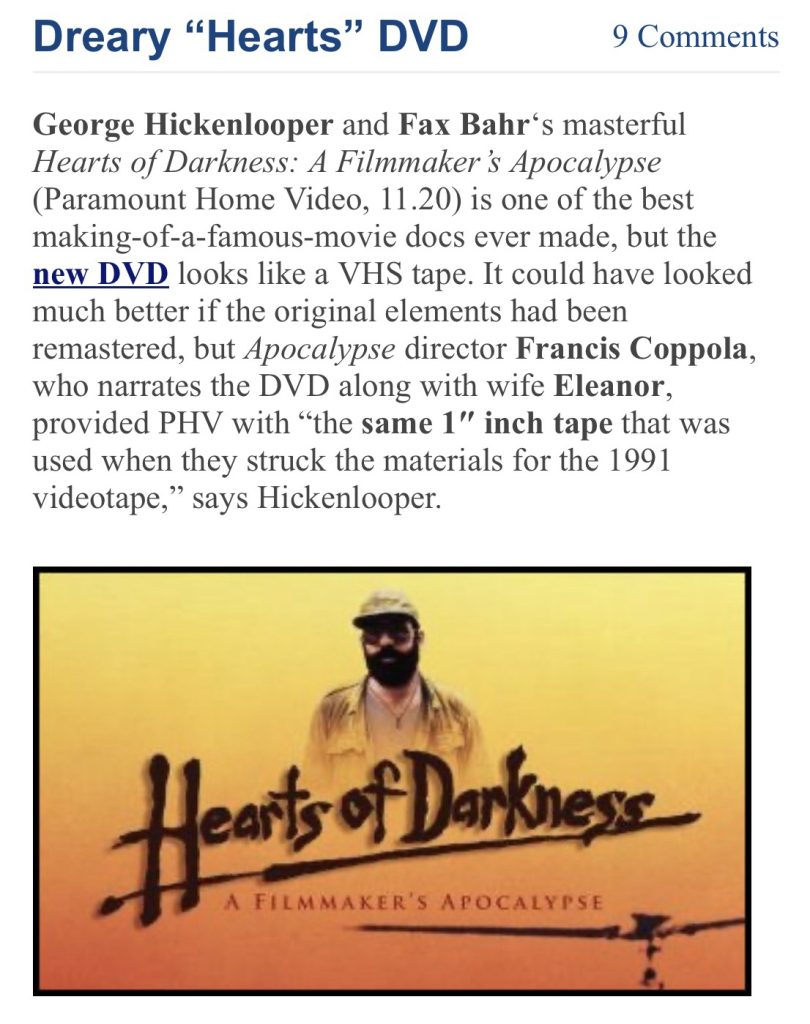
I have to see if the allegedly restored 4K Hearts of Darkness is all it’s cracked up to be. So I’m on the downtown IRT on this agreeably hot day, etc.
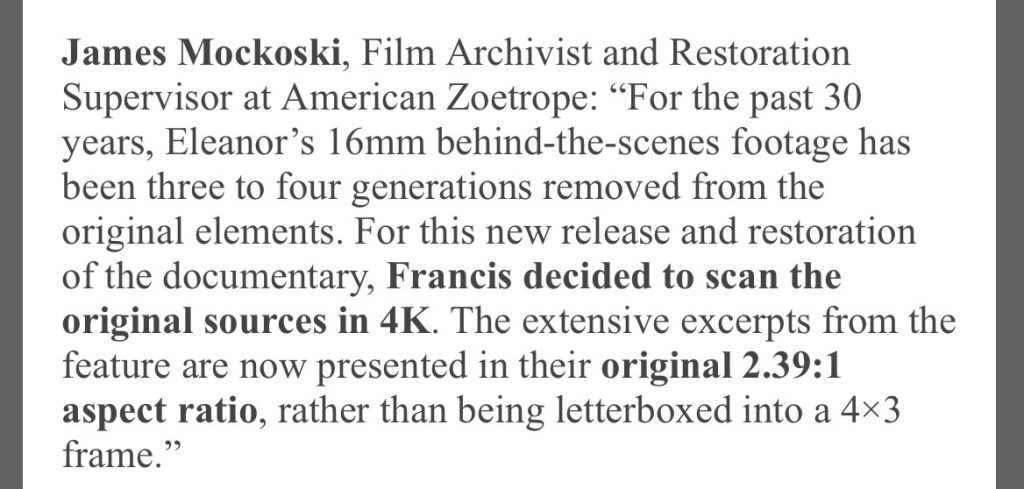
Posted on the eve of the release of the Hearts of Darkness DVD in 2008:
“The problem is that saving 200 pounds a month for a deposit on your first property makes very little sense when the price of that property grows by tens of thousands every year.
“This sense of the things you actually want speeding away from you on a train you’ll never catch…this is the real driving force behind the popularity of politicians like Mamdani.”
I still think Mamdani’s assured victory in the forthcoming New York mayoral election is a one-off.
Originally posted on 3.4.10: The Warner Bros. logo fanfare music that begins Lewis Milestone‘s Ocean’s 11 (1960) is the most enjoyable part of the film, hands down.
The second best part is Saul Bass‘s animated casino-attitude title sequence. Obviously old-school by today’s standards, but you can sense the smooth cocky mentality of late ’50s showbiz culture — the hold-the-clyde, chickie-baby attitude of Frank Sinatra and those those godawful orange sweaters he used to wear as he lounged around with Dean Martin and Sammy Davis, Jr. The mob guys who used to run things in Las Vegas would cater to the Rat Pack’s every whim, and there were always accommodating broads to hand out back rubs and…uhm, whatever else.
HE never even came close to a whiff of this kind of life (way before my time), but I can imagine.
>
If there’s one ’90s movie I’m determined to never, ever watch again, it’s Adrien Lyne‘s Indecent Proposal (’93). It was bad enough sitting through it the first time.
I lost it early on when Demi Moore‘s narration track used the term “dream house”. (Anyone who says those two words in that sequence deserves an instant, life-long demerit.)
Robert Redford‘s John Gage was supposed to be an odious millionaire, but there was no believing that because Redford can’t do odious, much less icky — it’s not in him. No matter the role (and I’m not counting Little Fauss and Big Halsy), he always played fair-minded straight-shooters.
As a testament to its own cynicism, Indecent Proposal uses a two-headed coin in the exact opposite way that Only Angels Have Wings uses one, which is interesting.
Just before his million-dollar night with Moore is about to commence on a yacht, Redford/Gage offers to forget the whole deal based on a coin toss — heads she submits, tails she walks.
Redford flips a half-dollar coin and it comes up heads, and so Moore stays and fulfills the deal by “doing” him every which way. At the finale he gives the coin to Moore for good luck. She flips it over and realizes it has heads on both sides. Redford/Gage therefore confirms that he’s a dishonest, manipulative shit.
Posted in 2018: The realm of Only Angels Have Wings is all-male, all the time. Feelings run quite strong (the pilots who are “good enough” love each other like brothers) but nobody lays their emotional cards on the table face-up.
Particularly Cary Grant‘s Geoff, a brusque, hard-headed type who never has a match on him. He gradually falls in love with Jean Arthur but refuses to say so or even show it very much.
But he does subtly reveal his feelings at the end with the help of a two-headed coin. It’s not what any woman or poet would call a profound declaration of love, but it’s as close to profound as it’s going to get in this 1939 Howard Hawks film. If Angels were remade today with Jennifer Lawrence in the Arthur role she’d probably say “to hell with it” and catch the boat, but in ’39 the coin was enough. Easily one of the greatest finales in Hollywood history.
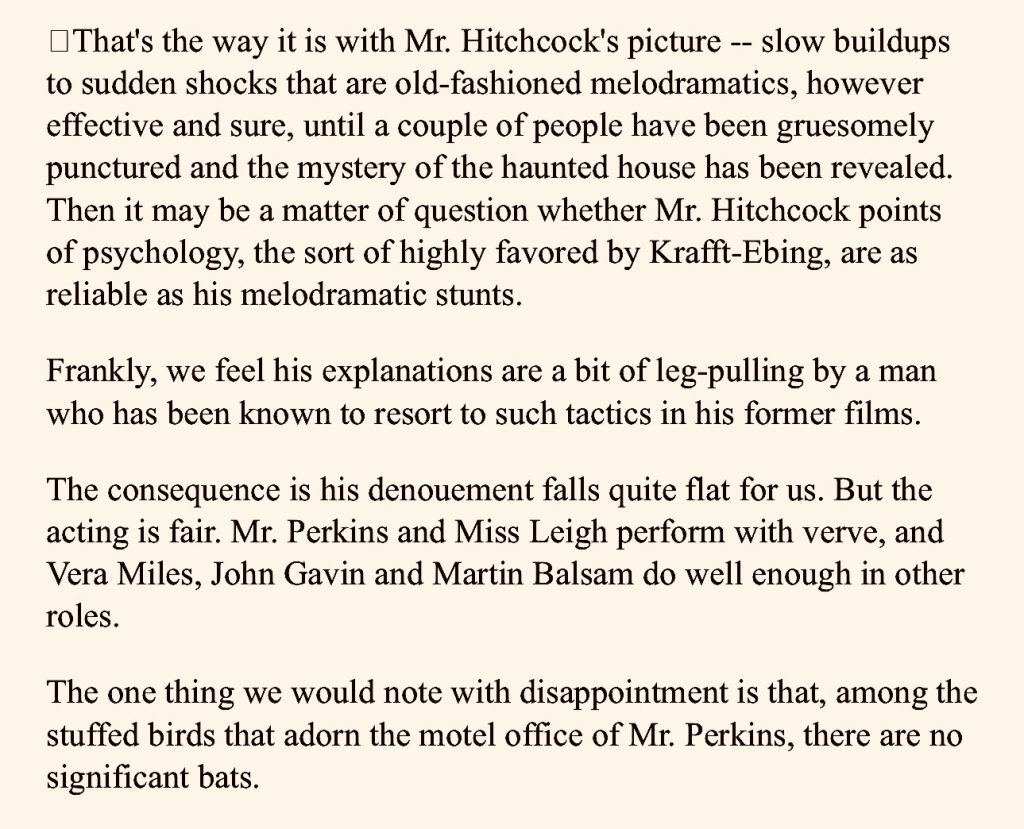
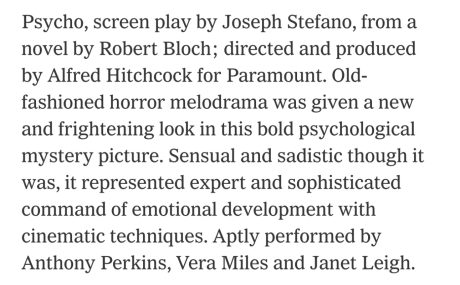
Bosley Crowther’s reaction to Alfred Hitchcock’s Psycho in his 6.16.60 N.Y. Times review is mostly one of distaste for the grisly stuff, which he regards as low-rent. He then masks his snooty prejudice by feigning boredom.
At age 54 the veteran critic was entering his harumphy, fuddy-duddy phase, I suppose, but how could this sophisticated movie maven…how could he have just sat in his seat like a heap of mashed potatoes during the startling, jittery editing of the shower-murder scene, compounded by Bernard Herrmann’s screechy violin score, neither of which he even mentions? Was he on painkillers?
And yet in the wake of Psycho’s striking popularity and financial success, Crowther’s opinion evolved. On 12.25.60 or six months later, he announced that Psycho was among his ten best of the year.Andrew Sarris’s highly adniring Village Voice review didn’t appear until the August 11th issue — almost two full months after the Crowther verdict. Why would it have taken this long for the Voice to register an opinion? The downtown paper couldn’t even publish a review sometime in July?
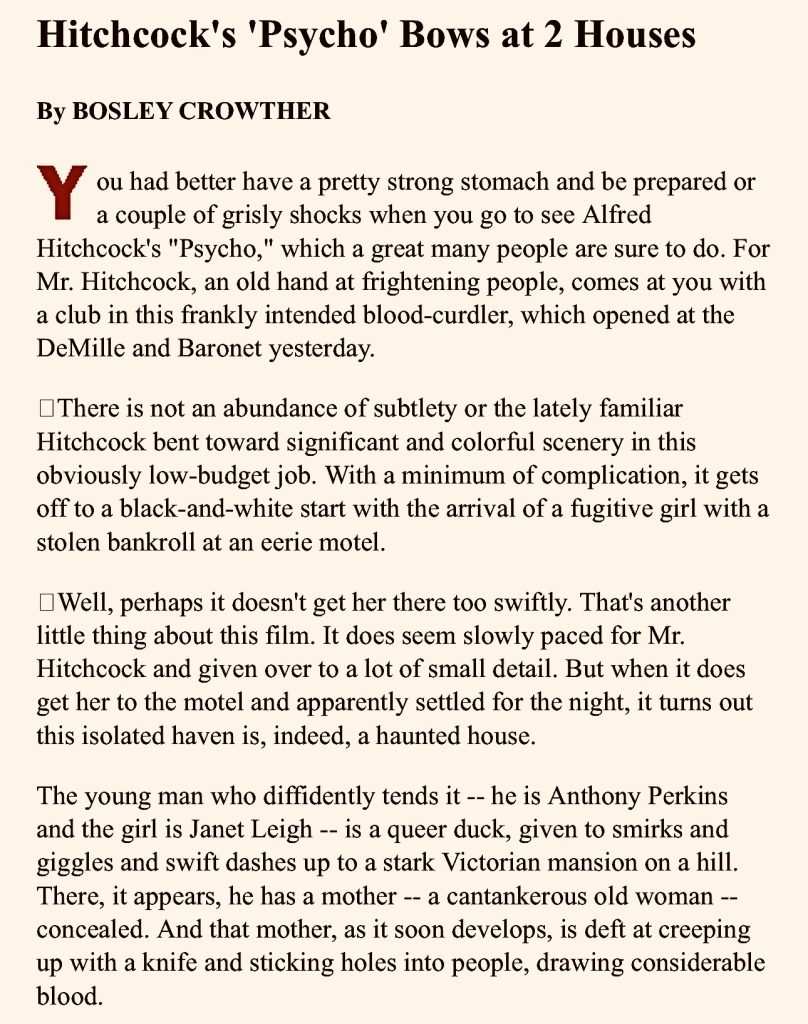
Portions of Sarris’s 8.11.60 review:
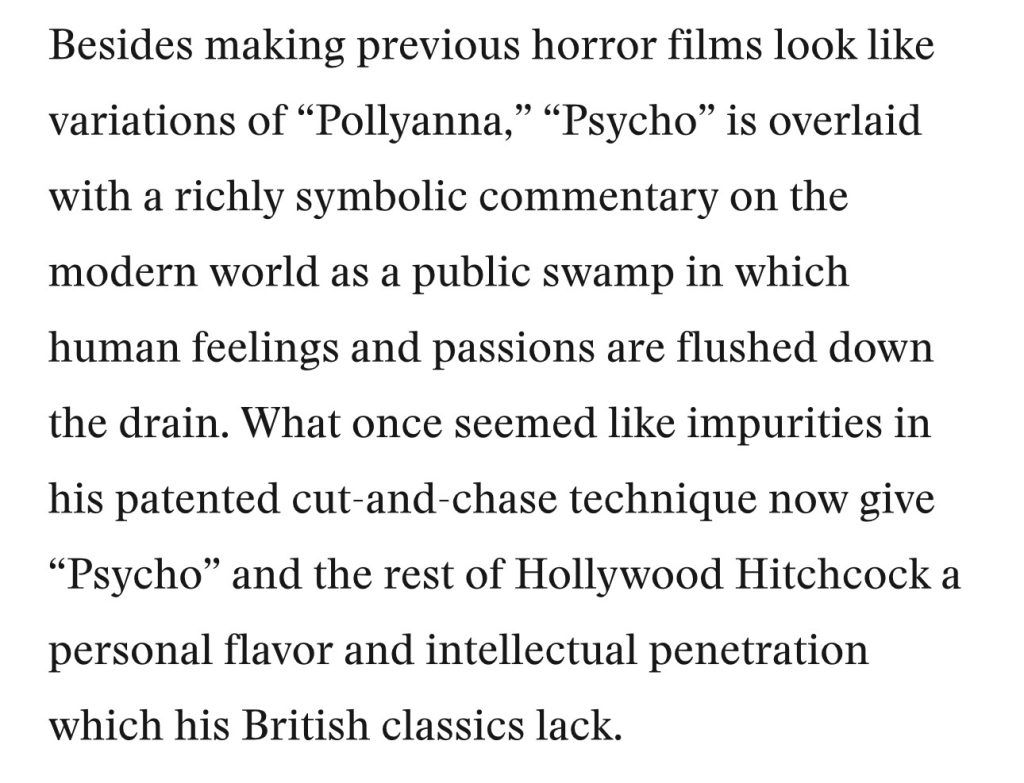
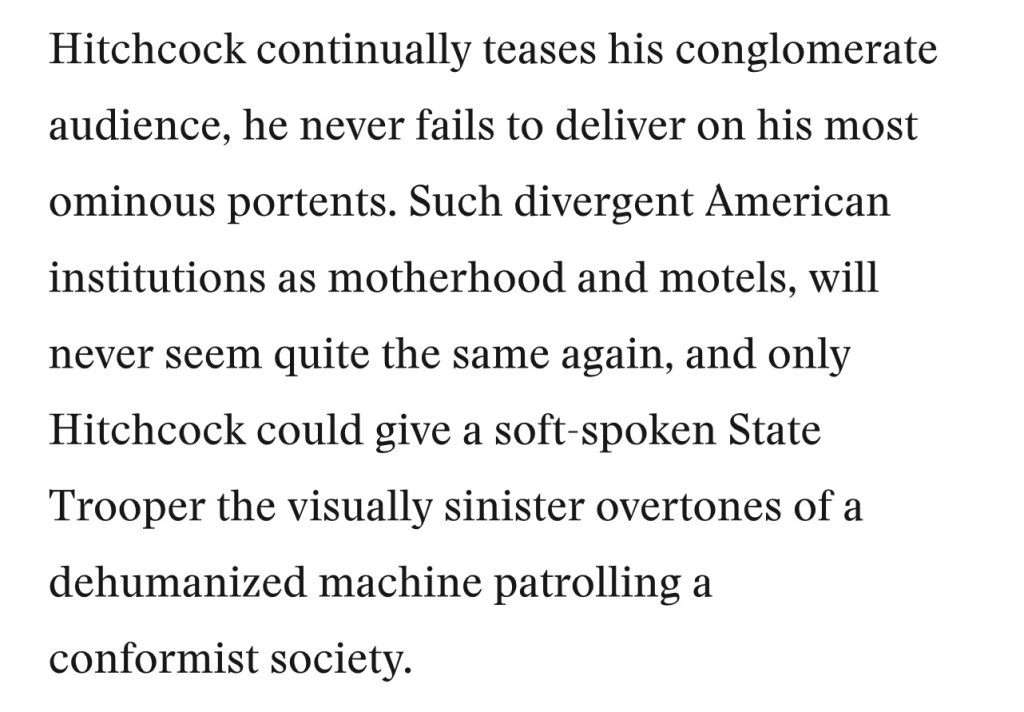
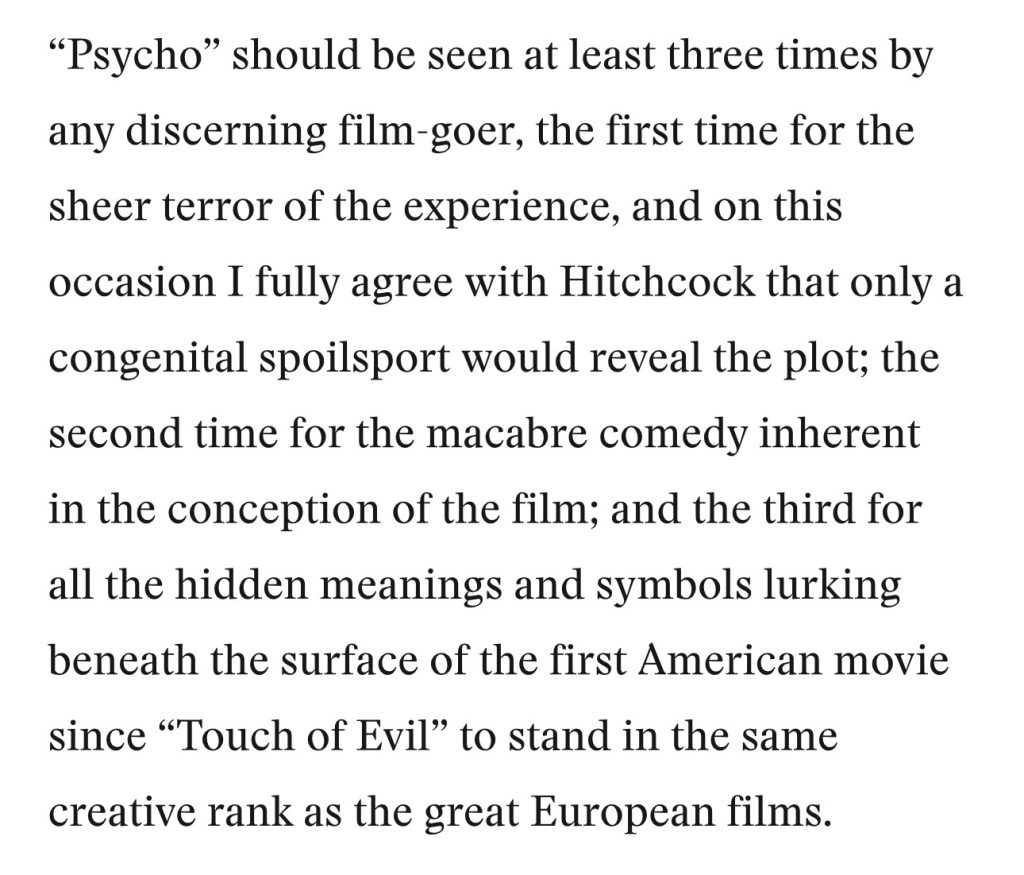
Crowther reconsiders:
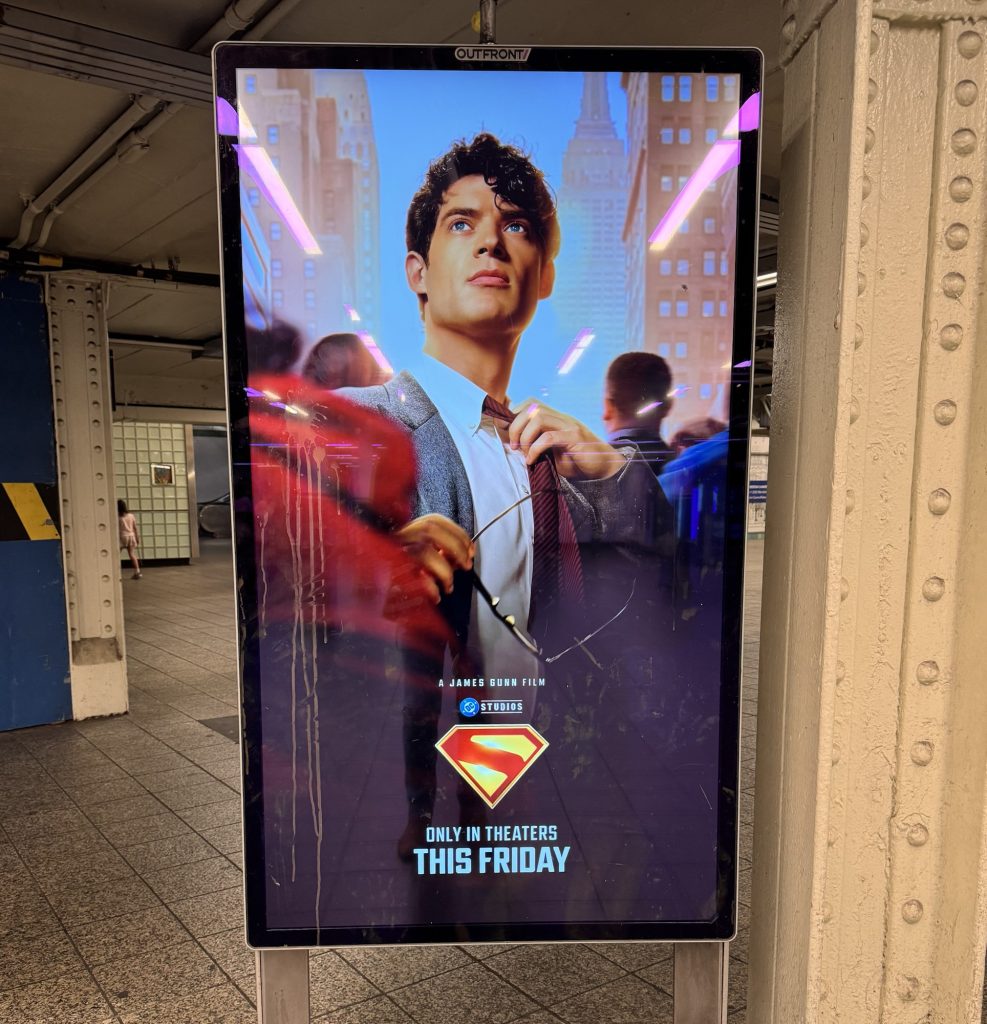
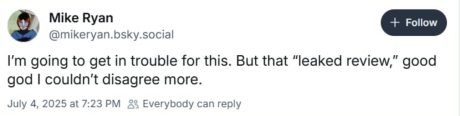
HE to friendo who’s seen James Gunn’s Superman: “How can you even stand to watch another DC Superman film? How can you let that shit into your soul? The endless reliance upon DC formula, remaking and remaking and remaking it all over again, is poison in the bloodstream.”
Friendo: “If I had a magic wand and could eliminate the blockbuster culture of the last 45 years, I would. But the poison didn’t start with comic-book movies. It started in the early ‘80s. And yet the bottom line is that some comic-book movies are good. That said, I’ve no doubt Superman will be trashed into the ground.”
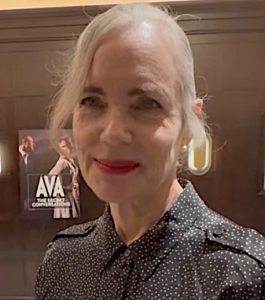
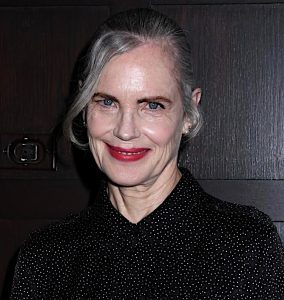
Born on 7.18.61, Elizabeth McGovern was around 18 when she played Jeanine Pratt in Robert Redford’s Ordinary People (9.10.80). A lively career followed, and 45 years have since flown by. McGovern is now about to begin a six-week run in Ava: The Secret Conversations at the New York City Center (131 W. 55th Street).
On-stage she resembles the older Ava Gardner, wearing a dark and tidy On The Beach wig. This Ava actually half-resembles the brunette Elizabeth McGovern who appeared in Cannes in 2012. But she’s gone gray in recent years and is making no effort to hold onto a semblance of her former self.
The truth is that McGovern currently looks like a blend of Jessica Tandy in The Birds and that care-worn woman who came to take Blanche Dubois to the mental hospital during the finale of A Streetcar Named Desire.
Not that there’s anything wrong with that.
McGovern is roughly Demi Moore’s age (actually a year older), but she sure as hell hasn’t been taking Substance injections. We’re simply accustomed to famous actresses looking a little bit better for wear, and it’s a wee bit jolting when, out of costume and sans makeup, they appear to be more or less their natural age. Which is not a crime — just a surprise.

On Friday afternoon I asked Mark Kane, a friend since ‘80 and a devoted fan of Bruce Springsteen from way back, to write about the approach of Scott Cooper’s Deliver Me From Nowhere (20th Century, 10.24), a film about the making of Nebraska:
Kane: “Obviously, I love Bruce Springsteen. I feel connected to him on many levels, and it’s been that way since 1975. I buy all of his music and listen to it over and over.
“That said, I’ve become a little uncomfortable with his increasing deification. It reminds me a little, although the analogy is far from perfect, of what Noah Cross said in Chinatown: ‘Of course, I’m respectable…I’m old.’
“I guess there’s no getting around the fact that Bruce is old too. I don’t think we have many heroes these days, but Bruce seems to fit the bill. And yet rock and roll, as I understand it, wasn’t about being respectable. It was about something much different, perhaps even the opposite of being respectable.
“I also felt Bruce was a good guy, perhaps better than just good, but he wasn’t perfect. He was a guy trying to figure it out, just like we all were, and that was one of the things I loved about him. The evolution of his music showed him trying to figure it out. I could relate.
“Which brings me to Nebraska, which came out in 1982 after The River. At that point, it was another example of Bruce doing his thing. Sure, it was different than his other records but it wasn’t that big a leap to follow Bruce down that dark and dusty road. After all, Dylan had evolved and we all kept up. So had the Beatles.
“The songs on Nebraska were good, and some bordered on great: “Atlantic City”, “Nebraska”, “State Trooper”, “Open All Night”, “Highway Patrolman”. Everyone has their favorites.
“My brother-in-law, a banjo player who isn’t much into commercial rock, was a big fan of Nebraska. I remember him saying that it was the one that made him impressed with Springsteen. Movies have been inspired by the record. The songs have been covered by many other artists, Johnny Cash, The Band, etc. Ryan Adams has covered the entire record.
“Nebraska isn’t a ‘respectable’ record. It’s an outlaw thing. A recording of someone exorcising demons. The narrators of those songs are fucked up. So it’s a brave record. The lo-fi production values (it was recorded at home) seemed risky. And given the trajectory of Springsteen’s career at the time, just after The River and right before Born In The USA, it was a detour that was surprising and perhaps a little dangerous career-wise.
“Interestingly, Nebraska sold well, soaring high on the charts and becoming certified Platinum. It continues to be revered.
“Which brings me to Deliver Me From Nowhere. I haven’t worked up much enthusiasm so far. The trailer tells us that Springsteen has become such an icon in our society. The movie, as far as I can see from the trailer, is part of the myth-making.
“But the dialogue in the trailer is Hollywood-reverent in a way that makes me somewhat uncomfortable. Jeremy Strong’s (Jon Landau) dialogue in the trailer is…well, I admire his commitment, but it seems kind of silly (‘He’s going to repair the world’).
“I’m sure Jeremy Allen White’s Bruce will be very good. But if I want to see young Bruce Springsteen, I can rent the No Nukes concert video of his performance only, which is truly awesome. I’m not sure I want, or need, to see someone playing Bruce Springsteen at this point. There are still too many ways for me to see Springsteen himself at every stage of his career.
“I also have my memories. Perhaps that is the most important thing. I don’t want the movie to interfere with my memories of what I thought and felt about Springsteen when Nebraska came out.
“In his concerts, Springsteen told us about his relationship with his father. I’ve read the interviews through the years about what he was trying to accomplish with the album. I know about his struggle with relationships. I’ve heard this story before. It’s old news to me in one sense.
“Perhaps the movie will be surprising in ways, but it will still be a movie with an actor and not the real thing. In some ways, this isn’t a movie for me. I guess it’s for a different generation. That’s okay.
“This is similar to the upcoming quartet of Beatles movies. I’m not that interested in seeing actors play the Beatles. A Hard Day’s Night is always streaming and it’s great to rewatch and admire it, and them.
“Of course, I’ll probably end up seeing Deliver Me From Nowhere. I’ve always assumed that there would be a movie made some day about Bruce. But for some of the reasons above, I wish it hadn’t been made because Jeremy Allen White won’t be as good in my mind as the original, not even close, and it just interferes.”
In his just-published Clint Eastwood book, author Shawn Levy dismisses Breezy (’73), a gentle, deftly handled romantic drama about an affair between William Holden’s 50ish real-estate salesman and Kay Lenz’s free-spirited bohemian, with “ew, just ew” (actually pronounced “eeyooh”).
I really don’t like that kind of thinking or judging about a nicely honed, well-written film that isn’t even vaguely lewd, so here’s what I wrote this morning about the jailbait aspect:
“I think somewhat older guys (10 years older or less) should keep their distance until a woman has hit 20, or her junior year in college.
“That said, there are 30 states in which the age of consent is 16, and 7 states that determine consent can be given at 17. (Connecticut is one of the former.)
“Breezy happens in California (primarily the flush environs of Laurel Canyon and the surrounding hills), where the age of consent is 18. If you accept the film’s narrative about Lenz’s Breezy being 17, Holden is definitely outside the legal zone when their relationship becomes intimate.
“Then again the social perimeters of ‘70s culture, especially in the affluent regions of Los Angeles, were more liberal than in today’s post-#MeToo era, in which taking down or shaking down inappropriately frisky or even half-interested older guys is par for the course. In today’s culture adult males are deer, and every younger woman is armed with a rifle and ready to shoot at the drop of a hat.
“But it wasn’t like dudes in the ‘70s weren’t mindful of the dangers of jailbait. Holden’s real-estate shark is a fairly crusty and guarded type and obviously a social conservative, and yet he doesn’t have a line in which he even ALLUDES to the fact that the age of consent is 18. Does that make any sense?
“Plus it really doesn’t figure that Breezy is 17. She tells Holden that she graduated from high school a year prior to their meeing. It would have been fairly unusual if she’d graduated at 17, but let’s bend over backwards and say she did. It naturally follows she would be 18 when she meets Holden.
“On the face of it, this kind of age gap (roughly 40 years) is unappealing, granted. But it’s the singer, not the song. Eastwood directs and cuts it just so, and Jo Heim’s’ script is nicely sculpted with just the right amount of restraint.”
Posted earlier today by gfoshizzle:
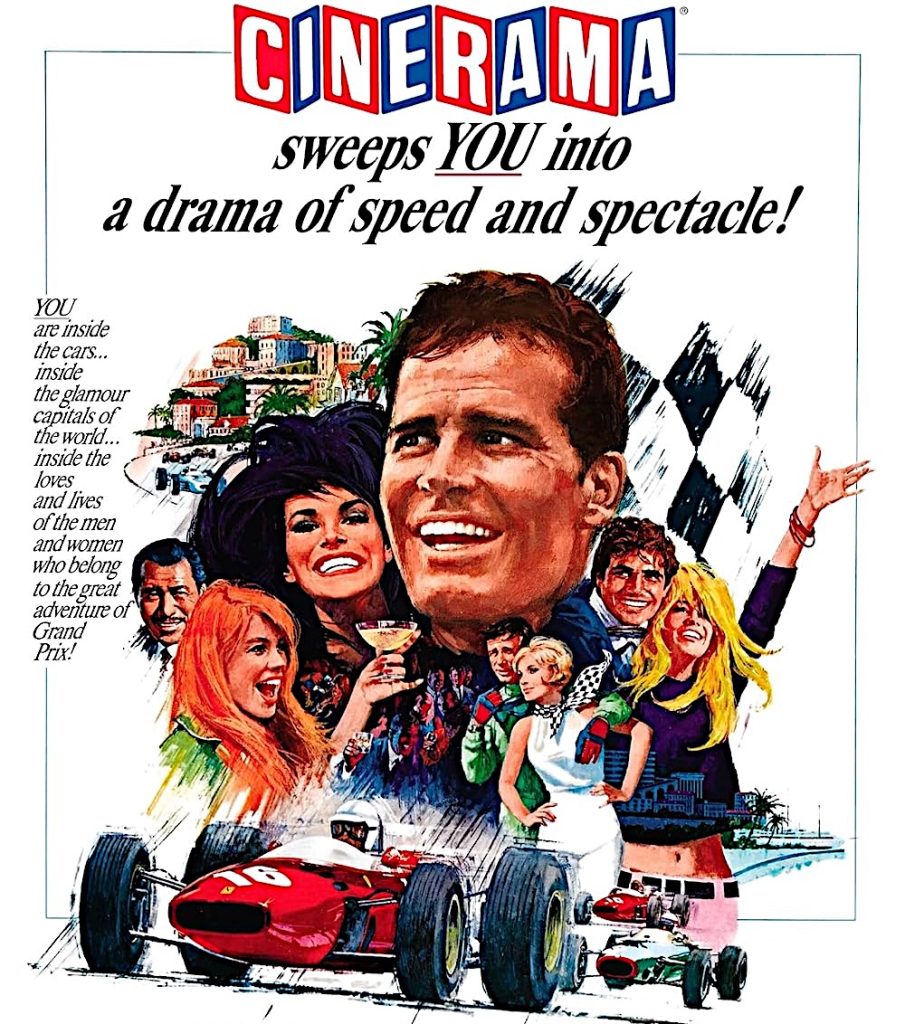
“Hey Jeff — I watched Grand Prix yesterday. For whatever it may be worth, it STILL is the quintessential car-racing film. Just a technical masterpiece from John Frankenheimer. I caught F1 in IMAX on the 23rd and enjoyed the hell out of it. But GP reaches for and finds a deeper place when it comes to super-fast, 180 mph racing and the competitive human spirit. The racing scenes are absolutely remarkable in their construction — you really do feel the speed in the final product. I had seen scenes of it before but had never sat for a full viewing, so glad I finally did. Thanks for recommending it.”
HE to MGM marketing (LBJ era): This 1966 poster art is shameless bullshit The mood of Grand Prix is tense, pensive, anxious, even melancholy at times. “I have a rendezvous with death” = nobody’s having a rollicking good time.