Nearly everyone agrees that rich assholes who pay big fees to kill African lions are despicable. I certainly feel this way. I also feel that Wilton deer hunters are cruel sadistic scum.
Two years ago 110 deer were killed in Wilton. Out of a total population of how many? Deer vibes are blessings…the mere sight of these gentle creatures ushers calm, grace and beauty into our souls.
According to Connecticut officials, 76 local deer were killed in ’23 by archery, 20 by shotgun or rifle, 10 by muzzleloader, three by cropkill and one via roadkill.
Does anyone recall the feeling in their hearts when Bambi’s mother was killed?
I would really and truly love it if two or three bow-and-arrow hunters from Wilton could be hunted down by some wealthy, Count Zaroff-type eccentric….see how you like it, fuckers.
An 8.12Varietystory by Jazz Tangcay reported that Steven Spielberg’s Saving Private Ryan (‘98) was the first battle film to use an accidental shot with small globs of splattered blood on the camera lens in the finished film.
I’m not disputing this claim, but I’ve watched Ryan at least four or five times (twice theatrically, two or three times on Bluray) and I don’t remember any such globs or blood splatters sticking to the lens.
The first time I noticed this kind of unintended effect was in Alfonso Cuaron’s ChildrenofMen (‘06).
At first I figured I had forgotten the SavingPrivate Ryan lens splatter, but I went searching for either a YouTube clip or a frame capture of same, and found nothing…zip.
Does anyone recall such a moment in Spielberg’s film, and if so can the splatter effect be specifically described? And have they seen a video clip or frame capture that proves it actually happened?
Australian film critic David Stratton, justly admired for being a devotional Film Catholic and a Roger Ebert-like TV critic and (occasional) evangelist, has died at age 85.
Stratton was best known for the Australian film review show, At The Movies, which he co-hosted with Margaret Pomeranz for 28 years. He also reviewed for The Weekend Australian for over 30 years.
Did Stratton fully deserve Geoffrey Wright’s wine splash in the face at the Venice Film Festival for panning Romper Stomper? In my opinion, yes. Stratton didn’t even rate Wright’s film, citing pic’s depiction of racist violence and its potential to incite further unrest….what a pedestrian!
In their just-published Esquire chit-chat (8.13), which is about promoting One Battle After Another (Warner Bros., 9.25), Leonardo DiCaprio says this to director Paul Thomas Anderson: “You’re considered a very art-house director. Would you call it that? What do you call it?”
Anderson: “Well, there’s no need to be insulting.”
DiCaprio: “No, what’s the term? You don’t do incredibly commercial movies, let’s put it that way. You are a writer, director. You have your own vision. What’s the term?”
Anderson: “Box-office challenged?”
HE translation: “Let’s face it — since Inherent Vice I’ve been red ink. Especially now in the case of One Battle After Another, which has dodged Venice and Telluride and is expected to more or less flop when it opens in late September. It cost a big pile of dough and, die-hard PTA mavens aside, nobody’s especially interested. Jordan Ruimy has declared it all but D.O.A. You can smell the lethargy in the social media chat threads.”
Anderson also delivers the best quote, which addresses the film’s theme as well as a general observation about getting older:
All I’m asking or hoping for is that the audience will be spared the default #MeToo trope, to wit: “The white middle-aged guy is odious, venal and reprehensible.”
Please don’t sink us into that fetid swamp yet again. Anything but that. Puhleeze.
We all have stand-out, less-than-becoming physical traits of one kind or another. Myself included.
Way back when a girlfriend joked that I had “bird legs”…not my thighs as much as my calves. She wasn’t wrong. They’re also called storklegs. I was born with them…couldn’t do much about that. Still can’t.
You know who else had bird legs and didn’t feel good about it, and didn’t want to wear swimming trunks before movie cameras out of shame? Paul Newman. He admitted this once in an interview about TheDrowningPool (‘75), for which he was obliged to wade into a large Louisiana lake (or the Gulf of Mexico) during an Act Two scene.
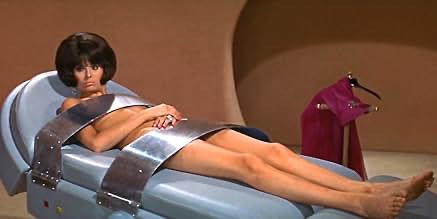
The late Israeli actress Dalia Lavi clearly had bird legs.
So for myself, Newman and Lavi, a common trait was acknowledged.
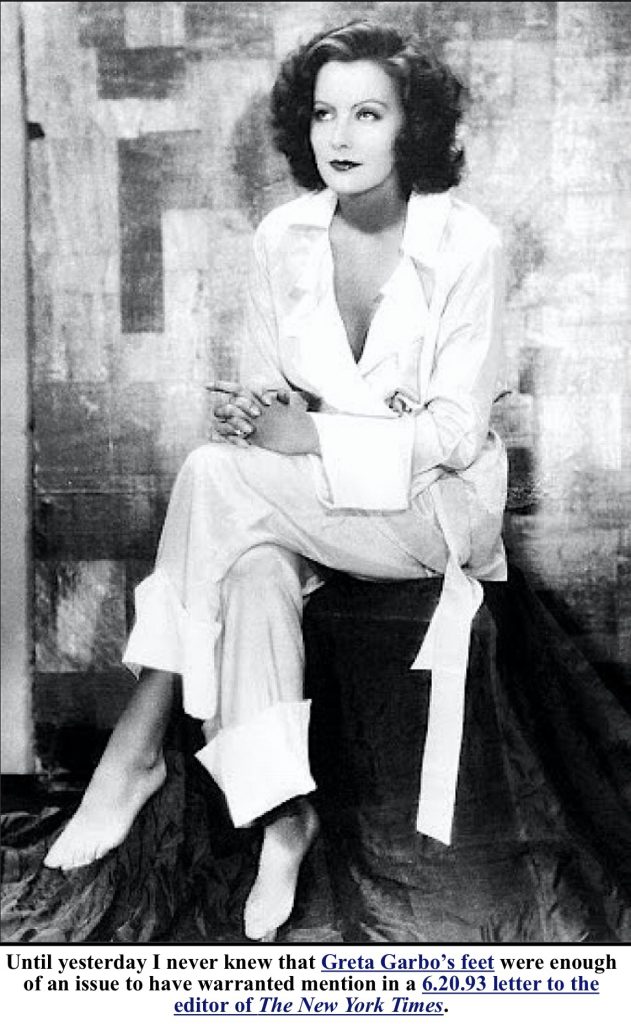
Inoneofmy2024 PoorThings riffs I wrote that Emma Stone had “large, slender, shovel-like feet.” Was I blaming her for this? Of course not —just observing a physical fact. No biggie. Join the Greta Garbo club.
It’s a universal rule that actors and actresses and foot close-ups are a must-to-avoid. Directors never go there. Nobody wants to be tagged for having funny-looking or less-than-attractive feet, which applies 98% of the time. Man-peds…no!
If anyone ever comes up and says, “You’re no one to talk…you have bird legs, for God’s sake!”, my response will be “yup…guilty.”
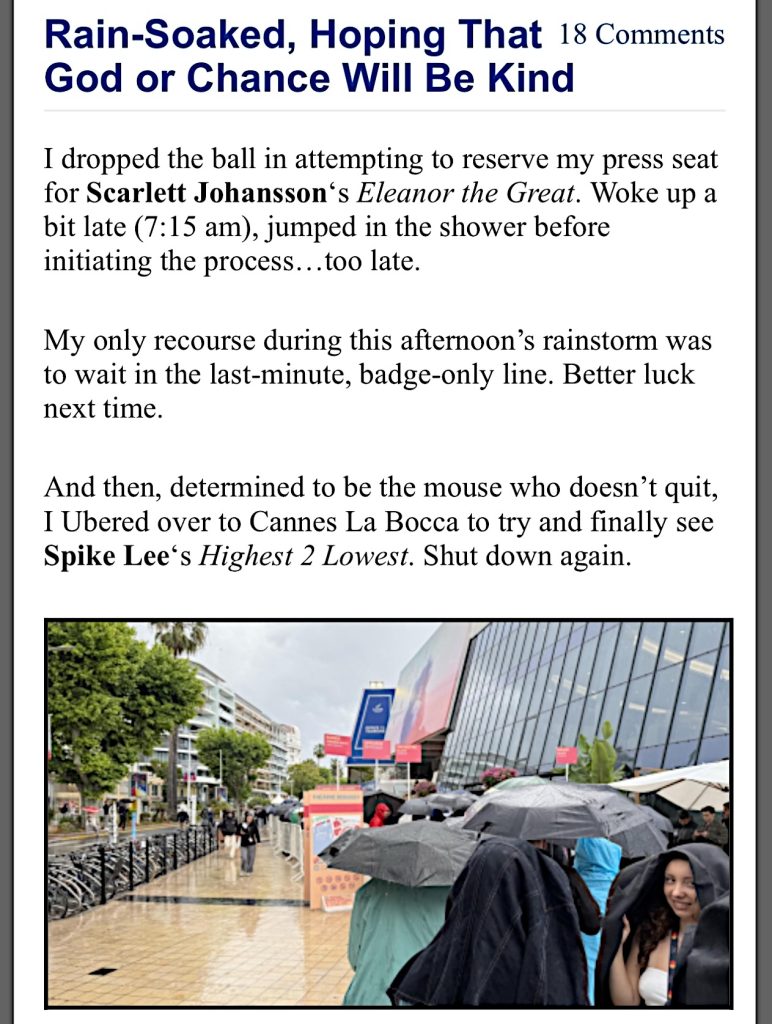
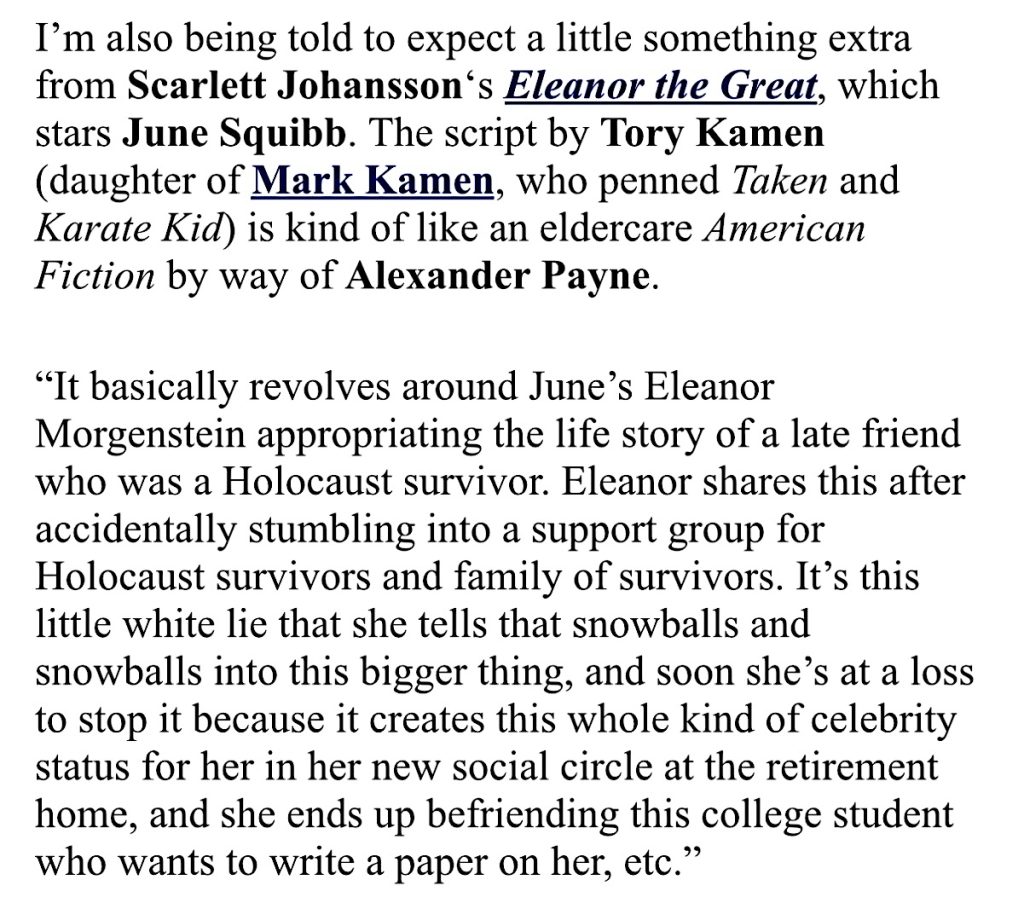
The Rotten Tomatoes verdict on Scarlet Johansson‘s Eleanor The Great (Sony Picures Classics, 9.26) is “okay, it feels fairly conventional as a ‘what a tangled web we weave when we practice to deceive’ story, and it certainly could’ve been better, but it’s at least worth the price for June Squibb‘s lead performance. Not a winnning success, but not a failure either.”
I’m sick to death of movies that portray this or that white guy as the proverbial villain — deplorable or weak or impossibly selfish or, you know, some kind of primal seed of evil. I’m sick of this shit…sick of it, sick of it, sick of it.
If the 32 year-old Martin Scorsese, livid about the MPAA’s demand to cut much or most of the Taxi Driver shoot-out finale, had somehow stolen the original work print and thereby preserved the original look of this climactic sequence…if Scorsese had manned up and done this, he would’ve found himself in a heap of legal trouble but would nonetheless have behaved like a dude of resolve and consequence.
In Rebecca Miller‘s forthcoming Mr. Scorsese (Apple TV+, 10.17) the now 82-year-old director tells the story of this traumatic episode. He definitely intended to steal the work print, he says. He also bought a gun and was thinking of waving it around or something.
Scorsese should have somehow gotten hold of that Taxi Driver work print and sent it to a lab and copied it. At least that. His failure to preserve the original color scheme of that shoot-out scene was nothing short of an artistic tragedy. It remains a stain upon his legacy to this day.
On 3.11.11 I ran a piece called “Taxi Driver‘s Brown Blood“. It was about (a) Grover Crisp and Martin Scorsese‘s Bluray restoration of Taxi Driver (4.5.11). and more particularly (b) a technical question asked of Crisp by The Digital Bits‘ Bill Hunt.
Hunt asked about the brownish, sepia-tone tinting of the climactic shoot-out scene, which had been imposed upon Scorsese by the MPAA ratings board. Scorsese had always intended this scene to be presented with a more-or-less natural color scheme, in harmony with the rest of the film. Hunt to Crisp: “Why didn’t you and Scorsese restore the originally shot, more colorful shoot-out scene?”
“There are a couple of answers to this,” Crisp replied. “One, which we discussed, was the goal of presenting the film as it was released, which is the version everyone basically knows. This comes up every now and then, but the director feels it best to leave the film as it is. That decision is fine with me.”
HE response: “There can be no legitimate claim of Taxi Driver having been restored without the original natural color (or at least a simulation of same) put back in. The film was shot with more or less natural colors, was intended to be shown this way, and — with the exception of the shoot-out scene — has been shown this way since it first opened in ’75.
“There’s nothing noble or sacred about the look of that final sequence. The fact that it was sepia-toned to get a more acceptable MPAA rating is, I feel, a stain upon the film’s legacy.”
Crisp explained that even if Scorsese wanted to present the natural color version, the original Taxi Driver negative is gone and there’s no way to “pump” the color back in.
Steven Gaydos 2011 comment: “Jeff’s right that it’s a shame a filmmaker had to alter his film in order for it to be seen in wide release, but according to my in-house expert (Monte Hellman, who oversaw the digital restoration/release of his 1971 film Two Lane Blacktop), if the negative is gone, as Crisp clearly says it is, then ‘you can put the color in but it will never look right, and certainly won’t look anything like the original footage.'”
And that was that.
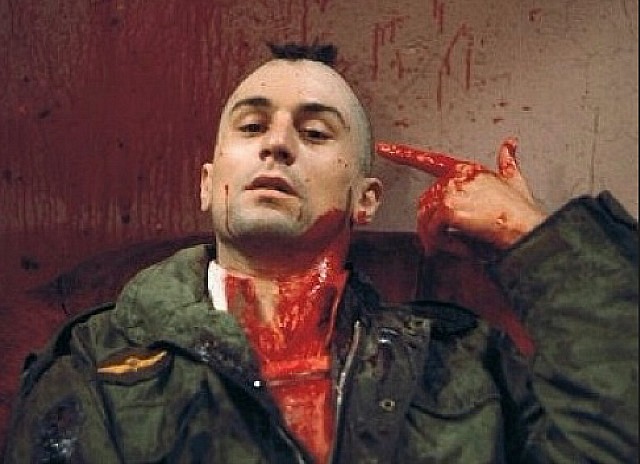
But two or three years later I came upon this image of the wounded Travis Bickle, and damned if it doesn’t look like the original probably did before the MPAA stepped in.
I wondered right away where it came from, and I asked myself “if someone could satisfactorily manipulate a single frame from that shoot-out sequence to make it look right and natural, why couldn’t someone manage the same trick for the whole sequence?”