Ozon’s “Stranger” Gives Good Despair

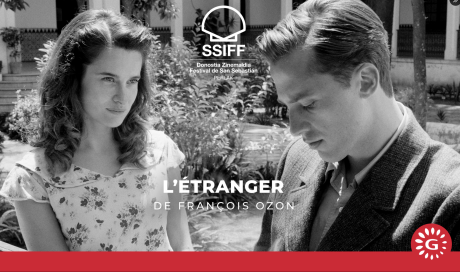
Late this morning I caught Francois Ozon‘s The Stranger, a clean, precise and matter-of-fact adaptation of the classic 1942 Albert Camus novella, which I’ve been read about for years and therefore have had a passing familiarity with but have never actually, like, uhm, read.

Nor have I ever seen Luchino Visconti’s 1967 adaptation, which costarred Marcello Mastroianni and Anna Karina. But the Camus novella has long been regarded as a masterpiece of chilly existentialism, and processing the randomness of life and fate in existential terms has always appealed to my suburban malcontent mindset so I’ve been “on the team” for decades, in a sense.

Set in late 1930s or ’40s French Algeria (definitely pre-Battle of Algiers), Ozon’s The Stranger, which adheres closely to the Camus narrative, is about an aloof, taciturn but mild-mannered fellow named Meursault (Benjamin Voisin) who isn’t given to rapturous celebration of anything. As in, like, nothing.

Except for the joy of sex, that is, with a young single woman named Marie (Rebecca Marder), a typist whom he knew from a workplace and whom he quickly seduces after attending his mother’s funeral, where he alienated fellow mourners by not showing even slight traces of emotion.

A polite, disciplined sort who’s into an exceedingly dry form of anhedonia, Mersault’s fate is sealed in a beach altercation in which he’s vaguely provoked by a native Algerian ruffian over some local incident of cruelty. He almost dispassionately puts five bullets into the guy, and soon after goes on trial for murder while steadfastly refusing to deny guilt or offer some kind of rationale for the shooting, much less plead for mercy.

Mersault’s basic attitude is “life sucks any way you slice it plus I’m just cruising along atop my laid-back-because-nothing-matters mental surfboard, and we’re all going to die sooner or later so who gives a shit?” and so on.

Mersault is a Nowhere Man but doesn’t mind this in the least. He feels no delight or worship in his veins because he’s just an office functionary without a love life or any devotional artistic passion or the blessings of a beautiful granddaughter or a dog or a cat or anything. He doesn’t even have social media to get lost in and sedated by.

So the Ozon film hit me fresh, and left me…well, generally swept along, never bored and consumed in contemplation.

Camus’s dry, chilly narrative is pretty much straight from the text, Voisson’s performance is appropriately curt and contained, Manuel Dacosse‘s black-and-white cinematography is luscious and razor-sharp, Marder is touching and tantalizing, the supporting cast (which includes Holy Motors costar Denis Lavant), and the 120-minute length just flies right by.

As I was approaching the main festival headquarters I was suddenly ten feet from the ginger-haired Voison, who was posing for a quick photo. I wanted to snap a photo also but I wasn’t fast enough. If I’d dropped a Lemon 714 a half-hour earlier I would have waved and said “yo, bruh!…just saw the film, and I’m on the team!…a fan, I mean.”

“House” On Fire

Only 60 minutes before the press screening of Julian Schnabel In The Hand of Dante so I must be brief:

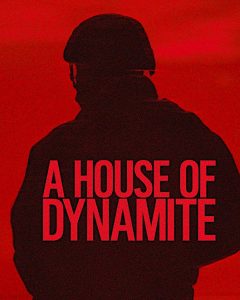
The house in Kathryn Bigelow and Noah Oppenheim‘s A House of Dynamite (Netflix, 10.10 theatrically) is the world itself…the entire interconnected realm…everyone…all the countries, all the leaders…and no one, it turns out, is fully up to dealing with impending Armageddon…not technologically, not emotionally or psychologically…so the movie is a firehouse alarm…a serious warning…a reality check from holy-shitville.

We’re all living on the edge of terrible destruction, Bigelow and Oppenheim are basically saying. How close or imminent is it? Very close, closer than we think, and our ability to protect Chicago or Washington or New York City, not to mention retaliate against the suspected aggressor[s], who might be our friends in the DPRK, is not what anyone would call formidable.

Bigelow’s film is therefore not a 21st Century version of Sidney Lumet‘s Fail Safe (although it’s certainly Fail Safe-adjacent) or Stanley Kubrick‘s Dr. Strangelove without the laughs…because unlike these mid ‘60s thrillers, it doesn’t…well, I guess I shouldn’t spoil.

But it’s basically “you think there’s some kind of response to an incoming missile that might save us? Or at least allow for semblance of a future? Think again.”

Surprisingly Not Half Bad

A few hours ago a friend texted that Benny Safdie‘s The Smashing Machine (A24, 10.3) “felt a bit flat.”

HE RESPONSE: “Yeah, maybe a bit but it mainly felt real and honest and committed to avoiding the usual sports-saga tropes…a probing, hand-held verite thing that adheres to an atmosphere that feels like lived-in reality.”

I was generally pleased with Johnson, whom I’ve found annoying for years, for having actually dug into a role and delivered in intimate, actorish terms…startling! I only know that I believed his Mark Kerr. Pain and Gain aside, Johnson has played the same, strapping, canned-dialogue icon in all his previous films, which have mostly been formulaic shit. He dropped the pose this time.

And Johnson’s argument scenes with Emily Blunt‘s Dawn Staples, whom Kerr was married to for roughly 15 years, touch bottom. Staples is portrayed as half a traditional heart-of-gold girlfriend, and half a pain-in-the-ass egotist who “cares” but is primarily focused on her own life designs — the very definition of a non-Zen partner.

Cheers also for Ryan Bader, who plays Kerr’s best friend Mark Coleman with relaxed assurance and conviction.

Holy-Roller Madness….Indecipherable, Shitty-Looking, Audacious To A Fault

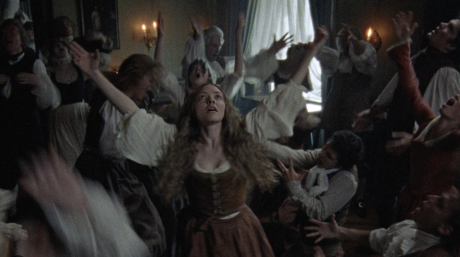
Mona Fastvold‘s The Testament of Ann Lee is certainly striking and, for what it’s worth, a wackazoid original — a regimented, pageant-like, nutbag historical musical about Ann Lee, the eccentric Shakers founder who was into ecstatic God-praising and celibacy and fervent denial of sexuality.

Lee was a devoted, shrewish-looking miserabalist who left northwest England, along with a couple of dozen followers, to re-settle in upstate New York (who’s ever even heard of Niskayuna?) and dedicate themselves to unmatched religious fanaticism.

How do you make a film about radical secularists who were into hymn-singing and general shrieking and, one presumes, pissing off the normies? Credit Fastvold, at least, for giving in to the crazy…for surrendering to Lee’s ecstatic mystical whateverisms, and really going for it willy-nilly.

While shooting near Budapest at the cost of a mere $10 million, Fastvold and her cast (Amanda Seyfried, Thomasin McKenzie, Lewis Pullman, Stacy Martin, Tim Blake Nelson, Christopher Abbott, Matthew Beard) and crew went mad with the Shaker spirit, and you have to respect that.

Congrats to composer Daniel Blumberg and choreographer Celia Rowlson-Hall. The madness clearly engulfed them also, and they’ve created otherworldly asylum vibes.

The movie pulsates with extreme this and that — extreme behavior, extreme denial of life, extreme visual murkiness despite being shot in 70mm, the embrace of puritanical madness. All of the terrible spiritual suppressive stuff that has given old-time Christian religion such a bad name for centuries is abundant.

Plus I couldn’t understand a single word of it, and for whatever reason there were no English subtitles, which every Venice Film Festival entry has brandished so far.

I knew early on that The Testament of Ann Lee would almost certainly give me pain because Fastvold cowrote it with husband Brady Corbet, whose direction of The Brutalist made people like myself writhe in agony last year, and whom I regard as a kind of louche anti-Christ of modern cinema. I knew, in short, that the Corbet influence would be bad news, and boy, was it ever!

HE to industry friendo after last night’s press screening: “Fastvold’s Shaker film is mute nostril agony. A journo pally concurs — ‘Awful’. I noticed five to six walkouts, heard a couple of boos when it ended.”

Friendo to HE: “It sounds like this year’s Women Talking.”

HE to friendo: “It’s much, MUCH worse than Women Talking. Somebody has called it The Brutalist: Folie a Deux.”

The real Ann Lee, who lived until age 48, was rather ugly, and Seyfried (who turns 40 in December) is, of course, beautiful, so the film’s realism is lacking in this regard.

And as long as hotness is on the table, 35-year-old Stacy Martin, who plays Jane Wardley, a British born co-founder of the Shakers, is way too attractive to play a woman who’s into a no-sex, God-and-only-God lifestyle…one look at Martin and you’re thinking “what is she doing with this bunch?”

Fastvold: “I thought Ann Lee deserved something grandiose and wonderful. How many stories have we seen about male icons on a grand scale, again and again and again? Can we not see one story about a woman like this?”

Seyfried on her Shaker singing: “A lot of it was animal sounds as opposed to melodic sounds.”

“About Half Of My Movies Are Good, Half Are Not”

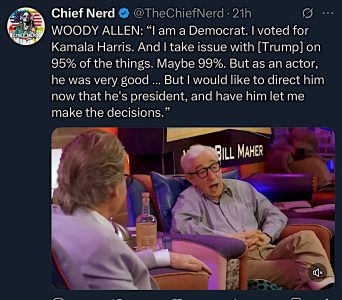
Woody Allen is a heavenly get for Bill Maher and Club Random. Obviously.

Woody Allen on the “capsule meaning” ofThe Purple Rose of Cairo (starting at 25:30):

“We are all, in my opinion, forced to choose between reality and fantasy. And it’s very pleasurable to choose fantasy. But that way, in the end, lies madness. So you have to choose reality, and reality always kills you. It always hurts you. but you have no choice. You can’t choose fantasy because you’ll go nuts [if you do]. So you have to choose real, and real is always heartbreaking because life is heartbreaking.”

2nd best observation, Maher quoting Allen (33:20): “The line that I loved was, uh, I think about about one of your early dates, and you said ‘I was so exhausted when I got home…so exhausted from being charming. I felt like I’d run a marathon’.

Allen: “But I would not want to give the impression that I was some kind of ladies man who scored all the time. Most of the time I struck out. I succeeded only a few times.”

Allen is too refined and discreet to use HE’s baseball analogy, but what he’s basically saying is that he probably batted around .400. (Okay, maybe .350.) The engulfing tragedy of 2025 and the generally disparaging view of intellectually limited or non-adventurous men among feminist-minded, #MeToo-influenced women is that so many average guys — the ones who aren’t flush, I mean, and are living marginally or modestly with a vaguely shitty car and perhaps an atrocious dress sense — a majority don’t even get lucky one time out of 100, if that.

Scott Galloway calls them “a generation of young men filled with rage and shame.”

A cheap, callous, antagonistic post from the Variety scumbags. Just a casual joke on Woody’s part, and they’re suggesting that he’s somehow on the team:

Jarmusch’s Aesthetic of Emptiness

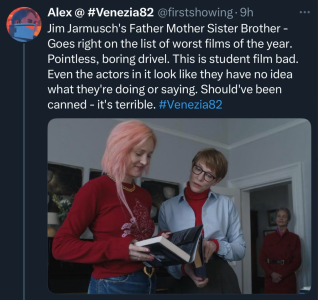
I could call Jim Jarmusch‘s Father Mother Sister Brother inert and threadbare and let it it go at that. I’m thinking of Casey Affleck‘s three-word confession to Michelle Williams in Manchester By The Sea — “There’s nothin’ there.” And that’s it, man.

Jarmusch has always been into less-is-more dialogue and fill-in-the-blanks minimalism, but this doesn’t even meet that standard.

Father Mother Sister Brother isn’t “about” Rolex watches (Chinese knockoffs), water, tea, “Bob’s your uncle”, stillnesses, absent parents in more than one sense, and most certainly the absence of dialogue. But these are what the film leaves you with.

Two of the three short films that comprise this 110-minute feature — the “father” opener with Adam Driver, Mayim Bialik and Tom Waits, and the “mother” follow-up with Charlotte Rampling, Cate Blanchett and Vicky Krieps — aren’t just about parents and kids who no longer matter much to each other, and are unable or unwilling to summon the will to indulge in polite, banal, family-style chit-chat…family members who really don’t care any more, and are just going through the motions.

Okay, to a certain degree Driver cares about Waits, his economically-strapped dad, as he slips him some cash from time to time. But Driver and Bialik can’t spend more than 45 minutes with Waits; ditto Blanchett and Krieps’ quality time with Rampling (their mom), which boils down to a short tea-and-cakes session in Rampling’s living room. As short as possible, I mean. Their little-sit-downs are over before they begin.

These chapters are basically about the expression of brittle, hostile indifference by way of silences. And these pregnant silences do nothing more than drain the viewer’s soul. It is baked into our DNA, of course, to fill empty, awkward, little-or-nothing-to-say encounters with vacuous small talk — we’ve all been there, and so has Harold Pinter, you bet. But these trios can’t be bothered with the blah-blah, and so the silences scream. And it’s fairly close to unbearable. Because it’s fundamentally inhuman.

Thank God for the brother and sister finale, costarring the attractive, Millennial-aged Indya Moore and Luke Sabbat. It’s basically about these two reminiscing about their dead, fondly recalled, mixed-race parents (mom was white, dad was Afro) while sitting in their emptied-out apartment in a large French city. (Possibly but not necessarily Paris.) This chapter offers a little warmth, at least. Moore and Sabbat actually talk to each other. What they say is mostly about about lazy regrets and resignation, but at least it’s something.