
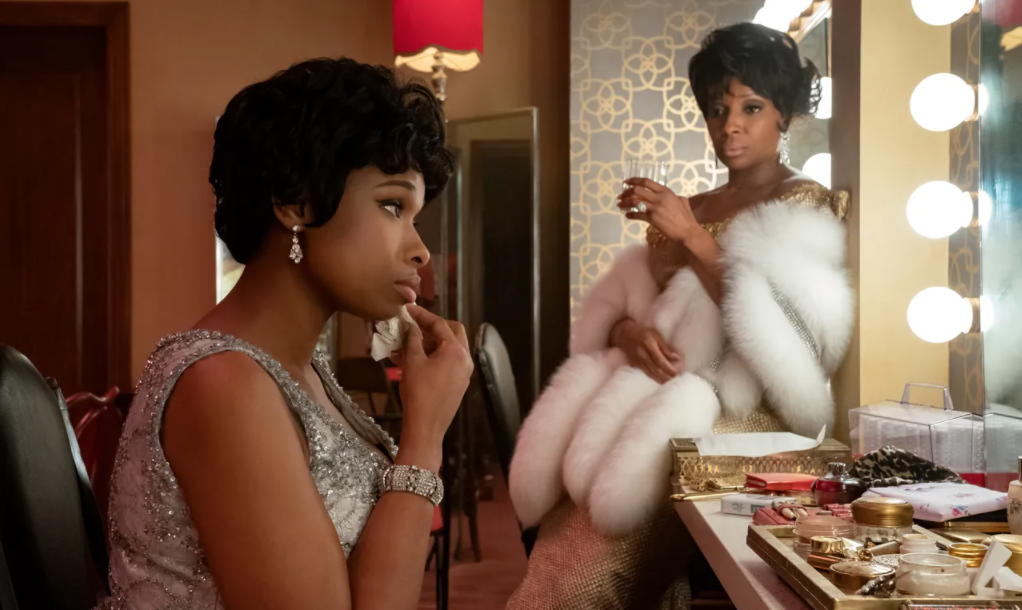
If you’ve heard that a film is underwhelming or mediocre, it will probably play better than expected when you get around to seeing it. If I’ve had this reaction once I’ve had it dozens of times, and this was more or less the shot when I caught Leisl Tommy‘s Respect at the Westside Pavillion last night.
I went in expecting to suffer or at least be bored by what I’d read would be a checklist of musical biopic cliches, delivered in paint-by-numbers fashion. But oddly enough, it didn’t depress me or annoy me or piss me off. I wasn’t knocked out or turned around or brought to tears, but I was more or less okay with it.
Mainly because of Jennifer Hudson‘s lead performance, of course, and her magnificent pipes.
I also knew that Respect is the friendly version of Aretha Franklin‘s story — the one that “the family” likes and supports. The shunned version is National Geographic’s four-part Genius: Aretha, which starred Cynthia Erivo. Experience has taught me to always be wary of a family-approved biopic, and there’s no question that Respect soft-pedals and sidesteps and does its best to make Aretha look as good as possible without totally lying. Respect delivers a few handfuls of “dirt” here and there, but not that much.
The bottom line is that even though I knew I was being sold a semi-sanitized bill of goods, I didn’t mind Respect. I occasionally muttered to myself “hmmm, yeah…not too bad.” I was quite taken by a couple of the musical performance scenes. And I was always seriously impressed by Hudson.
She’ll obviously be nominated for a Best Actress Oscar along with Will Smith as Best Actor. I can just see the two of them holding up their Oscars in front of press-room photographers.
Before she passed in ’18 Aretha said that David Ritz‘s “Respect: The Life of Aretha Franklin” (’14) was lies and trash and blah-dee-blah. That meant that at least some of Ritz’s book was accurate, and perhaps a bit more than that.
On the book’s Amazon page there’s a comment by “Occasional Critic,” to wit: “This book goes to remarkable depth in describing who Aretha really was. She was a wonderful person; she was a terrible person. She was incredibly generous; she was a cheap skinflint. She was a genius; she was dumber–than–a–stump. She was selfless; she was an egomaniacal narcissist. She was all that and more.
“But she was also indisputably one of the very best voices in the history of voices, and very, very human. This is a compelling read. Highly recommended if you want the good, bad & the ugly.”
If Respect had been made in the same spirit with which Ritz’s biography was written, if it had embraced a “tell it all, warts and all and let the chips fall” approach instead of trying to please the family and the fans and remind everyone what a glorious trailblazer she was (which is not an exaggeration), it would have been a better, tougher film.
Respect does acknowledge that Franklin was sexually molested and impregnated as child, and that her marriage to the territorial Ted White (Marlon Wayans) was turbulent, and that she developed an alcohol problem in the late ’60s, and that her relations with family and colleagues were often under strain, etc.
But from what I’ve read, a lot of the gnarlier stuff has been glossed over or flat-out ignored.
As played by Forrest Whitaker, her preacher father, Clarence Franklin, was a pious scold. But according to one biographical account he was a promiscuous hound who hosted orgies, and that Ray Charles allegedly described these orgies as a “sex circus.”
Marc Maron is especially good as legendary producer Jerry Wexler, who put Aretha together with the Muscle Shoals guys, which led to the seminal recording of “I Never Loved A Man (The Way I Love You)” — her first big hit.
Incidentally: A power surge hit the Westside Pavillion about 20 minutes into the film, and the sound totally went out. I rushed out and told management, and learned that each and every theatre had been affected. I went back in and watched the silent version, which has kind of interesting. Then the image froze and we were staring at a still of a couple of supporting players for six or seven minutes. Then a Landmark guy came in and announced that they were working on the problem. (No shit?) The movie finally resumed, and the show was finally over at the three-hour mark.