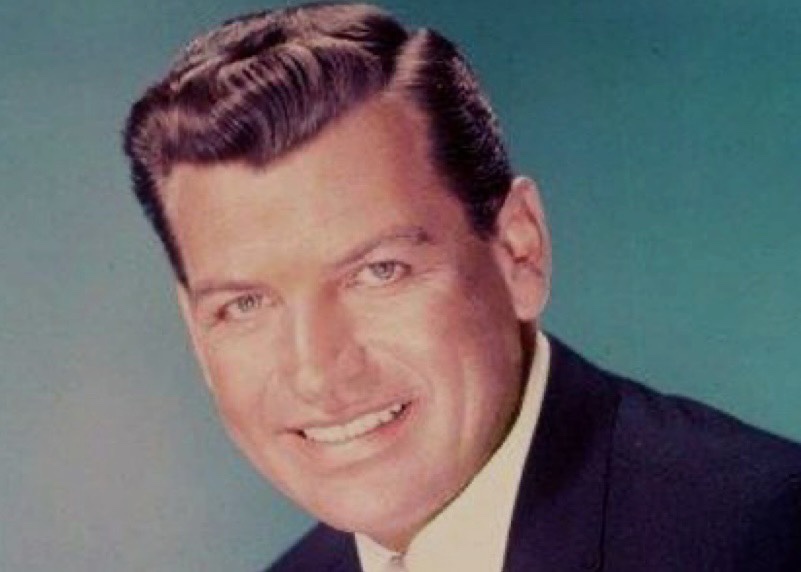
From the mid ’50s to the early ’60s, Richard Egan was a quiet, low-key, Clark Gable-ish movie star. Gable without the barking voice or judgmental eyebrow or rogue manner, I mean. But with a deeper voice. One of those steady guys with nothing to prove. Plant your feet, look the other guy in the eye and tell the truth…that was Egan’s basic thing. An aura of maturity, thoughtfulness, confidence.
And his characters never once behaved in a socially obnoxious manner. Egan had his center, understood himself, could actually act within his realm.
Best Egan performances: A brief but noteworthy swordfight scene with Victor Mature in Demetrius and the Gladiators (’54). Gog (also ’54). Underwater! (’55) with Jane Russell. The View from Pompey’s Head (’55). The Revolt of Mamie Stover (’56), again with Russell. Love Me Tender (’56). Slaughter on Tenth Avenue (’57). A Summer Place (’59). Disney’s Pollyanna (’60). Esther and the King (’60). King Leonidas in The 300 Spartans (’62).
But after a streak of seven or eight years, Egan was more or less gone from features like a puff of smoke. He had turned 40 in July 1961, and was already on the way down. For a decade or so he worked in TV, and then he moved into regional theatre.
Egan died in ’78 at age 65 — prostate cancer. It just seems a shame.
I was moved to say something after watching Egan in Love Me Tender. Elvis Presley is why that modest 1956 release made money, of course, but Egan was the brick and mortar — all the action spun around his plain-spoken character, Vance Reno, and he just said his lines straight and true with that great deep voice. And he never wept or lost his temper or his cool. And the whole time you can feel how much he wants to ravage Debra Paget and much she wants him to, and how blind Presley’s “Clint” character is in this regard.
Love Me Tender is just a low-budget programmer, really, but Egan gives it a certain gravitas and conviction.
Egan can be briefly glimpsed in a crowded bar in Michael Ritchie and Robert Redford‘s Downhill Racer (’69)…humiliating. A major star in the late ’50s, a no-dialogue guy in a bar scene a decade later.
The timing wasn’t right, of course, but if Quentin Tarantino had somehow emerged as a hotshot director in the early to mid ’70s he could’ve written a great role for Egan and then cast him…maybe.
Wiki excerpt: “In 1966, when asked about his lack of film roles, Egan said, ‘They want anti-heroes now, and it’s just not for me. I’m just not right for that. It’s much easier to be cynical than to make a positive statement, to set up a man only to knock him down, than to show convincingly a man who successfully sticks by his beliefs. We desperately need something to give strength and fortitude to the lost. I want to be a part of that. Part of the solution. And if I can’t…well…I’m sure not interested in becoming part of the problem instead.”