
From “Myth of Good Driving While Half-Stinko,” posted on 2.18.22:
As we all know, Robert Zemeckis‘s Flight is about the disease of alcoholism. I responded well to this 11.2.12 release, in part, because I had become a sober person roughly nine months earlier — on 3.20.12. And yet the film contains a certain drunk-driving paradox. Because Denzel Washington‘s “Cpt. Whip Whitaker” saves his commercial plane from crashing by flying upside down. We’re led to understand that if Whip had been 100% sober he might not have rolled the plane over and saved the day.
But even if this isn’t what the film says, I’m thinking that this principle applies to some extent to car driving.
If you’re driving your Lexus drunk your reaction time is slower than if you’re cold sober, and if you’re really stinko you’re definitely a menace to all humanity. But drunk or semi-drunk driving isn’t all bad, and sometimes it works. Or at least it did for me.
I know, I know — did I just say that? In today’s world DUI is a felony punishable by huge fines and jail time in some cases, and rightly so. But in the ’70s tens of thousands of people drove from place to place every night with a buzz-on and in some cases plain shitfaced, and some awful things resulted, I’m sure. But quite often, probably the vast majority of times, drunks just drove home and parked their cars and watched a little TV and went to sleep on the couch. And then woke up at 3 am, undressed and flopped in their bedroom.
May God forgive me but in my early drinking days when I lived in Wilton and Westport, Connecticut, I drove late at night with several beers and/or Jack Daniels on the rocks in my system, and I just cruised on through, and I mean weekend after weekend after weekend after weekend. No accidents, no fender benders, nothing. Others plowed their cars into ponds and trees and guard-rails, but not me.
There were times, in fact, when I drove down those winding country roads at high speeds and I would focus like a motherfucker, and I was convinced at times that I was driving like Paul Newman at Lime Rock.
I started to tell myself, in fact, that I drove better when half-bombed because I was less intimidated by the possibility of something going wrong. I drove without fear, without hesitation. I took those hairpin turns like a champ.
Present tense: In short, if you’re as good a driver as I was and you’re not flat-out wasted, driving with booze in your system isn’t such a bad thing. Or at least it doesn’t need to be. Would I drive drunk now? Of course not. I stopped drinking 8 and 2/3 years and I’m not an asshole. I’m just saying that I got away with it for years, and…well, I’ve said it.
“Drivers Who Ignore The Road Are The Worst,” posted on 1.25.13:
Few things make me more irate than driving-and-talking scenes in which the driver primarily looks at the person riding shotgun (usually a woman) and only glances at the road sporadically. Five or six seconds of eye-contact for every one or two seconds of road-watching. That’s exactly the opposite of what real driving is like, even in the case of reckless drunks. I never, ever look at a passenger except when we’re at a stop light or stalled in traffic.
And yet directors are constantly telling actors during driving scenes that they can eyeball the passenger all they want. I flinch and seethe when this happens. I twitch. “Asshole! Watch the road!”
Most actors don’t care about driving realism. The car they’re acting in is usually being towed by the camera-and-lighting car so what do they care? They just want as much eye-contact as possible with the person riding shotgun so they can show the audience how personable and sensitive they are. And 90% of the time the director indulges them when he/she should be saying, “Do you drive like this in real life? Glancing at the road in one- and two-second bursts while staring soulfully at your passenger?”
I’m mentioning this tendency because director James Ponsoldt and actor Miles Teller have taken the ignore-the-road aesthetic to a whole new level in a scene in The Spectacular Now, a decent Sundance flick about a teenage drunk that I saw two or three days ago.
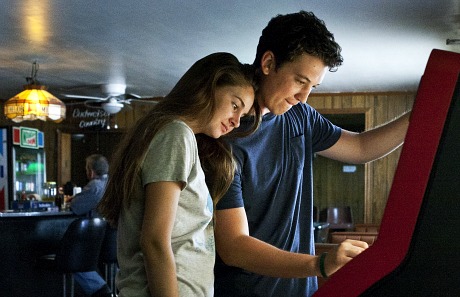
Shailene Woodley, Miles Teller in James Ponsoldt’s The Spectacular Now
Teller, a 25 year-old playing an 18 year-old, is driving down a suburban road when a car with a couple of girls pulls up on his left side and starts cruising at the same speed. Both parties roll down their windows and start chatting, and Ponsoldt and Teller blow Hollywood’s “four or five seconds of eye-contact for every one or two seconds of road-watching” rule out of the water. Teller — this guy is bold as brass — just fucking stares at the women in the car and ignores the road altogether…nine, ten, twelve seconds! Go for it, Miles!
Two little kids could have run out in front of Teller’s car and he would have flattened them like a flesh pancake. An elderly man who’s fallen out of his wheelchair could be crawling across the road and Teller would have come along and turned him into a pile of blood, broken bones, brain matter and hamburger.
I mentioned this to Ponsoldt yesterday when I ran into him at the Prospector, and he laughed in his usual charming way and said I need to ask Teller about this. Ask Teller?
It’s time for directors like Ponsoldt to man up and admit that they’re consciously trying to defy the reality of the road when they shoot driving-and-talking scenes, and once they’ve done that they need to man up and push it farther. One of these days a truly bold and visionary Kubrick-like director is going to tell his behind-the-wheel actor to ignore the road altogether when he/she is driving. Don’t glance at the road every five or six seconds or, in the case of guys like Teller, every ten or twelve seconds. What road? Make your own world, man!