Lost In Pedroland

Last evening (Tuesday, 5.19) I saw Pedro Almodovar‘s Bitter Christmas in the Salle Bazin, and in the immediate wake of the moaning man incident, I was saying to myself “this new Pedro movie is obviously thin gruel, but at least it’s not the cinematic equivalent of a 60ish frizzy-haired guy dying in his theatre seat.”

For in the usual Pedro style it’s vibrantly colored, emotionally sincere (the performances by Barbara Lennie and Leonardo Sbaraglia are the most compelling), cleanly written and generally well-ordered in terms of editing, production design and musical score. These in themselves are comforting elements, especially when there’s not much else going on.

I am telling you straight and true and with no small amount of attendant cruelty (and I take zero pleasure from saying this about a filmmaker I’ve dearly loved for many decades) that Bitter Christmas is the cinematic equivalent of Randy Newman‘s “I’m Dead and I Don’t Know It.” Pedro to fans: “I have nothing left to say, but I’m gonna say it anyway.”

Bitter Christmas is a movie that is so tangled up in itself you quickly feel lost in a house of mirrors and detours…a script within a script within the head of someone else as they look back upon 2004 while borrowing (i.e., stealing) from the misfortunes of friends and loved ones…l don’t even know what I’m talking about here…Bitter Christmas is basically Pedro’s “Whose Story is This Anyway?”

I for one didn’t care whose story it is. Because the sum of all the threads and tangents simply weren’t adding up. The film feels like an accumulation of vaguely melancholy scenes about some vaguely melancholy characters rather a single compelling narrative that (a) knows itself and (b) knows where it’s going, and (c) skillfully puts the hook in and leads you along.

The original Spanish title is Amarga Navidad, but the French title is Autofiction. Does that tell you anything?

Tell me if this Wiki rundown adds up for you: “Set in a timeline in 2025 but largely taking place in 2004, the plot explores how filmmaker Raúl (Sbaraglia), an Almodovar stand-in in the same fashion that Antonio Banderas played a Pedro-resembling character in Pain and Glory, writes a screenplay that turns out to be the story of Elsa (Lennie), Raúl’s alter ego. Raúl immerses himself in autofiction to overcome his writer’s block, and draws inspiration from his own life, his celibate boyfriend Santi and his assistant Mónica.”

Right away you’re going “good God, what is this…?”

Newman: “I always thought that I would know / When it was time to quit / When I lost a step or two or three or four or five I’d notice it / But now that I’ve arrived here safely / I find my talent has gone / Why do I go on and on and on and on and on and on? And on and on and on and on and on and on and on and on? And on and on and on and on?”

Nobody ever said art was easy. It’s most certainly not. But you know what Pedro needs to do going forward? Stop making autofiction movies about himself and find a good catchy screenplay or adapt a good novel and then weave his personal stuff into the narrative, just like Alfred Hitchcock threaded his pervy ice-blonde obsession along with his control-freak personality into James Stewart‘s Scotty Ferguson in Vertigo. That’s the way out of this thicket.

Sidenote: If I was going to suddenly become gay, I would like this sexual transformation to happen with an Almodovar movie. Because Pedro films are so ripe and delicious and soothing to the soul. I couldn’t be a bottom, but that goes without saying. Nor could I be a top, as the smell of shit is deeply unpleasant. Nor could I blow anyone. But I could at least pretend to be gay.

Read more

Salle Bazin Moaning Man

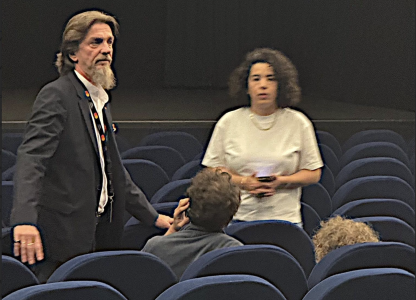
About 13 or 14 minutes into a Salle Bazin screening of Pedro Almodovar’s Bitter Christmas, or roughly around 6:30 pm, and ironically during a scene in a hospital emergency clinic, a 60ish, frizzy-haired journalist with a drab wardrobe…a guy sitting a row ahead, maybe eight or ten feet away…began to bellow with a hearty ”aaaggghhh!” The howl got louder and louder but he was kind of wheezing at the same time.

I thought for two or three seconds that an actor in Pedro’s make-believe hospital was performing some kind of seizure or what-have-you, but then I realized “holy shit, this is for real!”

Many in the rows in front of and behind the frizzy-haired guy reacted in this or that concerned way. Standing up and staring, shouting “stop the film…turn on the lights!” Nobody wanted to touch the poor guy, possibly out of fear of being sued, more likely due to an ick factor…they all just stared. I was thinking of that old Richard Pryor routine about people eyeballing a drunk guy who’d collapsed on a sidewalk with vomit on his chin and shirt collar and his pants halfway down. “Hey, buddy?” Pryor said to the guy. “I don’t think you’re gonna make it.”

The lights came up and Bitter Christmas ceased. Two ushers came over, leaned over and gently asked the guy if he’s okay. Mr. Frizzy was motionless, silent, nothing. His lips were making a half-drooling, half-gurgly sound. A possible heart attack?

The crowd was asked to leave and wait in the outer foyer. As I was shuffling out I snapped a photo of two ushers standing next to the seated Mr. Frizzy, and was immediately admonished by a couple of scolds. Two EMTs arrived and went into the theatre, but they were in there for a while without bringing the guy out. A female usher announced that the film would resume after Mr. Frizzy leaves the seating area. They finally wheeled him out in a wheelchair. He was conscious and seemed nowhere near death’s door. Tragedy avoided.

Deadline reported that “loud yelps were heard from an elderly moviegoer in the Bazin.” The guy didn’t yelp — he moaned and aaahhh’ed like he’d been struck with terrible chest pain, or like he’d been speared on the field during the Battle of Hastings or was taking a giant dump or coping with an attack of stomach gas. Hyenas yelp on the African savannah — this guy definitely didn’t sound like one.

The Salle Bazin ailing man (light brown frizzy hair) is slumped to the far right:

“This Is Not About Norway”

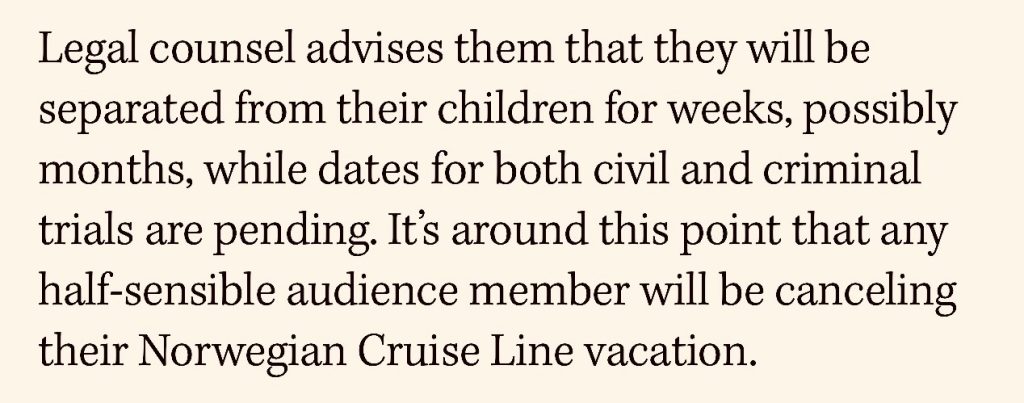
From David Rooney’s THR review of Cristian Mungiu’s Fjord:

And this:

Cannes Friendo: “Those passages from Rooney’s review are strong, but even there, his jokey conclusion — ‘cancel your Norwegian cruise!’ — misses the point, or avoids it. Fjord isn’t about effing Norway. It’s about a larger mentality, a larger ideology, that began to take root in the U.S. in the mid to late teens. A mentality, I shouldn’t have to add, that we’re all submerged in at Cannes. Will the critics acknowledge this?”

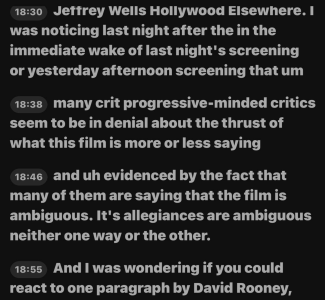
HE to Cannes Friendo: “Not only will they not acknowledge the widespread prevalence of Stalinist wokethink within elite showbiz and media circles — they will also insist on characterizing Fjord as fraught with ambiguity and declining to align itself with either side in the depicted dispute.”

Mungiu’s Complex, Non-Simplistic “Fjord” Is, Boiled Down, A Fascinating Assault on Socially Progressive Totalitarianism

In his recently posted review of Cristian Mungiu‘s Fjord, a culture-war drama set in a small Norwegian village, Deadline‘s Pete Hammond writes that Mungiu, “in his typical spare and deliberate style, has crafted yet another Palme d’Or-worthy film that fearlessly treads into controversial issues in our society but pointedly doesn’t take sides.”

Wrong, Pete. You’re not being honest with your readers. In this soft-spoken, matter-of-fact saga about a strict Christian family of five, headed by Sebastian Stan and Renate Reinve, being persecuted by a small clique of left-progressives, Mungiu is careful to deploy a somewhat ambiguous brush and in so doing avoid black-and-white condemnation of this or that character or chorus.

But Fjord unmistakably does take sides, and the shitheads — the heartless, judgmental child service bureaucrats, I should clarify, who take away Stan and Reinsve’s five children pending an investigation intio possible physical abuse — are definitely the lefties.

“This may frustrate people who want it to [take sides],” Hammond writes, “but Fjord is a fiercely intelligent and gripping movie that finds its power in providing no easy answers, only questions about what is right and what is wrong. This is a movie that defiantly refuses to ask us to take a stand in a polarized society, but rather consider that nothing is necessarily black and white, only shades of gray.”

Bullshit, Pete…bullshit.

There are three startling visual metaphors in Fjord. The first two are a pair of snowy avalanches, one tumbling down a steep hillside in Act One without much concern among the locals, and a second, larger avalanche arriving near the end of Act Three. Make of these what you will, but the idea is clearly that natural disaster looms.

The third metaphor…well, I’m not even 100% sure of what I saw, but I’m 85% to 90% certain that it shows a fraught teenaged girl walking on water.

Other Hammond-like critics are skirting the ideological slant, but make no mistake — Fjord is a complex, ambiguous, thoughtful assault upon left totalitarianism — a takedown of wokethink as practiced by the harshly judgmental residents of said village.

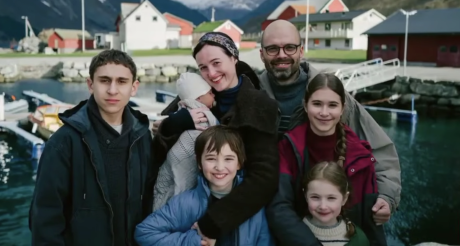
The victims, as noted, are the newly arrived Gheorghiu clan of seven — an evangelical religious couple, Stan’s Mihai and Reinsve’s Lisbet, with five kids. Their brood includes two teens — Vanessa Ceban‘s Elia and Jonathan Ciprian Breazu‘s Emmanuel — two tweeners, and a still suckling infant.

The Gheorghiu’s sins or offenses, as it were, are hardcore conservative values as far as child-rearing and setting boundaries and corporal disciplines are concerned. (Stan’s Mihai also frowns upon gays.) This is a strict, rightwing, traditional-marriage couple who don’t believe in progressive laissez-faire attitudes and are maintaining strict no-no rules — no social media, no rock music, no YouTube access, no smartphones.  

I don’t happen to believe in these kind of prohibitive behaviors being forced upon teens and tweeners, but there’s no mistaking that the bad guys are the socially progressive lefties, and two tight-faced women from Child Services in particular…soft-spoken, correctly-mannered ice monsters who decide that the couple’s five kids have to be taken away from them pending an investigation into possible child abuse (i.e., striking them and leaving bruises), although it’s not at all clear that the parents are generally guilty of this.  

And at the end, as a young girl (Henrikke Lund-Olsen‘s Noora) from a progressive family who’s become friends with Elia…as the Gheorghiu’s are leaving Norway to escape religious persecution, Noora, frantically upset at losing a good friend, gets out of a car and approaches the river/fjord as the ship is leaving, and she seemingly walks upon water as she’s crying “goodbye.”

That or there’s an invisible wooden pier just below the water line (i.e., the kind that Peter Sellers walked on at the end of Being There).

It’s mindblowing that a major auteur film being shown at the Cannes Film Festival, where pretty much all of the flicks involving social isses and whatnot skew pro-left or LGBTQ-friendly or at least left-progressive…it’s mindblowing that a film by the great Cristian Mungiu launches a blistering assault upon oppressive woke values, and laments the harsh persecution of rightwing Christians. 

Fjord, as noted, is not completely cut and dried.  There are notes and shades of uncertainty and ambiguity here and there, but the social progressives are definitely the asshats in this thing.

Mungiu’s Keenly Anticipated “Fjord” Screens at 5 pm (Debussy)

Directed, written and co-produced by Cristian Mungiu, Fjord toplines Sebastian Stan and Renate Reinsve as a Romanian-Norwegian couple, Mihai and Lisbet Gheorghiu, “who face scrutiny after moving to the wife’s remote Norwegian hometown.”

Boilerplate: “The Gheorghiu clan has moved to Lisbet’s birthplace. There they befriend the neighboring Halberg family. When the Gheorghius are suspected of disturbing behavior regarding their children, their lives are thrown into chaos as they become the center of scrutiny.”

Don’t Mess With The Barbie

I was reluctant to catch Laszlo Nemes’ Moulin because I knew that Nemes (Son of Saul, Orphan), though artful of eye, doesn’t shrink from grim depictions of besieged, war-torn situations. It therefore seemed conceivable that he might show what Barbie (“the butcher of Lyon”) actually did to Moulin.

Wiki excerpt: “According to witnesses, Moulin and his men had their fingernails removed using hot needles as spatulas. In addition, his fingers were placed in the door frame of the interrogation cell, with the door then repeatedly closed until his knuckles were shattered. They increasingly tightened his handcuffs until they penetrated the skin, breaking the bones in his wrists. He was beaten until his face was unrecognizable and he fell into a coma.”

As it turns out Nemes has soft-pedalled the Barbie torture accounts (no hot-needle fingernail removals, no door slammings). But what he does show is still fairly brutal. Moulin is savagely beaten to a pulp, bruised and bleeding. It gets so bad that at one point he tries to kill himself by leaping off a balcony. We’re also shown a beaten-to-a-pulp guy whose right eye has been plucked out.

For what it is and what it’s going for, Moulin is grade-A solid…grimly believable, appropriately haunted and paranoid in a “who can you trust?” sense of the term.

Gilles Lellouche is sufficiently invested and commanding in the title role.

Costar Louise Bourgoin is quite affecting as a French resistance member who, being attractive and all, indulges in some vaguely erotic wordplay with Moulin.

Lars Eidinger brings the Barbie like a malevolent pro, of course — playing baddie-waddies has become his specialty. I was surprised to note that Eidinger, who had a bulky appearance in Personal Shopper and Jay Kelly, has lost a fair amount of weight. This, to me at least, always warrants respect.

Tedious, Arduous, Despairing

While Uber-ing over to Cannes La Bocca at 8 am in order to catch an 8:45 am Cineum IMAX screening of Laszlo Nemes Moulin, I was reminded what a costly, time-consuming drag this option is. Plus the wifi is anemic once you’re there — all but worthless inside the theatres.

The second half of Moulin, which is mainly about Klaus Barbie’s interrogation and torture of French resistance martyr Jean Moulin, conveys a dungeon-like horror vibe, and as I was walking through the Cineum plex after the screening I still felt the malevolent dungeon atmosphere — the somber medieval interior literally feels like a house of horrors.

And then came the horrific bus ride back to Cannes…took forever, packed in like sardines, the bus stopping and lurching. Perhaps not a horrible experience, but certainly a grim one.

Nolan Needs To Quell Page-as-Achilles Casting Rumor

Few will argue with any sincerity that Chris Nolan‘s confirmed casting of 42-year-old Lupita N’yongo as The Odyssey‘s Helen of Troy is anything short of ludicrous.

But until last weekend I somehow hadn’t picked up on the absurd rumor that Elliot Page, whose general Odyssey casting has been common knowledge for several months, will play Achilles, the role that Brad Pitt played in Wolfgang Petersen‘s Troy.

N’yongo-as-Helen is one thing, but Nolan wouldn’t dare cast Page as Pitt’s replacement…he just wouldn’t dare. I read somewhere that Page plays some kind of half-pint crew member or mascot on Matt Damon‘s ship. This makes more sense.

I’ve just fast-forwarded through yesterday’s 60 Minutes segment on The Odyssey, and unless I’ve missed something Scott Pelley didn’t even ask Nolan about the N’yongo and Page castings. Do I need to watch it more thoroughly?

Read more

Luck Was A Lady

Posted on Sunday, 5.17, roughly 2 pm: I’ve just snagged a last-minute ticket to tonight’s (7 pm) screening of Maverick: The Epic Adventures of David Lean! I’d tried reserving a seat days ago at the proper time but the system said no.

11:25 pm update: Barnaby Thompson’s Maverick is a purely pleasurable, right-down-the-middle, devotional movie-buff documentary about the life and legend of the late, great David Lean.

I felt constantly wowed, massaged, comforted, reminded, elevated, amused. The doc does everything you want it to do. It takes care of the flock. And that final Lawrence of Arabia smash cut to the closing credits? Perfect.

There was a block of at least 45 or 50 unfilled seats when the doc began…curious.

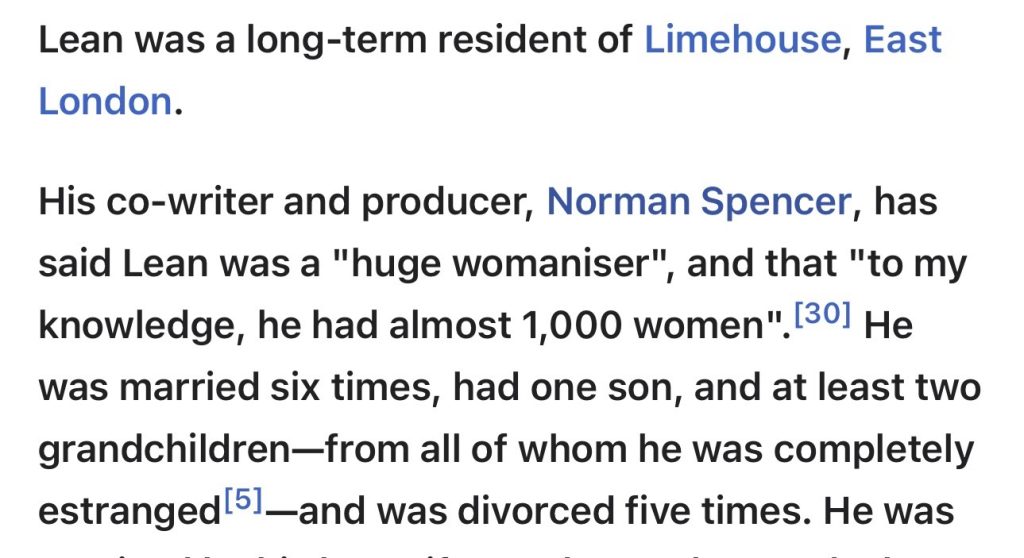
Romantic-sexual sidenote: By any measure Lean’s romantic life was episodic, fitful and even turbulent — never quite stable or settled. Thompson doesn’t shrink from the fact that Lean was a serious hound (the sexual conquests were allegedly in the hundreds) and that he wasn’t much of a stayer.

Lean apparently lived for those first-bloom hormonal highs, but once the relationship settled into the usual humdrum, up-and-down, we-need-to-put-in-the-work phase, he was always sniffing around for the next one. Or so it seemed.

This didn’t go down too well with some women in the seats.

Narrator Kenneth Branagh reads two or three love letters that Lean wrote over the decades, and the last one (a heartfelt confession, penned in the early ‘80s to the much-younger Sandra Holtz) suggested that Lean was something of a serial cad, crooning the same old sentiments decade after decade.

This prodded an audible reaction inside the Salle Bunuel — women coughing, groaning, clearing their throats, chuckling. You shoulda been there.

“Paper Tiger”, James Gray’s Smarthouse Crime Tragedy, Is 85% Terrific

I have one mild beef with James Gray‘s Paper Tiger, which I caught last night at 10 pm.

I felt completely throttled by Gray’s partly fact-based, family-history street drama, which isn’t so much a Queens-and-Brooklyn crime thriller as a middle-class film noir tragedy.

Like Gray’s Armageddon Time, Paper Tiger is set in suburban Queens, where Gray was raised in the ’70s and ’80s, and in Russian-mob-infiltrated Brooklyn and especially featuring the super-polluted Gowanus Canal, which I’d never even heard of until last night. (I’d now like to forget it.)

Set during the mid to late ’80s, it’s basically a “don’t fuck with the Russian mob psychos” deal, as well as a “life can be horrifically unfair” thing as well as a boilerplate serving of turbulent brotherly conflict.

The main characters are Gary Pearl (Adam Driver), a somewhat flamboyant ex-cop and flashy opportunist, and his younger brother Irwin (Miles “don’t be a pervert, man” Teller), an upstanding, straight-arrow reservoir engineer who’s a father of two teenage boys, Scott and Ben, and a dutiful husband of Hester (Scarlett Johansson).

There’s a third-act action sequence that I’ll never forget, set within what initially looks like a dense, elephant’s-eye cornfield straight out of Fred Zinneman‘s Oklahoma!, but instead of Gordon Macrae singing “oh, what beautiful morning” you’ve got a key protagonist along with four or five Russian goons tramping through the weeds, all with guns drawn.

Paper Tiger, as noted, is not an action-and-suspense thriller per se, but a riveting gloom-and-doomer. It’s a stunningly somber arthouse thing. I was reminded at times of Sidney Lumet‘s Before The Devil Knows You’re Dead. I’m telling myself that it’s Gray’s most jarring and absorbing film ever. It leaves you with a “whoa” feeling…a real bent-over, stomach-punch sense of shock.

My beef is something that I can’t make especially clear as I don’t want to spoil.

It basically comes down to the dramatic rendering of justice, which is a basic audience requirement in a drama. Joe and Jane Popcorn don’t necessarily need a happy ending, but they will defintely feel thrown if a major character — good or bad, noble or cowardly, gentle or cruel — doesn’t meet with some form of appropriate Biblical response.

Put another way, malevolent criminal characters (bullies, murderers, cruel dads, crime family bosses) who cause terrible things to happen to a film’s mostly sympathetic protagonist[s] need to be disciplined at the very least, or, more preferably, suffer some kind of eye-for-an-eye slapdown. I’m not saying that a major shithead character in Paper Tiger evades God’s terrible swift sword but…okay, I actually am saying that. And it’s still bothering me.

How would you have felt after seeing The Godfather, Part II…how would you have felt if Lee Strasberg‘s Hyman Roth had just walked away at the finale with a fresh slice of birthday cake?