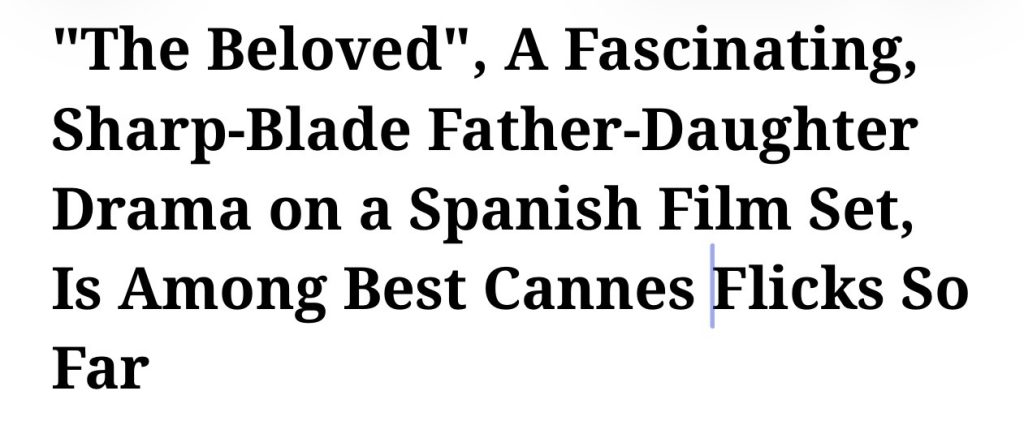
“The Beloved”, A Fascinating, Sharp-Blade Father-Daughter Drama on a Spanish Film Set, Is Among Best Cannes Flicks So Far

Let no one even briefly dispute that several big-name directors have earned reputations for occasionally behaving in a snippy or bullying manner with their actors and crew, or at the very least exuding crusty impatience, and sometimes even treating them with restrained cruelty.

Fitful, erratic eruptions, I mean…Otto Preminger, David Lean, Eric von Stroheim, William Friedkin, Michael Bay, David O. Russell, Michael Curtiz…allegedly Oliver Stone and James Cameron in their hormonal heydays…ditto John Huston and, on an allegedly random, bad-day basis, John Ford (ask Henry Fonda about the Mister Roberts shoot).

In Rodrigo Sorogoyen’s grade-A, exquisitely acted, brilliantly layered The Beloved, which I was totally wowed by on Saturday afternoon (5.16), Javier Bardem plays such a director…the mid-50ish, Oscar-rewarded Esteban Martínez, who behaved in decidedly loutish or tyrannical ways in his younger days. Esteban has since mellowed, as older guys tend to do, but with a certain lingering, simmering undercurrent within, especially regarding Emilia (the excellent Victoria Luengo), his somewhat estranged, mid-30ish daughter.

Esteban has hired Emilia for a supporting role in his latest film, Desierto. He’s told journalists and others that she was hired purely on her acting merits, but the real agenda, of course, is that Esteban, who abandoned Emilia and her mother a couple of decades earlier for a new lady or a fresh marriage (or both), is looking to heal or nourish their relationship.

This is The Beloved‘s core situation, and the principal emotional trigger, as we’ll soon learn, is Emilia’s avoidance of or resistance to Esteban’s subtle emotional overtures. The more she dodges these, the more slighted the headstrong Esteban feels, at first only faintly or slightly but then more and more so.

And then, during the shooting of an outdoor dinner scene involving Emilia and several actors, Esteban’s irked emotions explode into icy fury. He becomes more and more frustrated at this or that aspect of the scene not being quite right, and gradually becomes angrier and angrier. It’s a great showstopping scene…the kettle boiling over.

But after this eruption (which is certainly unpleasant but far from horrific), Esteban is frozen out by nearly everyone. He quickly realizes the Desierto shoot is in trouble.

Feelings are more more sensitive these days among younger actors and crew members (this is an emotional realm in which Millennials and Zoomers are notoriously intolerant…”if you don’t cease your abusive behavior we will rise up and destroy you, boomer or GenXer..we will go to the mattresses over this shit!”) and the chastened Esteban, he quickly realizes, has nearly incited a mutiny.

This sets the stage for a deep-down reckoning between himself and Emilia — a finale that is dramatically necessary, of course, but which feels a tiny bit undercooked.

It could be argued that in The Beloved, Bardem gives his strongest (some would say scariest) performance since No Country for Old Men. Then again Anton Chigurh was an unmitigated, murdering, pellet-gun psychopath while Esteban Martinez is simply an egoistic director whose refusal to be more emotionally honest (not just with Emilia but himself) about an underlying paternal agenda leads to serious trouble. Esteban blows it by under-estimating the emotional pushback among the wokeys within the Desierto crew.

These little candy-asses would faint, of course, if they worked for Preminger or von Stroheim or the Friedkin who forcefully directed The Exorcist a half-century ago.

This is what I would quietly confide to these little pussies if I was on the Desierto set…”Esteban overstepped, yes, and he should do the hard thing by explaining and apologizing. That would be the manly thing to do. But you guys should also acquire some crust…I’ve been yelled at by some real pros in my time and sometimes you just have to shake it off and let the water droplets roll off your backsides.

Put another way: “There are more things in heaven and earth, Horatio, than are dreamt of in your woke behavior etiquette manual.”
Legacy Lives On

Michael Che last night: “Speaking of giving little boys juice, Michael won the box office again this weekend, and since a few members of the Jackson family are actually in the audience tonight, I wanted to take a moment to tell everybody what I really think: Michael Jackson did nothing wrong! He was right to molest all those kids! And they were lucky. I would have paid him to do it, and I did. That’s right — when I was 10 years old, Michael Jackson molested me. And the only thing it gave me was a fetish for middle-aged white women.”

“…And Yet No One Blinks” At Anti-Semitic Dismissals

Friendo: The Real Time studio audience was conspicuously quiet for this one. Very little laughter, and (disturbingly) very little applause. The reason? I’m guessing many of the ideas and attitudes Maher is condemning here are ones they themselves hold. Regardless, this was — for me — one of Maher’s finest hours. And arguably his bravest.”

Soderbergh-Lennon Fizzle

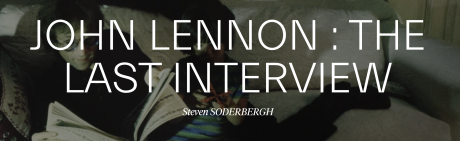
If you’re any kind of semi-knowledgable Beatle disciple, Steven Soderbergh‘s John Lennon: The Last Interview, which I saw this morning inside the Salle Agnes Varda, is almost completely worthless, certainly by Soderbergh standards.

There’s no 21st Century perspective of any kind…no fresh idea or strategy or sheen that might have given this thing a certain edge or extra dimension. Any garden-variety editor or director could have thrown this together on YouTube. Why did Soderbergh take this gig? Just for the bread?

JL:TLI is slick gruel…common, low-rent mulch — a montage-y, music-cue’d-to-death rehash of a radio interview Lennon gave to a trio of RKO Radio Network guys — San Francisco DJ Dave Sholin, scriptwriter/newscaster Laurie Kaye and radio producer Ron Hummel — to promote the recently released “Double Fantasy“.

The sit-down happened on the afternoon of 12.8.80, or roughly six or seven hours before Lennon was shot to death by Mark David Chapman, a pathetic fatass who believed that Lennon, having withdrawn from music and become a Dakota house-husband between ’75 and ’80, had betrayed his messianic legacy.

Much of the interview has been available from this or that source (a YouTube version, recorded right off the radio, has been there for the listening since 3.22.23) so it’s really not much of a thing.

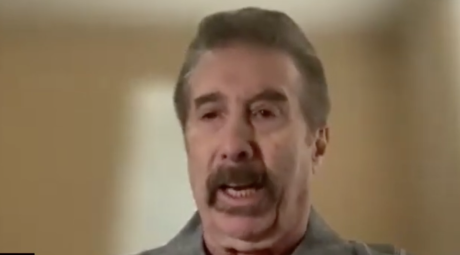
Soderbergh interviews Sholin, Kaye and Hummel as a framing device….a tiresome mistake.

I smelled crap when Sholin tells a story about David Geffen having played “Starting Over” without identifying the artist, and then asking if Sholin knew who it was. Sholin told Geffen he loved the song but didn’t recognize the voice…BULLSHIT! Everybody in the civilized world had known the sound of Lennon’s voice since the Beatles invasion of early ’64, and a guy who worked in rock radio drew a blank 16 years later?

Soderbergh should have stopped the interview in its tracks right then and there…”what the fuck are you talking about, Dave?…why are you bullshitting me?” Soderbergh should have yanked out a cat-oh-nine tails whip, told Sholin to take his shirt off and submit to ten lashes, which was a sentence of mercy as he deserved at least 20 or 25…sic semper bullshitters!

I was asking myself “why am I listening to these old kiss-asses?…they’re dishonest, not especially thoughtful or articulate even…they sound like typical starfuckers…in fact, why am I even watching this film? I feel burned.”

At one bizarre point Lennon defends disco music (“just another wave pouring into the vast ocean of music”), but he never mentions whether or not he’s been to CBGBs or if he’s listened to Television or Lou Reed or Patti Smith or The Police, whose Outlandos d’Amour and Reggatta de Blanc had been out for a while in ’80…none of this.

And yet the Lennon who spoke that afternoon was a seemingly happier fellow than he’d ever been…a contented family man who loved his wife, was starting anew as a recording artist, and was looking forward to touring and whatnot. But he wasn’t as interesting as he was before he met Ono. The inventive, highly attuned, occasionally angry, creatively on-fire Lennon of ’65, ’66 and ’67…now, there was a guy worthy of a Steven Soderbergh doc!

Yoko Ono was a good partner for Lennon…she protected and mommy’ed him and so on, and he needed that. But I really hate listening to Ono’s voice, and I was reminded of my loathing for this bitch when I watched Peter Jackson’s The Beatles: Get Back and that footage of her sitting silently in the studio for hours and days on end…a black hole of anti-matter sucking up the creative energy of the four lads…who does that?

Nobody liked Ono before and nobody likes her now. Each and every second of my time with JL:TLI I was muttering to myself, “Her ability to inspire repulsion over a half-century later is truly remarkable…who else has this kind of enduring power?”

Read more

Finest Snooze Opportunity on the Croisette

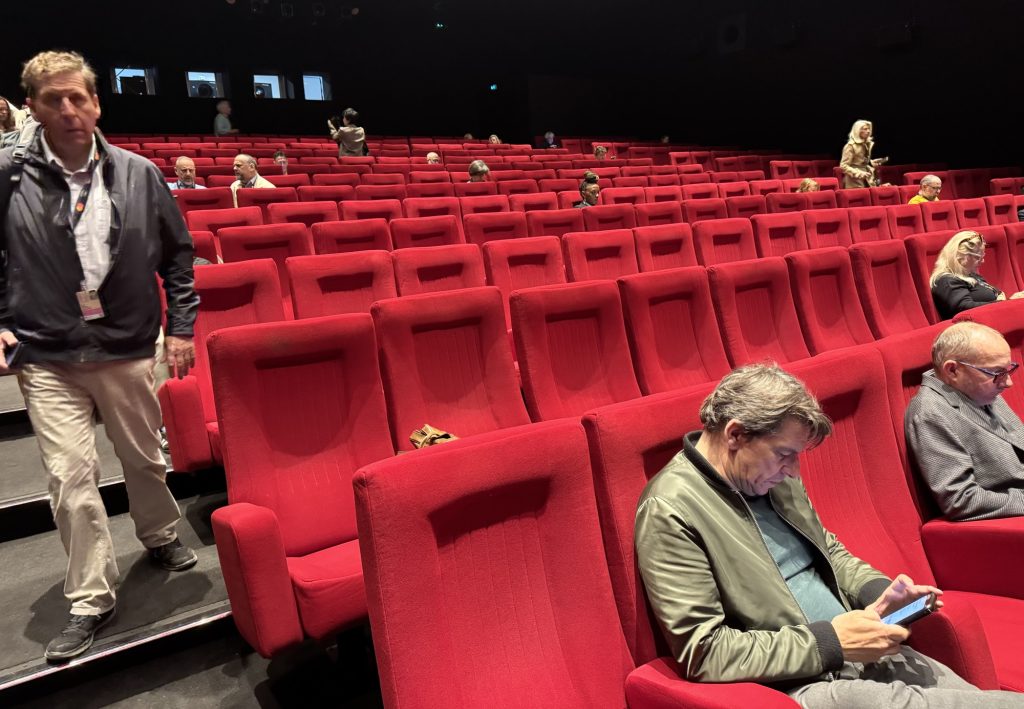
I’m not saying the Cannes Film Festival is principally, secondarily or even thirdly for catching zees. But if — if — you need a jet-lag napping recharge there’s no better option that the Salle Agnes Varda. Those red seats are cushy heaven. Five minutes after sitting down you’ll hear the cackly voice of Margaret Hamilton’s Wicked Witch of the West…”sleep…sleep…now you’ll sleeeep.”

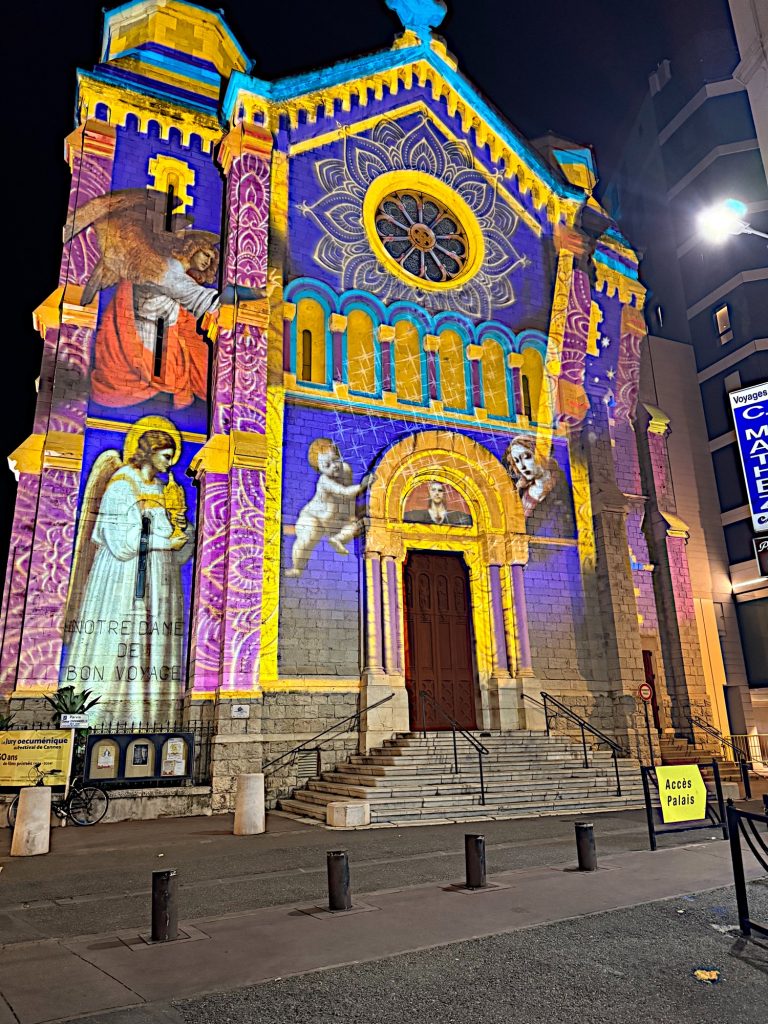
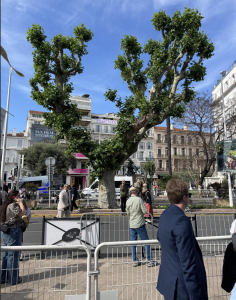
Sidenote: The gaudy designs and colors projected upon the Napoleon-era Notre Dame (third photo) are a vulgar desecration — as bad as Criterion’s teal vandalizing of Eyes Wide Shut, etc.

Non-Dramatic, Dialogue-Heavy Instructional About Facing Physical Decline and Death

In Ryusuke Hamaguchi‘s All of a Sudden, a harried, in some ways embattled director of a nursing home in the Parisian suburbs named Marie-Lou (Virginie Efira) has been attempting to institute a humane care technique known as Humanitude, in spite of bureaucratic resistance and general nursing-staff recalcitrance.

But then she happens to engage one evening with Mari Morisaki (Tao Okamoto), a terminally ill Japanese playwright-director, and boy, do they strike up a long conversation about end-of-life care and facing death! They talk and share for hours on end, not just into the night but into the pre-dawn hours and beyond.

And then they fly to Kyoto together and talk a lot more as well as explore the joyful art of foot massage (no lezzy stuff — just feet), and then they fly back to Paris for more talk and caring and well-massaged peds all around. And then (non-spoiler!) Okamoto’s character finally, inevitably gives up the ghost.

And there’s a Big Lebowski-like scene in which two of Morisaki’s nearest and dearest (a 70ish stage actor, played by Kyōzō Nagatsuka, and a developmentally disabled teenaged kid who yelps like a hyena when emotionally aroused) sprinkle her ashes from a pretty Kyoto mountaintop. Do they suffer the indignity of windblown ashes flying into their faces a la Jeff Bridges‘ Jeff Lebowski? Of course not — this isn’t that kind of film.

For what it’s worth, I didn’t suffer all that much through All of a Sudden. Well, I did to a certain extent (as did several viewers who bailed out of Friday afternoon’s press screening inside the Salle Bazin), but I was so impressed — amazed, really — at Hamaguchi’s audacity.

His bold-as-brass decision, I mean, to make a 196-minute film that is basically a slow-moving, didactic conversational instructional — a 21st Century counterpart to Jean-Luc Godard‘s Marxist instructional films (1967 to 1974) — that completely ignores pretty much all of the dramatic basics — no plot, no character arcs, no story tension, no second-act pivots, no third-act payoffs or dramatic surprises — but at the same time heavily invests in creating spiritual flotation vibes that are kind of catching and make you feel…well, settled and serene.

When my life eventually comes to an end, I would like this transitional passage to occur within a Marie-Lou-styled environment…seriously. I would probably decline offers of foot-and-toe massages but otherwise, cool. Let no one claim that All of a Sudden isn’t a nicely persuasive bit of pro-Humanitude propaganda.

Everyone gets and gives foot massages in this thing, and you can bet I was saying to myself “thank God Hamaguchi insisted on everyone receiving perfect pedicures before the cameras rolled….thank God Almighty for that.”

For what it’s worth sitting through Mascha Schilinski’s Sound of Falling last year was a much more uncomfortable experience.

Austere, Ultra-Refined “Fatherland” Is Mother’s Milk To Smarthouse Mavens

As expected, Pawel Pawlikowski‘s Fatherland, which I caught late yesterday afternoon, is an austere masterwork. Damn near perfect in every respect, it immediately struck me as a Palme d’Or winner waiting to happen. Spare and precise and honed to the bone, Fatherland runs only 82 minutes…a thrilling discipline!

The performances are equally spare, if not more so. Sandra Huller is being touted (and will continue to be touted) as a Best Actress Oscar contender, but she plays it very close to the vest, as in “very“. The German actress has two scenes in which she lets loose with emotional frustration and unleashed grief over the shocking suicide of her brother Klaus (August Diehl), but that’s it. The rest of her performance is subdued to the max, and yet the reality of her core situation sinks right in. Full exposure.

A 1949 road movie about the great Thomas Mann (Hanns Zischler) and his daughter Erika (Huller) travelling through a divided Germany for a Goethe celebration in the city of Weimar, Fatherland is about as narratively fat-free as a smarthouse feature (or even a popcorn flick) could possibly be.

Translation: Everything that needs to be said or understood is fully conveyed by Fatherland, although some of the HE rubes will probably complain “there’s not enough meat on the bone!” To which I say “there’s enough meat here, trust me…quality, not quantity…nutrition, nutrition.”

It was principally shot, of course, by Pawlikowski’s longtime collaborator Lukasz Zal with the usual needle-sharp monochrome palette — deep blacks, lush grays, ravishing silvertones — within a boxy 1.37:1 aspect ratio.

Fatherland is immaculate and exquisite, and is particularly admirable for the subtlety deployed at every turn. Plot advancements and historical underpinnings are never hammered home — it’s all played deftly and solemnly…fine period detail, a fascinating “you’re really there” aesthetic.

One of my favorite scenes is nominally of little consequence, and yet feels like a perfect brushstroke. Thomas and Erika are stopped — idling — at an East German border crossing. A young soldier, presumably unaware of the elder Mann’s status, taps on a rear passenger window and asks, by way of a slight gesture, if Thomas could spare a cigarette. The author rolls down the window and offers the lad one of his smallish cigars. Not a word, not a wink…a slight hint of disdain.

I’m sorry but I liked Fatherland so much that I’m leaving now to catch it a second time at an 8:30 am Grand Lumiere screening.

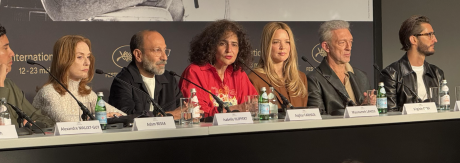
Farhadi’s Talky “Parallel Tales” Is A Fascinating, Brilliantly Woven Metaphor for Sometimes Manipulative Creative Process

HE to critic friend after 6:45 pm screening of Asghar Farhadi’s Parallel Tales: “So whadja think?”

Critic friend to HE: (Making thumbs-down gesture) “Boring. Totally bored. Too long.”

HE: “But it’s a really honest examination of what writers do, I thought…an exercise in naked self-portraiture. An admission that writers do whatever the fuck they can — imagine anything, steal ideas, stalk women, use others, play dishonest emotional games — in order to create a good story or write a good screenplay. Farhadi is admitting ‘this is who I am, what I am.’ And in this sense, it’s really bold.”

Critic friend: “It’s boring. All apartment interiors, two or three cafe scenes, two Paris Metro scenes…all talk. I kept wanting it to end, and time and again it refused to.”

HE: “I realize it’s visually self-limiting because it’s almost all dialogue, but I wasn’t bored at all. I was totally hooked because it’s kind of Rear Window-ish, and because it keeps you guessing as to where the narrative is going.”

Critic: “Great. Good for you.”

HE: “Too much dialogue? What were you looking for, a car chase or something?”

Critic: “I’m just tired of films that are basically just MCUs of people talking and talking. Cinema is changing. I want more than just dialogue.”

HE: “You’re tired of dialogue? God, you sound like a video game guy!”

Critic: “I was bored…sorry. I wanted more.”

I’m almost all alone on this one. Almost everyone I’ve read or spoken to disagrees. The dismissal of this obviously different, indisputedly ambitious, unusually told tale of serpentine plot threads, switching narratives, covert agendas and discreet fake-outs is unmistakable.

When the credits began rolling at the end of Thursday night’s Salle Debussy screening, faint clapping could be heard but the sound of ominous silence easily dominated.

I’m not saying the naysayers are wrong, but they seem to be ignoring the self-portraiture aspect. Farhadi cast Adam Bessa, a 34-year-old French-Tunisian actor who bears a certain resemblance to Farhadi, as Adam, the film’s central protagonist / instigator. It’s not a stretch to regard Bessa as some kind of Farhadi stand-in.

I’ll try to fill in some of the blanks tomorrow, but it’s 12:30 am and I have to attend an 8:30 am screening, not to mention be up and sharp by 6:50 am.

There can be no disagreement that the 49 year-old Virginie Efira is, right now, easily the most fetching, Marilyn Monroe in Some Like It Hot-level, middle-aged actress on the planet earth. Zaftig is beautiful.

It’s a bit disconcerting that costar Vincent Cassel, who will turn 60 this year, is presented by Farhadi as a withered, getting-older guy with aching limbs and thinning hair. In David Cronenberg‘s The Shrouds (’24) he played a hardbod cool cat with a perfect bop haircut. I know it sounds childish to say “I prefer the latter”, but I do.