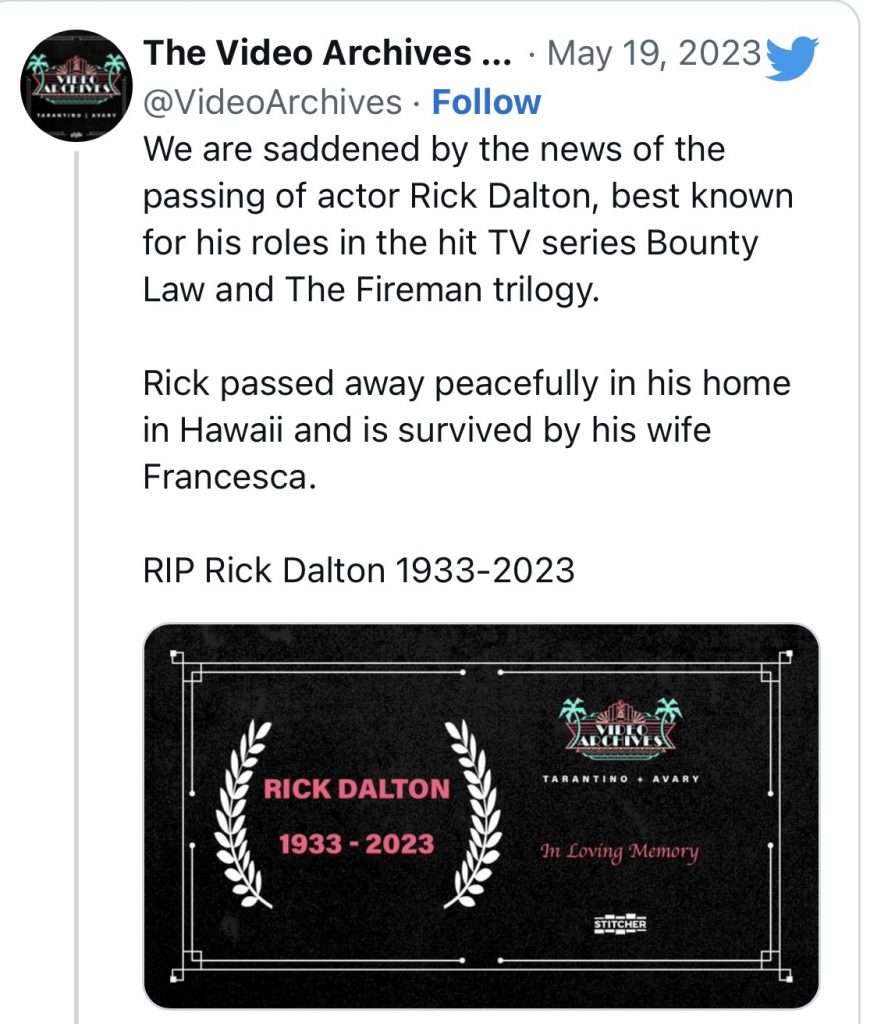
The other day Quentin Tarantino and Roger Avary offhandedly announced the death of Leonardo DiCaprio’s Rick Dalton, the struggling, none-too-bright C-level actor who initially caught on with BountyLaw, slowly faded and then resurged in ‘69 after roasting Manson follower Susan Atkins (aka “Sadie Glutz”) with a flame thrower.
Retired since the late ‘80s, Dalton died in Hawaii at age 90.
I for one would have appreciated a photo of Dalton in his dotage (sparse snow-white hair, Gabby Hayes beard, drooping neck wattle), which would have been easy to compose with Photoshop or any decent manipulation software. Okay, perhaps Quentin and Roger didn’t have such a photo ready at the exact moment on 5.19, but why not since?
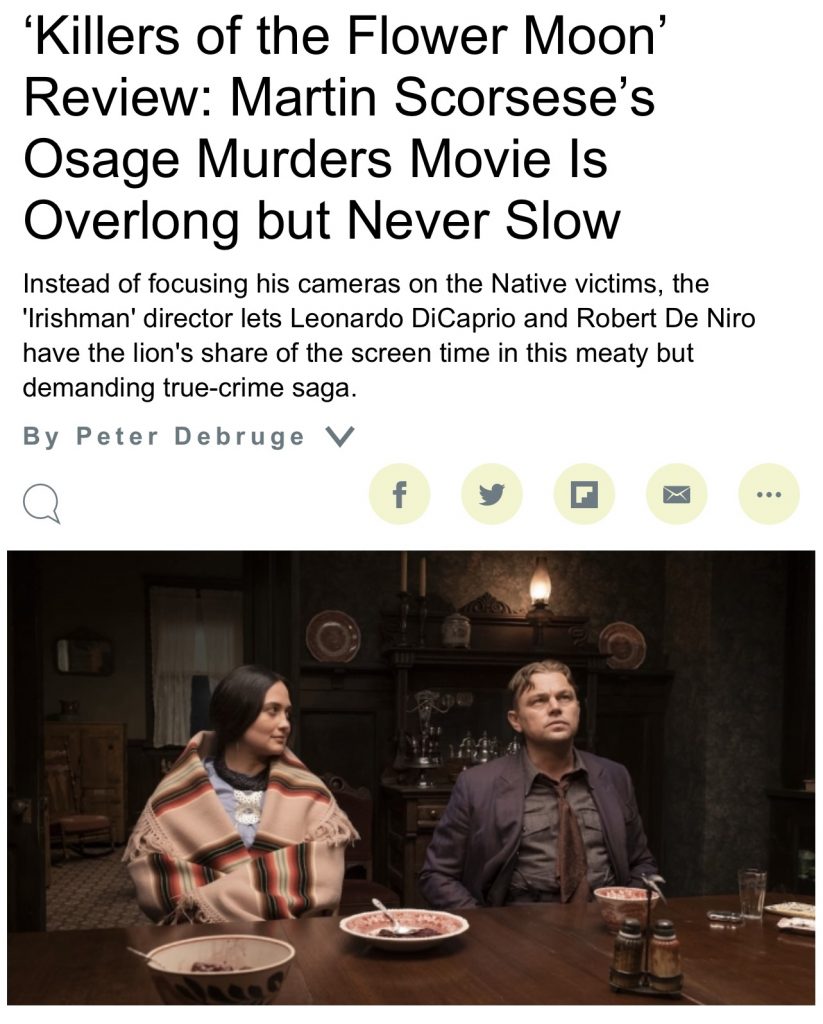
It pains me to report that KillersoftheFlower Moon-wise, there’s a little bit of trouble in River City. Not a huge amount of trouble, mind. I was moderately and at times actively engrossed and l certainly wasn’t in any kind of pain but…
It holds and occasionally fascinates in a dutiful, believable, step-by-step fashion, and it certainly radiates profound moral lament and heartache for the many Osage victims, but overall it doesn’t quite get there.
It’s basically a bit more than two hours of scheming and murder and fiendish plotting between Robert De Niro’s “King Hale” and Leonardo DiCaprio’s Ernest Burkhart, and a bit less than 90 minutes of Jesse Plemons and his FBI team arriving in Oklahoma and getting to the bottom of it all — but at the end of the day Killers doesn’t really generate enough juice.
Killers is certainly watchable in a steady, methodical way, but it never really builds up a head of steam. Authentic period atmosphere (early to mid 1920s) and beautifully shot. It certainly feels real and lived in, but also lacking a certain fire in the belly quality — a bit too measured and matter of fact and low-flamey.
It’s a good film but it feels too quiet and subdued and even…no, I won’t say mezzo-mezzo. It holds your interest and never bores. But it never really excites either.
All I can say is thank God for Plemons and the G-Men, whose arrival kicks up the dramatic tension and delivers a certain limited gusto.
Cheers for sad-eyed LilyGladstone (it’s definitely her movie — Native American actress wins acting Oscar!!) and a superbly suffering DiCaprio as the yokelish, none-too-bright, puffy-faced Burkhart — but the film is slowish and drawn-out and kinda plodding at times…obviously dialogue-driven but altogether rather quiet and far from any definition of incendiary. It never really combusts.
Was the 206-minute length really necessary? And was the massive budget really justified? Minus the stars and the enormous budget and visual sprawl it could have been a modest four-episode HBO movie that would earn respect…at least that. But with few jumping and shouting for joy.
IlyaPovolotsky’s Grace, a haunting, Wim Wenders-like father-daughter road film set in Russia’s outlying regions, is a Director’s Fortnight selection. Reviews will pop later tonight or tomorrow.
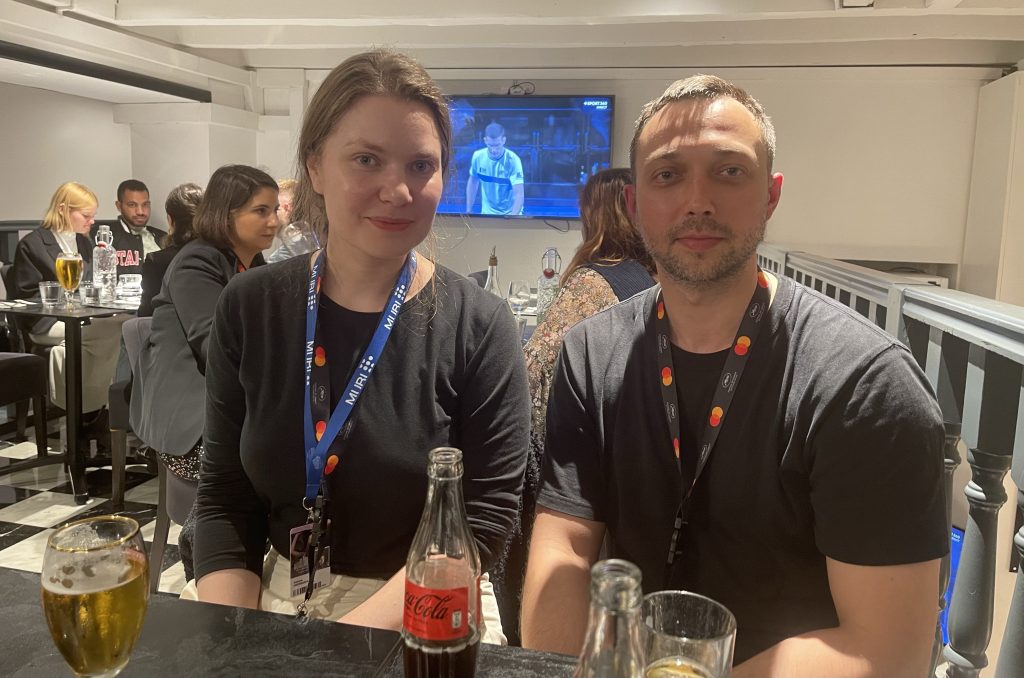
Last night HE enjoyed a friendly sit-down with Povolotsky and producer Victoria Chernukha. Povolotsky, a Cannes first-timer, knows this adrift and rootless turf, and commendably sticks to his stylistic guns. We bonded over his admiration for BlackFlies.
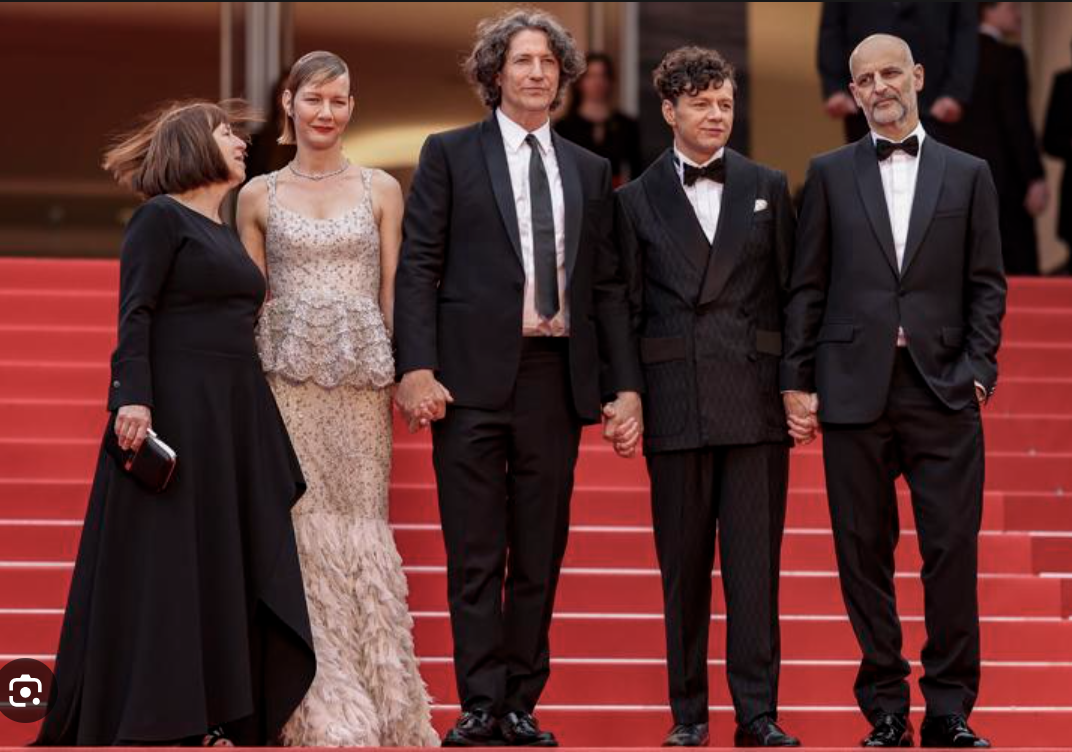
Jonathan Glazer‘s The Zone of Interest is an ice-pick art film about evil with a capital E — a riveting, unmistakably horrifying portrait of the home life of Rudolf Höss (Christian Friedel), commandant of the infamous Auschwitz prison camp during World War II, and his wife Hedwig (Toni Erdmann‘s Sandra Hüller).
Rudolf, Hedwig and the kids reside in a large, handsome home just outside the gates of the camp, and mostly we’re just shown the day-to-day of meals, housekeeping, horseback riding, idle chatting with friends, casual infidelities and whatnot.
Glazer’s basic strategy is to allow subtle allusions, hints and insinuations of the Auschwitz horror to seep into this atmosphere of domesticity. Toward the end are two or three scenes of Rudolf meeting with military colleagues about a planned, ramped-up extermination of Hungarian Jews, but Glazer keeps it all curt and officious, saying to us “can you sense it…can you feel it?”
The vibe is ghastly and revolting, of course. The moral delivery feels like…I don’t know, gas filling your lungs or poison spreading through your veins. Little plop-plops of horror like Alka Seltzer tablets.
The film is basically one static tableau after another. The Hoss family taking a swim, the children playing on the grounds, Rudolf professing love for his favorite horse in the stable, Rudolf and Hedwig indulging themselves with lovers on the side, etc.
The Zone of Interest begins with a spooky overture (the composer is Mica Levi) against a black screen, and to be completely honest it was this overture that put the hook in more than anything else.
Because the movie that follows has no story — it is simply about exposing Rudolf and Hedwig’s aloofness and apartness — cruelty, denial, an absence of basic humanity. Here be monsters.
The second best sequence comes at the very end, a series of flash-forward, present-day images of what I presume is the Auschwitz-Birkenau State Museum, and then Glazer dovetailing back to 1942 as Rudolf is seemingly struck by a vision of what the future will bring, and (perhaps) who and what he is.
It all “works” but man, this film is dry as a bone. Like a frigid, long-buried fossil. Dry-ice steam filling the air.
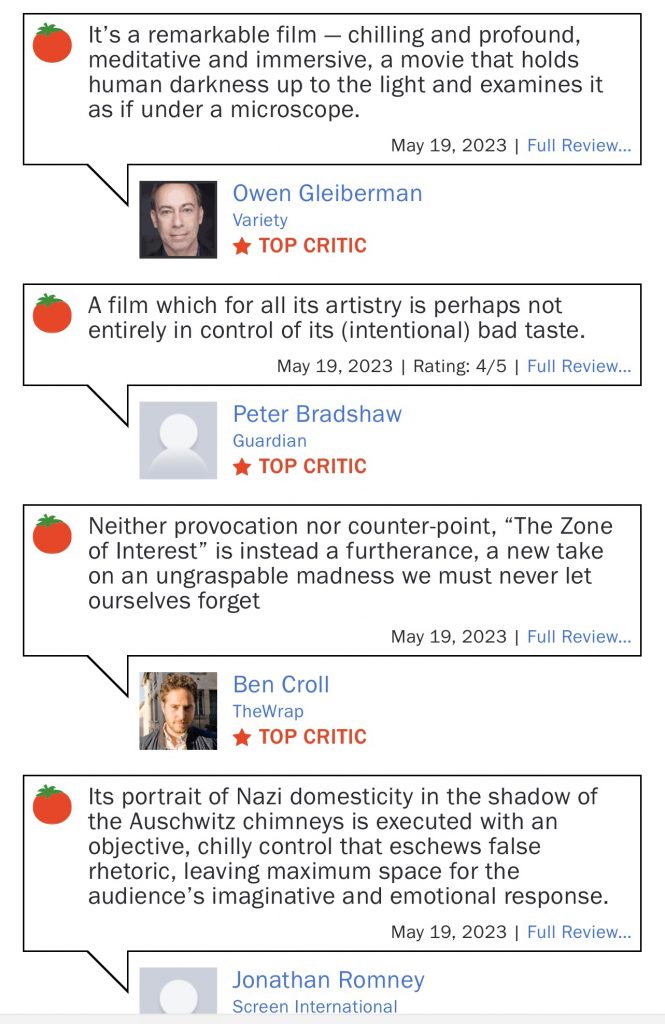
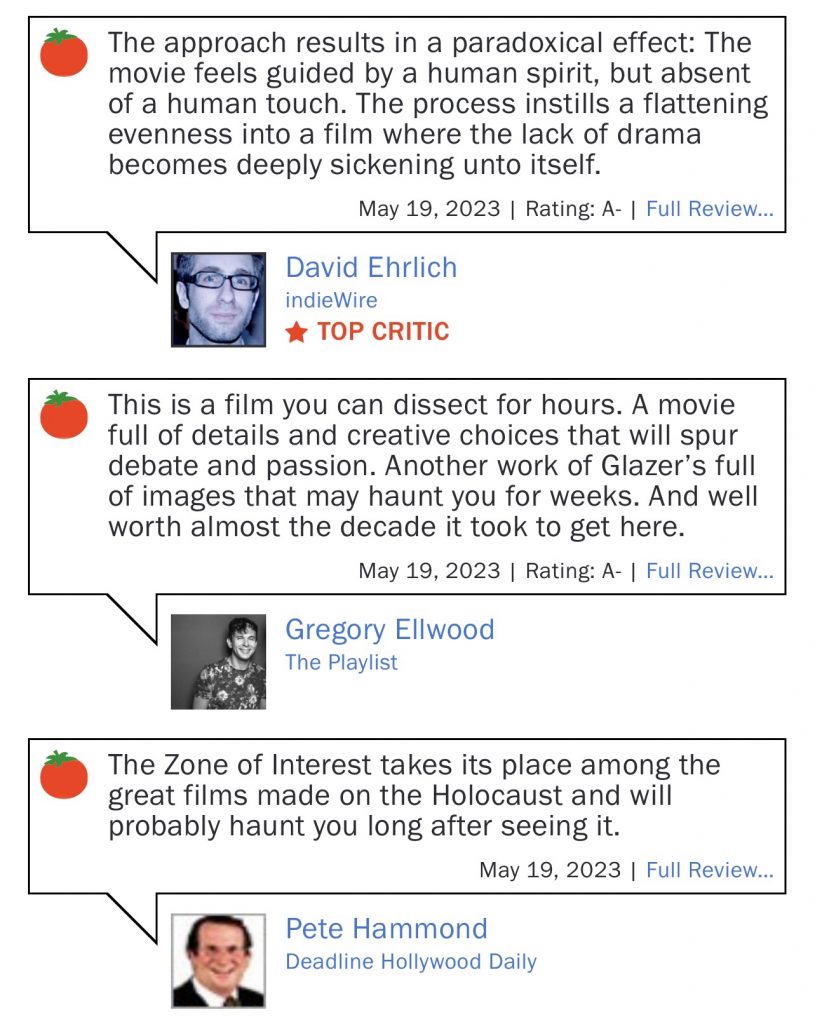
The Cannes mob, of course, is praising it to the heavens because of the toxic moral current and Glazer’s arthouse strategy. Cannes critics can’t be iffy about such a film — they have to jump up and down lest they seem indifferent or unmoved by what Zone is presenting and how it all sinks in.
It’s a film that certainly sticks to your ribs (I can feel it kicking around inside as I write this), but I have to say that I found it too spare, too artified and rigidly schematic to a fault.
As I watched I was asking myself what is this movie saying that wasn’t in Steven Spielberg‘s Schindler’s List or Loring Mandel‘s Conspiracy (’01), a made-for-TV drama that delved into the psychology behind the 1942 Wannsee Conference, which is where “the final solution of the Jewish question” was ratified and officially put into motion.
The answer, as noted, is that The Zone of Interest has been shorn of explicitness while humming with implication. That’s the basic idea, and either this approach knocks you flat or it doesn’t.
I was simultaneously chilled to the bone while muttering to myself “I wish this film had something more because as penetrating as Glazer’s strategy is, it’s like early haute cuisine…big plate, exquisite food but very small portions.”
The film is based upon Martin Amis’s same-titled 2014 novel. It’s about a Nazi officer named Angelus Thomsen who falls into lust for the wife of the Auschwitz camp commandant, named Paul Doll. The only basic element that the book and the film have in common is the Auschwitz setting.
I’m certainly not dismissing Glazer’s film, but if he’d gone with the Amis story he might have been able to kill two birds with a single stone.
Dancing on a balcony on rue d’Antibes, roughly ten minutes after the 6:30 pm ZoneofInterest screening let out. A sizable crowd stood and stared and took videos.
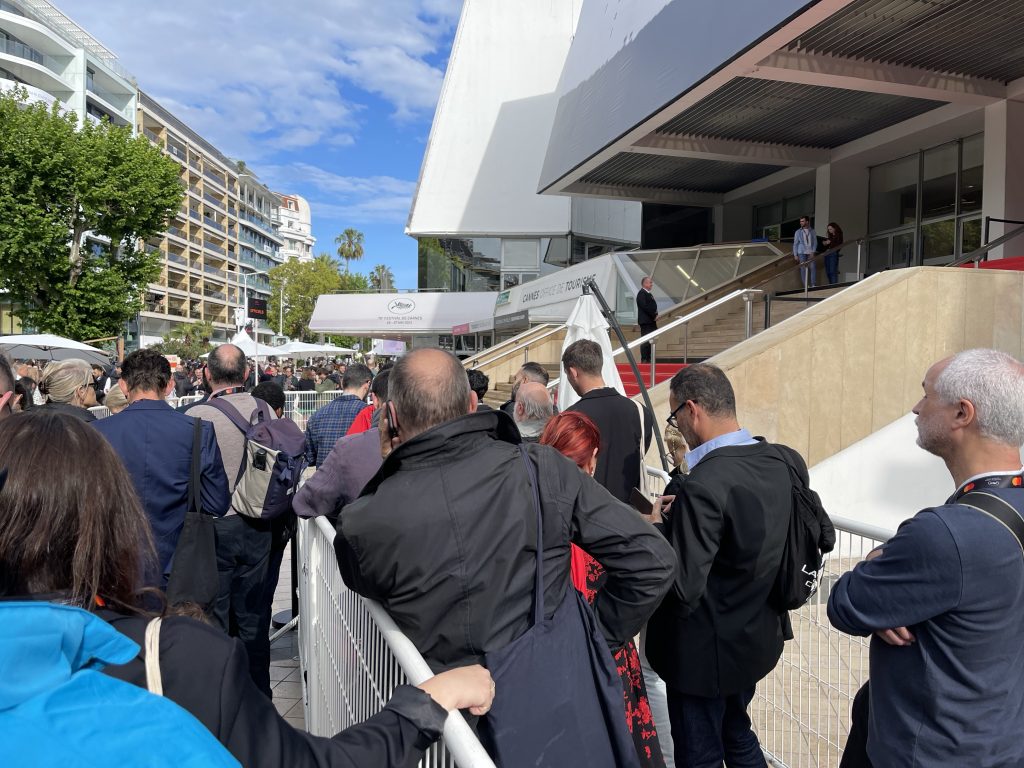
…is next on the dance card. Slated to begin showing at the Salle Debussy at 6 pm, and of course we’re still lined up outside at 6:12 pm. It would be nice if festival staffers would make at least some attempt to screen films at the scheduled time. We’re all on a clock, trying to squeeze in meetings, feedings and as many films as possible, etc.
Not a huge fan of Glazer’s UnderTheSkin. For me only Sexy Beast, 22 and 1/2 years old, hits it out of the park..
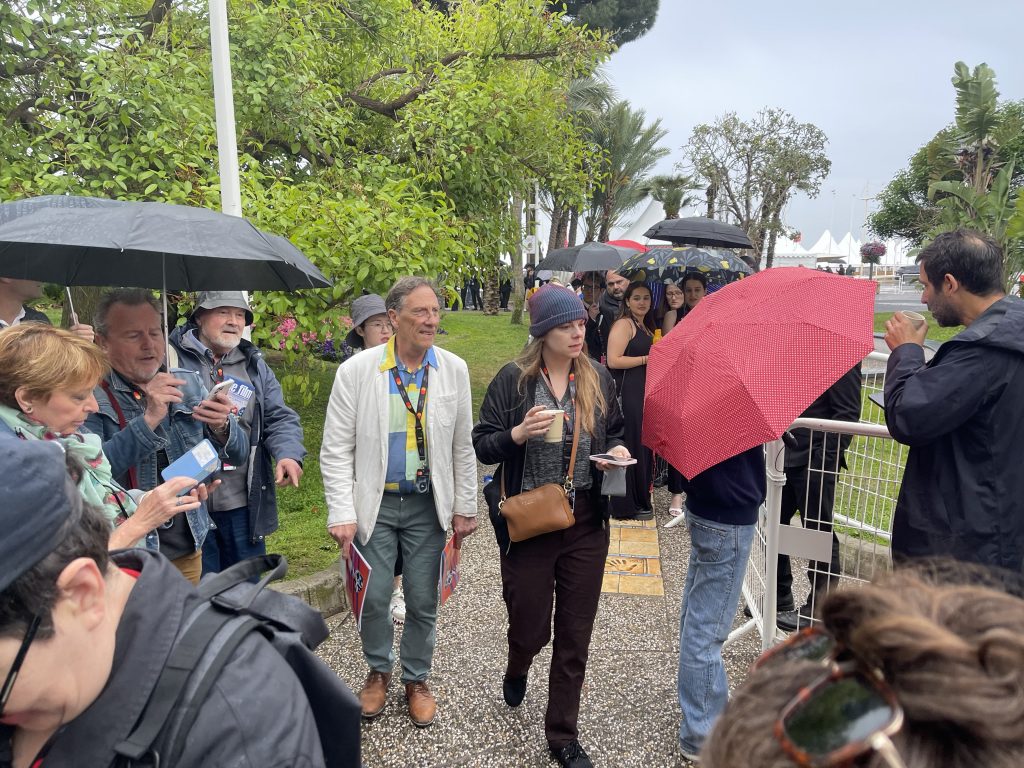
At 7:45 am, 150-200 people in a last-minute badge line for Indy5. Those who read last night’s reviews are at least considering a charge that it’s notthatgood, and they don’t care. Neither do I. Obedient corporate brand slaves, all of us.
I would feel derelict if I didn’t at least try to see it.
11:10amupdate: I got in because of a last-minute decision by festival staff to let journalists in first. Thanks, guys…appreciated.
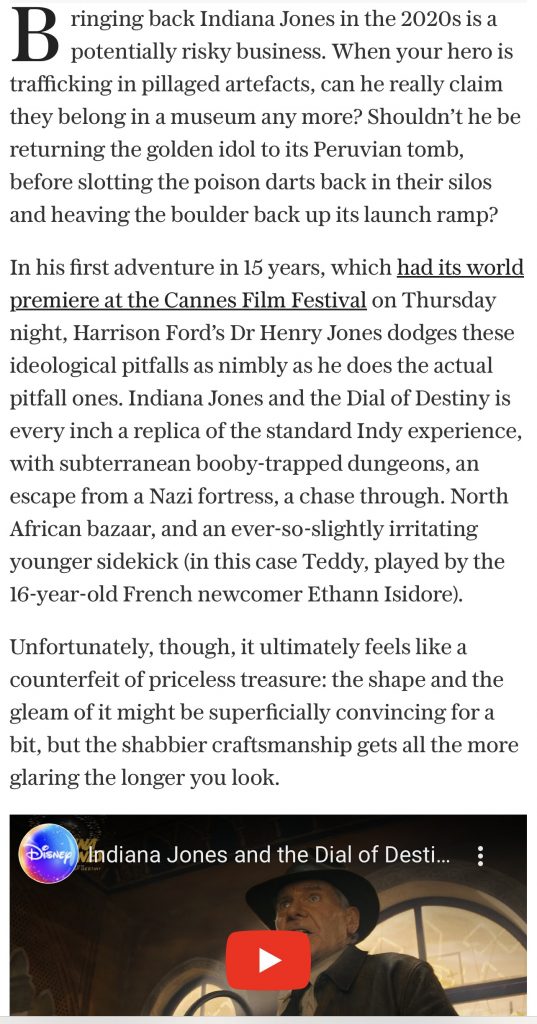
And guess what? Indiana JonesandtheDialofDestiny isn’t half bad — it follows the template to the letter, doing the time-honored Indy dance in a completely predictable but nonetheless tolerable and certainly professional fashion, and it has a CRAZY-ASS ending that HE definitely won’t spoil.
I’m sorry but I’ve never been a fan of Hirokazu Kore-eda, the humanist, kind-hearted, Ozu-like Japanese director whom everyone (i.e., the Cannes mob) admires. I “respect” his signature focus (sad, anxious, troubled families going through difficult times), but his films (Shoplifters, Broker, LikeFather, LikeSon) have always bored my pants off.
Which means, of course, that I don’t like Kore-era’s humanism…right? I know I’ve always found his stories frustrating because they seem to just go on and on.
I certainly felt this way during today’s Salle Debussy screening of his latest film, Monster, which deals with school bullying, repressed rage and various family misunderstandings.
It struck me as repetitive and meandering and lacking in narrative discipline. I began to feel antsy after the first hour, and then this feeling seemed to double-down. My soul was screaming during the final half-hour of this 125-minute film, which felt more like three hours. I was silently whimpering.
I’m not condemning Monster or calling it a bad film. I’m just saying the world of Kore-era is not for me, and never will be. This doesn’t make me a bad person, or so I’m telling myself. I know that at the 95-minute mark I leaned over and muttered to a friend, “I don’t know how much more of this I can take.”