Dweebs Have Gotten Dweebier

The Godfather and The Godfather, Part II have been shit-canned by the dweebs who vote in the Sight and Sound “greatest films of all time” poll, which publishes its list of toppers every ten years and has just released the 2012 results. Francis Coppola‘s twin crime classics occupied the fourth place slot in the 2002 poll, but a new rule was imposed for the 2012 ballot — i.e., “related films that are considered part of a larger whole are to be treated as separate films for voting purposes.” Apparently none felt that either film was strong enough on its own so that was that.
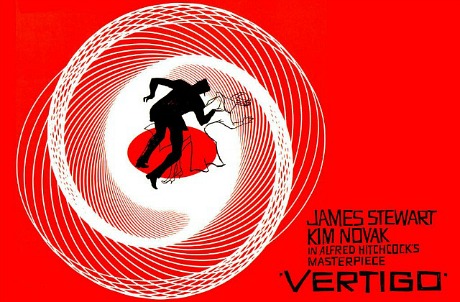
But the 2012 poll delivered good news, at least, to fans of Alfred Hitchcock‘s Vertigo, which finally pushed past Orson WellesCitizen Kane to take the top position. If the Sight and Sound poll wasn’t regarded as some kind of anecdotal tabulation of fringe-dweeb thinking — a far cry from what it used to mean in the ’50s, ’60s, ’70s and ’80s — the fall of Citizen Kane would be close to an earth-shaking headline. Kane sat at the top of the list for 50 years — a full half-century! — and now it’s been deposed. Kane is over, long live Scotty Ferguson.

The other films on the S&S 2012 Top Ten list were the usual venerated hand-me-downs….Yasujiro Ozu‘s Tokyo Story, Jean Renoir‘s The Rules of the Game, F.W. Murnau‘s Sunrise, Stanley Kubrick‘s 2001: A Space Odyssey, John Ford‘s The Searchers, Dziga Vertov’s Man with a Movie Camera (which I’ve never even seen), Carl Dreyer‘s The Passion of Joan of Arc and Federico Fellini‘s 8 1/2.

These salutations have changed very little over the decades. They’ve just been passed along from decade to decade, from older critics to younger critics. It’s like being in the mafia, except you’ll never hear about a pair of Young Turk film critics striding into a Little Italy restaurant and metaphorically shot-gunning a couple of older critics like Carmine Galante got it in 1979. The bottom line is that it’s much easier to go along with the crowd than stand alone and think boldly for yourself. Which isn’t to say or even imply that Vertigo, Citizen Kane, Tokyo Story, et. al. aren’t truly great films. Of course they are. But we’re sick of seeing them just sit there on this list, decade after decade after decade.
Downfall of Lee Daniels

“Two and a half hours after it finished screening in the Grand Palais, Lee DanielsThe Paperboy is being primarily spoken of as the Nicole Kidman-pees-on-Zac Efron flick. Her line before she does so — ‘If anyone’s gonna pee on him, it’s gonna be me’ — is also tweeting around.

“In other words, the press gang at Cannes thought The Paperboy was mostly a joke.

“Which is what Daniels apparently intended on some level — to flavor or season it with foolery. I love it when referenced goof humor is thrown into a drama, but the film has to be believable in the usual ways — you have to accept the bedrock reality of the story and characters — but almost all of The Paperboy reeks of fake. Bits and flourishes are pasted on and thrown at the wall. The result is something sloppy, inept and — sorry — appalling.

“Defenders (like Guy Lodge) have called it a camp classic and…whatever, an instant midnight movie for stoners. I actually think it might find some traction in this vein. But most reactions have been mocking and derisive. The response at the end of the 8:30 press screening went beyond boos. A guy somewhere to my right got a case of the giggles around the two-thirds mark and couldn’t stop…’Hoo-hoo-hoo…oh-hee-hee-hee!'” — from my 5.24.12 Cannes Film Festival review.

Even More Carefully Framed

As someone who’s fairly anal about aspect ratios, I always notice if a film is being shown in Scope or 1.85 or 1.37, but Average Joes rarely notice or remember. Even Hollywood professionals are clueless. I can’t tell you the number of times that I’ve asked film journalists or seasoned publicists if a film is in Scope or standard Academy ratio and they’ve answered “Uhm, I forget” or “what do you mean?”

So all in all, maybe 2000 or 3000 people in the entire world, if that, are going to notice that The Master was shot in 1.85, which is a departure, yes, for Paul Thomas Anderson.

But why shoot only half (or something close to half) of The Master in 65mm and the remainder in 35mm? To save money? Why not go whole-hog? I also wonder how many viewers will be able to tell which portions were shot in 65mm (which becomes 70mm when projected) and which portions were shot in 35mm. I’d like to think that I could tell the difference, but with today’s sophisticated lenses and ultra-sensitive film stocks plus high-end digital running through everything nowadays and even seasoned professionals not being able to tell the difference between film and digital, or at least not being 100% sure?

I honestly don’t think it matters that much anymore. Kodak is dead. Celluloid is almost dead. We have a ways to go before I can write that film is “dead, dead, deader than dead” but we might as well face facts and admit that it’s just about finished now and the only thing keeping it afloat are PTA and Chris Nolan and Wally Pfister and Reed Morano and a few other dps +Davy Crockett, Colonel Travis and Jim Bowie.

Carefully Framed

Can anyone imagine any director today shooting the final dialogue scene of a film — not a dialogue but a soliloquy scene, actually — in which the eyes of the lead actor are covered by the brim of a hat? This is one of the most brilliantly composed shots in any Hollywood drama, ever. The director of The Ox-Bow Incident was William Wellman; the dp was Arthur C. Miller (Young Mr. Lincoln. How Green Was My Valley, The Song of Bernadette, A Letter to Three Wives, The Gunfighter).

The Greatest

I don’t know why there are no YouTube or Vimeo clips from Franklin Schaffner‘s 1964 film version of Gore Vidal‘s The Best Man…but there aren’t. But one of Vidal’s best lines came from it: “There are no ends, only means.”

Agony of RPatz

Poor RPatz is said to be distraught beyond measure and “questioning everything” in the wake of KStew’s betrayal of their relationship by…okay, not necessarily boinking but wallowing in some kind of squishy physical proximity with Snow White and the Huntsman director Rupert Sanders. He’s now reportedly hiding out at Reese Witherspoon’s $7 million ranch in Ojai.

Let me explain something here, and I’m doing so because the gossip rags never even glance in this direction. The worst thing you can possibly do on this planet is to be complacent and question nothing, and the best thing you can possibly do is to embrace an existentialist philosophy and question everything. So as painful as the last few days have been for him, RPatz has, if nothing else, experienced significant spiritual growth as a result of this trauma…and that’s not something that young guys tend to come by naturally. So he’s basically in a much better place plus he gets to hang out in Ojai for a while and maybe boink a local or two.

I’ve noticed, by the way, that if you stay at a friend’s place (i.e., a home or apartment that they own or are leasing but aren’t sharing with you) they don’t want you boinking anyone. They’ll never say so in so many words, but under their roof they want you to live a monastic and fastidious life of denial and book-reading and contemplation with constant dusting and cleaning. They don’t want any heated activity or discharges of any kind, which they feel will sully or stain their place on some permanent level even with the cleaning of sheets and the use of Glade air fresheners and a top-tier cleaning service. A word to the wise.

Even Glorious Lives Must End

“Bless Gore Vidal for having exposed liars and hypocrites and monsters, and having made their lives just a bit more awkward or painful. Yes!” — tweeted around 10:40 pm, or about an hour after hearing of the death of Gore Vidal following a screening of Hope Springs.

Vidal worked as a Ben-Hur screenwriter for a long period — post-Karl Tunberg, pre-Christopher Fry. Here’s that famous story about Vidal having suggested to Ben-Hur director William Wyler that Messala’s fierce rage toward Ben-Hur might have been driven by a “lover’s quarrel gone wrong.”

Go All The Way

In this morning’s post about the new Skyfall trailer, I wrote that “the comedic surreal rules that were once used by the Wile E. Coyote vs. Roadunner cartoons have been embraced by the super-action genre.” I was referring to characters falling dozens or hundreds of feet (like Mr. Coyote used to in the cartoons) and somehow not hitting the pavement through this or that escape clause. But there’s one cartoon bit action movies haven’t embraced that I’d really like to see.

I’m speaking of the extended suspended animation rule. That’s the one in which the Coyote will chase the Roadrunner off a very tall mesa or mountaintop, and run right off the edge of a cliff…but without falling. That’s because he doesn’t realize that the cliff has ended and he’s now suspended over a canyon with nothing below him but air. He can’t fall, in short, until he fully accepts that there’s nothing holding him up. He starts to suspect that he might be in trouble. Without looking he reaches around underneath his feet to try and feel ground or rock…nothing. He looks back at the cliff edge and sees he’s not standing on it. Then he looks down and grasps the reality. Then he looks at the camera and goes “oh, no,” pleading with fate or God not to let him fall. And then he’s gone, making a whistling sound as he drops to the desert floor like a bomb. Sometimes the camera would just watch from above and note a very faint impact sound and a small puff of smoke as he hits. And then he’d be fine in the next scene.

I want to see Colin Farell perform this kind of scene in Total Recall. Seriously, why not? Action films haven’t the slightest interest in adhering to the laws of physics so why not just go full cartoon?

Regional Stereotypes

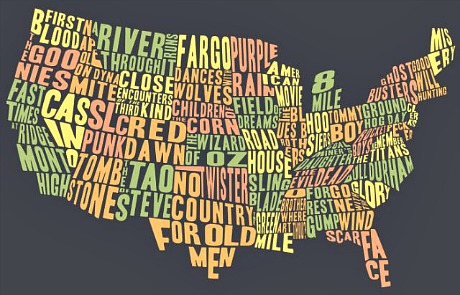
If this were my map I would throw out Fast Times at Ridgemont High as the fill-in for California (what an insult!…as if California is full of adolescent stoner mallheads), and replace it with either (a) Jacques Tourneur‘s Out Of The Past, which encompasses San Francisco, Los Angeles, Bridgeport and Lake Tahoe (as well as New York and Acapulco), or (b) Karel Reisz‘s Who’ll Stop The Rain, which encompasses Oakland, Berkeley and Los Angeles.

I’d like to see a much bigger map that gets much more specific and which assigns movie titles to particular towns and/or blends their names (like, let’s say, The Wild One and Hollister, California, where the original 1947 motorcycle-gang riot that inspired the 1953 Marlon Brando film).

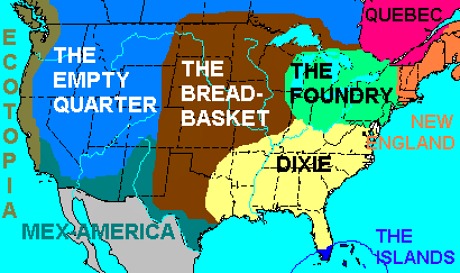
The Movie Map reminds me of the one that accompanied Joel Garreau‘s The Nine Nations of North America, which came out in 1981. Question: Do the same nations exist 30 years later, or have the borders shifted to some degree? Do the same names apply?

Pass The Cyanide

The first thing that comes to mind is “did Nancy Meyers have something to do with this?” She didn’t. The culprit is director-writer Justin Zackham, author of The Bucket List screenplay and director of Going Greek. Obviously aimed at silver-haired women and all the squares, schmucks and schmoes who love films about characters who have shiny copper pots hanging in their kitchen (i.e., a classic Meyers signature).

Painful dialogue, broad gestures, winking and signalling at the audience from a mile away…what kind of retardo finds this stuff remotely funny?

Robert De Niro is supposed to be better than pretty good in The Silver Linings Playbook so he probably took this one thinking, “90% of everything is crap….you can’t hit a homer every time at bat…money is money…I’ll just hold my nose and do it,” etc.

The bearded devil from Angel Heart finds De Niro leaving the set of Bang the Drum Slowly and ushers him into a room at a nearby motel. An irritated DeNiro says “whaddaya whaddaya?…I’m set to do Mean Streets and then The Godfather Part II and then Taxi Driver and then 1900 and then The Last Tycoon and New York, New York…whadday want from me?” And the devil cracks open a hard-boiled egg, sprinkles it with salt, turns off the light, fires up a projector and shows De Niro a reel from The Big Wedding and says, “This is what you’ll be doing in 40 years.”