Red House

I was on the scooter yesterday afternoon, buzzing along Mulholland and in and out the canyons and trails and cul de sacs between Beverly Glen to Laurel Canyon. And I guess I was thinking about the two 2012 Roman Polanski docs — Laurent Bouzereau and Andrew Braunsberg‘s Roman Polanski: A Film Memoir (which I reviewed in Cannes) and Marina Zenovich‘s Roman Polanski: Odd Man Out, which will play the fall festival circuit — because I found myself hanging a subconscious right onto Cielo Drive off Benedict Canyon south, and up to an area that used to be known as 10050 Cielo Drive.


The original Robert Byrd-designed home, apparently taken sometime in the late ’60s or early ’70s.

Jeff Franklin’s “Villa Bella,” was built in ’94 or thereabouts on the same lot after the Byrd home was torn down.

This was the site of Robert Byrd‘s now-demolished California ranch-styled home where Polanski’s late ex, Sharon Tate, and four others — Abigail Folger, Steven Parent, Voiytek Frykowski and Jay Sebring — were murdered by the Manson family on August 9, 1969. I knew that Trent Reznor lived there for two or three years in the early ’90s, and that the place had been torn down in ’94 and that a nouveau-riche Moorish-Mediterranean monstrosity called “Villa Bella” was built in its place by producer Jeff Franklin (Full House). The original street number was also erased — the address is now 10066 Cielo Drive.

I stood on the other side of the canyon and told myself that anyone who would trash the original single-storied structure, which had a nice homey vibe with a pool and a guest house and was painted red with white trim with huge trees on the grounds, and then cut down the trees and build a ghastly Uday Hussein-style Euro-mansion, must be a real animal. I can understand how a new owner might want to flush out the murder vibes by building a new place, but the Franklin mansion is an even worse nightmare — a monument to tastelessness and a metaphor for the mongrelization of architectural standards in Los Angeles and across the USA. You’d have to be truly coarse and clueless to build this place and be delighted with it. If and when I ever run into Franklin I think I’ll tell him that.

A certain percentage of those reading this article will go, “Wait, what’s wrong with the Franklin place? It looks like a nice McMansion — big and palatial with over-sized rooms and great wifi…probably has a home theatre and maybe a workout room and a pool and room for three or four SUVs in the garage…what’s not to like?
Choke On It

I’ve never been much for epic mano e mano conflicts between devotional good and malevolent evil. They’ve always seemed like stories for simpletons who don’t know from parking meters. So when I hear Chris Nolan describe The Dark Knight Rises as “a very elemental conflict between good and evil,” I immediately mutter to myself, “Jesus…give it a rest, for God’s sake.”

Good vs. evil is an ancient crock — a bullshit fable that epic poems and dime novels and comic books and superhero movies have been selling since forever and ever. Obviously there’s a basic emotional need to see these tedious tales told time and again and again. I realize I’m in the minority for being sick to death of them, but every time I hear people cheer a superhero, I think to myself “you fucking saps.”

Evil clearly abounds in the U.S. financial and political realms (Boehner, Cantor, Rove, Koch brothers, Tea Party idiocy, rightwing talk radio, Goldman Sachs, “banksters”) while internationally we’ve had Al Qeada, the Taliban executing female adulterers, Pol Pot and the killing fields, Adolf Hitler and the Final Solution, etc. But there are never any formidable polar opposites looking to stop or defeat them, no real-life Bruce Waynes or Supermans or Peter Parkers. There are only flawed and/or compromised alternatives (Obama, Warren, the progressive community) who are less selfish and less craven and nobler in their stated goals.

Bane is just a designated hitter — a cyborg built to enhance corporate earnings. He’s just a musclebound, gurgly-voiced S & M gay icon who’s essentially a tribute to George Miller and Kjell Nilsson‘s “Lord Humungus…the Ayatollah Rock-and-Rolla.” Now there was a baddie to believe in. Because thirty years ago, he felt semi-novel — a relatively new idea borrowed from gay leather culture.

Fleet Finesse

I was in hiking in Switzerland when The Hollywood Reporter‘s Todd McCarthy posted his LAFF review of Jonathan Dayton and Valerie Faris‘s Ruby Sparks (Fox Searchlight, 7.25), so the conversation has begun — I just wasn’t paying attention.

“A beguiling romantic fantasy about the creative process and its potential to quite literally take on a life of its own, Ruby Sparks performs an imaginative high-wire act with finesse and charm,” McCarthy wrote.

“It’s perhaps no coincidence that the long-awaited second feature from the directors of Little Miss Sunshine centers on a novelist (Paul Dano) suffering from writer’s block, but the film itself reveals no sense of artistic stasis, proving vital and responsive to the nervy improbabilities of co-star Zoe Kazan‘s original screenplay.

“It’s unlikely that commercial lightning will strike twice for Fox Searchlight to the same degree it did after the distributor picked up Dayton and Faris’ debut six years ago, but the genuinely romantic core and Harvey-like fantastical element suggest real box-office potential to be tapped equally among young men and women

“It’s an intimate, tightly focused tale that’s been handled with impressive rigor but not too insistent a touch. The fleet filmmaking style, which briskly moves things along but never feels manipulative or invasive, is invigorating, as are the exceptionally luminous images created by cinematographer Matthew Libatique.

“A couple in real life, Dano and Kazan individually and together project what is often called offbeat appeal. His large head and mop of hair atop a slim frame convincingly representing an egghead writer, Dano registers many different temperatures of doubt, frustration, inspiration, love and creativity. A sparkling personality shining through regardless of circumstances, Kazan injects earthy life into a fantasy character, capping her extremes of behavior in a wild scene in which Dano’s Calvin rapidly types conflicting commands to which Ruby instantly responds.

“Supporting performances are uniformly sharp, and the use of locations — mostly in the Los Feliz and Hollywood area — is excellent, lending the film a warm, lived-in feel.”

No Spark, No Fire

In a 7.6 article by The Oregonian‘s Shawn Levy about the uncertain commercial prospects facing Benh Zeitlin‘s Beasts of the Southern Wild, Cinema 21 owner-operator Tom Ranieri offers a succinct analysis of what makes a hit film: “A movie has to have a spark for there to be any chance of finding an audience. Winning awards is part of the overall marketing can of gasoline. A ton of fuel with no spark equals no fire.”

My quote in Levy’s piece says that “there’s always been a huge aesthetic gap between film journos and cineastes who attend film festivals and Average Joes who buy tickets to see films.” The difference, in Rainieri’s equation, is that film festival audiences are hip and perceptive enough to spot a film with good gasoline, and that in itself is enough to warrant praise. But Joe Popcorn wants that spark, and if he senses it isn’t there he won’t show up, asshole that he sometimes can be.

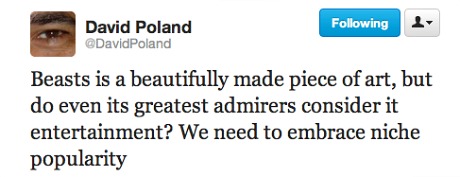
David Poland‘s tweet about Beasts says it all — he thinks it’s a beautiful art film on its own terms, but it doesn’t play to the schmoes because it doesn’t entertain. I think it does “entertain” if you just open your pores a bit. My only beef was that Nancy-boy remark about Beasts starting to feel too gooey and muddy and boozy after the first hour or so. But then it pays off beautifully at the finale so I’m not understanding why people are taking shots.

Awards Daily‘s Sasha Stone, an unabashed Beasts lover, is also sensing this resistance.

Can’t Trust ‘Em

If you really want a sense of how great or good The Dark Knight Rises plays, you need to hear from somebody like me — some non-vested, geek-despising cool customer who stands alone. Or someone like Andrew O’Hehir or Anthony Lane. Anyone who got into yesterday’s screening was/is almost certainly too heavily immersed and invested to be trusted. You need to hear from someone who doesn’t give a rat’s ass and is completely ready to take a dump on the floor if the situation warrants. But who is also ready to be fair and straight.

Read more

(Some) Geeks Are Girls

Scratch a ComicCon geek and nine times out of ten you won’t find a shrewd analyzer of popular art or culture or aesthetic expertise. Not necessarily, I mean. What you’ll almost certainly find, I suspect, is someone who’s thisclose to weeping when something gets to him/her emotionally. You’ll find, in short, a girly girl who’s looking to wet her panties and then cry about it. As some guy who saw The Dark Knight Rises yesterday (and whose reaction was captured by comicbookmovie.com) made clear.

Remember all that fluttery geek ecstasy that greeted The Avengers? All those falsetto hossannahs? Remember how Harry Knowles wept when he saw Armageddon?

In their heart of hearts geeks are fair young maidens singing “some day my prince will come,” except their “prince” is that one super-special, unbelievably cool CG comic-book superflick that will make them really damp and squishy.

Agreed — Chris Nolan is an exceptionally brilliant, high-pedigree, world-class filmmaker, and his three Batman films represent some kind of eternal high water mark, etc. But I think I’ve really tapped into something here. The not-so-secret heart of geekdom is basically feminine in nature. If I was a geek I would make a point of channeling Lee Marvin when I take to Twitter, just to counteract this impression. This is one of the reasons I could never be one. My traditional XY tendencies are too pronounced. On top of which I’m reasonably slim, I don’t wear toenail-fungus-exposing flip-flops, I’m not one for facial hair, and I never wear low-threadcount Hanes T-shirts.

Oh, Lord, Please Don’t Let Me Be Misunderstood

N.Y. Times “Sweet Spot” guys David Carr and A.O. Scott discuss Aaron Sorkin‘s The Newsroom + the myths about journalism promulgated by films like Ace In The Hole, Deadline U.S.A. and All The President’s Men. Slight Problem: Times exec editor Jill Abramson has a curious conversational tonality in her larynx. I’m sorry but she almost sounds like a brilliant Kim Kardashian, or a brilliant K.K. as voiced by Saturday Night Live‘s Nasim Petrad.

Idiocy X Infinity

N.Y. Times reporter Michael Barbaro explains Mitt Romney‘s 4th of July “tax/penalty” flip-flop to TimesCast Politics host Megan Liberman. Romney’s remark contradicts a recent statement by top Romney adviser Eric Fehrnstrom that Governor Romney “believes that what we put in place in Massachusetts was a penalty and he disagrees with the court’s ruling that the mandate was a tax,” etc. This is all about swaying the “low information” dummies. People with a semblance of brain matter see right through the bullshit.

Slick, Flashy, Thick, Appalling

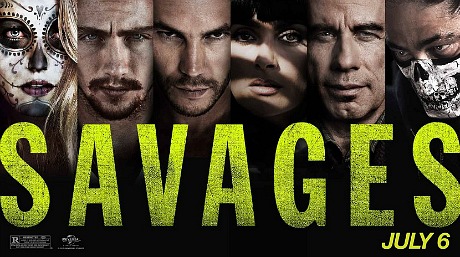
I made a point of reading Don Winslow‘s “Savages” before catching Oliver Stone‘s film version last night, and I was fairly taken with it. I love Winslow’s tight sentences and smack-dab phrasings, and the way it reads like a screenplay. So despite the beating Savages has taken on Rotten Tomatoes and Metacritic, I was hoping for at least a modicum of satisfaction. Some of the book had to rub off.

To me, that didn’t happen. At all. I felt assaulted and trapped and underwhelmed all through Savages. Almost nothing but pique. The first thing I said to a friend as I left the theatre was “why did they even make this thing? Who could possibly like this or recommend it with any enthusiasm?”

I was “directing the movie” as I read Winslow’s book, of course, and in my version the action was fast and brutal, like in real life, but I didn’t wallow in it. And the actors didn’t “act” — they read their lines flat, fast and straight. They just about threw them away, which is what you more or less have to do when you’re dealing with “I think we’ve struck gold” and “I had orgasms — he had wargasms.”

Stone does the opposite, for the most part. He whips up the visual energy every which way, glossing and flashing it up like there’s no tomorrow. And flaunting the spilt blood, gougings, torturings. All you want is for the killing and the sadism to ease up a bit, for Stone to go the “less is more” route. A touch of suggestion, imagination…not a chance. And the three leads — Taylor Kitsch, Aaron Johnson, Blake Lively — drop their on-the-nose lines like spoonfuls of mashed potatoes on the kitchen floor, “acting” with their eyes and smiling too much and pretty much murdering the potential coolness at every turn. It’s too “on the nose duhh” in all kinds of pushy, flagrant ways.

Narration is almost always a bad idea, but especially so with an action film. Lively is the
narrator here, and her opening line — “Just because I’m telling this story doesn’t mean I’m alive at the end of it…it’s that kind of story” — is terrible. I bought Joe Gillis narrating his own Sunset Boulevard saga from the morgue, but Lively saying she may or may not be dead at the end made me want to spit on the carpet. Stop prepping me!

Thank God for those occasional “well, at least that worked!” moments from Benicio del Toro and John Travolta. Because I had a really rough time with Savages, and particularly with that awful ending, which smells of the worst kind of “holy shit, let’s throw it in reverse and spin it around so it doesn’t feel so dark” post-test-screening desperation. It’s one of the worst endings I’ve ever seen in my life — a shattering, major-league embarassment for poor Oliver, whom I’ve admired much of my moviegoing life, and a failing grade for Winslow right out of the gate.

Savages is about a couple of youngish, very flush Laguna Beach pot dealers (Kitsch’s “Chon”, Johnson’s “Ben”) somehow failing to grasp the obvious when a Baja crime cartel tells them they want to distribute their potent product and split revenues 80-20. Which basically means “game over” and “time to move to Indonesia” because the Mexicans are fiends who will chew them up and spit them out one way or the other. Travolta’s character, a corrupt DEA guy, explains that the cartel, run by Salma Hayek‘s “Elena” and enforced by Del Toro’s “Lado”, is basically Walmart and that “they want a Ben and Chon section on aisle three.”

The guys intend to make a run for it while pretending to play along, but Elena smells duplicity and orders their girlfriend Ophelia, a.k.a. “O” (Lively), kidnapped. And once that happens it’s war — theft, hijackings, frame-ups, burnings, counter-kidnappings, etc.

You know who should have narrated Savages? Benicio’s enforcer. That I would have accepted. It would’ve worked. I can hear the lines right now.

This “you’re going to be bought out” scenario is the same one presented to Warren Beatty‘s John McCabe in McCabe and Mrs. Miller (’71). The owner of a burgeoning brothel in the small mining town of Presbyterian Church, McCabe is approached by reps of the Harrison Shaughnessy mining company and basically told “if you don’t sell out you’re dead.” McCabe doesn’t take this seriously, and before you know it three hired guns have come to town to kill him. Robert Altman‘s film ends with McCabe being hunted down in a snowstorm as the townfolk try to put out a fire in a church. McCabe and Mrs. Miller doesn’t end happily or triumphantly, but it’s a helluva lot better than the finale in Savages.