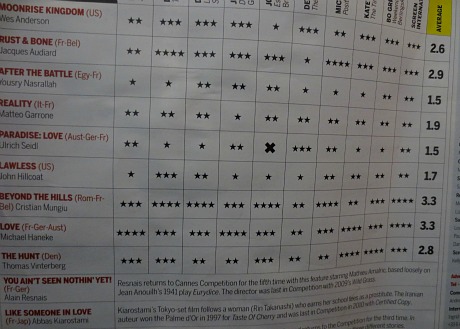
It may not be a home run or even a triple, but Abbas Kiarostami‘s Like Someone In Love has provided more pleasure and intrigue than any film I’ve seen at the 2012 Cannes Film Festival. It’s a trifle on one level, but it’s plain and true and masterful — a pitch thrown straight without a shred of pretension. I’m probably going to fail in trying to describe what it amounted to for me, but that’s okay. I only know I was mesmerized start to finish…even though I dropped off for about eight or ten minutes.
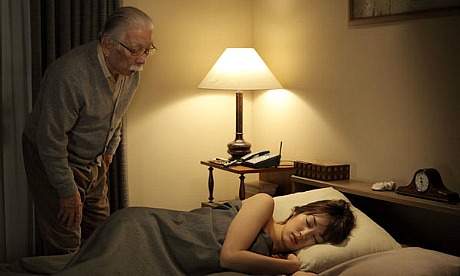
Tadashi Okuno, Rin Takanashi in Abbas Kiarostami’s
Like Someone In Love.
Set in present-day Tokyo, it’s basically about a contest for the attention and affections of Akiko (Rin Takanashi), a young, drop-dead beautiful, none-too-bright student who moonlights as a prostitute. In one corner is her 20something garage-mechanic fiance, Noriaki (Ryo Kase), who’s basically about possessiveness and jealousy and rage. In the other is an elderly sociologist and author, Takashi (Tadashi Okuno), whom Akiko visits late at night for an erotic tryst that which doesn’t amount to much beyond her getting undressed and falling asleep in his bed.
(My lights also went out during this scene — odd. I was told what had happened after the screening by Eric Kohn and Owen Gleiberman.)
The next morning Takashi drives Akiko to her university, and witnesses a testy argument between her and Noriaki on the school steps. She goes inside and Takashi and his Volvo remain at the curb, engine idling. Noriaki notices the old gent, becomes curious, comes over and asks for a light. And then “who are you?”, and “how do you know Akiko?” The old man doesn’t exactly say he’s her grandfather — Noriaki assumes this because he knows Akiko’s grandmother is in town to visit — and he gradually suggests that he’s not. But of course, he doesn’t tell Noriaki what’s really going on.
They begin to talk. Noriaki explains his obsession for Akiko, and how he’s determined to marry her because she’s the perfect wife and he doesn’t want to lose her, etc. Takashi tells him he lacks experience, and that a wiser man wouldn’t badger Akiko about her whereabouts — he would open the cage and let the bird fly free. But Noriaki has found a business card with a photo of a woman who looks like Akiko (it’s actually her photo) offering her services, and can sense she’s constantly lying to him. Which she is, of course.
Noriaki is such a hardhead, such a hammer. Akiko, an empty Coke bottle who doesn’t know what Charles Darwin did and can’t be bothered to call her grandmother and make arrangements to meet her (she tells a cab driver to cruise by a public park where granny is waiting, watching but not stopping to get out and converse), has apparently led Noriaki on into thinking they’re engaged because he pays her bills, but why she’s picked such an uneducated, hair-trigger clod is a mystery. She’s breathtaking. She could have anyone.

In any event Akiko gets into the car with Takashi and Noriaki, the latter saying he’ll ride along for a bit. Noriaki then informs Takashi that his Volvo engine belt is worn down and needs replacing, and he persuades the old fellow to drop by his garage so he can replace it. At the garage an old student of Takashi’s happens to recognize him and says hello. This exchange concerns Akiko as Noriaki has overheard it and she’s told him that her grandfather is a fisherman. He might get wise. “But everyone has two grandfathers,” Takashi reminds her. “Oh, yes,” she says, slightly relieved but not entirely. How dumb is this girl? She never says boo. Putting more than five or six words together in a sentence seems like a tremendous effort for her.
Takashi and Nokiko leave the garage, leaving Noriaki to his clients. Takashi drops her off at a book store. And then she calls him a short while later, conveying anguish and stress. And then things escalate. I’ll stop here with the synopsis, but suffice that Noriaki smells what’s up and is determined to have it out.
The one problem I have with Like Someone In Love is the ending. It doesn’t really fit or pay off or anything. It just happens, and I’m not even sure what happens as far as a certain character’s health and fate are concerned. Kohn and Gleiberman weren’t 100% sure either.
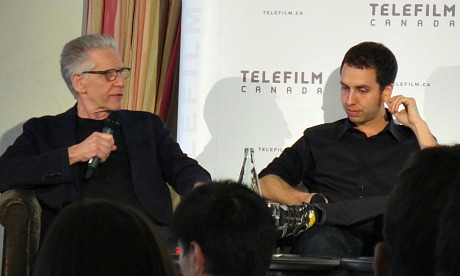
The fact that I’ve just typed out seven paragraphs of story exposition obviously indicates my absorption. I could honestly watch it again right now (a repeat screening in the Lumiere begins in 15 minutes) if I didn’t have five or six things to do. More writing, a lunch, an encounter with David and Brandon Cronenberg, an Oscar Poker podcast recording, a Studio Babelsberg party, more filing, a Weinstein Co. preview reel.
The slowness of the pace of Like Someone To Love and the way this and that detail is revealed like cards in a solitaire game is fascinating. It’s the Yasujiro Ozu influence again, and I’ve always been a fan of that. I’ll definitely see this again. I’ve already decided to buy the Bluray.