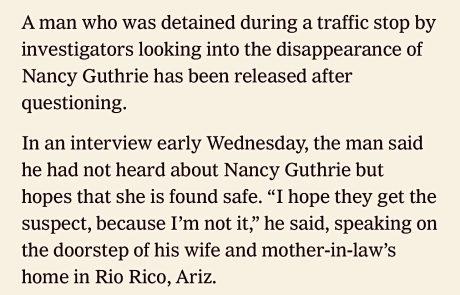
Multiple persons of interest, are there?
Was the roly-poly fathead kidnapper alone? Was he / she wearing mascara?? Where are the accomplices?






 Jeffrey Wells
 Multiple persons of interest, are there?
Was the roly-poly fathead kidnapper alone? Was he / she wearing mascara?? Where are the accomplices?
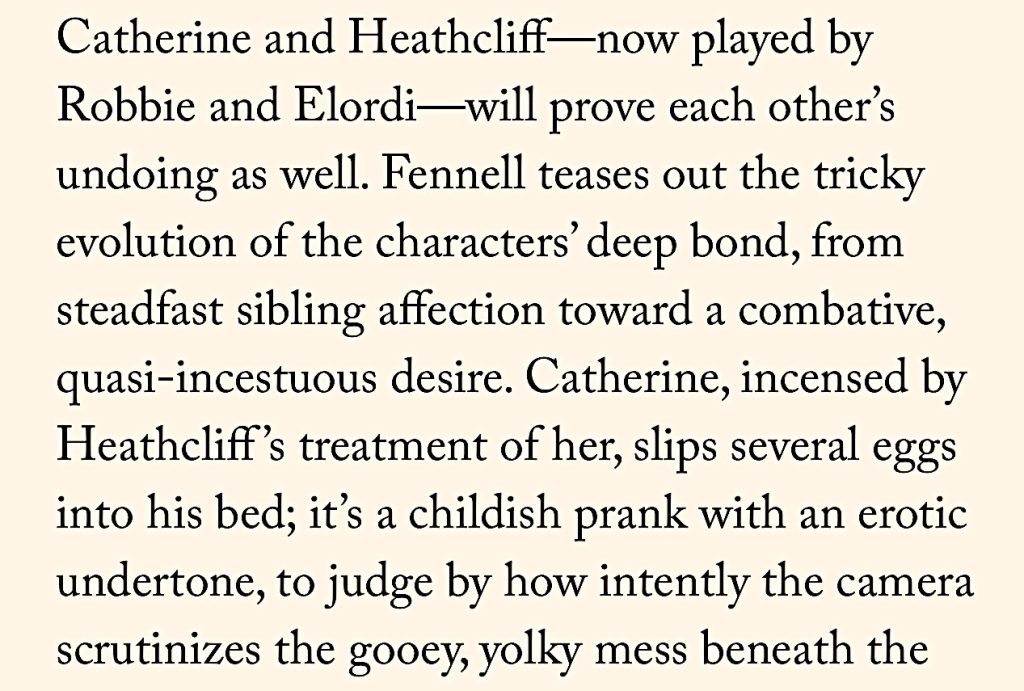
I can’t wait to hate-watch Emerald Fennell’s Wuthering Heights (Warner Bros., 2.13). I’m tasting the resins as we speak. Nobody despises 21st Century woke presentism in English historical dramas (i.e., the Bridgerton syndrome) more than yours truly. I almost feel tumescent about this.
THR’s David Rooney:
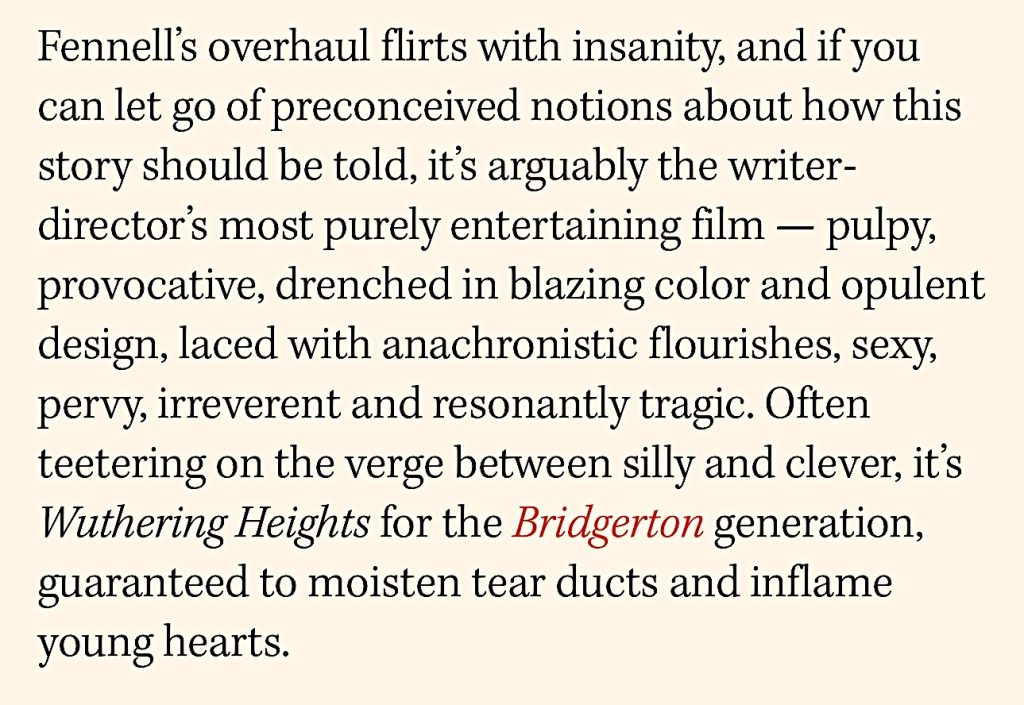
The New Yorker’s Justin Chang:

JB Pritzker will not push Gavin Newsom aside in the 2028 Democratic nomination race because deep down American voters (even the corpulent ones) just can’t settle into electing a serious beefalo chunkbod for U.S. President.
Before Donald “Jabba the Hut” Trump the last seriously overweight Oval Office occupant was William Howard Taft. The relatively trim aesthetic lasted all the way from Teddy Roosevelt to Joe Biden. There’s a reason for that.

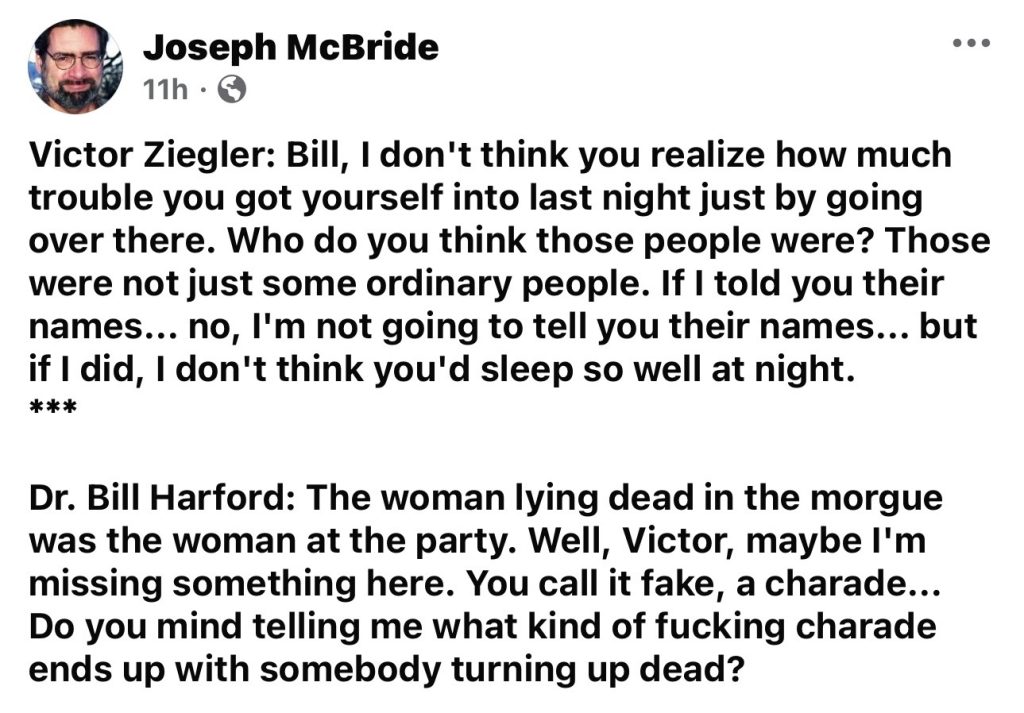
HE to Joseph McBride (Facebook, early this morning):
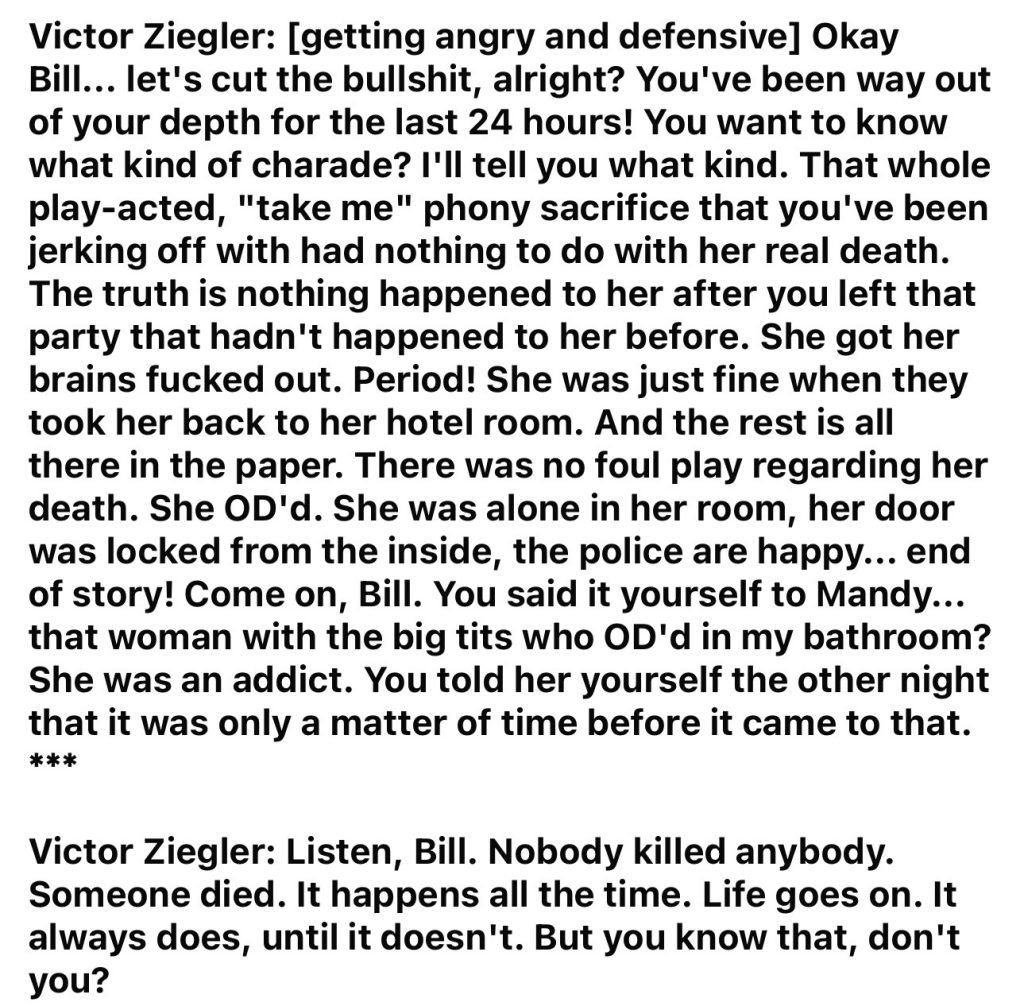
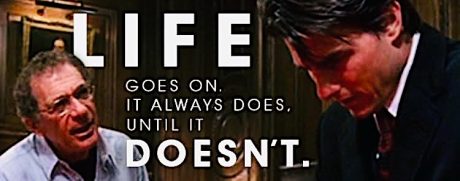
At the beginning of his big angry red-felt pool table explanation rant, Sydney Pollack twice repeats the word “let’s.” Three times in all. He says “okay, Bill, let’s…let’s…let’s cut the bullshit, okay?”
And you left out that odd spitty sound…that Bix Beiderbicke pursed-trumpet-lips “pyht!”…call it a conclusive emphasis sound…Pollack says “her door was locked from the inside, the police are happy, end of story…pyht!”
We’re not allowed to say it, but the possibility of wipeouts is why breakneck downhill racing and bobsledding are high-interest events. I don’t want anyone to suffer agonizing bone snaps, but if I’m being nakedly honest something inside me…something a bit cruel goes “yes!” when a gifted downhill racer wipes out at 85 mph.
I also love it when big-wave surfers lose their luck or their curl groove and get eaten by the wave.
Posted four or five hours ago: “Veteran homicide investigator Paul Ciolino, who has worked with 48 Hours and CBS News as an on-air expert, says key elements of a true kidnapping aren’t present in the Nancy Guthrie case. With more than 25 years appearing on hundreds of programs across major U.S. and Canadian networks, Ciolino points to the lack of negotiations, forensic evidence, and planning signs as major red flags.”
But I found the basic Latin-X signature…the spirit of it…the Central- or Caribbean-American, Puerto Rican or Cuban sugar-cane-cutting atmosphere quite enjoyable and electric…I admired the boldness of the zero-apologies, we’re-not-Kid-Rock-Americans-and-we-don’t-wanna-be attitude.
Trump hated it, of course, but Bad Bunny’s horribly-tailored white pants aside, it was fine.
I wasn’t able to sit down and watch the Super Bowl last night in real time, but the out-of-nowhere teaser for David Fincher‘s The Adventures of Cliff Booth…that woke me up. The Peter Gunn theme especially.
Set in the late ’70s, the teaser is presenting the Quentin Tarantino-written “comedy-drama” as a hardball action piece that football fans will enjoy…muscle cars, screeching tires, edgy-looking black and Hispanic dudes with moustaches, six-foot-two Elizabeth Debicki towering over the five-eleven Pitt.
Cliff Booth is supposed to be an Eddie Mannix-like fixer or problem-solver for the big studios. But I don’t see any studios or movie stars. All I’m getting is a standard L.A. mean-streets atmosphere and a Then Came Bronson vibe.
I’m doubling down on my heartfelt thanks to all the good people who dropped dough into HE’s Cannes and Venice GoFundMe cookie jar.
A total of $6K has been raised ($4K from GoFundMe, another $2K sent to HE’s Venmo). Both apartments have been rented and locked down. I’ve yet to purchase the air fares and figure out certain logistics., but it’s all good.
It would be nice to raise another $2K for this and that, given that festival trips always wind up costing more than anticipated. (Last year’s stolen-wallet episode, which necessitated a three-day stay in Milan, certainly wasn’t expected.) I’ll probably post another ask in late March or early April….just a one-week quickie.
For those who haven’t yet contributed, please remember that I’m not “begging” for dough, as a few haters have claimed. I’m simply attempting to attract donations in a different, far less draining manner than the monthly method used by other webzines and columnists. I’m just asking for a one-off gimmee of $25 or $50 and whatever feels right. HE stopped paywalling this site a couple of years ago, and so the regularly refreshed content is entirely free and wide open, and this — this! — is the only pitch I’m making.
Not that a Fargo ending (victim killed, bad guys killed or captured) would be anything but horrific for all concerned.
But what if the Guthrie case ends without an ending? What if there’s never a solve or a final resolution? What if Nancy Guthrie‘s disappearance becomes Peter Weir‘s Picnic at Hanging Rock? What if this beloved 84-year-old, this proverbial mom who was young in the 1950s and early ’60s…what if she just gets swallowed up by the void? If she simply becomes vapor and nobody ever learns what really happened?
HE is hoping for a Man on Fire ending, but with Creasy unharmed.
Why is Peter Debruge leaving Variety? Why would he throw away a nice, well-salaried gig at the top of the heap…why abandon his position one of the industry’s most listened-to film critics? It doesn’t calculate.
Apparently Debruge, who’s been with Variety since ’05 (21 years), just wanted to make a change in order to make a change. A friend says “he’s got a lot of irons in the fire”, and apparently wants to do something aside from (or above and beyond) the cricket game.
Super-smart, uber-knowledgable and never missing a trick, Peter has always seemed (to me anyway) like an obliging, generous-hearted fellow who has always been reluctant to scold filmmakers. He’s always had much more in common, attitude-wise, with the film buff-ish Martin Scorsese or Francois Truffaut in his Cahiers du Cinema days.
I’m not saying “butter wouldn’t melt in his mouth” but Debruge has certainly never written with any kind of stinging, knife-like, John Simon-ish mentality.
Rumor has it that Hasan Hadi‘s The President’s Cake opened theatrically two days ago. You coulda fooled me**.
If there was a God this Iraqi drama, winner of the Directors’ Fortnight Audience Award as well as the Cannes Film Festival’s Caméra d’Or, would win the Best Int’l Feature Oscar. Maybe it will despite the cold, barren emptiness of the cosmos.
Cake has a 100% rating on Rotten Tomatoes, and an 88% rating on Metacritic.
Posted on 5.16.25: All hail Hasan Hadi‘s The President’s Cake, which I saw this morning at 8:45 am. It’s EASILY the best Cannes ’25 film thus far…EASILY.
The only thing that scares me is that I saw Netflix’s Albert Tello at the screening, and it would be awful if Netflix were to capture this jewel of a children’s adventure film and bury it in their streaming feed. Cake is an upscale crowd-pleaser in the finest, richest, most culturally authentic sense of the term, and it needs to be seen theatrically….please. It’s my idea of an instant classic — all but guaranteed to be nominated for a Best Int’l Feature Oscar.
I tend to be impatient with films about young kids but this handmade Iraqi film (apparently the first from that formerly turbulent, war-torn country to be shown in Cannes) is different…it has an impoverished but compassionate Bicycle Thief atmosphere with just a tiny little touch of The Red Balloon and maybe a slight spritzing of Hector Babenco‘s Pixote, and you can tell almost immediately it’s a grade-A, pick-of-the-litter pearl.
Partially set in the wetland marshes of southern Iraq (which for the 37th time is not pronounced EYE-rack but Uhraq) but mostly in a big city (not precisely identified as Bagdad but shot there) and all of it occuring just before the 2003 U.S. invasion, it’s basically about a nine-year-old girl, Lamia (Banin Ahmad Nayef), who lives in a floating straw hut upon the Mesopotamian marshes with grandmother Bibi (Waheed Thabet Khreibat).
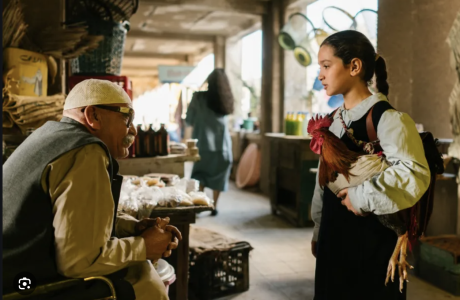
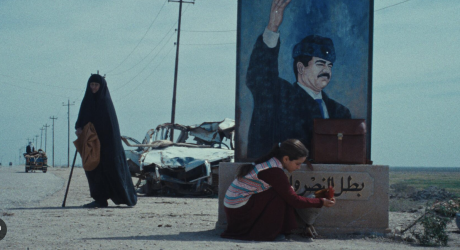
The plot comes from Hadi’s childhood memory of a school event in which one member of each class is chosen to bake a cake for Saddam Hussein‘s birthday (4.28). Lamia is selected to be her class’s cake-baker. She and Bibi are dirt poor and can barely afford, much less find, the chief ingredients (eggs, flour, sugar) but failing to deliver or, worse, refusing this honor is out of the question.
And so Lamia, Bibi and Lamia’s pet rooster Hindi head for the big city (Basra, Nasiriyah and Amarah are closest to the marshes). And yet the diabetic, overweight Bibi has a secret agenda in visiting the city, and this freaks Lamia out. So she takes off and hooks up with Saeed (Sajad Mohamad Qasem), a school friend and an Artful Dodger-like thief who’s roughly her age. The heart of Cake is about these two scrounging around Bagdad in a search for the cake ingredients and coping with a few Dickensian twists and turns.
Boiled down, the film is essentially a portrait of Bagdad street life and all kinds of crafty, hustling, struggling denizens (including a devious would-be molester) trying to save or make a buck or otherwise stay afloat.
Nayef and Qasem are not only perfect in a way that only non-actors can be, but they blend together beautifully.
The brilliant cinematography by Tudor Vladimir Panduru and the nimble editing by Andu Radu are genius touches.
Eric Roth and Marielle Heller helped bring Cake to life from a Sundance Screenwriting Lab. Roth: “It’s a small miracle…dear Hasan has a poet’s soul…in this too public business of absorbing the blows of outrageous fortune, Cake is that sweet taste of honey.”
Chris Columbus and Michelle Satter also pulled strings on the film’s behalf.
** It’s not even slated to open within a few weeks at the Jacob Burns Center, and that’s unusual.