Misses

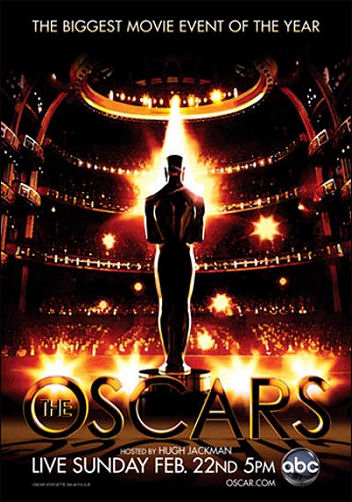
“The Biggest Movie Event of the Year”? I don’t want to sound like a sourpuss, but this line doesn’t seem to quite get it. Next month’s Oscar telecast promises to be both more and less than this. The copy doesn’t begin to express the kind of Oscar year this has been. It seems oblivious to the Dark Knight, WALL*E, Kristin Scott Thomas and Gomorrah blow-offs. It ignores all the panicking going on right now. Barack Obama, ethical/cultural transformation and the current economic nightmare are “big” — what are the Oscars alongside these?

What should this poster say? If someone has a better line and can Photoshop it into the original, please send along.

Quiet Hour

Breakfast at a mostly vacant French Marketplace. Staffers, two or three patrons, a pair of Los Angeles County highway patrolmen and a grumpy-looking guy staring a hole in his scrambled eggs and fuming at his slower-than-a-turtle AT&T Communications air card — Monday, 1.26.09, 7:35 am.

Newbies

Poetry Arts Confidential’s Terry McCarty reports that Megan Seling and Brendan Kiley have been hired by L.A. CITYBEAT management to replace the jettisoned Andy Klein. Links to reviews written by these three are offered for comparison.

Meltdown Maestros

The Guardian‘s 1.26 edition includes a report by Julia Finch, Andrew Clark and David Teather that names the 25 bigwigs most responsible for bringing about the grimmest economic episode since the Great Depression. Remember these guys, hang them in effigy, take a poke at them on the street, boil them in oil, etc. It won’t solve anything, but it’ll feel good.

Steel Kisses

Deadline Hollywood Daily‘s Nikki Finke reported this evening that there may be layoffs “in both the business and editorial sides” of Variety happening this week, perhaps as soon as Monday. One tipster told her the number or rolling heads “might be as high as 30.”

Winslet Muddle

If even someone like myself is feeling a wee bit confused about the categorizing of one of Kate Winslet‘s award-worthy performances, surely the average Academy voter is also. Tonight she won the SAG award for Best Supporting Actress for The Reader, although she’s (a) been Oscar-nominated for that same performance in the Best Actress category, (b) recently won a Golden Globe Best Actress / Drama award for her acting in Revolutionary Road and yet (c) also won a Golden Globe Best Supporting Actress trophy for The Reader.

After tonight’s honor who is even half-sure which category Winslet’s Reader performance belongs in? (There’s no question that her Revolutionary Road performance is a lead.) I for one am thoroughly befuddled. And that is why I’m starting to wonder if Meryl Streep‘s SAG award for Best Actress in Doubt may have given her a distinct advantage over Winslet in the Best Actress Oscar race. Because there is no ambiguity about Streep. Her Doubt performance has always been considered a Best Actress thing — no ifs, ands or buts.

Envelope columnist Pete Hammond wrote tonight that Winslet’s loss to Streep in SAG’s lead actress race “was not a surprise” because “SAG wasn’t gonna give Kate two of them. Revolutionary Road is not a popular picture among many voters, and Streep was the clear beneficiary. The two winning performances will now go head to head on an even playing field, and it will be interesting to see if Streep’s joyous, infectious and altogether charming acceptance at SAG wins her any new converts and turns the best actress Oscar race into a genuine contest.

“Streep’s triumphant run to the stage and her unbridled enthusiasm would make you think this was the first time the 15 time Oscar nominee and two time winner had ever gotten an award. The SAG showcase and heartfelt standing ovation is gonna register. She hasn’t won an Oscar in 27 years. If Miramax can get that across, it’s a horse race.”

Well Said

One of the best-written tributes to Revolutonary Road, by none other than San Francisco Chronicle critic Mick LaSalle. It ran three weeks ago, I missed it and I don’t care. LaSalle states his case with conviction and simplicity, which are hard to get right in a piece. Together and harmoniously, I mean. (Thanks to HE reader Jeremy Fassler.)

Little Big Man

Carl Bialik‘s 1.23 Wall Street Journal piece about the great and small distortions that always result from the use of stars — i.e., little asterisks — to summarize a film critic’s opinion moved me not. That’s mainly because I’ve never paid any attention to stars, or at least not in comparison to how I’ve responded all my life to the Little Man.

I love that the Little Man is very adamant and emotional in his reactions to films, and the fact that he doesn’t frown or glare or shake his fist at the stinkers — he goes to sleep on them. That leaning forward and clapping so hard he lifts himself out of his seat routine? I know that feeling. The creation of San Francisco Chronicle artist Warren Goodrich, the Little Man is now 61 years old.

Creepy Rightie Clan (Except For Otis)

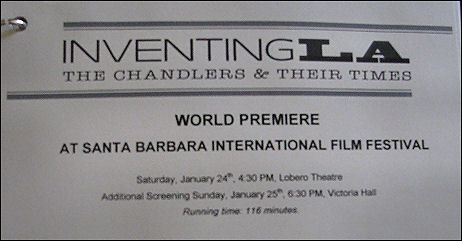
Two days ago L.A. Times “Big Picture” columnist Patrick Goldstein wrote a fair assessment of Peter JonesInventing L.A.: The Chandlers & Their Times. I saw the doc at Santa Barbara’s Lobero theatre last night and agree with most of what he says. But the film ends on a bizarre note of omission that I found almost deranged.

Inventing L.A., which will screen later this year on PBS, is a sharply focused, generally fair-minded and very well-ordered portrait of a family of ultra-conservative robber barons — the Chandlers — who used their newspaper, the Los Angeles Times, to sell L.A. to the rest of the country as a land of opportunity and a warm and balmy paradise, union-free and especially friendly to decent white folk.

It all began with founder Harrison Gray Otis, continued with his son-in-law Harry Chandler, and then Harry’s son Norman Chandler and his wife Dorothy Buffum Chandler, and finally Otis Chandler — the first guy in the family to really believe in and practice aggressive journalism and who, during his publishing reign from 1960 to ’80, made the L.A. Times into the highly admired (if considerably weakened) newspaper it is today.

The bizarre part is that Inventing L.A. ends with (a) the purchasing of the Times-Mirror company by the Chicago-based Tribune Company in 2000 and (b) the death of Otis Chandler in February ’06, but without any mention whatsover of the purchase of the Tribune Co. by Sam Zell and — hello? — the gradual creeping death of print journalism.

Jones’ publicist told me last night that he wanted to keep the focus on the Chandlers and not print journalism per se. I understand that. But Jones’ decision to end his film this way is akin to his having made a documentary about the 19th Century and early 20th Century Russian aristocracy and particularly Czar Nicholas II and deciding to end it without mentioning Bolshevism and the Russian revolution of 1917.

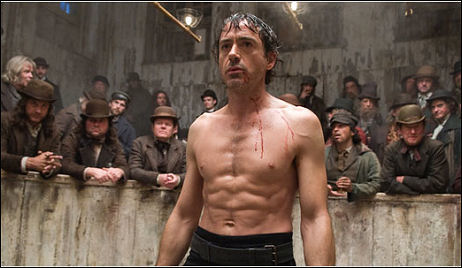
Batman Ironman Indiana Holmes

The N.Y. TimesSarah Lyall is reporting about the making of producer Joel Silver and director Guy Ritchie ‘s Sherlock Holmes (Warner Bros., 11.13), a big-budget effort aimed at the knuckle-dragging popcorn-munchers who don’t know from Sir Arthur Conan Doyle or Basil Rathbone or Billy Wilder‘s The Private Life of Sherlock Holmes or Herbert Ross‘s The Seven Per Cent Solution or any of those other 20th Century, pre-iPhone elements.

We’re basically talking about a digitized Indiana Holmes and the Temple of Doom times ten with brilliant powers of deduction and totally hot washboard abs. A kick-boxing, James Bondian Holmes played by Robert Downey, Jr., and Jude Law — Jude Law! — as Dr. Watson. And, I guess, no cocaine addiction.

This is surely evidence of a degraded culture — the animalization of rarified values and dashing cerebral derring-do, which were once admired or at least found intriguing by average moviegoers. You know that if everyone had my taste in films Silver, Ritchie and Warner Bros. wouldn’t dare make something like this. Will their Holmes be successful? Probably. What would this say about the state of under-30 sophistication? Don’t ask.

23 years ago Steven Spielberg and Barry Levinson ‘s Young Sherlock Holmes pulled the same horseshit — i.e., use the sellable Holmes name to make an action thriller with an extremely limited interest in the legend of the pipe-smoking Holmes (as well the genuine 19th Century London milieu in which the original character operated) but which would nonetheless sell tickets to the mid ’80s mongrel youth market.

Why even call the character Sherlock Holmes? Because doing so will make it easier to market with those who knows the Holmes name. But you know this movie began as a big-dick dice roll in which all the major participants figured out their fat salaries and profit participations, and that the “creativity” followed from there.

I think Silver and Warner Bros. let Lyall write this article in order to get the shock out of the way early. By the time Sherlock Holmes opens 10 months from now, everyone will be saying, “Yeah, yeah…it’s heretical, we know that. But is it any good?”

The Sherlock Holmes of Sherlock Holmes, Lyall writes, “will not be wearing a deerstalker hat. Nor will he be wearing an Inverness overcoat, the kind with the dashing cloak that hangs over the shoulders as extra protection against the English rain.”

No, no…mistake! Because if Downey is wearing an Inverness overcoat, he can leap from the top of of a seven-story London apartment building and soar over the city like Batman, using the cloak as a kind of aeronautical flotation device.

Works This Way

At yesterday’s screenwriter’s panel at the Santa Barbara Film Festival, moderator Anne Thompson asked Dustin Lance Black (Milk), Tom McCarthy (The Visitor), Robert Knott (The Appaloosa) and Andrew Stanton (Wall*E) about their writing process — when they write best, how they write best, etc.