

 Jeffrey Wells
Club Flame
40 kids are burnt toast and 119 are injured because of a New Year’s Eve flash fire at Le Constellation bar in Crans-Montana, Valais, Switzerland — a ski resort town about 112 kilometers southwest of Lauterbrunnen, which HE has visited twice.
Bottom line: 40 kids are dead because the guy who decided to place sparklers atop champagne bottles for the New Year’s Eve celebration didn’t consult with the guy who had installed flammable foam in the ceiling. Maybe it was the same guy.

Rogue Regime Change in Venezuela
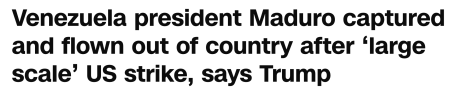
Yes, darting video of Trump’s military attack upon Caracas a few hours ago and reports of the capture and arrest of Venezuelan president Nicholas Maduro, a hulking moustachioed figure who reportedly stands 6’3″, and his elfin wife Cilia Flores…wee-hour videos of this Apocalypse Now-influenced invasion (rat-a-tat choppers overhead, smoke plumes rising hundreds of feet, sounds of automatic gunfire and Hollywood-style explosions) produce a brief endorphin rush among news-channel viewers.
But then the hoolah-boolah settles down and the inevitable aftermath of a forcible regime change is always a mess…never simple or satisfying. The N.Y. Times editorial board has voiced its disapproval. Early this morning Trump spoke briefly to N.Y. Times reporter Tyler Pager. An 11 am Mar a Lago news conference is scheduled.
Who has stepped into the breach as Venezuela’s new president, and where have Nick and Cilia been flown to? Did they have time to pack before leaving, and were they allowed to take suitcases, wardrobes, toiletries and personal computers and phones with them? Nick will stand trial in New York City…right? Where will he serve his hard time?
Trump has been rattling the sabre since his second term began 11 months ago. If Maduro had been smart he would have transferred his ill-gotten drug wealth to safe banks and then resigned last summer or fall and flown off with Celia to a friendly tropical country where a nice beachfront home awaits.



2011 Was Aces (Almost as Good As ’07)
On 10.21 Matt Walsh posted a video essay about the last peak period of movies (’06 through ’08) and the all-but-total disappearance of our shared American monoculture.
I think Walsh was a bit off in his timeline. We still had a vibrant monoculture in 2011. An HE article I came across today proves this. Here’s how it went:
Here are HE’s rankings and classifications for over 200 films released in 2011. My top 14 met the usual pick-of-the-litter characteristics — quality, audacity, originality, personal satisfaction, stylistic excitement, something strong and central.
If you include the “decent, not half bad” category the bottom line is that 2011 delivered 60-plus films that ranged from excellent to very good to respectably passable.
How many 2025 fims were excellent to very good to respectably passable? 15 or 20? Less? Here’s my top ten.
HE’s 14 Best of 2011 (in this order): Moneyball, A Separation, The Descendants, Miss Bala, Margaret, Drive, Contagion, Win Win, Tyrannosaur, The Tree of Life, Mission: Impossible — Ghost Protocol, Warrior, Haywire, In The Land of Blood and Honey. (14)
Special “I Don’t Know Where They Precisely Belong But I Like ‘Em More Than Some Of The Others” Distinction (i.e., Close With Unlit Cigar): Attack The Block, Beginners, Rise Of The Planet Of The Apes, X-Men First Class, The Girl with the Dragon Tattoo, Captain America, Hugo, 50/50, Young Adult, The Artist, Hanna, The Guard, Bridesmaids, Buck, Page One: Inside The NY Times, Rampart. (15)
Frostily, Tiresomely, Enervatingly Good: Shame. (1)
Good & Generally Approved With Issues (in this order): Take Shelter, A Better Life, Tinker Tailor Soldier Spy, The Ides of March, Midnight in Paris, A Dangerous Method, Albert Nobbs, J. Edgar, Martha Marcy May Marlene, Applause, Melancholia, The Lincoln Lawyer, Another Happy Day, Source Code, Point Blank, Cedar Rapids, The Iron Lady, Happy Happy, Super, The Housemaid, Carnage, Another Earth, Le Havre. (23)
The Wrong Stuff: War Horse, Tintin, The Lie. (3)
Decent, Not Half Bad: Coriolanus, Harry Potter and the Deathly Hallows, Part 2, Insidious, The Last Lions, Myth of the American Sleepover, Tabloid, Super 8, The Trip, Making The Boys (doc about Mart Crowley and The Boys in the Band), Jane Eyre, Paranormal Activity 3, Restless, Submarine, Take This Waltz, Thor, Meet Monica Valour, Rango. (18)
Approved But Lesser Almodovar: The Skin I Live In. (1)
Lesser Dardennes: The Kid With A Bike. (1)
Lesser Kiarostami: Certified Copy (1)
Respectable Intentions, Didn’t Get There: Meek’s Cutoff, London Boulevard, Texas Killing Fields, Extremely Loud & Incredibly Close, Straw Dogs, The Way Back, Like Crazy, The Rum Diary, Sleeping Beauty, The Adjustment Bureau, The Company Men, White Irish Drinkers, The Devil’s Double, The Dilemma, We Bought A Zoo, Wuthering Heights, Anonymous. (19)
Meh, Underbaked, Less is Less, Insufficient: Rubber, Ceremony, Hall Pass, Bullhead, Fright Night, The Help, Magic Trip, Our Idiot Brother. (8)
Regretful Shortfallers: 30 Minutes Or Less, The Beaver, Higher Ground, Knuckle, Larry Crowne, Limitless. (6)
No Comment: Black Power Mixtape, Elite Squad 2: The Enemy Within, Jeff Who Lives At Home, The Last Circus, The Oranges, Paul Williams Still Alive, Project Nim, Red State, Pina, Pariah, The Deep Blue Sea, This Must Be The Place, The Turin Horse. (13)
Haven’t Seen ‘Em & Don’t Care That Much: Apollo 18, The Lady, Arthur Christmas, Soul Surfer, Henry’s Crime, Blank City, Cold Weather, Blackthorn, Bonsai, A Boy And His Samurai, Burke & Hare, Cars 2, The Catechism Cataclysm, Conan The Barbarian, The Double, Gnomeo & Juliet, Happy Feet 2, The Human Centipede II, I Am Number Four, Jack and Jill, Just Go With It, Kung-Fu Panda 2, The Muppets, Mars Needs Moms, My Sucky Teen Romance, No Strings Attached, Paul Williams Still Alive, Phillip The Fossil, Priest, The Sitter, The Smurfs, Snow Flower & The Secret Fan, Sound Of My Voice, The Thing, The Woman, The Three Musketeers, Alvin And The Chipmunks: Chipwrecked. (38)
Acute Dislike, Blah, Nothing, Stinko: The Big Year, Arthur, Bad Teacher, Battle: Los Angeles, Butter, The Caller, Cat Run, The Change-Up, Cowboy & Aliens, Colombiana, Crazy, Stupid, Love, Dream House, Fast Five, Final Destination 5, Five Days of War, Footloose, Friends With Benefits, The Green Hornet, Green Lantern, Hall Pass, The Hangover Part II, Hobo With A Shotgun, Horrible Bosses, Kaboom, Machine Gun Preacher, New Year’s Eve, One Day, Paul, Pirates Of The Caribbean: On Stranger Tides, Red Riding Hood, Sucker Punch, Transformers: Dark Of The Moon, The Twilight Saga: Breaking Dawn — Part 1, Tower Heist, Twixt, Water For Elephants, We Need To Talk About Kevin, Your Highness, The Zookeeper, Your Highness, Miral. (41)
Performative Personalities
Art Garfunkel‘s “Sandy” to Candice Bergen ‘s “Susan” in Carnal Knowledge (’71): “I’m an act.”
People with performative personalities or social inclinations always make excellent impressions. They live and breathe by way of what’s conventionally known as an outgoing manner. They’re great at parties, in political careers, in high-pressure business environments or in retail jobs that require the usual instant rapport with customers, in social situations of whatever kind.
You always want to hire performative types because you know they’ll never screw things up socially, and that they’ll easily adapt to any odd or unexpected situation and will smooth it all over if necessary…dependables who will always finesse with skill and basically chill things out. Bringers of performative empathy.
The other side of the coin is that you can’t really trust them in a romantic relationship. They’re narcissists — no one’s idea of a steady-as-she-goes romantic partner. Boiled down and up close and personal, they basically radiate the vibes of (no offense) a transactional sociopath. Not much in the way of having a solid or consistent center. I’ve been there three or four times, girlfriend-wise, so don’t tell me.
Character Studies of Gambling Junkies & Alcoholics Have Nowhere To Go
Certain types of movie characters are impossible to relate to, much less feel any sort of rooting interest for. Minus-zero allegiance. James Caan in The Gambler aside, gambling junkie flicks are a one-way toilet flush. Even if a gambler protagonist wins a big glorious pot, you know it’s just a passing distraction because he/she has no interest in anything other than the next roll, the next card, the next horse or the next wheel spin. Talk about a film that hasn’t a prayer…the very definition of dramatic futility. With the exception of Leaving Las Vegss, the same terms apply to films about chronic boozers (Under The Volcano).
Man About Town
If I was Zohran Mamdani right now, I wouldn’t do this with any regularity or consistence. He obviously doesn’t want to give nutters any bad ideas.
Conflicted But Mostly At Peace
Movie-focused columnists obviously need to engage with films as often and fully as possible, and preferably without an attitude. (Hah!) Actually it doesn’t matter if I go in with a fuck-me attitude — if a film is good, it’s good. Even if an unseen film is generating toxic street buzz or worse, you still have to submit to the damn thing…tough it out, take the pain. (I certainly did this while watching The Housemaid.)
Except, that is, when it comes to pricey, cynical, corporate-funded, big-studio sequels, which I almost always despise. (Exceptions happen once in a blue moon…The Godfather, Part II, Ocean’s Twelve, etc.) So yes, I’m feeling a tad conflicted and a tiny bit guilty about my decision to avoid Avatar: Fire and Ash (totally sick of Cameron’s franchise), Wicked: For Good, Predator: Badlands, Jack Black and Paul Rudd‘s Anaconda and the fifth season of Stranger Things.
But I’m mostly (90%) at peace with with my decision. Especially in the case of Fire and Ash. I also feel this way about Park Chan Wook‘s No Other Choice.
Genuinely Mythic HE Headline
Any half-honest film critic or columnist (a few actually exist) will admit the truth of things, which is that roughly 75% or 80% of commercial features have problems of varying degrees and are therefore a drag to wade through, some more than others.
On a year-by-year basis, how many films tend to be really and truly primal on some level…imbued with grace and poetry and levitational perception? Less than 5%…hell, closer to 3%. And that’s just the way it is. Fear inhibits receptivity. Inspiration is fleeting, sporadic…comes and goes.
But most critics, terrified of sounding like old-fart sourpusses, tend to slip on their ballet shoes and dance around the groaning reality when they write their reviews. That’s the basic difference between Hollywood Elsewhere and the Scott Mantz congregation. I don’t dance. Or at least I try not to.

Took Me Hours To Find This
The only pure capturing of last night’s Eiffel Tower eruptions….no commentary, no title cards. And I don’t think it’s fake. It looks and sounds “real.” Things have almost gotten to a point in which you can’t trust anything you find on YouTube. Everything, it seems, has been AI-tweaked or AI-enhanced. It’s all AI cartoons.
I post this every year, but no New Year’s Eve celebration of any kind will ever match what the kids and I saw in front of the Eiffel Tower when 1999 gave way to 2000. A bit dippy from champagne and standing about two city blocks in front of the Eiffel Tower and watching the greatest fireworks display in history. And then walking all the way back to Montmartre with thousands on the streets after the civil servants shut the Metro down at 1 a.m. No cabs anywhere. We didn’t arrive home at our rue Durantin pad until 2:30 am.
Warming Up For Tonight’s Chevy Chase Doc on CNN
“I’m okay…you can write whatever you want…it doesn’t really matter what people write or say.”